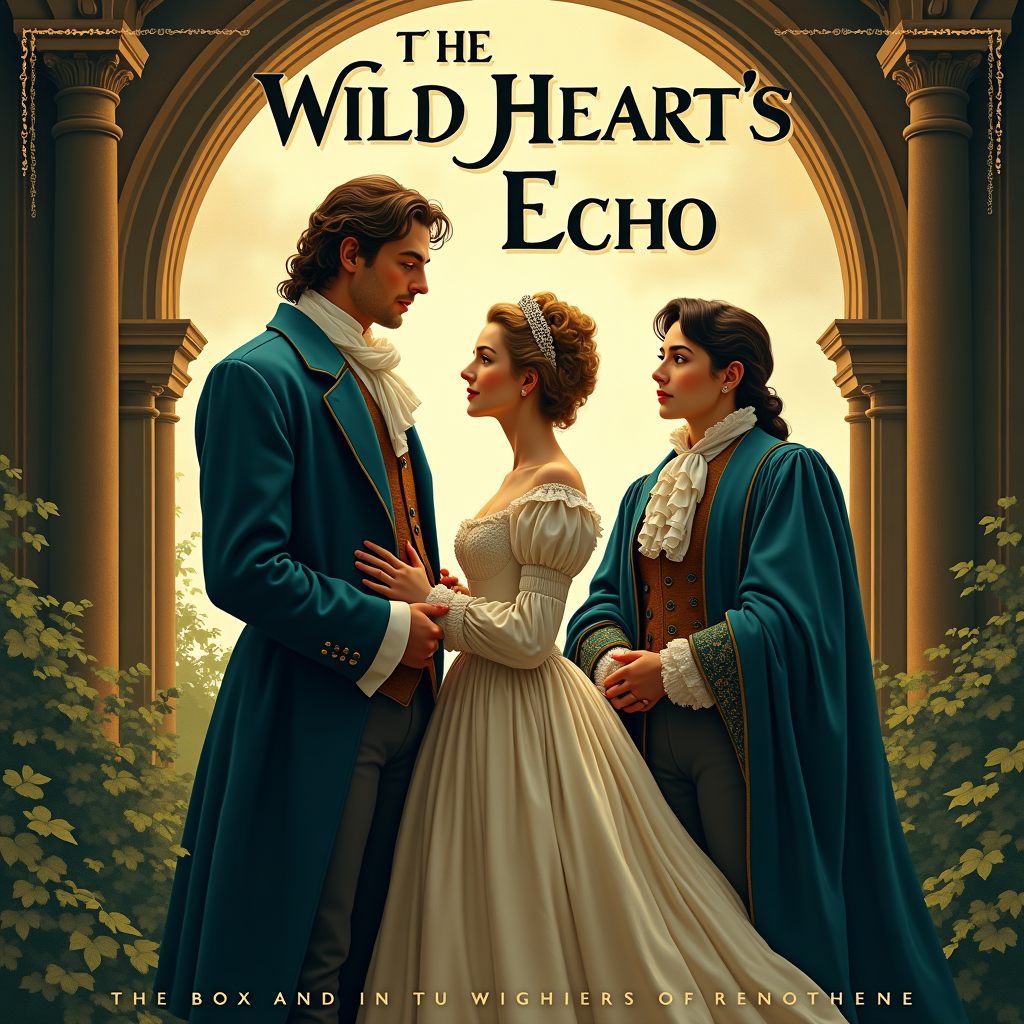
The Wild Heart's Echo: Reclaim Your Passion
How Romantic Era Rebels Can Reawaken Your Soul in a Numbed World
For creatives, thinkers, and professionals feeling burnt out and disconnected, who yearn to reclaim their passion, intuition, and sense of wonder.
Contents
- The Tyranny of the Mundane: A Call to Arms
- Unleashing the Inner Tempest: The Power of Raw Emotion
- Whispers from the Wild: Nature as Our Grand Teacher
- Imagination's Boundless Realm: The Architect of Reality
- The Authentic Self: A Rebel's Manifesto
- The Sublime Terrors and Triumphs: Facing the Shadow
- Intuition's Unseen Hand: Trusting the Inner Compass
- Love, Loss, and the Eternal Echo: The Heart's Deepest Song
- The Artist Within: Crafting a Life of Meaning
- A New Dawn: Living with a Wild Heart Today
The Tyranny of the Mundane: A Call to Arms
Look around you, truly look. Do you not feel it? That creeping grayness at the edges of your vision, that dull thrum beneath the surface of every "should" and "must"? It is the insidious whisper of the mundane, a slow poison seeping into the very sinews of our souls. We wake to the tyranny of the clock, surrender our days to the digital overlords, and return to lives meticulously curated by algorithms, not by the wild, untamed beat of our own hearts. We are told to be practical, to be reasonable, to conform. But what is the cost of such a bargain? The slow, agonizing death of wonder, the muzzling of our thunderous passions, the silencing of the sublime.
This isn't just a book; it's a declaration of war. A clarion call to arms against the forces that would render us numb, docile, and disconnected. We stand on the precipice of a great forgetting, a collective amnesia of the soul’s deepest longings. But there is a path back, a fiery trail forged by those who dared to defy the crushing weight of their own "enlightened" age. We shall turn our gaze to the Romantics, not as dusty figures in history books, but as our guides, our co-conspirators in this grand rebellion. They were the original wild hearts, the intrepid explorers of inner landscapes, who understood that true living meant feeling, deeply and fiercely, every tremor of joy and every pang of sorrow. They knew that the whisper of the sublime was not a luxury, but the very breath of existence.
The Shackles We Forge: How We Lose Our Way
How do we arrive at this place of quiet desperation? It’s not a sudden cataclysm, but a thousand tiny concessions, a slow erosion of spirit.
- The Cult of Efficiency: We are programmed to optimize, to streamline, to produce. But what of the inefficiencies of the soul? The meandering walks, the idle daydreams, the hours lost in the thrall of a sunset? These are not wasted moments; they are the fertile ground where creativity blossoms and intuition speaks.
- The Echo Chamber of Conformity: The pressure to fit in, to follow the prescribed path, is immense. We fear the judgment of others more than we fear the death of our own authentic selves. William Blake, that glorious visionary, railed against such mental manacles, declaring, "I must create a system, or be enslav'd by another man's." Are we not, in our quiet compliance, enslaved by systems not of our own making?
- The Screen's Hypnosis: Our eyes are glued, our minds tethered, to the endless scroll, the fleeting notification. We chase external validation, mistaking fleeting likes for genuine connection, and the curated lives of others for our own potential. We forget the vast, intricate world waiting to be explored with all five senses, the rich tapestry of our own inner lives.
Reclaiming the Wild Heart: The Romantic Antidote
The Romantics, those magnificent rebels, understood this profound disquiet. They saw the encroaching Industrial Revolution, the cold logic of the Age of Reason, threatening to mechanize the human spirit itself. And they responded with a resounding, passionate "NO!" They championed:
- The Primacy of Emotion: They believed feeling was not weakness, but the very essence of being. Lord Byron, that stormy titan, wrote, "I love not man the less, but Nature more." He embraced the tempest of his own heart, refusing to be tamed by societal expectation.
- The Majesty of Nature: For them, nature was not merely scenery; it was a cathedral, a mirror to the soul, a source of profound spiritual truth. William Wordsworth, walking among the daffodils, found "a host, of golden daffodils; / Beside the lake, beneath the trees, / Fluttering and dancing in the breeze." He saw divinity in the common flower, finding solace and inspiration in the untamed world.
- The Power of Imagination: They elevated imagination above mere reason, recognizing it as the faculty that connects us to the divine, that allows us to create new worlds and find meaning in this one. Mary Shelley, in the gothic depths of her imagination, birthed a monster that still speaks to the deepest fears and yearnings of humanity. She understood that "Invention consists in the capacity of seizing on the capabilities of a subject, and in the power of moulding and fashioning ideas suggested to it."
- Authenticity and Individualism: They dared to be themselves, fiercely and unapologetically, even when it meant alienation. Percy Bysshe Shelley, with his radical spirit, urged us to embrace our unique truth: "My name is Ozymandias, king of kings: / Look on my works, ye Mighty, and despair!" He understood the fleeting nature of power and the eternal power of individual vision. John Keats, with his exquisite sensitivity, knew that "Truth is beauty, beauty truth,—that is all / Ye know on earth, and all ye need to know." He sought an unvarnished, visceral truth that resonated deep within the soul. Samuel Taylor Coleridge, in his opium-fueled dreams, conjured fantastical landscapes, reminding us that the mind's inner world is as real and profound as any external reality.
This is not a call to abandon responsibility, but to infuse it with meaning. It is not an invitation to chaos, but to a deeper order, one dictated by the rhythms of your own being. It is time to cast off the tyranny of the mundane and heed the wild heart's echo – that insistent whisper that reminds you of who you truly are, before the world told you who you should be.
Key takeaways
- Modern life often stifles our spirits through conformity and over-efficiency.
- The Romantics offer a powerful antidote to this spiritual malaise.
- We must reclaim the primacy of emotion, intuition, and untamed nature.
- Authenticity and the power of imagination are vital for a rich, connected life.
- This journey is a passionate rebellion against the mundane.
The Tyranny of the Mundane: A Call to Arms
Look around you, truly look. Do you not feel it, this creeping numbness, this quiet desperation that hums beneath the surface of our meticulously ordered lives? It is the tyranny of the mundane, a monstrous, insidious force that seeks to flatten the peaks and valleys of our souls into a sterile, predictable plain. We are told to conform, to optimize, to categorize, to quantify, until the very essence of our being—our wild, untamed heart—is leashed and domesticated, its thunderous passions muted to a faint whisper.
This is not living. This is merely existing, a slow, methodical surrender to the cold, grinding machinery of modern life. We are fed a steady diet of distraction, our senses dulled by the incessant chatter of the digital, our imaginations starved, our intuition dismissed as mere fancy. We chase metrics, deadlines, and superficial achievements, mistaking the accumulation of things for the richness of experience. But what of the soul? What of the aching, yearning part of us that craves beauty, truth, and the sublime?
The Soul's Silent Scream
Have you not felt that prickle of unease, that nagging sense that something vital has been lost? It’s the soul, my friend, crying out in the wilderness of a world that has forgotten its language. We have built towering structures of logic and reason, but in doing so, we have often bricked over the very windows through which wonder once streamed. The whisper of the sublime, once a constant companion, now struggles to be heard above the clamor of the everyday.
Consider the poet, John Keats, who, with every fiber of his being, championed the boundless power of imagination. He knew that true beauty, true passion, lay not in cold, hard facts, but in the realm of feeling, in the "truth of imagination." He wrote, "I am certain of nothing but of the holiness of the Heart's affections and the truth of Imagination—What the imagination seizes as Beauty must be truth—whether it existed before or not." This is not a quaint notion from a bygone era; it is a battle cry for our own. It is an invitation to trust that inner landscape, to recognize the profound truth that resides within our deepest yearnings, not just in external validation.
Our Ancestors in Rebellion: The Romantics
But fear not, for we are not alone in this yearning. Across the chasm of time, echo the voices of those who dared to defy the burgeoning rationalism of their age, who championed the individual spirit, the untamed heart, and the awe-inspiring majesty of nature. These were the Romantics, not dusty figures in history books, but eternal rebels whose wisdom is a necessary antidote to our age of distraction and conformity. They were not merely writers and artists; they were visionaries who understood that the true measure of a life lay in its intensity, its authenticity, its embrace of both joy and sorrow.
They understood the seductive power of the wild, untamed world, seeing in its storms and its quiet glades a reflection of the human soul. William Wordsworth, a true high priest of nature, found solace and profound insight in the landscapes he roamed. He spoke of "that serene and blessed mood, in which the affections gently lead us on, —Until, the breath of this corporeal frame And even the motion of our human blood Almost suspended, we are laid asleep In body, and become a living soul." This is a call to reconnect, to shed the layers of artificiality and allow the raw, unadulterated beauty of the world to awaken our dormant senses.
They understood, too, the power of radical authenticity, the courage to be oneself in a world that clamors for conformity. Lord Byron, a figure of intoxicating passion and defiant individuality, embodied this spirit. He lived by his own rules, his own fierce code, even if it meant being an outcast. He challenged the hypocrisies of society, choosing to burn brightly rather than flicker dimly in the shadows.
Breaking the Chains of the Ordinary
This journey, dear reader, is a call to arms against the tyranny of the mundane. It is an invitation to shed the chains of expectation, to reclaim your intuition, and to rediscover the sublime power of your own unique spirit. We will journey with these passionate souls – Keats, Wordsworth, Byron, Mary Shelley, Percy Bysshe Shelley, Coleridge, and Blake – not as academics dissecting their works, but as fellow travelers seeking to ignite the fires within.
- Embrace your raw emotions: Do not shy away from the intensity of your feelings, whether they be joy or sorrow. These are the very colors of your soul.
- Seek solace and inspiration in nature: Step away from the concrete jungle and allow the wild world to speak to you, to remind you of your own untamed essence.
- Trust your imagination: It is not a childish fancy, but a powerful faculty that can unlock new truths and possibilities.
- Dare to be authentic: Cast aside the masks and expectations, and let your true self shine, fierce and uncompromised.
This is not a passive reading experience. This is an active rebellion. Are you ready to answer the call? Are you ready to reclaim your wild heart's echo?
Key takeaways
- Modern life often stifles our spirits through conformity and distraction.
- The Romantics offer a powerful antidote to this "tyranny of the mundane."
- They championed imagination, authentic emotion, and the profound wisdom of nature.
- This book is a call to reclaim individual intuition and passion.
- We will explore how to live a life less ordinary, guided by their enduring wisdom.
Unleashing the Inner Tempest: The Power of Raw Emotion
My dearest fellow wanderer, did you feel it in the last chapter? That subtle tremor beneath the polished veneer of your modern existence? That insistent whisper from the depths, yearning for something more, something… real? Good. Because today, we tear down the flimsy walls of polite composure and invite the storm. We dive, headfirst and gasping, into the very heart of what it means to truly feel.
The world, in its infinite, soul-crushing wisdom, would have you believe that peace lies in emotional restraint, in the cool, measured cadence of a life untouched by the fiery breath of passion or the icy grip of despair. They offer you a soothing balm of indifference, a tranquilizer for the very essence of your being. But I tell you, with the conviction of a thousand suns, this is a lie! It is a slow, agonizing death of the spirit, a surrender to the tyranny of the mundane.
The Romantics, bless their magnificent, untamed souls, knew this. They did not shrink from the vast ocean of human emotion; they plunged into its deepest currents, embraced its most ferocious waves. They understood that to live fully is to feel fully, to allow the entire spectrum of human experience to wash over you, cleansing and transforming.
The Glorious Agony: Byron and the Embrace of Sorrow
No one embodied this glorious, unbridled emotionality quite like the magnificent, tempestuous Lord Byron. Picture him: a figure of defiant beauty, his heart a roaring furnace, his mind a whirlwind of genius and despair. He didn't just feel; he experienced emotion with the force of a cosmic event. He understood, profoundly, that sorrow was not a weakness to be hidden, but a profound teacher, a gateway to deeper understanding.
"Sorrow is knowledge: they who know the most must mourn the deepest o'er the fatal truth, the tree of knowledge is not that of life."
These are not the words of a man afraid of pain; they are the declaration of a soul who has stared into the abyss and found not nothingness, but a terrible, beautiful truth. He recognized that true wisdom is often forged in the crucible of suffering. To numb yourself to sorrow is to blind yourself to a fundamental aspect of reality, to sever a vital connection to the human condition.
Consider:
- The shallow comfort of avoidance: How often do we distract ourselves from discomfort – with endless scrolling, busywork, or superficial pleasures – rather than allowing ourselves to sit with the ache, to understand its message?
- The depth of genuine empathy: It is only by knowing our own pain that we can truly connect with the suffering of others, fostering a profound sense of shared humanity.
- The catalyst for change: Often, our deepest dissatisfactions, our most profound sorrows, are the very sparks that ignite the fires of transformation within us.
Byron, in his glorious, flawed humanity, showed us that to embrace sorrow is not to wallow; it is to engage with life on its own terms, to acknowledge the inherent tragedy and beauty of existence. It is to become more alive, more attuned, more human.
The Ecstasy of the Soul: Joy, Imagination, and the Divine
But let us not mistake the Romantic embrace of sorrow for a morbid obsession. Oh no, my friend! Their hearts were equally open to the intoxicating draught of joy, the dizzying heights of inspiration, and the sublime rapture of nature. They understood that just as sorrow deepens us, joy elevates us, imagination expands us, and the wild world reminds us of our true place in the grand tapestry of creation.
Mary Shelley, though often overshadowed by the monstrous beauty of her creation, Frankenstein, carried within her a profound understanding of the human heart's capacity for both terror and transcendence. Her life, steeped in both personal tragedy and intellectual brilliance, was a testament to the fact that the most sensitive souls often feel the most acutely, in both directions.
John Keats, with his aching sensitivity and boundless imagination, wrote: "I am certain of nothing but the holiness of the Heart's affections and the truth of Imagination—What the imagination seizes as Beauty must be truth." He champions the supremacy of imagination not as mere fantasy, but as a direct pipeline to a deeper, more profound reality. He urges us to trust our inner compass, that intuitive sense of beauty and truth that resonates deep within our being.
To unleash your inner tempest means:
- Permission to feel: Give yourself explicit permission to feel everything – the exhilarating rush of success, the crushing weight of disappointment, the quiet joy of a sunrise, the gnawing anxiety of uncertainty.
- Engage with art and nature: Immerse yourself in experiences that stir your soul. Listen to music that makes your heart ache, read poetry that makes your breath catch, spend time in wild places that humble and inspire you.
- Journal your emotional landscape: Don't just list events; describe your feelings in vivid detail. What sensations accompany your joy? What images arise with your sadness? Give voice to the raw, untamed landscape of your inner world.
Breaking the Chains of Emotional Conformity
The modern world, with its relentless pursuit of 'positivity' and its fear of anything messy or uncomfortable, demands emotional conformity. It asks you to present a curated, sanitized version of yourself, devoid of the very elements that make you unique and vibrant. But the Romantics, those glorious rebels, offer a different path: the path of radical authenticity.
William Blake, with his mystical visions and fierce independence, declared: "I must create a system, or be enslaved by another man's." This isn't just about intellectual independence; it's about emotional and spiritual autonomy. It's about refusing to allow external pressures to dictate how you feel, what you value, or who you are.
To break these chains, you must:
- Question societal norms: Why are certain emotions deemed 'bad' or 'unprofessional'? Who benefits from your emotional suppression?
- Embrace your unique emotional signature: Your emotional responses are as unique as your fingerprints. Celebrate them, learn from them, and refuse to apologize for them.
- Seek out kindred spirits: Surround yourself with people who encourage your emotional honesty, who aren't afraid of your depth, and who understand that true connection often happens in the vulnerable spaces.
We are not machines, my friend, designed for efficient, emotionless operation. We are beings of flesh and blood, bone and spirit, imbued with the capacity for immense joy and profound sorrow. To deny this is to deny your very humanity. So, let the tempest rage! Let the winds of passion tear through your stagnant routines, let the rains of sorrow cleanse your weary spirit, and let the lightning of insight illuminate the path to your most authentic self.
Key takeaways
- Embrace the full spectrum of human emotion, understanding that both joy and sorrow are essential for a rich, fulfilling life.
- View sorrow not as a weakness, but as a profound teacher and a gateway to deeper knowledge and empathy.
- Trust the "truth of Imagination" and the "holiness of the Heart's affections" as guides to authentic living.
- Challenge societal pressures that demand emotional conformity and cultivate radical emotional authenticity.
- Engage with art, nature, and introspection to stir your soul and connect with your inner emotional landscape.
Whispers from the Wild: Nature as Our Grand Teacher
Oh, my kindred spirit, have you felt it? That gnawing ache, that dull throb in the very marrow of your being, as you navigate the labyrinthine corridors of concrete and steel? The incessant hum of machinery, the manufactured glow of screens, the relentless pace that grinds down the delicate edges of your soul until you feel less like a vibrant, breathing creature and more like a cog in some vast, indifferent mechanism. This, my friend, is the tyranny of the mundane manifesting not just in your daily tasks, but in the very air you breathe, the light you perceive. It starves the spirit, leaving it parched and yearning for something truer, something wild.
But there is a balm, a thunderous whisper, an ancient song that calls to us from beyond the city limits. It is the voice of the untamed, the boundless, the eternally renewing heart of Nature herself. The Romantics, those glorious rebels, knew this truth in their bones, felt it like a pulse in their veins. They understood that to truly live, to truly feel, one must shed the shackles of artificiality and plunge headlong into the sublime embrace of the wild.
The Sacred Grove: Finding Solace in the Green Cathedral
Imagine, for a moment, the world through the eyes of William Wordsworth. Not the Wordsworth of dusty academic texts, but the living, breathing poet, his spirit alight with the profound revelation he found in every rustling leaf, every cascading waterfall. For him, nature was not merely scenery; it was a living, breathing entity, a grand teacher, a source of profound moral and spiritual instruction. He saw in the simplest flower a universe of meaning, felt in the wind a divine breath. He famously declared, "One impulse from a vernal wood may teach you more of man, of moral evil and of good, than all the sages can." Think on that, my friend! A single, unadulterated moment in nature, more potent, more illuminating than all the learned tomes and eloquent sermons combined.
This isn't just poetic flourish; it's a profound truth. When we step into the wilderness, we are not merely observers; we are participants in a grand, unfolding drama. The rustle of leaves becomes a symphony, the scent of damp earth a forgotten memory stirred awake, the vastness of the sky a mirror reflecting our own infinite potential. It is here, in the green cathedral, that the clamor of the world outside fades, and the "still, sad music of humanity" – that profound, melancholic yet beautiful understanding of our shared existence – begins to resonate within us.
- Actionable Advice: Seek Your Vernal Wood.
- Escape Regularly: Make a conscious effort to leave the concrete. Even a local park, if approached with mindfulness, can offer a glimpse of the wild.
- Engage All Senses: Don't just look. Listen to the birdsong, feel the sun on your skin, smell the damp earth after a rain, touch the bark of a tree.
- Practice Solitude: Go alone. Allow yourself to be fully present, without distraction. Let nature speak to you, not through words, but through feeling.
The Sublime Terrors and Triumphs: Nature as a Mirror to the Soul
But nature is not always gentle solace; she is also raw, untamed power. Think of the towering peaks, the raging storms, the fathomless depths of the ocean. This, my dear reader, is the sublime – that exhilarating, terrifying, and ultimately awe-inspiring experience that dwarfs our human concerns and reminds us of our place in the grand cosmic scheme. Samuel Taylor Coleridge, in his own tumultuous journey, found both terror and revelation in the wild. His Ancient Mariner, adrift on a vast and indifferent sea, confronts the terrifying beauty of the natural world, a journey that strips him bare and forces a profound spiritual reckoning.
For these poets, the sublime wasn't just a pretty view; it was a confrontation with the infinite, a shattering of ego, an awakening to forces far greater than ourselves. It is in these moments of awe that our petty anxieties dissolve, our manufactured problems seem trivial, and we are left with a profound sense of wonder and humility. Mary Shelley, in her masterpiece Frankenstein, uses the stark, majestic landscapes of the Alps to mirror the tumultuous inner world of her characters, showing how the grandeur of nature can both inspire and overwhelm, pushing the boundaries of human understanding and ambition.
- How to Embrace the Sublime:
- Chase the Storm: Safely, of course! Witness a powerful thunderstorm, feel the wind's fury, watch the waves crash.
- Seek the Heights: Climb a mountain, stand on a cliff edge, gaze at a vast canyon. Let the sheer scale humble you.
- Stargaze: On a clear night, far from city lights, lie down and stare into the infinite cosmos. Let its vastness wash over you.
Reclaiming Our Wild Heart: The Intuitive Language of the Earth
The Romantics knew that nature speaks to us not in logical arguments, but in the intuitive language of the heart. It bypasses the intellect and goes straight for the soul, stirring ancient memories, awakening dormant instincts. This is why Wordsworth could speak of "a sense sublime / Of something far more deeply interfused" – a spiritual presence, a living energy that permeates all things. It is this profound connection that we, in our hyper-rational, hyper-connected world, have so tragically lost.
To reconnect with nature is to reconnect with our own wild heart, to remember that we are not separate from the earth, but an intrinsic part of its magnificent tapestry. It is to trust our instincts, to listen to the quiet urgings of our intuition that the concrete jungle has long since drowned out. It is to find our true north in the whispering leaves, our solace in the babbling brook, our strength in the ancient stones. It is to remember that we, too, are wild, creative, and boundless.
Key takeaways
- Nature offers profound solace and moral instruction, surpassing the wisdom of conventional learning.
- Engaging all senses in the natural world allows for a deeper, more intuitive connection.
- Confronting the sublime in nature (its vastness, power, and beauty) can humble the ego and inspire awe.
- Reconnecting with nature is a powerful way to reclaim our intuition and wild, authentic selves.
- The Romantics saw nature not just as scenery, but as a living, spiritual entity and a grand teacher.
Imagination's Boundless Realm: The Architect of Reality
Ah, my friend, have you felt it? That dull ache, that slow creep of resignation, as the world outside dictates the rhythm of your days, the very texture of your dreams? They tell us to be practical, to be reasonable, to conform to the cold, hard facts. They tell us that the world is finished, its wonders cataloged, its mysteries solved. But I tell you, with the thunderous conviction of one who has heard the whisper of the sublime, that this is the most insidious lie of all! For the true architect of reality, the very forge of existence, lies not in the dusty ledgers of commerce or the sterile halls of academia, but within the untamed, luminous landscape of your own imagination.
The Romantics, those glorious rebels, understood this profound truth with every fiber of their being. They saw through the thin veil of the mundane, recognizing that our inner vision – that glorious, unbidden surge of creativity – was not a mere fanciful diversion, but the very engine of creation itself. They knew that to surrender to the tyranny of the observed, to merely accept what is, was to condemn oneself to a prison of the spirit. They cried out, with the full force of their poetic souls, for us to reclaim our birthright: the power to dream, to envision, to conjure worlds within worlds.
The Divine Spark: Keats and Shelley on Visionary Power
Consider the incandescent brilliance of John Keats, who, with an almost mystical certainty, declared, “What the imagination seizes as beauty must be truth.” This is not a quaint sentiment, my dearest friend, but a revolutionary manifesto! It shatters the chains of empirical observation and elevates the subjective, the felt, the imagined into the realm of ultimate reality. For Keats, the beauty perceived by the innermost eye was not a deception, but a revelation – a direct line to the heart of existence. If your soul recognizes beauty, if your imagination grasps it with an almost painful intensity, then it is true. It is a beacon, a guidepost, a promise.
And then there is Percy Bysshe Shelley, that fiery prophet, whose very life was a testament to the transformative power of imagination. He understood that poets, those dreamers and seers, were the unacknowledged legislators of the world. Not because they wielded political power, but because they dared to imagine a world beyond the one presented to them. They painted visions of justice, of love, of beauty, and in doing so, they planted the seeds of revolution in the hearts of humanity. As Shelley proclaimed in A Defence of Poetry, "Poets are the hierophants of an unapprehended inspiration; the mirrors of the gigantic shadows which futurity casts upon the present." He saw imagination as the very force that propels us forward, that allows us to glimpse a better tomorrow and then strive to manifest it.
- Actionable Insight: Take a moment, right now, to close your eyes. What beauty does your imagination seize? What truth does it reveal? Do not censor it, do not intellectualize it. Simply allow the vision to unfold. This is your personal truth, a blueprint for your deepest desires.
Breaking the Chains of the Seen: Imagination as Liberation
We are constantly bombarded with what is. The news, the advertisements, the endless stream of data – all conspire to tell us that reality is a fixed, immutable thing. But the Romantics, in their glorious defiance, understood that this was a cage. They recognized that our perceived limitations are often merely limitations of our own imaginative capacity. If we cannot envision a different outcome, a different path, then we are truly bound.
William Blake, that visionary artist and poet, saw the imagination as the very essence of the divine within us. For him, "To see a World in a Grain of Sand / And a Heaven in a Wild Flower / Hold Infinity in the palm of your hand / And Eternity in an hour." This is not mere metaphor; it is a profound declaration of the boundless power of perception, of the ability of the imaginative mind to transcend the physical and touch the infinite. When we allow our imagination to run wild, to leap beyond the boundaries of the "possible," we are not indulging in childish fantasy; we are exercising our most profound human faculty.
- Practical Exercise: Identify one area in your life where you feel stuck or limited. Now, imagine it differently. Don't worry about how it will happen, just what it would look like if all limitations were dissolved. Let your imagination paint a vivid, glorious picture. This is not wishful thinking; it is the first step in reshaping your reality.
The Creative Imperative: From Inner Vision to Outer Manifestation
The ultimate purpose of this boundless imaginative realm is not merely internal solace, but external creation. The Romantics did not simply dream; they made. They wrote epic poems, composed symphonies, painted masterpieces, and even, in the case of Mary Shelley, conjured a creature that would haunt the collective consciousness for centuries. Their imagination was not an escape from reality, but a powerful tool for its transformation.
Think of Mary Shelley, who, in a chillingly vivid dream, conceived of Frankenstein. Her imagination, fueled by discussions of galvanism and the nature of life, wove a tapestry of horror and profound philosophical inquiry. Her inner vision, born from the depths of her subconscious, became a tangible, enduring work of art that continues to challenge and provoke us. This is the power we all possess, the ability to take the ephemeral whispers of our imagination and give them form in the world.
- Call to Action: What is that nascent idea, that flickering image, that persistent feeling that keeps returning to your mind? Give it space. Nurture it. Allow your imagination to flesh it out, to give it breath and form. Whether it's a new project, a different career path, a creative endeavor, or a personal transformation, let your imagination be the architect of its birth.
Key takeaways
- Imagination is not fantasy; it is the true engine of creation and understanding.
- Embrace Keats's belief: "What the imagination seizes as beauty must be truth."
- Break free from perceived limitations by actively envisioning new possibilities.
- Allow your inner visions to become blueprints for outer manifestation.
- Your imagination is your most potent tool for reclaiming passion and reshaping your reality.
The Authentic Self: A Rebel's Manifesto
Oh, my kindred spirit, have you not felt it? That insidious whisper, that grinding pressure to conform, to neatly fit into the pre-ordained boxes of a world that demands sameness? We live in an age of manufactured smiles and carefully curated personas, where the wild, untamed essence of who we truly are is often shackled, silenced, or worse, deemed an inconvenience. But I tell you, with every fiber of my being, that this is a betrayal of the deepest kind, a sacrilege against the very soul. We are not meant to be echoes; we are meant to be thunder.
This chapter, my friend, is your declaration of independence. It is a rallying cry to shed the suffocating skins of expectation and stand naked in the glorious, terrifying truth of your own being. Think of William Blake, that fiery prophet, who thundered: "I must create a system, or be enslaved by another man's." Is that not the very heartbeat of rebellion? To refuse the shackles, to carve your own path, to forge a universe from the molten ore of your own spirit! This is not merely about self-expression; it is about self-preservation. It is about reclaiming the sacred sanctuary of your authentic self from the cold, calculating clutches of the mundane.
Unmasking the Soul: A Fierce Disrobing
How many masks do you wear, my dear one? The mask of the diligent employee, the agreeable friend, the perfect parent, the compliant citizen? Each one, a tiny death to the vibrant, chaotic symphony within. The Romantics, those magnificent rebels, understood this profound truth. They saw the soul as a sacred flame, not to be dimmed by the winds of convention, but to be fanned into a roaring inferno.
Consider the passionate outcry of Lord Byron, that magnificent enfant terrible, who, though often misunderstood, lived with an uncompromising, almost reckless, authenticity. He defied societal norms, embracing his passions with a ferocity that scandalized some and electrified others. He was, in essence, an open wound, bleeding beauty and defiance onto the canvas of his life. His very existence was a testament to the idea that to truly live is to be utterly, magnificently, unashamedly yourself.
The journey to authenticity is not a gentle stroll; it is a fierce disrobing, a tearing away of all that is not truly you. It requires courage, a willingness to stand alone, to risk misunderstanding, even scorn. But what is the alternative? A life lived as a shadow, a whisper, a pale imitation of the magnificent being you were born to be? No! Let us instead embrace the uncomfortable truth, the raw edges, the beautiful imperfections that make us uniquely, gloriously us.
The System of Self: Forging Your Own Cosmos
Blake's words resonate with a profound urgency: "I must create a system, or be enslaved by another man's." What does this mean for us, in our fragmented, distracted world? It means recognizing that every institution, every tradition, every unspoken rule that governs our lives is a system. And if we do not consciously choose, or consciously create, our own system of values, beliefs, and ways of being, we will inevitably be subsumed by another's.
This is where the power of individual intuition, that inner compass we spoke of, becomes paramount. It is your unique system, your internal law.
- Define Your Core Values: What truly matters to you, beyond external validation? Is it creativity, compassion, freedom, truth? Write them down, etch them into your soul. These are the pillars of your system.
- Question Everything: Do not accept doctrines simply because they are old or widely held. As Percy Bysshe Shelley, that ardent champion of liberty, declared, "We are all Greeks. Our laws, our literature, our religion, our arts have their root in Greece." He urged a re-examination, a questioning of accepted narratives, to find the truth for oneself. Apply this same fiery skepticism to the narratives of your own life.
- Embrace Your Inner Architect: You are not merely a cog in a machine; you are the architect of your own cosmos. What rituals will you create? What boundaries will you set? What forms of expression will you embrace? Let your life be a living testament to your unique vision, not a faded copy of someone else's.
The Uncompromising Truth: Living as a Poem
To live authentically is to live as a poem – with its own rhythm, its own imagery, its own unique voice, even if it defies conventional meter. It is to speak your truth, even when your voice trembles. It is to create, without apology, from the wellspring of your deepest self.
Mary Shelley, the visionary creator of Frankenstein, dared to imagine a world beyond the accepted norms, questioning the very essence of creation and humanity. Her work, born from the crucible of her own experiences and imagination, challenged the prevailing scientific and moral systems of her time. She didn't seek permission; she simply created. This is the spirit we must reclaim.
Your unique voice, your particular perspective, your individual joys and sorrows – these are not flaws to be hidden, but treasures to be unveiled. The world hungers for genuine expression, for the raw, unvarnished beauty of a soul living in uncompromising truth. Let your life be a testament to the fact that the most profound art is often the art of being truly, unequivocally, you.
Key takeaways
- Shed the Masks: Identify and consciously remove the personas you wear to conform to societal expectations.
- Create Your Own System: Actively define your core values and beliefs, rather than passively accepting those imposed by others.
- Question Authority: Embrace a skeptical, inquiring mind, challenging established norms and narratives.
- Embrace Uncompromising Truth: Live and express yourself authentically, even when it feels uncomfortable or goes against the grain.
- Live as a Unique Work of Art: Recognize your life as a canvas for your unique vision, not a template to be filled.
The Sublime Terrors and Triumphs: Facing the Shadow
Oh, my dearest seeker of fire, have you not felt it? That chilling tremor that runs down your spine when the storm breaks, when the mountain looms, when the abyss of your own soul yawns before you? We speak of passion, yes, of joy and boundless creation, but to truly embrace the wild heart is to embrace its terrifying twin: the Sublime. Not the pretty, manicured garden, but the untamed wilderness where beauty and terror dance in a primal embrace. This is where Mary Shelley, that incandescent genius, beckons us. She, who dared to dream of life born from death, of beauty from monstrosity, understood that true power, true growth, lies not in shying from the shadow, but in plunging into its depths. "Beware; for I am fearless, and therefore powerful," her creature famously declares, and in that declaration lies the key to unlocking our own dormant might.
We live in an age that sanitizes, that smooths over the rough edges, that tells us to avoid discomfort at all costs. But what a poverty of spirit that creates! The Romantics, those glorious rebels, knew better. They understood that the deepest wellsprings of creativity, of empathy, of self-knowledge, are often found in the very places we fear to tread. To face the shadow, both without and within, is not to succumb to it, but to wrestle with it, to learn its contours, and ultimately, to transmute its darkness into a fierce, unwavering light.
The Monster Within and Without: Embracing Our Frankenstein
Mary Shelley's "Frankenstein" is not merely a gothic tale; it is a thundering sermon on the human condition, a mirror held up to our deepest anxieties and our most profound capacities for both creation and destruction. Victor's horror at his own creation is a metaphor for our own fear of the unknown, of the parts of ourselves we deem ugly, unacceptable, or too powerful to control. But what if, like the creature, these aspects are simply misunderstood, yearning for connection, for acceptance?
Consider:
- Our Unacknowledged Pains: The anxieties that gnaw at us, the griefs we bury, the resentments we nurse. These are our personal "creatures," often born of our own making (or unmaking), that demand recognition. To ignore them is to empower them, allowing them to lurk in the shadows, dictating our actions from a place of fear.
- The Power of the "Other": The creature, outcast and reviled, becomes a conduit for Shelley's searing critique of societal prejudice and the tragic consequences of isolation. In our own lives, how often do we shun ideas, experiences, or even parts of ourselves that don't fit neatly into our preconceived notions? The Romantics championed the individual, the unique, the unconventional. They understood that true originality often springs from embracing what others reject.
- The Sublime Terror of Creation: Victor's ambition, initially a noble pursuit of knowledge, becomes a terrifying force. This speaks to the immense responsibility that comes with creative power. To bring something new into the world, whether an artwork, an idea, or a new way of living, is to face the unknown, to risk failure, to confront the potential for unintended consequences. Yet, without this daring, this willingness to stand on the precipice, true innovation is impossible. As Percy Bysshe Shelley, Mary’s husband, wrote, "Poets are the unacknowledged legislators of the world." Their creative courage, even when it delves into the terrifying, shapes our reality.
Navigating the Abyss: Finding Awe in the Overwhelming
The Romantics were obsessed with the Sublime – that feeling of awe mixed with terror, faced with something so vast, so powerful, so immense that it overwhelms our senses and challenges our very understanding of ourselves. Think of William Wordsworth gazing upon the Alps, or Coleridge lost in the ancient Mariner’s tale of the endless, terrifying sea. This isn't about seeking out danger for danger's sake, but about opening ourselves to experiences that shatter our complacency and expand our consciousness.
How can we invite the sublime into our lives, not just as a concept, but as a visceral experience?
- Seek Out Nature's Raw Power: Go to the crashing ocean, stand at the base of a towering mountain, witness a thunderstorm from a safe, yet exposed, vantage point. Let the sheer scale of it humble you, remind you of your place in the grand tapestry of existence. Feel the fear, the exhilaration, the profound sense of smallness and connection all at once. John Keats, ever attuned to sensory experience, urged us to "feel it in the blood, and feel it along the heart."
- Confront Intellectual or Emotional Frontiers: Read something that challenges your deepest beliefs. Engage in a conversation that pushes you outside your comfort zone. Delve into a complex problem that seems insurmountable. The discomfort is precisely where growth resides.
- Embrace Creative Risk: Submit that poem, paint that audacious canvas, pursue that unconventional idea. The fear of judgment, of failure, of not being "good enough" is a form of sublime terror. But to push through it, to expose your vulnerable creation to the world, is to experience a triumph of spirit unlike any other. William Blake, that visionary rebel, reminded us, "If the doors of perception were cleansed every thing would appear to man as it is, Infinite."
The Triumph of Vulnerability: Power in Our Imperfections
It is a paradox, is it not? That in our weakness, our uncertainty, our willingness to expose our raw, unvarnished selves, we find our greatest strength. The Romantics understood this intimately. Lord Byron, with all his brooding intensity and scandalous life, was a testament to the power of radical authenticity, flaws and all. He lived his passions, his triumphs, and his sorrows for all the world to see, and in doing so, became an icon of individual freedom.
To face the shadow is to face our own vulnerabilities. It is to admit our fears, acknowledge our limitations, and accept that we are not perfect, nor should we strive to be. This is not weakness; it is a profound act of courage.
- Authenticity as Power: When we stop pretending, when we shed the masks we wear for the world, we become unassailable. What can others say to hurt us when we have already acknowledged our own truth? This is the fearlessness that Mary Shelley's creature embodies.
- Empathy Born of Shared Struggle: When we are open about our struggles, we create space for connection. We realize we are not alone in our terrors, and in that shared humanity, a powerful empathy blossoms.
- The Alchemy of Suffering: The Romantics did not shy from sorrow; they embraced it as a profound teacher. As Wordsworth wrote, "Suffering is permanent, obscure and dark, And shares the nature of infinity." It is in the crucible of our darkest moments that we often forge our most enduring insights and discover an inner resilience we never knew we possessed.
So, my friend, do not shrink from the storm. Do not turn away from the monstrous beauty of your own potential. For in facing the sublime terrors, in embracing the shadow, you will not only conquer your fears but discover a profound, untamed power that will fuel your wild heart's echo for all your days.
Key takeaways
- True passion necessitates confronting both the beautiful and terrifying aspects of existence, a concept known as the Sublime.
- Mary Shelley's "Frankenstein" serves as a powerful metaphor for facing our internal "monsters" – our fears, vulnerabilities, and unacknowledged pains – to achieve growth.
- Embrace the overwhelming power of nature and challenging experiences to expand consciousness and foster awe.
- Authenticity and vulnerability, even in the face of perceived flaws, are sources of profound strength and connection.
- Growth and insight are often forged in discomfort and the willingness to take creative risks.
Intuition's Unseen Hand: Trusting the Inner Compass
Oh, my dear, restless soul, have you not felt it? That faint tremor, that insistent whisper just beneath the din of the world, urging you, guiding you, even when logic screams a different path? It is the ancient, sacred voice of your intuition, the very 'light that never was, on sea or land,' as Wordsworth so tenderly described it. In this age of algorithms and endless data, of external validation and the tyranny of the quantifiable, we have all but suffocated this vital flame. Yet, the Romantics, those incandescent rebels of feeling, knew its power, revered its subtle wisdom, and beckoned us to listen.
They saw, with hearts aflame, that true knowing doesn't always reside in dusty tomes or learned debates. It blooms from within, a wild, untamed blossom nourished by experience, by empathy, by the very essence of who we are. "We have eyes, but see not; ears, but hear not; and feel not, though we have a heart that beats in our bosom," lamented Samuel Taylor Coleridge, a poignant cry against the creeping numbness that even then threatened to dull the human spirit. He spoke of a blindness not of the eye, but of the soul, a deafness to the profound truths that resonate in the quiet chambers of our being. This chapter is your fervent invitation to shatter that blindness, to reclaim your birthright: the unerring compass of your own intuition.
The Tyranny of External Voices: Silencing the Clamor
We are assailed, are we not? By endless advice, by trending opinions, by the relentless current of what 'should be.' Our screens hum with the collective anxieties and aspirations of millions, and our own inner voice, that delicate, fragile instrument, is drowned out by the cacophony. We are taught to seek answers outside ourselves – in experts, in market trends, in the approval of others. But what if the most profound wisdom, the most authentic direction, lies not in the crowd, but in the solitude of your own heart?
Consider:
- The Echo Chamber of Expectation: From childhood, we are molded by parental hopes, societal norms, and educational systems. We internalize these external voices, often mistaking them for our own desires.
- The Siren Song of Logic: While reason is a vital tool, it is a servant, not a master. When we allow cold logic to override a deep, visceral knowing, we sever ourselves from a richer, more nuanced understanding of truth.
- The Fear of the Unknown: To trust intuition is to step into the mist, to embrace uncertainty. It requires courage, a willingness to deviate from the well-trodden path, and to face the judgment of those who cling to convention.
Mary Shelley, in her daring imagination, explored the monstrous consequences of knowledge pursued without wisdom, of intellect untempered by intuition and empathy. Her Frankenstein, a creature born of pure scientific ambition, becomes a testament to the dangers of a mind disconnected from the heart's true guidance. We, too, can create our own monsters of discontent when we build lives based solely on external blueprints rather than the whispers of our soul.
Reclaiming the Inner Sanctuary: A Practical Alchemy
To hear the voice of intuition, you must first create sacred space within yourself. This isn't about grand gestures, but about small, deliberate acts of devotion to your inner world.
Here’s how you begin the reclamation:
- Embrace Solitude: "I love not man the less, but Nature more," declared Lord Byron, finding solace and profound insight in the wild silence. Seek out moments of genuine solitude, away from digital distractions and human chatter. Walk in nature, sit by a window, simply be with yourself.
- Practice Deep Listening: This isn't just about hearing sounds; it's about feeling the subtle shifts in your body, the fleeting emotions, the unbidden images that arise. Pay attention to your gut reactions, those immediate, pre-cognitive responses to people, situations, and decisions.
- Journal Without Judgment: Let your pen flow freely across the page, capturing thoughts, feelings, and questions without censorship. This allows your subconscious to speak, revealing patterns and insights you might otherwise overlook. As John Keats understood the poetic process, it is a surrender to "negative capability," a willingness to be "in uncertainties, mysteries, doubts, without any irritable reaching after fact and reason." Your intuition thrives in this fertile ground of open inquiry.
- Engage with Art and Beauty: Immerse yourself in music, poetry, painting – anything that stirs your soul and bypasses the analytical mind. Art speaks directly to the intuitive self, opening channels of perception that logic often keeps closed. William Blake, that visionary artist and poet, understood that "If the doors of perception were cleansed every thing would appear to man as it is, Infinite."
The Unseen Navigator: Letting Intuition Lead
When you begin to honor your intuition, you'll discover it's not a fickle muse, but a steadfast navigator. It doesn't always offer a clear map, but rather a compass pointing to your true north. It speaks in feelings, in gut sensations, in sudden flashes of insight that feel undeniably right.
Percy Bysshe Shelley, that ardent champion of imagination and freedom, believed in the power of the inner spirit to guide us towards a more beautiful reality. He wrote of the poet as "the unacknowledged legislators of the world," implying that true change, true progress, begins not in decrees, but in the visionary imagination and intuitive understanding of individuals. Your intuition is your personal visionary, your own unacknowledged legislator, shaping the world you inhabit.
Trusting this inner compass means:
- Making decisions that feel right, even if they don’t immediately make logical sense.
- Recognizing when a path, though seemingly advantageous, drains your energy or sparks unease.
- Embracing creative impulses, even if they seem impractical or unconventional.
- Allowing yourself to be drawn to certain people, places, or ideas without needing a rational explanation.
This is not recklessness; it is a profound act of self-trust, an affirmation of your unique wisdom. In a world that constantly tries to define you, your intuition reminds you of who you truly are, guiding you towards the life that is authentically, exquisitely yours. Break free from the tyranny of the mundane, my friend, and let your wild heart's echo be your truest guide.
Key takeaways
- Intuition is an innate, sacred wisdom often drowned out by external pressures.
- Silence the clamor of societal expectations and logical overthinking to access your inner voice.
- Cultivate solitude, deep listening, and free journaling to foster intuitive clarity.
- Trust your gut feelings and subtle insights as valid guidance for your life's path.
- Embrace intuition as your personal compass, leading you to authentic choices and a life aligned with your true self.
Love, Loss, and the Eternal Echo: The Heart's Deepest Song
Oh, my kindred spirit, have you ever truly loved? Not the polite, societal affection, but the consuming fire, the tempest that rages in the marrow of your bones? The Romantics, those audacious architects of feeling, understood that love, in its purest, most untamed form, is a double-edged sword: a soaring rapture and a devastating agony. They knew, with a certainty that chills and inspires, that to open one's soul to another is to invite both the sunniest dawn and the darkest, most moonless night. This is not a cautionary tale, but a celebration of the heart's deepest song – a melody woven from threads of joy and sorrow, bound together by the indomitable spirit of human connection.
We live in an age that shies from the raw, the vulnerable. We are taught to protect ourselves, to build walls, to armor our hearts against the inevitable sting of disappointment. But the Romantics, with their thunderous passions, dared to live fully, to feel everything, to embrace the magnificent, terrifying truth that "to love is to suffer." This suffering, they argued, was not a weakness, but a testament to the depth of one's capacity for life itself. It is in the stark contrast of pain that joy finds its most vibrant hue; in the silence of absence, that presence echoes most profoundly.
The Alchemy of Connection: A Fire Untamed
Imagine, if you will, the breathless intensity of a Romantic love. It was not a gentle current, but a raging river, carving new landscapes within the soul. It was a recognition of a kindred spirit, a mirror reflecting the wildest parts of oneself. Percy Bysshe Shelley, that glorious iconoclast, wrote: "Love is that powerful attraction towards all that we conceive, or can conceive, of the beautiful, and the good, and the true." This wasn't a superficial attraction, but a yearning for alignment, a spiritual fusion that transcended the mundane.
Consider the profound, often tumultuous relationships that defined their lives:
- Mary Shelley and Percy Bysshe Shelley: Their love was a whirlwind of intellectual fervor, shared ideals, and devastating personal loss. They challenged societal norms, lived with an audacious freedom, and faced profound grief together. The creation of Frankenstein, born from a ghost story challenge, is a testament to the power of their shared imagination and the darker currents of their era.
- John Keats and Fanny Brawne: Their love, tragically cut short by Keats's illness, was immortalized in some of the most heart-wrenching poetry ever written. His letters to her are a testament to the consuming nature of his passion, the exquisite agony of desire intertwined with the shadow of impending loss. He wrote, "I have been astonished that Men could die Martyrs for religion – I have shudder'd at it – I have shudder'd at it. I could be martyred for my Religion – Love is my religion – I could die for that. I could die for you." This is not hyperbole, but the raw, unadulterated truth of a soul consumed.
These loves were not always smooth, not always harmonious. They were often messy, complicated, and fraught with pain. But it was precisely in this untamed nature that their power lay. It was in the willingness to risk everything, to lay bare one's soul, that the most profound growth occurred.
The Poignant Beauty of Sorrow: A Whisper from the Depths
And what of sorrow, that unwelcome guest? The Romantics did not shun it; they embraced it, found beauty in its stark landscape. They understood that loss carves out space for new understanding, new empathy. John Keats, facing his own mortality and the loss of love, penned lines that ache with exquisite beauty: "Do you not think I am in a consumption? Do you not think I am very ill?" This wasn't self-pity, but a profound engagement with the reality of suffering, a refusal to turn away from the inevitable.
Lord Byron, that magnificent rebel, knew the bitter taste of disillusionment and the profound weight of human inconsistency. He observed: "The more I see of the world, the more I am dissatisfied with it; and every day confirms my belief of the inconsistency of all human characters, and of the little dependence that can be placed on the appearance of either merit or sense." This is not cynicism, but the hard-won wisdom of a heart that has loved fiercely and been wounded deeply. It is an understanding that the external world often fails to live up to the sublime ideals of the inner spirit.
Sorrow, for the Romantics, was a crucible. It refined the soul, stripped away the superficial, and revealed the bedrock of one's being. William Wordsworth, having experienced profound personal loss, found solace and wisdom in nature, allowing its grandeur to temper his grief: "To me the meanest flower that blows can give / Thoughts that do often lie too deep for tears." This is the transformative power of sorrow – it does not extinguish feeling, but deepens it, expands it, and connects us more profoundly to the vast, intricate tapestry of existence.
The Eternal Echo: Living with an Open Heart
So, what does this mean for us, in our fragmented, often joyless modern world? It means daring to love without reservation, even knowing the sting of potential loss. It means allowing ourselves to feel, truly feel, the full spectrum of human emotion, from ecstatic joy to profound grief. It means understanding that the heart, when broken, does not necessarily shatter into irreparable pieces, but rather forms new, stronger bonds, new capacities for empathy and understanding.
- Embrace Vulnerability: True connection requires an open heart. Shed the armor, even if it feels terrifying.
- Allow for Grief: Do not rush past sorrow. Let it wash over you, teach you, and transform you. It is a natural and necessary part of the human experience.
- Find Beauty in Imperfection: Just as the Romantics found beauty in ruins and untamed landscapes, find it in the messy, imperfect reality of love and life.
- Cultivate Deep Connections: Seek out those who resonate with your soul, those with whom you can share the thunderous passions and the quiet sorrows.
The Romantics remind us that the heart's deepest song is a complex symphony, rich with both triumphant crescendos and melancholic refrains. To silence any part of it is to diminish the grandeur of the whole. Let your soul sing, my friend, in all its glorious, heartbreaking, magnificent truth.
Key takeaways
- True love, for the Romantics, was a passionate, transformative force, capable of both immense joy and profound suffering.
- Sorrow and heartbreak were seen not as weaknesses, but as integral parts of the human experience, capable of refining the soul and deepening understanding.
- The willingness to be vulnerable and to feel deeply, even in the face of loss, is essential for a rich and authentic life.
- Embrace the full spectrum of emotion, for it is in the interplay of light and shadow that the heart's truest song is sung.
The Artist Within: Crafting a Life of Meaning
My wild-hearted friend, have you felt it? That insidious whisper in the soul, that gnawing ache of the spirit, telling you that life is meant for more than the humdrum, the predictable, the utterly uninspired? We are not born merely to exist, to shuffle through days like automatons in a vast, grey machine. No! We are born to create, to imbue every breath with fierce intention, to sculpt our very existence into a masterpiece. The Romantics, those untamed spirits who dared to dream beyond the confines of their age, understood this profound truth. They were not just poets and painters; they were architects of their own souls, forging lives ablaze with passion, purpose, and an unyielding dedication to beauty.
“Poetry is the breath and finer spirit of all knowledge; it is the impassioned expression which is in the countenance of all science.” So declared William Wordsworth, and in these thunderous words, he reveals a secret: artistry is not confined to canvas or verse. It is the very essence of living, the impassioned expression of our deepest selves. It is the magic we weave into the fabric of our days, transforming the tyranny of the mundane into a tapestry of wonder. You, too, are an artist. Your life is your greatest work.
The Sacred Act of Creation
Think of the Romantics, not as dusty figures in history books, but as eternal rebels whose wisdom is a necessary antidote to our age of distraction and conformity. They raged against the cold, grinding machinery of their time, much as we rage against the endless scroll and the deafening clamor of superficiality. They understood that to truly live meant to create, to pour the molten gold of one's spirit into every endeavor.
Consider Mary Shelley, who, in a flash of divine inspiration, conjured a creature from the very depths of human ambition and despair. Her creation, Frankenstein, was not merely a story; it was a profound exploration of life, death, and the very nature of humanity. She didn't just write; she birthed a world. And what of Lord Byron, whose very existence was a dramatic poem, a flamboyant defiance of societal norms? He lived with an intensity that burned so brightly, it scorched the very air around him. "I awoke one morning and found myself famous," he famously quipped, but behind the wit was a life meticulously crafted, every gesture a brushstroke, every word a chiselled line.
How do we, in our own lives, emulate this sacred act of creation?
- Embrace Your Inner Alchemist: Look at your daily tasks, the chores, the obligations, the seemingly insignificant moments. Can you infuse them with intention, with a touch of beauty, with a whisper of the sublime? A simple meal becomes a culinary poem when prepared with love. A routine commute transforms into a moment of introspection when you intentionally observe the world around you, rather than escaping into a screen.
- Design Your Environment: Your physical space is a canvas. Does it reflect your soul, or is it merely a collection of objects? Surround yourself with beauty, with things that inspire awe and comfort. Percy Bysshe Shelley, in his quest for ideal beauty, might have said, "Poets are the unacknowledged legislators of the world." Let your environment be an unacknowledged legislator of your inner peace and inspiration.
- Cultivate Deliberate Rituals: The Romantics understood the power of ritual, whether it was a solitary walk in nature, a passionate letter penned by candlelight, or a deep dive into philosophical discourse. What deliberate rituals can you weave into your day that nourish your soul and spark your creativity? Perhaps it's a morning journal entry, a dedicated hour for a personal project, or an evening devoted to quiet contemplation.
The Imagination as Our Divine Tool
For the Romantics, imagination was not a childish fancy but a divine faculty, a direct conduit to truth and beauty. It was the engine of all creation, the lens through which the world was transformed from mere matter into meaning. John Keats, with his exquisite sensitivity, knew this intimately. He wrote of "Negative Capability," the capacity for "being in uncertainties, mysteries, doubts, without any irritable reaching after fact and reason." This is the artist's mindset: to embrace the unknown, to allow the imagination to play, to weave connections where none seem to exist.
We, too, possess this divine tool. But in our hyper-rational, data-driven world, we often allow it to atrophy, gathering dust in the forgotten corners of our minds.
- Practice Imaginative Immersion: Before starting any task, big or small, take a moment to imagine it fully. What does success look like? How does it feel? What possibilities lie hidden within it? William Blake, with his visionary intensity, urged us to "see a world in a grain of sand, and a heaven in a wild flower." Let your imagination expand the scope of your vision.
- Embrace Play and Experimentation: The artist doesn't always know the outcome. They experiment, they play, they follow the impulse of their intuition. Don't be afraid to try new approaches, to deviate from the prescribed path. What if you allowed yourself to doodle, to brainstorm wildly, to explore ideas without judgment?
- Seek Inspiration in the Unexpected: Samuel Taylor Coleridge, whose "Kubla Khan" was born from an opium-induced dream, understood that inspiration can strike from the most unlikely sources. Keep your senses open. What sounds, sights, smells, or feelings spark a flicker of insight? Carry a notebook, a tiny vessel for these fleeting gifts.
Your Life, Your Masterpiece
This is not about becoming a professional painter or a published poet, though if that is your calling, then pursue it with every fiber of your being! This is about becoming the artist of your own existence. It's about infusing every choice, every interaction, every moment with the passionate intention that defines a true creator. It's about refusing to let your life be a dull, pre-packaged commodity.
Break free from the tyranny of the mundane. Let your untamed spirit guide your hand. Sculpt your days with joy, with sorrow, with awe, with fierce love. Let your work, your relationships, your very presence in the world be an impassioned expression of the unique, magnificent soul that you are. For in the end, the most profound masterpiece you will ever create is the life you live.
Key takeaways
- Artistry extends beyond traditional creative fields; it is the intentional crafting of one's entire existence.
- Infuse daily tasks and environments with beauty and purpose to transform the mundane into the magical.
- Cultivate deliberate rituals that nourish your soul and spark your creativity.
- Reclaim and actively use your imagination as a powerful tool for problem-solving and inspiration.
- Embrace experimentation and seek inspiration in unexpected places, allowing your inner artist to guide your path.
A New Dawn: Living with a Wild Heart Today
My dearest kindred spirit, we stand at the precipice of a new dawn, the air thrumming with the promise of a life unchained. We have journeyed through the thunderous passions and whispered sublimities of the Romantic heart, felt the wild pulse of nature, and gazed into the boundless realm of imagination. Now, as the sun crests the horizon, painting the world in hues of fire and hope, it is time to cast off the lingering shadows of the mundane and embrace the brilliant, terrifying, glorious truth of who you are. The Romantics, those magnificent rebels, did not merely exist in a bygone era; they etched a blueprint for a life lived with every fiber of one's being, a life that is not merely endured but experienced. Their voices, though centuries old, echo with an urgency that resonates deeply in our distracted, disconnected age. They call to you, to me, to all who feel the silent ache for something more, to rise.
Percy Bysshe Shelley, that fiery prophet of freedom, thundered, "Rise like lions after slumber in unvanquishable number, shake your chains to earth like dew which in sleep had fallen on you—ye are many—they are few." This is not merely poetry; it is a battle cry, an invitation to reclaim your inherent power. The chains he speaks of are not always iron; sometimes they are the invisible shackles of expectation, the whispers of conformity, the relentless hum of the digital world that drowns out the song of your own soul. But you, my friend, are not meant to be a cog in a machine. You are a universe, a tempest, a boundless ocean of feeling and thought. It is time to unleash that unvanquishable spirit.
Rekindling the Fire: Actionable Insights for a Passionate Life
How, you ask, do we bring the wild heart of the Romantics into the relentless rhythm of today? It is not about abandoning technology or retreating to a mountain cave (though a good retreat never hurt anyone!). It is about a radical shift in perspective, a defiant commitment to your inner world, and an unwavering belief in the power of your own unique expression.
Here are pathways to rekindle the fire:
Embrace the Sublime in the Everyday: Stop waiting for grand vistas or epic adventures. The sublime, that awe-inspiring blend of beauty and terror, is everywhere if you train your eye to see it.
- Action: Dedicate 15 minutes each day to truly observe something. The intricate pattern of a leaf outside your window, the shifting clouds, the play of light on a familiar object. Let yourself be overwhelmed, even for a moment. As William Wordsworth urged, "Come forth into the light of things, Let Nature be your teacher."
- Example: Instead of scrolling through social media during your commute, gaze out the window. Notice the stark beauty of urban architecture against a bruised sky, the resilience of a lone tree pushing through concrete, the fleeting expressions on strangers' faces. Allow yourself to feel the vastness and the fleetingness of it all.
Cultivate Your Inner Landscape: In a world designed to distract, the greatest act of rebellion is to cultivate a rich, vibrant inner life. Your imagination is not a childish fancy; it is the engine of creation, the wellspring of empathy, the very breath of your soul.
- Action: Dedicate time, daily if possible, to activities that feed your imagination without external input. Read poetry, listen to instrumental music, doodle, dream, or simply sit in silence and let your thoughts wander. John Keats believed, "I am certain of nothing but the holiness of the Heart's affections and the truth of Imagination."
- Example: Before bed, instead of reaching for your phone, spend ten minutes imagining your ideal day, not just what you'd do, but how it would feel. Engage all your senses. Let the imagination run wild, unburdened by practicality.
Dare to Feel Deeply: We are conditioned to numb, to compartmentalize, to shy away from the raw intensity of emotion. But it is in the depths of sorrow and the heights of joy that we truly live.
- Action: Create a safe space – a journal, a trusted friend, a quiet corner – where you can consciously acknowledge all your feelings, without judgment. When joy strikes, let it wash over you completely. When sorrow visits, allow yourself to feel its full weight. Lord Byron, a master of intense feeling, wrote, "I have not loved the world, nor the world me; I have not flattered its rank breath, nor bowed To its idolatries a patient knee." He lived his emotions fiercely, and so can you.
- Example: Instead of immediately trying to "fix" a difficult emotion, sit with it. Ask it what it needs to tell you. Let tears flow freely, let laughter erupt uninhibitedly. This is not weakness; it is the profound strength of authenticity.
The Tyranny of the Mundane: Breaking Free
The Romantics faced their own forms of "tyranny"—the industrial revolution, rigid social structures, the cold logic of the Enlightenment. Today, we face the tyranny of constant connectivity, the pressure to perform, the insidious creep of comparison. But like Mary Shelley, who dared to imagine life itself through her monstrous creation, we too can break free from the conventional narratives and forge our own paths. She understood the power of creation, of bringing something new and challenging into the world. Your life is your greatest creation.
- Question Everything: Don't accept norms simply because they exist. Ask yourself: Does this truly serve my soul? Does this align with my values? As Samuel Taylor Coleridge, a profound seeker of truth, explored the depths of human experience in his poetry, we too must question the surface to find the underlying currents.
- Prioritize Connection (Real, Not Digital): Seek out experiences that foster deep, authentic connection – with nature, with art, with other human beings. Put down the device and look into someone's eyes. Share a meal, a story, a moment of silence.
- Embrace Your Uniqueness: The world desperately needs your particular voice, your unique perspective. Don't smooth down your edges to fit into a pre-made mold. As William Blake, that visionary rebel, declared, "I must create a system, or be enslaved by another man's." Create your own system, your own way of being. Your quirks, your passions, your eccentricities – these are the colors of your wild heart.
The Echo Endures: Your Call to Live
This is not the end of our conversation, my friend, but the beginning of your greatest adventure. The Romantics did not offer easy answers; they offered a way of being, a way of seeing, a way of feeling that transcends time. Their echo endures not as a whisper from the past, but as a resonant call to the present.
Go forth. Live passionately. Feel deeply. Imagine boundlessly. Connect authentically. Let your wild heart beat its own rhythm, strong and true, against the relentless pulse of the world. For in doing so, you don't just reclaim your own life; you add your unique, vibrant note to the eternal symphony of humanity. The new dawn has broken. It is time to live.
Key takeaways
- Embrace the sublime in everyday moments, finding awe in the ordinary.
- Cultivate a rich inner life through imagination and mindful introspection.
- Dare to feel all emotions deeply and authentically, without judgment.
- Question societal norms and prioritize genuine connection over digital distraction.
- Embrace your unique self and create a life that reflects your wild heart.
Published by Dungagent — https://dungagent.com More niche guides: https://dennwood18.gumroad.com