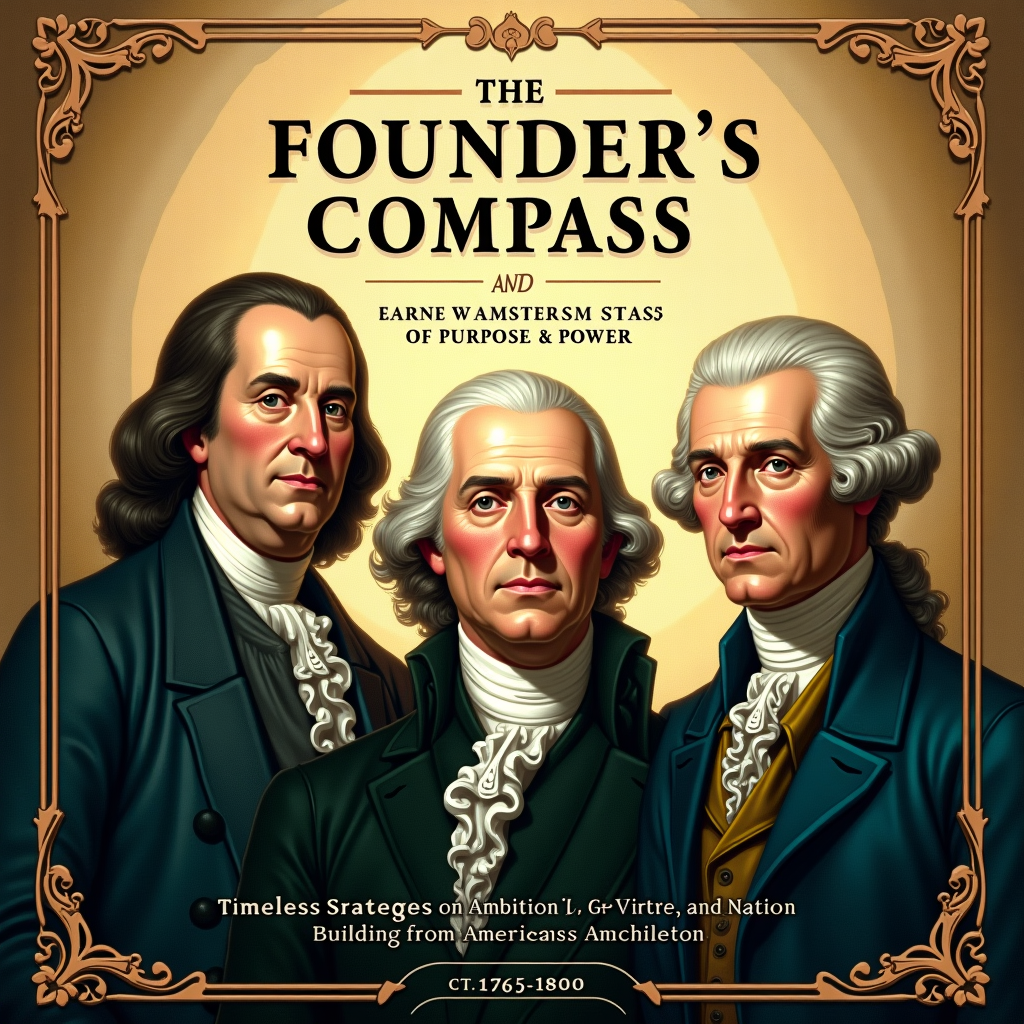
The Founder's Compass: Build a Legacy of Purpose & Power
Timeless Strategies on Ambition, Virtue, and Nation-Building from America's Architects
Professionals, entrepreneurs, and students of history interested in practical lessons on leadership, personal discipline, and civic engagement from America's founding generation.
Contents
- Chapter 1: The Architect's Blueprint – Vision & Virtue in the Crucible of Creation
- Chapter 2: Benjamin Franklin – The Pragmatist's Proverb: Cultivating Personal Discipline for Public Impact
- Chapter 3: George Washington – The Unwavering Anchor: Leading with Integrity Under Immense Pressure
- Chapter 4: Thomas Jefferson – The Visionary's Pen: Articulating Purpose and Shaping Ideals
- Chapter 5: Alexander Hamilton – The Force of Will: Building Institutions from Chaos
- Chapter 6: John Adams – The Independent Mind: Conscience, Conviction, and the Cost of Principle
- Chapter 7: Abigail Adams – The Unseen Strength: Influence, Counsel, and the Private Pillars of Public Life
- Chapter 8: James Madison – The Architect of Compromise: Navigating Faction and Forging Consensus
- Chapter 9: The Perils of Power – Checks, Balances, and Guarding Against Tyranny (Internal & External)
- Chapter 10: Your Legacy Compass – Applying Founder's Wisdom to 21st-Century Nation-Building
Chapter 1: The Architect's Blueprint – Vision & Virtue in the Crucible of Creation
In the frigid depths of Valley Forge, a nascent nation teetered on the brink of collapse. Disease, starvation, and desertion gnawed at the Continental Army, and the grand experiment of American independence seemed destined for the ash heap of history. Yet, amidst this despair, General George Washington, his boots worn thin and his resolve unyielding, penned letters to Congress, not of surrender, but of steadfast determination. His leadership, forged in the crucible of unimaginable hardship, was not merely tactical; it was an embodiment of a profound conviction that the cause was greater than any individual’s comfort or ambition. He understood that a nation, like any great enterprise, could only be built on a foundation of shared purpose and unwavering integrity.
We stand today at a different precipice, yet the challenges are strikingly similar. The modern landscape, rife with disruption, ethical quandaries, and the ceaseless clamor of competing interests, demands a leadership that transcends transient trends and fleeting gains. This book posits that the wisdom of America's Founders, often relegated to dusty archives, offers not merely historical insight but a live playbook for navigating the complexities of the 21st century. Their struggles to forge a nation from thirteen disparate colonies, to balance individual liberty with collective good, and to sustain a vision against overwhelming odds, provide a timeless template for building a career, a business, or a life of enduring meaning.
The Republic of Self: Virtue as a Strategic Asset
The Founders were acutely aware that the success of their grand experiment depended not only on brilliant ideas but also on the character of its citizens and, crucially, its leaders. They spoke often of "republican virtue"—a concept far removed from modern self-help platitudes. For them, it was a practical necessity: the civic-minded dedication to the common good, even at personal cost. This wasn't altruism for its own sake, but a recognition that collective prosperity, and thus individual opportunity, hinged on a shared commitment to principles.
Consider Benjamin Franklin, the quintessential pragmatist and self-made man. He meticulously cultivated virtues such as industry, frugality, and sincerity, not as abstract ideals, but as tools for personal and civic advancement. He understood that trustworthiness and diligence were not merely moral imperatives but strategic advantages. As he observed in his autobiography, "A small leak will sink a great ship." This applies equally to a personal reputation, a startup, or a corporate empire. A lack of integrity, like a small leak, can undermine the most ambitious ventures.
For the ambitious professional or entrepreneur, understanding republican virtue means:
- Prioritizing Trust: In an era of informational overload and transactional relationships, genuine trust is a rare and invaluable commodity. Building it requires consistent, principled action, transparency, and a commitment to promises, even when inconvenient.
- Cultivating Diligence: The Founders understood that sustained effort, not just flashes of brilliance, built lasting structures. Washington's perseverance at Valley Forge, Adams's relentless diplomatic efforts, and Jefferson's tireless scholarship all underscore the power of disciplined work.
- Serving a Greater Purpose: While personal ambition is a powerful motivator, the Founders recognized its limitations. True legacy, they believed, came from contributing to something larger than oneself. This might be a company's mission, a community initiative, or a cultural movement.
From Tyranny to Micromanagement: Recognizing Modern Obstacles
The Founders' language of "tyranny" and "faction" might seem archaic, but their underlying concerns resonate deeply with contemporary challenges. "Tyranny" in their context was the arbitrary exercise of power, the stifling of individual agency. In our world, this manifests as:
- Micromanagement: The overbearing boss who suffocates initiative and creativity, effectively "taxing" innovation.
- Market Monopolies: Entities that stifle competition and dictate terms, limiting consumer choice and entrepreneurial spirit.
- Bureaucratic Inertia: Systems so entrenched and complex that they resist change, regardless of merit, mirroring the Founders' frustration with colonial administration.
Similarly, "faction" represented divisive self-interest, groups prioritizing their own gain over the collective good. Today, this is seen in:
- Office Politics: Internal rivalries that undermine team cohesion and organizational objectives.
- Special Interest Lobbying: Groups influencing policy for narrow benefit, often at public expense.
- Social Media Echo Chambers: Divisions amplified by algorithms, hindering constructive dialogue and shared understanding.
The Founders' solutions to these problems—checks and balances, deliberative democracy, an informed citizenry—offer not prescriptive answers, but a framework for resilient leadership. They teach us to build systems that encourage accountability, foster collaboration, and prioritize long-term sustainability over short-term gratification.
The Tension of Creation: Ambition & Integrity
The architects of American independence were not saints, nor were they devoid of personal ambition. Alexander Hamilton, a titan of intellect and energy, envisioned a powerful, industrialized nation, and his drive was relentless. Yet, his profound commitment to establishing a stable financial system, even when unpopular, stemmed from a deeper conviction about the nation's future. John Adams, fiery and brilliant, yearned for recognition and influence, but his integrity would not allow him to compromise on principle. He famously wrote to his wife Abigail, "I must study Politicks and War that my sons may have liberty to study Mathematicks and Philosophy." This encapsulates the founding generation's understanding: that personal sacrifice and principled action were prerequisites for future prosperity.
This tension between soaring ambition and grounded integrity is the crucible in which true leadership is forged. It demands:
- Strategic Vision: The ability to see beyond the immediate horizon, to articulate a compelling future, and to inspire others to pursue it.
- Ethical Anchors: A non-negotiable set of values that guide decisions, particularly when faced with lucrative but ethically dubious opportunities.
- Resilience: The capacity to endure setbacks, confront opposition, and remain committed to the vision, even when the path is arduous.
The Founders understood that building a new nation, launching a startup, or leading a purpose-driven team are all acts of creation. They require not only technical prowess and strategic acumen but also a profound sense of purpose and an unshakeable commitment to integrity. Their lives serve as a potent reminder that while power may be gained through cunning, true legacy is built on virtue.
Key takeaways
- Republican virtue—civic-minded dedication to the common good—was a practical necessity for the Founders and remains a strategic asset for modern leaders.
- Modern "tyranny" includes micromanagement and market monopolies, while "faction" manifests as office politics and divisive special interests.
- Great endeavors demand a balance between soaring ambition and grounded integrity, a tension the Founders navigated daily.
- Building a legacy requires prioritizing trust, cultivating diligence, and serving a purpose greater than oneself.
- The Founders' experiences offer a blueprint for building resilient systems and leading with principled pragmatism.
Chapter 1: The Architect's Blueprint – Vision & Virtue in the Crucible of Creation
In the frigid depths of Valley Forge, amidst starvation and disease, George Washington faced not just the British army, but the collapse of his own. His officers, many of them ambitious, some opportunistic, threatened to resign. Supplies dwindled, Congress wavered, and the very idea of an independent America seemed a fool's errand. Yet, Washington remained. He wrote to Congress, not with pleas for personal comfort, but with stark, unvarnished assessments of the army’s plight, coupled with an unwavering commitment to the cause. He did not quit, nor did he allow his vision to falter. His perseverance, rooted in an unshakeable belief in the nascent republic, became the bedrock upon which the nation's future would be built.
This moment, one of countless such crucibles, illuminates the core paradox of the American Founding: a colossal undertaking of nation-building, driven by individuals who grappled daily with the tension between soaring ambition and grounded personal virtue. They were not saints, nor were they devoid of self-interest. But they understood, with profound clarity, that the success of their audacious experiment depended not just on brilliant strategy, but on the disciplined cultivation of character. For ambitious professionals and entrepreneurs today, navigating the complex currents of the 21st century, this understanding is not merely historical curiosity; it is a live playbook for building a legacy of purpose and power.
The Republic of Self: Virtue as Strategic Imperative
The Founders understood that a republic, by its very nature, demanded a different caliber of leadership than a monarchy. Where a king ruled by divine right and inherited power, a republican leader derived authority from the consent of the governed, a consent sustained by trust. This trust, they argued, was forged in the fires of "republican virtue"—a concept far more robust than mere politeness. For them, virtue encompassed:
- Public-Spiritedness: A willingness to prioritize the common good over personal gain.
- Self-Control: The discipline to master one's passions and appetites.
- Integrity: Unwavering adherence to moral and ethical principles.
- Industry: Diligence and hard work in pursuit of worthy goals.
- Prudence: Sound judgment and practical wisdom in decision-making.
Benjamin Franklin, the quintessential self-made man, embodied this blend of ambition and virtue. His autobiography, a manual for self-improvement, chronicled his deliberate cultivation of thirteen virtues, a daily ledger against his own imperfections. He wrote, "Human felicity is produced not so much by great pieces of good fortune that seldom happen, as by little advantages that occur every day." Franklin understood that grand achievements were built upon a foundation of consistent, disciplined effort and ethical conduct.
Consider the modern corporation or startup. A culture rife with self-interest, backstabbing, or a disregard for ethical boundaries is a culture destined for internal strife, reputational damage, and eventual collapse. The "tyranny" of micromanagement or market monopolies, the Founders' great fear, finds its modern echo in environments where individual ambition trumps collective purpose, or where ethical shortcuts are rationalized for short-term gain. The Founders’ insight was that true, enduring power—the kind that builds institutions and inspires loyalty—is inextricably linked to integrity.
Nation-Building as a Startup: Navigating Faction and Foundational Principles
The American Revolution was, in essence, the ultimate startup. It began with a radical idea, a lean team, and formidable competition. The "new nation" they were building was not merely a geographic entity, but a set of ideals. This required not only vision, but also a robust framework for managing dissent and disagreement—what they termed "faction."
James Madison, grappling with the nascent republic's internal divisions, articulated this challenge with unparalleled clarity in Federalist No. 10. He defined faction as "a number of citizens, whether amounting to a majority or a minority of the whole, who are united and actuated by some common impulse of passion, or of interest, adverse to the rights of other citizens, or to the permanent and aggregate interests of the community."
Madison's genius lay not in seeking to eliminate faction—he recognized this as impossible, rooted in human nature—but in designing systems that would mitigate its destructive potential. For the modern leader, this translates directly to:
- Office Politics as Faction: Internal rivalries, departmental silos, and competing agendas are the modern equivalents of faction. Madison's lesson is not to wish them away, but to design organizational structures and communication channels that channel these energies productively, or at least contain their negative impact.
- Building Consensus, Not Unanimity: The Founders rarely achieved perfect agreement. Debates were fierce, and compromises were hard-won. George Washington, in his Farewell Address, warned against "the baneful effects of the spirit of party generally." Yet, he also understood that the pursuit of a common goal required leaders to rise above narrow interests.
- The Power of a Guiding Charter: The Constitution itself was a foundational document, a living blueprint for governance. For a company or team, a clearly articulated mission, vision, and set of values serve a similar purpose. They provide the "permanent and aggregate interests" around which diverse individuals can coalesce.
The Founders understood that a grand vision without a principled framework for execution was merely a dream. Their practical approach to governance, born from a deep study of history and an unblinking assessment of human nature, offers a powerful lesson: great endeavors require both soaring ambition and grounded, systematic integrity. The tension between these forces is not a weakness; it is the crucible in which enduring legacies are forged.
Key takeaways
- Virtue is not soft; it's strategic. The Founders saw integrity, self-control, and public-spiritedness as essential for enduring leadership and institutional stability.
- Ambition must be tethered to purpose. Personal drive, while powerful, becomes destructive without a guiding commitment to a larger, shared good.
- "Faction" (internal conflict) is inevitable. The challenge is to design systems and foster cultures that manage dissent and channel competing interests productively.
- A strong foundational "charter" (mission, values) is critical. It provides the shared principles that unite diverse individuals towards a common goal, much like the Constitution for the early republic.
- Your project, your team, your career – it's all "nation-building." Approach it with the same blend of audacious vision and disciplined virtue that characterized the American Founders.
Chapter 2: Benjamin Franklin – The Pragmatist's Proverb: Cultivating Personal Discipline for Public Impact
The young Benjamin Franklin, a mere 20 years old, arrived in Philadelphia with little more than the clothes on his back and two Dutch loaves of bread, one tucked under each arm, eating the third as he walked. He was a runaway apprentice, an unknown amidst a bustling colonial city. Yet, within a few decades, this same Franklin would be a successful printer, famed inventor, astute diplomat, and one of the most revered figures in the burgeoning American experiment. His rise was no accident of fate, but the deliberate outcome of a meticulously cultivated personal philosophy: a blend of rigorous self-discipline, relentless industry, and an unwavering commitment to practical virtue. Franklin understood, perhaps better than any of his contemporaries, that the internal architecture of the self directly informed one's capacity for external impact.
For ambitious professionals and entrepreneurs today, Franklin’s journey offers a profound lesson: individual mastery precedes collective influence. His "way to wealth" was not merely about accumulating capital, but about building an unassailable reputation, a network of trust, and the personal fortitude to navigate complex challenges. His life serves as a blueprint for transforming raw ambition into tangible achievement, grounded in a bedrock of personal integrity.
The Moral Ledger: Engineering a Virtuous Self
Franklin's most enduring contribution to personal development is his celebrated pursuit of "moral perfection," detailed in his Autobiography. He identified thirteen virtues – Temperance, Silence, Order, Resolution, Frugality, Industry, Sincerity, Justice, Moderation, Cleanliness, Tranquility, Chastity, and Humility – and meticulously tracked his adherence to each. This wasn't a spiritual quest in the traditional sense, but a highly pragmatic exercise in self-optimization. He sought to eliminate personal flaws that hindered his effectiveness and cultivate habits that amplified his potential.
Consider his reasoning for this systematic approach: "I concluded at length, that the mere speculative conviction that it was our interest to be completely virtuous, was not sufficient to prevent our slipping; and that the contrary habits must be broken, and good ones established and confirmed, before we can depend on a steady uniform rectitude of conduct." This is not the language of a mystic, but of an engineer diagnosing and solving a system problem.
For the modern leader, Franklin’s moral ledger offers a powerful framework for:
- Identifying Blind Spots: What habits or character traits consistently undermine your productivity, relationships, or decision-making? Like Franklin, catalog them.
- Targeted Improvement: Instead of vague resolutions, focus on one virtue at a time. Franklin spent a week concentrating on each, before cycling through them. This prevents overwhelm and allows for deep integration.
- Accountability through Tracking: Whether a digital habit tracker or a physical journal, the act of daily self-assessment forces awareness and encourages consistency. Franklin's system was a precursor to modern KPIs (Key Performance Indicators) for personal growth.
His emphasis on "Order" – "Let all your things have their places; let each part of your business have its time" – directly translates to contemporary time management and organizational strategies. A cluttered desk or a chaotic schedule is not merely an aesthetic problem; it's an impediment to focused work and strategic thinking.
Industry and Frugality: The Engines of Independence
Franklin understood that financial independence was the bedrock of intellectual and political freedom. His maxims on industry and frugality are not just quaint aphorisms; they are strategic imperatives for anyone seeking to build something of lasting value.
"Early to bed, and early to rise, makes a man healthy, wealthy, and wise," is perhaps his most famous adage. While often dismissed as simplistic, it encapsulates a profound truth about the compounding effects of disciplined effort and prudent resource management.
Industry as Strategic Investment: Franklin wasn't just busy; he was productively busy. He invested his time in learning, inventing, and building his printing business. His industry was a deliberate channel for acquiring skills and creating value. For today's entrepreneur, this means:
- Avoiding "busy work": Distinguish between activity and accomplishment.
- Continuous Skill Acquisition: Dedicate time daily to learning new tools, market trends, or leadership techniques.
- Focus on Value Creation: Every hour should aim to advance a core objective, not merely occupy time.
Frugality as Capital Formation: In an era of easy credit and consumerism, Franklin's insistence on frugality might seem anachronistic. Yet, his perspective was that "a penny saved is a penny earned," not just for personal enrichment, but for strategic advantage.
- Funding Innovation: Saved capital can be reinvested into a business, fund a new venture, or provide a buffer during lean times.
- Reducing Vulnerability: Financial independence reduces susceptibility to external pressures, be they market fluctuations or the whims of demanding clients.
- Freedom of Action: As he famously stated, "He that has a calling, has an office of profit and honor." A strong financial foundation grants the freedom to pursue projects of passion and purpose, rather than being dictated by immediate necessity.
Sincerity and Justice: Building the Unshakeable Reputation
Beyond personal habits and financial acumen, Franklin prioritized the cultivation of character traits that fostered trust and respect. His virtues of "Sincerity" – "Use no hurtful deceit; think innocently and justly, and, if you speak, speak accordingly" – and "Justice" – "Wrong none by doing injuries, or omitting the benefits that are your duty" – were not mere moral niceties. They were essential components of his public relations strategy, long before the term existed.
In an 18th-century world where reputation was paramount, Franklin understood that integrity was the most valuable currency. A reputation for honesty and fairness opened doors, secured contracts, and built alliances. For the modern professional, this translates to:
- Radical Transparency (where appropriate): In an age of instant information, attempts at deception are quickly exposed. Authentic communication builds trust with teams, clients, and stakeholders.
- Ethical Leadership: Decisions must be guided not just by profit, but by principles of fairness and equity. A leader who consistently acts justly inspires loyalty and commitment.
- The Long Game of Trust: Building a strong reputation takes years; destroying it can take moments. Franklin's consistent demonstration of sincerity and justice meant his word was his bond, an invaluable asset in diplomacy and business alike. His life demonstrated that personal virtue, systematically cultivated, is the most robust foundation for public impact.
Key takeaways
- Personal discipline is a strategic asset: Systematically cultivate virtues to optimize your performance and character.
- Industry and frugality build independence: Channel effort productively and manage resources wisely to gain freedom and resilience.
- Integrity is your greatest currency: Prioritize sincerity and justice to build an unshakeable reputation and foster trust.
- Self-improvement is an ongoing project: Like Franklin, regularly assess and refine your personal operating system for continuous growth.
Chapter 3: George Washington – The Unwavering Anchor: Leading with Integrity Under Immense Pressure
The winter of 1777-1778 at Valley Forge was not merely a military encampment; it was an existential test of the nascent American republic. With 12,000 Continental soldiers, a fifth of whom would perish from disease, hunger, and exposure, the army teetered on the brink of dissolution. Supplies were scarce, morale was brittle, and the political will of the fledgling Congress often seemed as thin as the soldiers' threadbare coats. Yet, amidst this crucible of suffering and doubt, George Washington remained. He could have retreated to his comfortable estate, resigned his commission, or even seized power in the ensuing chaos. Instead, he chose to stay, sharing the privations of his troops, writing impassioned pleas to Congress, and projecting an unshakeable resolve that steeled the resolve of others. His presence, stoic and unwavering, became the anchor that prevented the American cause from drifting into oblivion.
Washington's leadership at Valley Forge offers a profound lesson for any professional navigating a period of intense pressure, whether it be a startup facing bankruptcy, a team enduring a product recall, or an individual confronting a personal crisis of faith. It demonstrates that true leadership is often forged not in victory, but in the steadfast endurance of adversity, powered by an unwavering commitment to integrity and purpose.
The Cultivation of Public Trust: Beyond Charisma
Washington was not a charismatic orator in the mold of a Patrick Henry or a spellbinding intellectual like Jefferson. His power lay in his palpable integrity and his consistent demonstration of self-command. He understood, implicitly, that genuine authority is earned through consistent, principled action, not through rhetoric alone.
In an era rife with political maneuvering and personal ambition, Washington consistently prioritized the public good above his own. This was not a performative act but a deeply ingrained habit, cultivated over decades. Consider his famous statement upon accepting command of the Continental Army in 1775:
"As to pay, Sir, I beg leave to assure the Congress, that as no pecuniary consideration could have tempted me to accept this arduous employment at the expense of my domestic ease and happiness, I do not wish to make any profit from it. I will keep an exact account of my expenses. Those, I doubt not, they will discharge, and that is all I desire."
This declaration, made at the very outset of his command, set a precedent. He served without salary for eight years, meticulously documenting every expenditure. This act of self-denial, far from being a mere gesture, became a bedrock of public trust.
For the modern leader, this translates into several critical principles:
- Lead by Example, Always: Your actions carry more weight than your words. When the organization faces austerity, does leadership take the first cuts, or are they insulated? When deadlines loom, are you in the trenches with your team, or merely delegating from afar?
- Transparency in Adversity: While not every detail can be shared, a consistent commitment to transparent communication, especially during difficult times, builds credibility. Washington's regular, if sometimes grim, dispatches to Congress and his officers kept them informed, even when the news was bleak.
- The "No Profit" Principle: While you are certainly compensated for your work, consider the spirit of Washington's declaration. Are you making decisions that disproportionately benefit you, or are you genuinely putting the organization's long-term health and your team's welfare first? This is particularly crucial for entrepreneurs with equity stakes.
Self-Command as a Strategic Imperative
Washington's famed stoicism was not a lack of emotion but a masterful exercise in self-command. He was capable of immense anger, as evidenced by his rare but explosive outbursts, yet he largely kept his passions in check, particularly in public. This internal discipline was not merely a personal virtue; it was a strategic asset.
At Valley Forge, amidst calls for his removal and outright mutiny, Washington maintained a calm exterior. He understood that panic or despair from the commander would be catastrophic for the troops. His composure provided a psychological anchor for an army on the verge of collapse.
In the 21st century, where information travels at light speed and crises can erupt instantaneously, self-command is more vital than ever.
- The "Digital Valley Forge": Imagine a social media storm, a market downturn, or a critical system failure. The leader who reacts impulsively, vents publicly, or projects fear will sow panic throughout their organization.
- Decisive, Not Reactive: Washington's calm allowed him to analyze situations, consult with his generals, and make reasoned decisions, even under duress. This contrasts sharply with leaders who allow external pressures to dictate their emotional state and, consequently, their judgment.
- The "Inner Citadel": As the Stoics taught, and Washington exemplified, while external events are often beyond our control, our reactions to them are not. Cultivating this "inner citadel" of calm resolve allows for strategic thinking even when the external environment is chaotic. It demands introspection, emotional regulation, and a clear understanding of one's core values.
Prioritizing the National Interest: A Blueprint for Purpose-Driven Leadership
Perhaps Washington's greatest legacy was his consistent prioritization of the national interest over personal ambition. Twice, he voluntarily surrendered power: once at the end of the Revolutionary War, resigning his commission to Congress, and again after two terms as President, establishing the precedent of peaceful transition. These acts, unprecedented in their time, solidified the republican ideal.
His farewell address, a masterpiece of statesmanship, warned against the dangers of factionalism and unchecked ambition, urging future generations to place the unity and well-being of the nation above partisan interests.
"The alternate domination of one faction over another, sharpened by the spirit of revenge, natural to party dissension, which in different ages and countries has perpetrated the most horrid enormities, is itself a frightful despotism."
For today's leaders, "national interest" can be translated into the overarching purpose of your organization, the mission of your team, or the ethical impact of your work.
- Beyond Self-Interest: Are your decisions driven by what is best for the long-term health and mission of the organization, or by personal gain, ego, or short-term metrics that benefit your own standing?
- Combating Factionalism: Just as Washington warned against political factions, modern organizations are plagued by inter-departmental rivalries, team silos, and internal politics. A true leader actively works to unify these elements toward a common, greater purpose.
- The Legacy Mindset: Washington thought not just about the present but about the future of the republic. What kind of legacy are you building? Are you creating an organization that is sustainable, ethical, and purpose-driven beyond your tenure?
Washington's unwavering anchor at Valley Forge and throughout his career reminds us that leadership is not merely about achieving success but about embodying the virtues that make success meaningful and sustainable. It is a call to principled pragmatism, where integrity is not a luxury but a strategic imperative.
Key takeaways
- Integrity is Your Anchor: Cultivate public and team trust through consistent, transparent, and self-sacrificing actions.
- Self-Command is Strategic: Master your emotions to make reasoned decisions and project stability during crises.
- Prioritize the Greater Good: Always place the organization's mission and long-term health above personal ambition or factional interests.
- Lead by Enduring: True leadership is often demonstrated most powerfully in your steadfastness through adversity, not just in times of triumph.
Chapter 4: Thomas Jefferson – The Visionary's Pen: Articulating Purpose and Shaping Ideals
In the sweltering Philadelphia summer of 1776, a young Virginian lawyer, Thomas Jefferson, was tasked with articulating the nascent nation's claim to independence. Confined to rented rooms on Market Street, he labored over a document that would not merely declare separation but would justify it to a skeptical world. With a small, portable writing desk of his own design, he penned phrases that have echoed through centuries, transforming a colonial rebellion into a revolution of ideas. He understood that before arms could secure liberty, words must first define its very essence. His work, the Declaration of Independence, stands as a testament to the power of compelling rhetoric to galvanize a movement, articulate a shared purpose, and lay the conceptual groundwork for a new order.
The Power of the Preamble: Defining and Disseminating Purpose
Jefferson’s genius lay in his ability to distill complex Enlightenment philosophy into accessible, resonant language. The opening lines of the Declaration are not merely ceremonial; they are a strategic act of nation-building, a foundational manifesto for a new civilization. He understood that any great endeavor, be it a revolution or a startup, requires a clear, universally understood statement of its raison d'être.
"We hold these truths to be self-evident, that all men are created equal, that they are endowed by their Creator with certain unalienable Rights, that among these are Life, Liberty and the pursuit of Happiness." This single sentence, crafted with surgical precision, did several critical things:
- Established Universal Principles: It elevated the colonial grievances beyond mere taxes and trade, grounding them in fundamental human rights. For the modern leader, this means articulating your organization's mission not just in terms of profit or market share, but in its contribution to a greater good, its impact on stakeholders, or its advancement of a core value.
- Created a Shared Ideal: By declaring these truths "self-evident," Jefferson appealed to a common human understanding, bypassing the need for extensive argumentation. This fostered a sense of unity among disparate colonies and served as a powerful recruiting tool for the cause. Your mission statement should be equally undeniable, inspiring collective action and loyalty.
- Set the Standard for Accountability: Once these principles were declared, they became the benchmark against which the new government, and indeed all future governments, would be judged. For the entrepreneur, this is akin to defining your company's core values—they are not just slogans, but the ethical framework that guides every decision and measures every success.
Jefferson’s pen, though often wielded from a distance, provided the ideological ammunition for the revolution. He understood that clear, compelling purpose is the first step toward effective execution.
The Architect of Ideas: Translating Philosophy into Actionable Principles
Jefferson was not a battlefield general, nor was he a financial wizard like Hamilton. His battlefield was the realm of ideas, and his weapon was language. He drew heavily from John Locke's theories of natural rights and government by consent, but he transformed these abstract concepts into a call to action. His skill was not just in quoting philosophers, but in applying their wisdom to a concrete political crisis.
Consider his articulation of the people's right to alter or abolish government: "That to secure these rights, Governments are instituted among Men, deriving their just powers from the consent of the governed, That whenever any Form of Government becomes destructive of these ends, it is the Right of the People to alter or to abolish it, and to institute new Government..."
This passage offers profound lessons for contemporary leadership:
- Legitimacy from Consent: Jefferson clearly states that authority derives from those being led. In a modern organization, this translates to earning the trust and buy-in of your team. Leaders who rule by fiat, ignoring the sentiments and expertise of their people, often find their authority undermined.
- Purpose-Driven Governance: Governments are "instituted to secure these rights." Their existence is not an end in itself but a means to a greater purpose. For any enterprise, its structure, processes, and even its very existence must serve its overarching mission. When they cease to do so, they become impediments.
- The Right to Innovate and Reorganize: The implicit message is that systems are not sacred if they fail to serve their intended purpose. This is the entrepreneurial spirit embodied: the willingness to "alter or abolish" outdated methods, redefine roles, or pivot strategies when they are "destructive of these ends." Stagnation often begins when leaders cling to established structures rather than adapting to new realities.
Jefferson demonstrated that true leadership often involves the courage to challenge the status quo, not with brute force, but with irrefutable logic and a clear alternative vision. His words provided the theoretical justification for revolution, giving moral weight to the colonists' struggle.
The Shadow of Contradiction: The Gap Between Ideal and Practice
It is impossible to discuss Jefferson without acknowledging the profound tension between his soaring rhetoric and his personal conduct. The man who penned "all men are created equal" was a lifelong slave owner. This stark contradiction is not merely a historical footnote; it is a vital lesson in leadership: the chasm between espoused values and lived reality can undermine even the most eloquent declarations.
For today's leader, this serves as a potent reminder:
- Integrity is Non-Negotiable: No matter how brilliant your vision or how compelling your articulation of purpose, a lack of integrity in your personal or organizational conduct will eventually erode trust and legitimacy.
- Consistency Builds Credibility: "Do as I say, not as I do" is a leadership aphorism that inevitably leads to cynicism and disengagement. Leaders must embody the values they espouse, or their words become hollow.
- The Ongoing Struggle for Alignment: Jefferson's hypocrisy highlights that aligning actions with ideals is a perpetual struggle, even for the most insightful minds. Leaders must constantly self-assess, seeking to close the gap between their stated principles and their operational realities. This requires humility, self-awareness, and a commitment to continuous improvement.
Jefferson's legacy compels us to strive for the ideals he articulated while remaining acutely aware of the human fallibility that often prevents their full realization. His vision was profound, but his life reminds us that the journey toward justice and equality is long and often fraught with personal failure.
Key Takeaways
- Articulate a Compelling Purpose: Clearly define your mission with universal principles that resonate deeply and inspire collective action.
- Translate Ideals into Action: Move beyond abstract philosophy to connect your vision with concrete, actionable principles that guide decisions and operations.
- Legitimacy Through Consent: Ensure your authority is derived from the buy-in and trust of those you lead, not merely from your position.
- Embrace Strategic Adaptation: Be willing to "alter or abolish" systems and strategies that no longer serve your core purpose.
- Bridge the Gap Between Words and Deeds: Strive for unwavering consistency between your stated values and your actual conduct to build and maintain credibility.
Chapter 5: Alexander Hamilton – The Force of Will: Building Institutions from Chaos
In the sweltering summer of 1790, amidst the political wrangling of a nascent republic, Alexander Hamilton, then Secretary of the Treasury, faced a seemingly insurmountable challenge. The newly formed United States was burdened by immense war debts, its currency was devalued, and its credit was nonexistent. The nation teetered on the brink of financial collapse, its very existence threatened by economic disarray. Hamilton, a man of humble origins but towering intellect, presented his audacious "Report on Public Credit." It proposed that the federal government assume the states' debts, establish a national bank, and implement a system of tariffs and taxes to stabilize the economy. The plan was met with fierce opposition, deemed by many as too powerful, too centralized, and too risky. Yet, through sheer force of intellect, relentless persuasion, and strategic maneuvering, Hamilton ultimately prevailed, laying the bedrock for America's future economic prowess. This was not merely financial policy; it was an act of nation-building, transforming a collection of disparate states into a unified economic entity.
Hamilton's story is a testament to the power of a single, determined individual to forge order from chaos, to translate abstract vision into enduring institutions. For the ambitious professional or entrepreneur, his life offers a masterclass in strategic execution, financial acumen, and the unwavering resolve required to bring grand designs to fruition, even when the odds seem insurmountable. He understood that a vision, however noble, remains inert without the will to implement it.
The Architect of Financial Stability: From Vision to System
Hamilton’s genius lay not just in conceiving a robust financial system, but in understanding that a nation’s economic health was inextricably linked to its political stability and its ability to act on the global stage. He recognized that a strong credit rating was not merely an accounting entry, but a demonstration of national competence and trustworthiness. His proposals were radical for their time, challenging the agrarian ideals of many Founders who distrusted centralized power and financial institutions.
His "Report on Public Credit" (1790), followed by the "Report on a National Bank" (1790) and the "Report on Manufactures" (1791), collectively outlined a comprehensive economic strategy. These documents were not just theoretical treatises; they were detailed blueprints for action. Hamilton understood that a nation, like a startup, needed capital, structure, and a reliable engine for growth.
Consider these elements of his approach:
- Consolidation of Debt: His proposal for the federal government to assume state debts was a stroke of genius. It bound the states more closely to the federal government, giving creditors a vested interest in the success of the unified nation. In a modern context, this is akin to a CEO consolidating multiple departmental budgets under a single, transparent financial reporting system, creating unified accountability and shared incentives for success.
- Establishment of a National Bank: Hamilton argued for a central bank to manage the nation's finances, regulate currency, and provide credit. This was a bold move, opposed by those who feared its power. He saw it as a vital instrument for economic development and stability. For today's entrepreneur, this underscores the importance of robust financial infrastructure – whether it’s a strong banking relationship, a well-managed treasury, or a clear investment strategy – to fuel growth and manage risk.
- Promotion of Industry: His "Report on Manufactures" advocated for protective tariffs and government support for nascent industries. He understood that a diversified economy, not solely reliant on agriculture, was essential for national strength. This foresight is a powerful lesson for leaders in any sector: identify future trends, invest in innovation, and cultivate new capabilities, even if it means challenging existing paradigms.
Hamilton articulated his philosophy with characteristic clarity: "A national debt, if it is not excessive, will be to us a national blessing." He understood that debt, when managed responsibly and invested wisely, could be a tool for creating capital and fostering growth, not merely a burden.
Overcoming Opposition: The Art of Principled Pragmatism
Hamilton’s vision did not materialize without intense struggle. His proposals were fiercely debated, often along regional and ideological lines. Thomas Jefferson and James Madison, among others, viewed his plans as an overreach of federal power, threatening republican liberty. Yet, Hamilton, despite his aristocratic leanings, was a master of political negotiation and strategic communication.
His approach to overcoming opposition included:
- Intellectual Rigor: Hamilton meticulously researched and presented his arguments, leaving little room for ambiguity. His reports were exhaustive, anticipating objections and providing detailed rebuttals. This emphasizes the importance of thorough preparation and data-driven arguments in any high-stakes negotiation.
- Strategic Compromise: The famous "Compromise of 1790," where Hamilton agreed to move the nation's capital to a more southern location (what would become Washington D.C.) in exchange for Southern votes for his debt assumption plan, is a prime example of his political dexterity. He understood that achieving a grand vision often requires tactical concessions on secondary issues.
- Relentless Advocacy: Hamilton did not shy away from public debate. He wrote extensively, often under pseudonyms, to sway public opinion and counter his critics. He recognized that leadership involves not just formulating policy, but also effectively communicating its rationale and benefits to all stakeholders.
Hamilton's belief in the necessity of a strong, active government was unwavering. He argued that "Energy in the Executive is a leading character in the definition of good government." This conviction drove him to push through his agenda, understanding that inaction in the face of crisis was a greater threat than bold, potentially controversial, solutions.
The Entrepreneur of the State: Building a Legacy of Institutions
Hamilton's life was a continuous act of entrepreneurship, but on the grandest scale. He was not merely managing an existing system; he was inventing one. He understood that true leadership involved not just solving immediate problems, but creating enduring structures that would outlast any individual. His work laid the foundation for America's economic dominance and its capacity to project power and influence globally.
For the modern leader, Hamilton’s legacy offers profound lessons:
- Institutions Endure, Individuals Fade: Hamilton built systems – a national bank, a revenue collection apparatus, a framework for public credit – that transcended his personal tenure. This is the mark of true legacy building: creating structures that can operate effectively long after you depart.
- Vision Requires Execution: A brilliant idea is only a starting point. Hamilton demonstrated that relentless effort, meticulous planning, and the courage to confront opposition are essential for transforming vision into tangible reality.
- Financial Acumen as a Core Competency: Whether leading a nation, a company, or a personal project, a fundamental understanding of financial principles is critical. Hamilton’s work underscores that financial health is not peripheral, but central to sustainability and growth.
His life, though cut tragically short, left an indelible mark. He exemplified the "force of will" required to navigate complexity, challenge the status quo, and build something lasting from the raw materials of ambition and necessity. His enduring institutions continue to shape the American economy, a testament to his strategic genius and unwavering resolve.
Key takeaways
- Translate Vision into Systems: Grand ideas require detailed, actionable plans and institutional structures to endure.
- Embrace Financial Acumen: A strong understanding of financial principles is critical for stability, growth, and strategic decision-making.
- Confront Opposition with Rigor and Pragmatism: Prepare thoroughly, argue persuasively, and be willing to compromise strategically to achieve core objectives.
- Build Enduring Institutions: Focus on creating systems and frameworks that will outlast your direct involvement, ensuring a lasting legacy.
- Exhibit Unwavering Resolve: The path to innovation and nation-building is fraught with challenges; success demands persistent effort and a strong will.
Chapter 6: John Adams – The Independent Mind: Conscience, Conviction, and the Cost of Principle
The streets of Boston, March 1770, pulsed with an anger that threatened to consume the very foundations of civil society. British soldiers, beleaguered and provoked, had fired into a crowd, leaving five colonists dead. The city, already a tinderbox of revolutionary fervor, demanded swift and brutal justice. Yet amidst this seething outrage, one man stepped forward to defend the accused, not out of political sympathy, but from an unshakeable belief in the sanctity of law and due process. John Adams, a man whose intellectual prowess was matched only by his formidable conscience, accepted the thankless task. He knew the cost: public scorn, professional damage, even threats to his family. But for Adams, the principle of justice, however unpopular, was paramount. He declared, "Counsel ought to be the very last thing that an accused person should want in a free country." His successful, albeit controversial, defense of the soldiers is a testament to the power of an independent mind, a conscience unbowed by popular sentiment, and a conviction that transcends immediate political gain.
Adams’s journey offers a vital lesson for ambitious professionals and entrepreneurs: true leadership often demands a willingness to stand apart, to champion principles even when they are inconvenient or unpopular. In an age of instant gratification and market-driven consensus, the independent mind, anchored by conviction, is a rare and powerful asset.
The Unpopular Truth: Integrity in the Face of the Mob
Adams understood that integrity is not merely adherence to a moral code, but a steadfast commitment to principles, especially when they are tested. His defense of the British soldiers was not a betrayal of the American cause, but a profound affirmation of the very ideals that cause sought to establish: a government of laws, not of men; due process; and the presumption of innocence. He articulated his rationale with stark clarity: "Facts are stubborn things; and whatever may be our wishes, our inclinations, or the dictates of our passions, they cannot alter the state of facts and evidence."
For the modern leader, this translates into:
- Data-Driven Decisions Over Groupthink: In an environment where consensus can be mistaken for correctness, Adams reminds us to prioritize objective evidence and rigorous analysis. Don't let the prevailing sentiment or the loudest voice drown out inconvenient truths.
- Ethical Non-Compromise: When faced with pressure to cut corners, bend rules, or sacrifice long-term principles for short-term gains, remember Adams. His actions illustrate that true strength lies in an unyielding commitment to what is right, even if it means temporary unpopularity or financial sacrifice.
- Protecting Due Process: In any organization, ensuring fair treatment, transparent processes, and impartial judgment, even for those who are disliked or have made mistakes, builds a foundation of trust that ultimately benefits everyone.
The Intellectual Crucible: Rigor, Reflection, and Relentless Self-Improvement
Adams was, above all, an intellectual. His diary entries, letters, and voluminous writings reveal a mind constantly engaged in rigorous self-examination and critical thought. He believed deeply in the power of education and the cultivation of reason as the bedrock of a virtuous republic and a successful life. His famous admonition to his wife, Abigail, "I must study Politicks and War that my sons may have liberty to study Mathematicks and Philosophy, Geography Natural History Naval Architecture, navigation, Commerce and Agriculture, in order to give their Children a right to study Painting Poetry Musick Architecture Statuary Tapestry and Porcelaine," underscores his belief in successive generations building upon the intellectual capital of their predecessors.
This relentless pursuit of knowledge and intellectual discipline provides powerful lessons for today's dynamic professional landscape:
- Lifelong Learning as a Strategic Imperative: The world shifts constantly. Adams's example urges us to never cease learning, adapting, and challenging our own assumptions. Whether through formal education, constant reading, or seeking out diverse perspectives, intellectual curiosity is a competitive advantage.
- The Power of Reflection: Adams's diaries were not just records of events but arenas for deep reflection, self-critique, and the development of his ideas. Schedule time for deliberate thought, strategizing, and evaluating your actions and decisions. This is where true wisdom is forged.
- Articulation of Vision: Adams's ability to clearly articulate complex legal and political principles was a direct result of his intellectual rigor. Leaders must be able to communicate their vision, strategy, and values with precision and clarity.
The Cost of Conviction: Navigating Personal Sacrifice and Public Scrutiny
Adams's principled stands often came at a steep personal and political cost. His defense of the British soldiers made him a target of public scorn. His bluntness and independent streak often alienated allies. Despite his immense contributions, he felt undervalued and misunderstood, particularly by his contemporaries like Jefferson and Franklin. He wrote, "The consequence of my defense of the soldiers was, that I lost a considerable part of my business." Yet, he never wavered. His correspondence with Abigail Adams, an intellectual and political partner in her own right, reveals a profound personal strength and mutual support that sustained him through these trials. She famously urged him to "Remember the Ladies," a testament to their shared commitment to progressive ideals.
For modern leaders, this highlights:
- Resilience in the Face of Criticism: Leading with conviction inevitably attracts scrutiny and opposition. Adams’s story reminds us that not all criticism is valid, but all must be endured with a steadfast focus on one's core mission.
- The Importance of a Support System: Adams’s relationship with Abigail was a critical anchor. Identify and cultivate trusted advisors, mentors, and personal relationships that provide honest feedback, emotional support, and a refuge from the pressures of leadership.
- Long-Term Legacy Over Short-Term Popularity: Adams was often unpopular, yet his contributions to American constitutionalism and legal principles are foundational. Focus on building enduring value and a legacy of integrity, rather than chasing fleeting popularity.
Key takeaways
- Principle over Popularity: True leadership demands the courage to uphold justice and core values, even when it means standing against the prevailing sentiment or risking personal and professional cost.
- Intellectual Rigor is a Leadership Imperative: Cultivate a mind that relentlessly pursues knowledge, engages in critical thought, and prioritizes objective evidence over emotional appeal or groupthink.
- Integrity Comes at a Cost: Be prepared for criticism, isolation, and even personal sacrifice when you commit to a path of principled leadership.
- Cultivate Your Inner Circle: A strong personal and professional support system is crucial for navigating the pressures and loneliness of leadership.
Chapter 7: Abigail Adams – The Unseen Strength: Influence, Counsel, and the Private Pillars of Public Life
The year is 1776. As her husband, John Adams, labored in Philadelphia to declare independence, Abigail Adams, managing their farm and raising their children amidst the chaos of war, penned a letter that would echo through history. With the British navy threatening Boston, she wrote not of domestic concerns alone, but of fundamental rights and future governance. "I long to hear that you have declared an independency," she urged, "and by the way in the new Code of Laws which I suppose it will be necessary for you to make I desire you would Remember the Ladies, and be more generous and favourable to them than your ancestors." This was not a plea from a subordinate, but a strategic counsel from an equal, a clear directive from a mind deeply engaged with the political project at hand. Abigail Adams, though denied a public platform, understood the profound power of influence, wielded through intellect, persuasion, and an unwavering commitment to principle. Her story offers a playbook for those who seek to shape outcomes and lead from positions beyond formal authority, demonstrating that the most potent forces are often those that operate with quiet conviction.
The Strategist's Correspondence: Shaping Policy from Afar
Abigail Adams's epistolary legacy is a masterclass in strategic communication and long-distance leadership. While John Adams navigated the treacherous waters of nascent nation-building, Abigail served as his vital intelligence officer, sounding board, and moral compass. Her letters were not mere personal updates; they were incisive analyses of public sentiment, economic conditions, and the character of political actors. She understood that effective leadership requires a comprehensive understanding of the environment, a network of reliable intelligence, and a trusted confidante with whom to test ideas.
Consider her role during the tumultuous early years of the Republic. She observed the political landscape with a keen eye, often offering a more grounded perspective than the highly theoretical debates in Philadelphia or Paris. Her insights were invaluable to John Adams, providing him with a necessary counterpoint to the often-insular world of political elites. This dynamic illustrates several enduring principles for today's leaders:
- Cultivate a diverse advisory network: Even if formal advisors are homogenous, seek out diverse perspectives from those operating in different spheres. Abigail provided a crucial "outside-in" view.
- Leverage indirect influence: Formal power is one form of leverage; intellectual and moral authority, wielded through private counsel and persuasion, is another, often more resilient, form.
- The power of the informal brief: Her letters functioned as a sophisticated, continuous intelligence brief, keeping her husband informed of popular opinion and the practical implications of policy. She understood that abstract ideals must eventually confront the realities on the ground.
Her famous admonition to "Remember the Ladies" was not simply a request; it was a strategic intervention, reminding the Founders that the principles of liberty and equality, if truly universal, must extend beyond the privileged few. She pressed for a more inclusive vision, foreseeing that a republic founded on such grand ideals would eventually be judged by its adherence to them across all segments of society.
The Moral Compass: Integrity in Public and Private Life
Beyond political strategy, Abigail Adams was a fierce proponent of moral integrity as the bedrock of both individual success and national stability. She believed that public service demanded not just intellect, but character. In an era where ambition often clashed with virtue, she consistently reminded her husband of the higher calling of their work. She understood that a leader's character, even in private, would inevitably manifest in public decisions and ultimately shape the destiny of their enterprise.
She wrote to John in 1777, during a particularly trying period: "Great learning and superior abilities, should you ever possess them, will be of little service to you unless virtue, honor, integrity, are added to them." This counsel, originally directed at her son, John Quincy Adams, encapsulates her broader philosophy. It is a timeless reminder for any aspiring leader or entrepreneur:
- Competence without character is fragile: Technical expertise and strategic acumen are insufficient without a strong moral foundation. A brilliant mind can still lead to ruin if unmoored from ethical principles.
- Lead by example, even in private: The integrity of one's personal life profoundly impacts the credibility and effectiveness of one's public leadership. Hypocrisy erodes trust and undermines authority.
- The long game of reputation: While expediency might offer short-term gains, true legacy is built on consistent adherence to principles. Abigail Adams understood that the "new nation" they were building required a moral foundation as solid as its legal one.
Her steadfast commitment to these principles provided John Adams with a constant reminder of the ideals they were fighting for, preventing him from succumbing to the cynicism or compromises that often accompany the pursuit of power. She was his conscience, his partner in virtue, anchoring him to the higher purpose of their shared endeavor.
Pillars of Resilience: Education, Self-Reliance, and Purpose
Abigail Adams's life was a testament to resilience, forged through personal hardship and sustained by an unyielding commitment to education and self-reliance. While her husband was abroad for years, she managed their household, farm, and finances, demonstrating remarkable business acumen and fortitude. She understood that true independence, both personal and national, required practical skills, intellectual rigor, and an unwavering spirit.
Her dedication to education, particularly for women, was revolutionary. She believed that an educated populace, irrespective of gender, was essential for a thriving republic. Her own vast reading and intellectual curiosity fueled her ability to engage with the complex political and philosophical debates of her time. This emphasis on continuous learning and practical competence offers actionable insights:
- Lifelong learning is non-negotiable: In rapidly changing environments, intellectual stagnation is a death knell. Like Abigail, cultivate a habit of continuous learning and critical engagement with ideas.
- Self-reliance as a foundation for leadership: The ability to navigate challenges independently, to manage resources, and to make sound decisions without constant oversight, builds the confidence and competence necessary for leadership.
- Purpose as a driving force: Abigail's commitment to the American cause extended beyond her family's immediate needs. Her purpose was larger than herself, providing the resilience to endure immense personal and national trials.
Abigail Adams, though never holding public office, exerted an influence that shaped the trajectory of the early American republic. Her unwavering intellect, moral clarity, and practical resilience serve as an enduring model for those who seek to lead with purpose, whether from the public stage or from behind the scenes. Her story reminds us that true power often resides not in titles or positions, but in the strength of one's convictions, the acuity of one's mind, and the integrity of one's character.
Key takeaways
- Influence beyond authority: Formal position is not a prerequisite for profound influence; intellectual rigor, strategic counsel, and moral authority can be equally, if not more, potent.
- The indispensable confidante: Cultivate trusted advisors who offer diverse perspectives and serve as a moral compass, grounding leaders in reality and principle.
- Character as currency: Integrity, honor, and virtue are not optional add-ons but foundational elements for sustainable leadership and lasting legacy.
- Resilience through education & self-reliance: Continuous learning and practical competence are essential for navigating challenges and maintaining independence, both personally and professionally.
- Private virtues, public impact: The strength and integrity cultivated in one's personal life directly translate into the effectiveness and trustworthiness of one's public endeavors.
Chapter 8: James Madison – The Architect of Compromise: Navigating Faction and Forging Consensus
In the sweltering Philadelphia summer of 1787, amidst the clatter of horse-drawn carriages and the fervent debates within Independence Hall, sat a slight, studious Virginian named James Madison. He arrived early, prepared meticulously, and spoke frequently, often taking the floor immediately after a heated exchange. He listened intently, absorbed the cacophony of competing interests – large states against small, agricultural against mercantile, North against South – and then, with quiet precision, began to weave together the disparate threads. His brilliance lay not in overpowering dissent, but in understanding its roots and designing mechanisms to channel it productively. The Constitution, arguably the greatest act of political compromise in history, stands as his enduring testament to the power of thoughtful negotiation and institutional design.
The Problem of Faction: Understanding Competing Interests
Madison, a profound student of history and political theory, understood that human nature, with its inherent diversity of opinion and self-interest, inevitably led to what he termed "factions." In his seminal Federalist No. 10, he articulated this challenge with stark clarity: "By a faction, I understand a number of citizens, whether amounting to a majority or a minority of the whole, who are united and actuated by some common impulse of passion, or of interest, adverse to the rights of other citizens, or to the permanent and aggregate interests of the community."
For the modern leader, "faction" manifests as:
- Corporate Silos: Departments optimizing for their own metrics at the expense of organizational goals.
- Startup Disagreements: Co-founders with differing visions for product development or market strategy.
- Team Conflicts: Individuals prioritizing personal ambition over collective success.
- Market Monopolies: Powerful entities leveraging their position to stifle competition and innovation, harming the broader economic community.
Madison argued that the causes of faction were "sown in the nature of man." This is a crucial insight: you cannot eliminate competing interests. To attempt to do so is to pursue an impossible ideal, often leading to authoritarianism. The pragmatic approach, Madison asserted, was to manage their effects. He dismissed the idea of eliminating faction by destroying liberty ("a remedy worse than the disease") or by forcing everyone to think alike ("as impracticable as it would be unwise"). Instead, he proposed a system that would "control its effects."
Designing Systems for Constructive Conflict
Madison's genius lay in translating this theoretical understanding into practical institutional design. He understood that a well-structured system could mitigate the destructive potential of faction by forcing diverse interests into dialogue and compromise. His solutions, embodied in the U.S. Constitution, offer a masterclass in governance for any complex organization:
Extended Republic (Scale): Madison argued that a larger republic, encompassing a greater diversity of interests, made it harder for any single faction to gain tyrannical control. "The smaller the society, the fewer probably will be the distinct parties and interests composing it; the more frequently will a majority be found of the same party; and the smaller the compass within which they are placed, the more easily will they concert and execute their plans of oppression."
- 21st-Century Application: For a startup, this means diversifying your team's backgrounds, skills, and perspectives. For a large corporation, it means ensuring cross-functional collaboration and preventing insular departmental thinking. A broader base of stakeholders makes it harder for a single, narrow agenda to dominate.
Checks and Balances (Separation of Powers): By dividing power among different branches (legislative, executive, judicial), each with the ability to constrain the others, Madison created a system where ambition would counteract ambition. "The great security against a gradual concentration of the several powers in the same department, consists in giving to those who administer each department the necessary constitutional means and personal motives to resist encroachments of the others."
- 21st-Century Application: Implement robust internal controls within your organization. Separate roles and responsibilities to prevent any single individual or department from having unchecked power. For example, separating product development from quality assurance, or sales from finance, creates healthy tension and oversight.
Representation (Refinement of Public Views): Rather than direct democracy, Madison advocated for a representative republic, where elected officials would "refine and enlarge the public views, by passing them through the medium of a chosen body of citizens, whose wisdom may best discern the true interest of their country, and whose patriotism and love of justice will be least likely to sacrifice it to temporary or partial considerations."
- 21st-Century Application: Delegate authority to trusted, competent leaders who can synthesize diverse feedback and make informed decisions. Encourage open discussion within teams, but empower leaders to make final calls, ensuring a balance between democratic input and effective execution. This isn't about ignoring the team, but about having clear decision-makers who can steer the ship.
The Art of Compromise: Forging Consensus
Madison's role in the Constitutional Convention was a masterclass in coalition-building and strategic negotiation. He understood that progress often required concessions from all sides. The Great Compromise, which balanced the interests of large and small states by creating both proportional representation (House of Representatives) and equal representation (Senate), was a testament to this principle. He didn't just advocate for his preferred solutions; he worked tirelessly to find common ground.
- Active Listening: Madison was renowned for his meticulous notes during the Convention, demonstrating an unparalleled commitment to understanding every viewpoint.
- Identifying Shared Interests: He skillfully identified the fundamental desire for a stronger, more stable union that transcended narrow state interests.
- Incremental Progress: Rather than demanding an all-or-nothing victory, he championed a process of continuous amendment and refinement, knowing that the perfect was the enemy of the good.
His approach teaches us that true leadership in complex environments is not about imposing a singular vision, but about facilitating a process where diverse perspectives can contribute to a robust, collectively owned solution. It requires patience, intellectual rigor, and an unwavering commitment to the greater good of the enterprise.
Key takeaways
- Acknowledge Inevitable Faction: Understand that competing interests are inherent in any group endeavor; don't try to eliminate them, but manage their effects.
- Design for Dialogue: Create systems and structures that force diverse stakeholders to engage, negotiate, and compromise.
- Embrace Checks and Balances: Implement internal oversight and distributed authority to prevent the concentration of power and mitigate risks.
- Champion Representation: Empower trusted leaders to synthesize feedback and make informed decisions, balancing broad input with decisive action.
- Master the Art of Compromise: Cultivate the skills of active listening, identifying shared goals, and making strategic concessions to build lasting consensus.
Chapter 9: The Perils of Power – Checks, Balances, and Guarding Against Tyranny (Internal & External)
In the sweltering Philadelphia summer of 1787, as the Constitutional Convention neared its close, the aged Benjamin Franklin was asked what form of government they had given the people. His legendary reply, "A republic, if you can keep it," was not a casual observation but a profound warning. It underscored the Founders' deepest fear: that even the most meticulously crafted systems were vulnerable to the corrupting influence of power, whether wielded by a monarch, a mob, or an unprincipled leader. Their tireless work to construct a government of checks and balances was a testament to this conviction, a practical acknowledgment that human nature, left unchecked, tends toward dominion. For the ambitious professional, the entrepreneur building an enterprise, or any individual seeking to exert influence, this chapter offers a vital lesson: the greatest threats often emerge from within, and the most robust structures are those designed to withstand the inevitable temptations of unchecked authority.
The Corrosive Nature of Unchecked Ambition
The Founders understood that power, while essential for action, was also a potent solvent for virtue. They had witnessed firsthand the abuses of monarchical rule and were acutely aware that even well-intentioned individuals could succumb to its allure. Their solution was not to eliminate power, but to distribute and constrain it.
James Madison, often called the "Father of the Constitution," articulated this concern with remarkable clarity in Federalist No. 51: "If men were angels, no government would be necessary. If angels were to govern men, neither external nor internal controls on government would be necessary." This profound statement encapsulates the Founders' realistic view of human nature. It is not an indictment of ambition itself, but a recognition that ambition, when unbridled, can lead to oppression.
For the modern leader, this translates directly to the dangers of concentrated authority within an organization. Consider:
- The Micromanaging CEO: A leader who retains all decision-making power, stifling initiative and innovation, mirrors the "tyranny" the Founders sought to avoid. Such a structure breeds resentment and inefficiency.
- The Untouchable Founder: An entrepreneur who believes their initial vision grants them perpetual, unquestionable authority risks alienating key talent and missing critical market shifts. Without mechanisms for feedback and accountability, even brilliant minds can become blind to their own flaws.
- The Siloed Department: When one division holds disproportionate influence without oversight or collaboration with others, it can lead to internal "factions" that prioritize their own interests over the collective good of the enterprise.
To counteract this, the Founders advocated for mechanisms that forced deliberation and required consensus. They understood that the friction generated by competing interests, when properly channeled, could refine decisions and prevent hasty, unilateral actions. This is the essence of "checks and balances" – not merely a governmental concept, but a principle applicable to any complex human endeavor.
Building Internal Controls: The Ethical Architecture of an Enterprise
Just as the Founders designed a tripartite government to prevent any single branch from becoming too powerful, organizations and individuals must build internal systems that guard against the accumulation and abuse of power. This is about establishing an "ethical architecture."
John Adams, ever the pragmatist concerning human fallibility, once wrote, "Power always thinks it has a great soul and vast views beyond the comprehension of the weak." This speaks to the self-justifying nature of unchecked authority. To counter this, deliberate structures must be put in place:
- Distributed Authority: Empower teams and individuals with genuine decision-making capacity. This is not merely delegation but the creation of parallel centers of influence, each with its own scope and accountability.
- Transparent Processes: Just as public debate and recorded votes were crucial for the Founders, clear, documented processes for decision-making, resource allocation, and performance evaluation are vital. Opacity breeds suspicion and enables hidden agendas.
- Independent Oversight: This might manifest as an independent board of directors, an ombudsman, or even a culture that encourages respectful dissent and peer review. The goal is to ensure that no single individual or group can operate entirely without scrutiny.
- Defined Term Limits or Rotational Leadership: In certain contexts, rotating leadership roles or establishing term limits can prevent individuals from entrenching themselves and becoming indispensable, thereby reducing the risk of power becoming personal rather than positional.
Consider the words of George Washington, who famously relinquished command of the Continental Army and later stepped down after two terms as President. His voluntary surrender of power set a crucial precedent. It demonstrated that true leadership is not about clinging to authority, but about serving a higher purpose and trusting in the systems established. For Washington, his personal integrity was the ultimate check on his own immense power.
Guarding Personal Integrity: The Inner Constitution
Beyond external structures, the Founders recognized the critical role of personal character in preventing the abuse of power. A leader's "inner constitution" – their commitment to virtue, self-restraint, and principle – is the ultimate safeguard against the corrupting influence of authority.
Thomas Jefferson, reflecting on the nature of leadership, observed, "When a man assumes a public trust, he should consider himself as public property." While this might seem extreme in a modern context, it speaks to the profound responsibility that accompanies power. It implies a duty of transparency, accountability, and a willingness to subordinate personal gain to the greater good.
To cultivate this "inner constitution," consider:
- Self-Awareness & Humility: Regular self-reflection on motives, biases, and potential blind spots. Are decisions driven by ego or by the organization's best interests?
- Commitment to Principles Over Expediency: The temptation to cut corners or compromise ethical standards for short-term gain is a perennial challenge. A strong moral compass, rooted in defined principles, acts as a bulwark against this.
- Cultivating a Culture of Feedback: Actively soliciting and genuinely considering critical feedback, even when uncomfortable, is essential. This is a personal "check" on one's own judgment.
- Mentorship and Accountability Partnerships: Engaging with trusted advisors or peers who can offer candid counsel and hold one accountable for ethical conduct.
Abigail Adams, in her voluminous correspondence, frequently urged her husband John to remain true to their core values, even amidst the intoxicating atmosphere of power. Her constant reminders served as an invaluable "check" on his own ambition, demonstrating that even the most formidable figures benefit from trusted, principled counsel. The Founders understood that the struggle against tyranny begins not in grand legislative halls, but in the quiet chambers of the human heart, where integrity must constantly contend with the siren song of unchecked power.
Key takeaways
- Power is inherently corrupting if unchecked: Anticipate and design against the natural human tendency toward self-interest when authority is concentrated.
- Implement structural checks and balances: Distribute authority, ensure transparency, and establish independent oversight within your organization to prevent any single entity from dominating.
- Cultivate personal integrity as an internal safeguard: Self-awareness, principled decision-making, and a commitment to humility are vital for leaders to resist the temptations of power.
- Embrace feedback and accountability: Actively seek out diverse perspectives and create systems that hold all individuals, especially those in leadership, responsible for their actions and decisions.
Chapter 10: Your Legacy Compass – Applying Founder's Wisdom to 21st-Century Nation-Building
The year is 1787. Fifty-five men, representing a disparate collection of states, are locked in a Philadelphia assembly room, sweltering in summer heat. They are attempting to forge a new framework for governance, a task fraught with peril and disagreement. George Washington, presiding, understood the gravity of their endeavor. He knew that the success of their "experiment" hinged not merely on clever clauses and cunning compromises, but on the enduring character of its future citizens. This was nation-building in its purest form, a testament to the idea that collective destiny is shaped by individual virtue and shared purpose.
We stand today at a similar precipice, albeit on a different scale. The "nations" we build are often companies, communities, or even our own lives, but the underlying principles of creation, sustenance, and legacy remain constant. The Founders, through their struggles and triumphs, offer not just historical testament, but a living playbook for navigating the complexities of modern ambition and ethical leadership. Their "nation-building" was not a singular event, but a continuous act of strategic acumen, profound integrity, and unwavering conviction.
From Republic to Enterprise: Principles for Modern Nation-Builders
The Founders understood that the long-term viability of their republic depended on more than just laws; it required a cultivated civic character. For us, this translates into the culture we foster within our organizations and the values we embody in our professional lives.
Cultivating Public Virtue in Private Enterprise: Benjamin Franklin, in his pursuit of "moral perfection," understood that personal discipline underpinned public trust. For the modern entrepreneur, this means that the integrity of your product, the fairness of your dealings, and the ethical treatment of your employees are not merely optional best practices, but foundational pillars. Just as Franklin meticulously tracked his virtues, so too must we audit our organizational ethics, ensuring our actions align with our stated values. A "republican virtue" for a startup might mean prioritizing sustainable growth over short-term gains, or fostering a culture of transparency that builds internal and external trust.
Leadership as Stewardship, Not Dominion: George Washington, famously reluctant to assume power, ultimately accepted the presidency out of duty. His example underscores the principle that true leadership is a form of stewardship, a temporary custodianship of a greater purpose. For the modern leader, whether at the helm of a multinational corporation or a nascent project team, this means seeing your position not as a right to command, but an obligation to serve the mission and those who contribute to it. As Washington wrote, "I was summoned by my Country, whose voice I can never hear but with veneration and love." Your "country" might be your company, your community, or your family – it demands your devoted service.
The Power of Articulated Purpose: Thomas Jefferson's Declaration of Independence was not merely a political document; it was a profound articulation of purpose, a set of ideals that galvanized a nascent nation. In the business world, this translates to a compelling vision and mission statement, not as corporate platitudes, but as living documents that inspire and direct. What is the "self-evident truth" of your enterprise? What ideals do you declare to be fundamental? A clear, ethically grounded purpose acts as both a compass and a rallying cry, attracting talent and loyal customers.
Navigating Faction and Forging Consensus in the 21st Century
The Founders grappled with deep divisions – between states, between economic interests, and over the very nature of governance. James Madison's genius lay in designing a system that, while acknowledging "faction," sought to mitigate its destructive potential through checks, balances, and the art of compromise.
From Political Faction to Organizational Silos: Madison’s concern over "the mischiefs of faction" finds its modern parallel in organizational silos, inter-departmental rivalries, or even the echo chambers of social media groups. These factions, left unchecked, can cripple innovation and erode collective purpose. The Founders' solution was not to eliminate dissent, but to channel it productively. For us, this means actively fostering cross-functional collaboration, creating forums for respectful debate, and designing processes that require diverse perspectives to converge.
The Art of Principled Compromise: The Constitution itself was a grand exercise in compromise. For Madison, compromise was not surrender, but the pragmatic path to progress. In today's competitive landscape, whether negotiating a merger, resolving team conflicts, or navigating stakeholder demands, the ability to find common ground without sacrificing core principles is paramount. As John Adams advised, "Every good citizen ought to be a man of candour." This 'candour' allows for honest engagement, leading to solutions that respect differing legitimate interests.
Building Enduring Institutions: Alexander Hamilton, understanding that mere rhetoric would not suffice, dedicated himself to building the financial and administrative institutions necessary for the new nation's survival. For modern entrepreneurs and leaders, this translates to establishing robust systems, clear policies, and scalable infrastructures that can withstand challenges and outlast individual personalities. Your "institutions" might be your company culture, your operational procedures, or your intellectual property – they are the scaffolding upon which lasting success is built.
Your Legacy: A Call to Principled Pragmatism
The Founders did not seek personal aggrandizement but aimed to create something larger than themselves, a "more perfect Union." Their legacy is not merely a collection of historical facts, but a testament to the power of vision, integrity, and persistent effort.
Abigail Adams, often behind the scenes, reminded her husband John of the broader implications of their work: "Remember the Ladies, and be more generous and favorable to them than your ancestors." Her counsel highlights that true nation-building, whether of a country or a company, demands an expansive view of inclusion and justice. Your legacy is not defined solely by what you accomplish, but by who you empower, what injustices you address, and the equitable foundations you lay for those who follow.
The challenges of the 21st century—from technological disruption to societal fragmentation—demand a leadership that is both visionary and grounded, ambitious and ethical. The Founders, in their principled pragmatism, offer a compass for navigating these turbulent waters. See your own projects—your startup, your team, your community initiative—as a form of "nation-building." Approach them with the strategic acumen of Hamilton, the integrity of Washington, the vision of Jefferson, the discipline of Franklin, the conviction of Adams, the consensus-building of Madison, and the expansive empathy exemplified by Abigail Adams.
Your decisions today are shaping the contours of tomorrow's landscape. What kind of "nation" will you build? What legacy will you leave? The Founders, in their audacious endeavor, invite you to answer these questions with courage, wisdom, and an unwavering commitment to purpose.
Key takeaways
- Integrity is Foundational: Personal virtue and ethical conduct are not optional but essential for building lasting trust and value, whether in a republic or an enterprise.
- Leadership is Stewardship: View your position as an opportunity to serve a greater purpose, fostering a culture of service and accountability.
- Purpose Drives Progress: Articulate a clear, compelling vision that inspires and directs collective effort, much like the Declaration of Independence.
- Master the Art of Compromise: Learn to navigate conflict and differing opinions to forge consensus, building resilient systems and collaborative environments.
- Build Enduring Institutions: Establish robust structures, systems, and cultures that will outlast individual contributions and provide a foundation for future success.
Published by Dungagent — https://dungagent.com More niche guides: https://dennwood18.gumroad.com