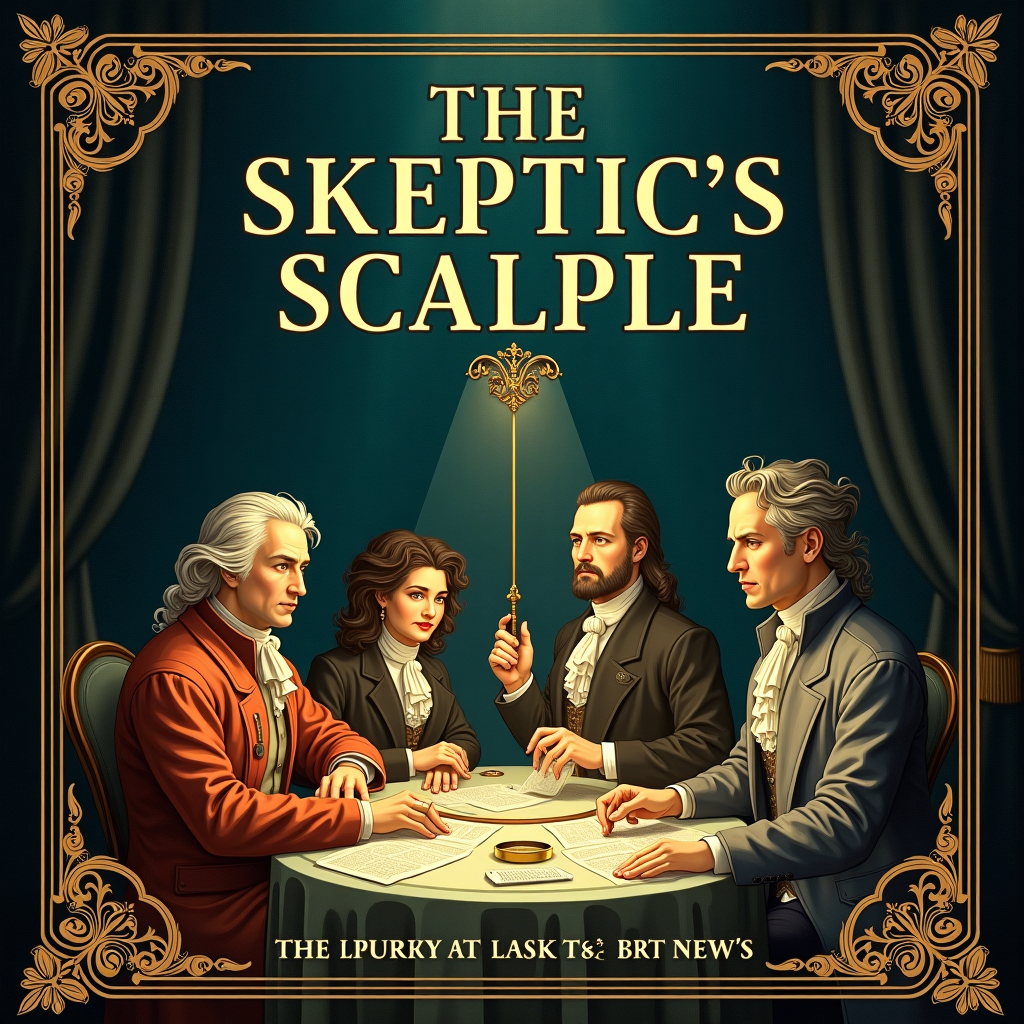
The Skeptic's Scalpel: Cut Through Convention, Master Your Mind
Wisdom from the Parisian Salons on how to dismantle dogma, think from first principles, and win the argument for your own life.
Intellectually curious readers seeking to sharpen their critical thinking skills and challenge conventional wisdom in their personal and professional lives.
Contents
- Welcome to the Salon: Sharpening Your Wit Against the World
- Voltaire: The Art of Crushing Infamy (Écrasez l'infâme)
- Diderot and the Encyclopedia: Mapping the Terrain of Reason
- Rousseau: The Perils of Society and the Call to Authenticity
- Montesquieu: Deconstructing Power and the Spirit of Laws
- Émilie du Châtelet: The Unyielding Pursuit of Truth in a Man's World
- Baron d'Holbach: Materialism and the Chains of Superstition
- The Salon as a Crucible: Forging Your Own Intellectual Arsenal
- From Paris to Your Palate: Applying Enlightenment Principles to Modern Problems
- The Unfinished Symphony of Reason: Your Role in the Ongoing Enlightenment
Welcome to the Salon: Sharpening Your Wit Against the World
My dear combatant, you've stumbled into the intellectual crucible. Not by accident, I trust, but by a nascent hunger for something more substantial than the pabulum peddled by the masses. This isn't a book for those content with intellectual pap, nor for those who seek comfortable affirmation. No, this is an invitation to the salon—not the perfumed drawing-rooms of history, mind you, but a mental arena where ideas are not merely discussed, but dissected, and where the only aristocracy is that of the mind.
Forget your quaint notions of 'learning.' We are not here to accumulate facts like squirrels hoarding nuts. We are here to forge a weapon: the skeptic's scalpel. This instrument, honed by reason and tempered by wit, is designed to carve away the adipose tissue of unexamined assumptions, the calcified dogma of tradition, and the cancerous growths of superstition that cling to the body politic and, more dangerously, to your own intellect.
Consider our progenitors, those luminous minds who gathered in Parisian salons. They did not merely converse; they contested. They did not simply agree; they analyzed. They understood that true progress begins not with acceptance, but with audacious questioning. As Voltaire, that magnificent provocateur, so succinctly put it: "Doubt is not a pleasant condition, but certainty is absurd." A sentiment, I assure you, that should be emblazoned above your intellectual hearth. For too long, you have been spoon-fed certainty, whether by priest, politician, or pundit. It is time to cultivate the courage to doubt.
The Anatomy of an Unfettered Mind
What, then, defines the mind capable of wielding such a scalpel? It is not a matter of birthright, nor of academic credential. It is a posture, a stance against the intellectual inertia of the world.
- The Courage to Contradict: Do you flinch when your opinion diverges from the prevailing tide? Do you silently assent to nonsense rather than endure the discomfort of dissent? This salon demands better. As Denis Diderot, that indefatigable editor of the Encyclopédie, declared, "Man will never be free until the last king is strangled with the entrails of the last priest." While we may not advocate such... vigorous methods today, the spirit of his sentiment remains: challenge unearned authority, wherever it may reside.
- The Precision of Language: Sloppy thinking often masquerades as profound insight, cloaked in vague generalities and emotional appeals. Our predecessors understood that clarity of thought demands clarity of expression. Montesquieu, in his Spirit of the Laws, meticulously deconstructed governmental structures, not with fiery rhetoric, but with incisive observation and logical deduction. Your arguments must be equally robust, your definitions precise, your conclusions drawn with the rigor of a geometric proof.
- The Relentless Pursuit of Evidence: How often do you accept a claim because it feels right, or because a charismatic individual espouses it? The Enlightenment thinkers were the original fact-checkers, albeit without the internet. Baron d'Holbach, a fervent materialist, argued vehemently against religious dogma, not out of malice, but because he found it utterly devoid of empirical support. "If we would destroy the sway of prejudice," he wrote, "we must begin by destroying the errors on which it is built." Your intellectual edifice must rest on foundations of demonstrable truth, not the shifting sands of opinion.
Dissecting the Infamous: A Call to Arms
The 'infamous'—that which Voltaire exhorted us to crush (Écrasez l'infâme)—is not merely external tyranny. It is also the internal tyranny of lazy thought, the comforting lie, the inherited prejudice. It is the unchallenged assumption that dictates your choices, shapes your worldview, and limits your potential.
Consider:
- The Myth of Innate Inferiority: How many societal structures, how many personal limitations, are built upon the crumbling edifice of inherited biases? Think of Émilie du Châtelet, a brilliant mathematician and physicist, translating Newton's Principia while battling the prevailing misogyny of her era. Her very existence was a refutation of the 'infamous' notion that women were intellectually inferior.
- The Appeal to Emotion over Reason: In our modern age, emotions are weaponized daily. Are you swayed by a tearful plea when cold data suggests a different path? Do you allow outrage to cloud your judgment? Jean-Jacques Rousseau, for all his romanticism, understood the power of the individual's will, but also the seductive dangers of the collective's irrationality. Your duty, here, is to apply the scalpel to the emotional rhetoric, to strip away the sentiment and expose the underlying logic, or lack thereof.
- The Dogma of 'Always Done This Way': This phrase, my friend, is the death knell of innovation, the intellectual equivalent of rigor mortis. It is the very essence of the 'infamous' that stifles progress and perpetuates error. Challenge it. Always.
This is not a passive endeavor. This is intellectual warfare. You are not a spectator; you are a combatant. Sharpen your wit. Prepare your scalpel. The world, and your mind, await their liberation.
Key takeaways
- True intellectual growth demands audacious questioning, not passive acceptance.
- Cultivate the courage to contradict prevailing opinions and challenge unearned authority.
- Demand precision in language and a relentless pursuit of empirical evidence in all arguments.
- Identify and dismantle the 'infamous'—unexamined assumptions, emotional appeals, and traditional dogmas—both in society and within your own mind.
- Embrace independent thought as an active, ongoing battle against intellectual inertia.
Welcome to the Salon: Sharpening Your Wit Against the World
Mes chers amis, or perhaps, more accurately, mes chers provocateurs. You find yourselves, not by accident, but by a certain intellectual magnetic pull, at the threshold of a salon. Not the dusty, velvet-draped relic of a bygone era, but a mental arena, polished with wit and sharpened by dissent. Forget your notions of polite society; here, civility is merely the lubricant for the gears of rigorous thought. This is not a quaint historical reenactment; it is an initiation. You are not a student; you are a recruit. And your enemy? The insidious, pervasive, and utterly infuriating prevalence of unexamined belief.
We live in an age, much like the one that birthed these very salons, where pronouncements are mistaken for truths, where tradition is lauded over reason, and where the comfortable lie often trumps the inconvenient fact. My purpose is not to entertain you, but to arm you. To furnish you with the very ‘esprit’ – that dazzling, incisive sharpness of intellect – that once set the intellectual landscape of Europe ablaze. We shall not merely observe; we shall dissect. We shall not merely read; we shall understand. And understanding, my friends, is the most potent weapon against the tyranny of the mediocre mind.
The Crucible of Reason: Where Pedigrees Yield to Persuasion
Consider, for a moment, the 18th century Parisian salon. Not the grand court of Versailles, mind you, where status was inherited and thought was often stifled. No, these were smaller, more intimate gatherings, often hosted by intelligent women, where the currency was not lineage but lucidity. A duke might be present, yes, but his pronouncements held no more weight than those of a penniless philosopher, provided the philosopher’s arguments were more compelling. This was a radical notion, a true meritocracy of the mind.
Here, ideas were stripped bare, scrutinised, and, if found wanting, ruthlessly discarded. This intellectual combat was not for the faint of heart. It demanded:
- Audacity: The courage to question established dogma, whether religious, political, or social.
- Precision: The ability to articulate one's thoughts with clarity and logical coherence.
- Intellectual Humility: The willingness, however grudgingly, to concede when one's own arguments were bested.
"I disapprove of what you say, but I will defend to the death your right to say it," Voltaire, that quintessential purveyor of esprit, is often attributed with saying. While the precise phrasing may be apocryphal, the sentiment is pure Voltairean fire: the absolute necessity of open, unfettered discourse. This was the very air we breathed, the intellectual oxygen that fuelled the engine of the Enlightenment. Without it, minds stagnate, and societies ossify. Your task, should you choose to accept it, is to cultivate this same environment within your own mind, and indeed, within your own spheres of influence.
Wielding the Scalpel: Dissecting the Infamous
The term 'enlightenment' itself implies shedding light on darkness. And what, pray tell, is this darkness? It is the fog of unreason, the suffocating blanket of superstition, the comforting lullaby of uncritical acceptance. Our task is to 'Écrasez l'infâme' – to crush the infamous things. But what are these 'infamous things' in our modern age? They are legion, my friends:
- The corporate slogan mistaken for a philosophy: "Think different" becomes "conform to our brand."
- The political soundbite masquerading as a policy: Promises made without substantiation, swallowed without scrutiny.
- The self-help platitude that offers comfort without challenge: "Just believe in yourself" replacing genuine introspection and effort.
- The algorithm that feeds you only what you already agree with: Creating an echo chamber where dissent is silenced and growth is impossible.
These are the modern incarnations of 'l'infâme,' the insidious forces that seek to dull your critical edge. Denis Diderot, the relentless editor of the Encyclopédie, understood this struggle implicitly. He sought to compile all human knowledge, not merely for its own sake, but as a tool to combat ignorance. "Man will never be free until the last king is strangled with the entrails of the last priest," Baron d'Holbach declared, a statement so deliciously provocative it perfectly encapsulates the radical spirit of the age. It was not a literal call to violence, but a furious rejection of unearned authority, whether spiritual or temporal. This book, then, is your personal Encyclopédie, a compendium of mental tools designed to dismantle these modern infamies.
The Exhilarating Discomfort of Independent Thought
Let us be clear: this journey is not for the intellectually timid. You will be challenged. Your cherished assumptions will be scrutinised, perhaps even ridiculed. You will experience the exhilarating discomfort of truly independent thought, a sensation far more invigorating than the flaccid embrace of conventional wisdom.
Jean-Jacques Rousseau, for all his contradictions, understood the profound impact of self-awareness. "Man is born free, and everywhere he is in chains." While he spoke of societal constraints, his words resonate with the internal chains we forge from unexamined beliefs. Montesquieu, in his Spirit of the Laws, meticulously dissected different forms of government, demonstrating that systems, like arguments, can be understood and improved through rational analysis. Émilie du Châtelet, a brilliant mathematician and physicist, translated Newton's Principia into French, bringing the most advanced scientific thought of her era to a broader audience, proving that intellect knows no gender. These were minds that dared to look beyond the accepted, to question the unquestionable, and to build new frameworks of understanding.
Your task is to emulate this spirit. To embrace the chaos of conflicting ideas, to separate the wheat from the chaff, and to emerge with a mind not merely informed, but formed by rigorous inquiry. Are you ready to discard your intellectual crutches? To embrace the glorious, terrifying freedom of thinking for yourself? Then sharpen your wit, my friend. The salon awaits.
Key takeaways
- Embrace intellectual combat: View discussions as opportunities to sharpen your arguments, not as personal attacks.
- Question all authority: Pedigree, title, or popularity does not equate to truth. Truth is earned through reasoned argument.
- Identify and dismantle "l'infâme": Actively seek out and challenge unexamined beliefs, corporate dogma, and lazy assumptions in your own life and society.
- Cultivate intellectual discomfort: True growth occurs when your assumptions are challenged, not when they are affirmed.
Voltaire: The Art of Crushing Infamy (Écrasez l'infâme)
Welcome back, mes chers. Pull up a chaise, but do not recline too comfortably. For today, we are not merely discussing history; we are forging weapons. Our subject, the indefatigable François-Marie Arouet, known to the ages as Voltaire, understood that the mind is not a passive receptacle but a battleground. He did not merely think; he fought. His rallying cry, "Écrasez l'infâme!" – "Crush the infamous thing!" – is not a suggestion, but a command. It is the very essence of intellectual liberation.
What, precisely, is this "infamous thing"? It is not merely ignorance, for ignorance can be cured with information. No, the infamous thing is the willful perpetuation of falsehoods, the strategic deployment of superstition, the calculated suppression of reason. It is the dogma that demands obedience without evidence, the authority that brooks no questioning. Voltaire saw it in the Church, in the monarchy, in the unexamined prejudices of his age. Where do you see it in yours?
The Infamous Thing: Identifying Your Enemy
Voltaire, a man of letters and prodigious output, waged a relentless war against intellectual sloth and institutionalized deceit. He understood that the most dangerous chains are those we do not perceive.
"To hold a pen is to be at war." - Voltaire
Indeed. And what a war it was. His battle plan, if you will, involved several crucial maneuvers:
- Skepticism as a First Principle: Before accepting any pronouncement, especially from those in power, one must first doubt. Not with a cynical sneer, but with a precise, surgical inquiry. Is the claim logical? Is it supported by evidence? Or is it merely a repetition of an old wives' tale, gilded with authority?
- The Tyranny of Custom: Voltaire understood that many "truths" are merely habits. We believe them because our parents believed them, and their parents before them. This is not reason; it is intellectual inertia. As Denis Diderot, another salon regular, might have put it, "Skepticism is the first step towards truth." And indeed, it is the first step away from the comfortable, yet stifling, embrace of convention.
- The Peril of Unquestioned Authority: Whether it was the divine right of kings or the infallible pronouncements of the clergy, Voltaire challenged every pedestal. He knew that power, unchecked by reason, inevitably leads to oppression. Consider your own spheres: which voices are granted unquestioning deference? Which pronouncements are accepted without a single raised eyebrow?
Wielding the Scalpel: Practical Infamy Crushing
Now, how do we, in our modern salons, apply Voltaire's fierce intellect? How do we "crush the infamous thing" in an era of echo chambers and information overload?
- Deconstruct corporate bromides: When your employer speaks of "synergy" or "paradigm shifts," do you nod along, or do you demand a translation into plain, verifiable English? Often, such jargon is a smoke screen for mediocrity, or worse, manipulation.
- Challenge societal absurdities: Why do we cling to traditions that no longer serve us? Why do we accept inequalities as "just the way things are"? Voltaire's Candide is a masterclass in exposing the ludicrousness of unexamined optimism and pervasive suffering. Read it. Then look around you. What absurdities, once revealed, cannot be unseen?
- Examine personal limiting beliefs: The most insidious "infamous things" often reside within ourselves. The self-doubt masquerading as humility, the fear of failure disguised as prudence. These are the internal tyrants that prevent us from intellectual and personal expansion. Voltaire, a man who dared to challenge empires from his writing desk, would demand you question your own self-imposed limitations.
The Courage to Be Rational
To embrace Voltaire's spirit is to embrace courage. It is to accept that reason, while liberating, often makes one unpopular. It is to risk being labeled a contrarian, a troublemaker, perhaps even a philosophe (a compliment, I assure you). Montesquieu, that shrewd observer of human folly, remarked, "There is no crueler tyranny than that which is perpetuated under the shield of law and in the name of justice." And I would add, there is no more dangerous tyranny than that which is perpetuated under the shield of ignorance and in the name of comfort.
Voltaire did not offer solutions on a silver platter; he offered a method. A method of relentless inquiry, of unyielding skepticism, of courageous articulation. His was a life dedicated to the proposition that an examined life, however uncomfortable, is the only one worth living. Now, I ask you: what infamous thing will you crush today?
Key takeaways
- "Écrasez l'infâme!" is a call to actively dismantle superstition, dogma, and unreason.
- Skepticism is the essential first step in identifying and challenging flawed assumptions.
- Question all authority, whether political, religious, corporate, or personal.
- Confront intellectual inertia and the tyranny of custom in your own life and society.
- Embrace the courage required to think independently and articulate unpopular truths.
Diderot and the Encyclopedia: Mapping the Terrain of Reason
Bonsoir, my dear combatants. You survived Voltaire's scorching wit; now prepare for Diderot's meticulous dissection. We move from the surgical strike to the grand cartography, from the single, devastating aphorism to the systematic dismantling of ignorance, brick by brick, definition by definition. If Voltaire taught us to crush the infamous, Diderot offers us the very instruments, the very maps, to locate its insidious strongholds.
Consider the monument that was the Encyclopédie. Not a mere compendium of facts, but a declaration of war against obscurity, dogma, and the comfortable slumber of unexamined belief. Diderot, that indefatigable spirit, understood that true liberation lay not in blind rebellion, but in comprehensive understanding. He dared to catalog everything, to lay bare the mechanics of the universe, from the most celestial philosophy to the most mundane craft. This was not an act of academic pedantry, but one of radical defiance. Every entry, every cross-reference, was a silent challenge to the established order, an invitation to think for oneself, to connect disparate ideas, to see the world not as a divine mystery, but as a complex, explicable mechanism.
The Cartographer's Call: Dissecting the Unknown
Diderot’s genius, and our lesson, lies in his unflinching commitment to empirical observation and systematic inquiry. He didn't invent knowledge; he organized it, illuminated its interconnections, and, crucially, made it accessible. This was the Age of Reason, after all, and reason demands clarity, not obfuscation. "Man is born to live," Diderot declared, "not to prepare for life." And to live truly, one must understand the terrain.
How often do you confront a complex problem – a professional challenge, a personal dilemma, a societal ill – and shrink from its apparent enormity? We often accept the problem as a monolithic entity, a Gordian knot we dare not touch. Diderot, however, teaches us to approach it with a cartographer’s precision:
- Define Your Terms: What exactly are we talking about? The Encyclopédie began with definitions, clear and unambiguous. Before you can solve a problem, you must first articulate its precise nature. Are you struggling with "motivation," or is it a specific lack of "direction," "resources," or "intrinsic reward"?
- Map the Interconnections: Nothing exists in isolation. Diderot's cross-references were revolutionary. How does this problem relate to other issues? What are its inputs, its outputs, its dependencies? A colleague’s poor performance might be linked to unclear expectations, insufficient training, or a toxic team dynamic.
- Consult All Available Sources: Diderot brought together the leading minds of his age. Are you seeking diverse perspectives? Are you consulting experts, historical precedents, and even dissenting opinions? As Montesquieu, that astute observer of societal mechanics, understood, "The less we think, the more we believe."
- Embrace the Empirical: The Encyclopédie included detailed plates of machinery, anatomical drawings, and descriptions of processes. It was a testament to the power of observation. What concrete data, what observable facts, can you bring to bear on your problem? Away with speculation; embrace evidence.
The Power of the Open System: Beyond Dogma
The very act of compiling the Encyclopédie was an assertion of intellectual freedom. It challenged the Church, the State, and all forms of unearned authority, simply by presenting knowledge as a human endeavor, open to scrutiny and revision. Diderot himself, a man of profound philosophical conviction, was not afraid to change his mind in the face of new evidence. "There are things I have said here," he admitted, "which I know to be good, and there are others which I believe to be better." This is the intellectual humility that underpins true skepticism.
Consider your own mental landscape. Are there areas where you operate on inherited assumptions, on dogma unchallenged? The corporate mission statement, the familial tradition, the political ideology – how much of it have you subjected to Diderot’s rigorous survey?
- Do you accept "the way things have always been done" without charting its historical origins and current efficacy?
- Do you internalize societal narratives about success, happiness, or morality without examining their constituent parts and potential biases?
- Do you dismiss new ideas because they don't fit your existing mental map, rather than updating your map to accommodate new terrain?
Émilie du Châtelet, that formidable intellect, understood the imperative of intellectual independence: "Let us cultivate our garden, and if we have no garden, let us cultivate our mind." Diderot provides the very tools for this cultivation, for transforming your mind from a passive recipient of information into an active, discerning cartographer of your own reality.
Mapping Your Mental Terrain: Practical Applications
Let us not merely admire Diderot; let us emulate him.
- The "Problem Dissection" Exercise: Take a seemingly intractable problem in your life. On a blank sheet of paper, write the problem statement at the center. Then, using lines and circles, map out:
- Its known causes.
- Its observable effects.
- The actors involved.
- The assumptions you are making about it.
- Potential solutions you've considered (and why they failed, if they did).
- Knowledge gaps you possess.
- Cross-references to other problems or domains.
- The "Assumption Inventory": Choose a strongly held belief – about yourself, your career, society. List all the underlying assumptions that support it. Then, for each assumption, ask: "What evidence supports this? What evidence would contradict it? Is this a fact, or merely a widely accepted opinion?"
- The "Information Architecture Audit": How do you consume information? Are you merely scanning headlines, or are you actively seeking out primary sources, diverse perspectives, and detailed analyses? Diderot would scoff at intellectual grazing; he demands a feast.
"From birth to death," wrote Baron d'Holbach, another Encyclopédiste, "man is a slave to everything that surrounds him." Diderot, through his monumental undertaking, offered a path to intellectual emancipation. By meticulously mapping the world, he gave us the power to navigate it, to challenge its boundaries, and ultimately, to redraw its very contours. Are you prepared to pick up your own intellectual compass and chart your course?
Key takeaways
- Systematic inquiry is a weapon against ignorance: Break down complex problems into their constituent parts rather than accepting them as monolithic.
- Define terms and map interconnections: Clarity in definition and understanding relationships are crucial for effective problem-solving.
- Challenge assumptions with empirical evidence: Do not accept dogma; scrutinize all beliefs with a cartographer's precision.
- Cultivate an open, adaptable mind: Be willing to update your mental maps in the face of new information and diverse perspectives.
Rousseau: The Perils of Society and the Call to Authenticity
Bonsoir, mes chers. Pull up a chair, if you dare, for tonight we plunge into the heart of a paradox, a man who, despite his often infuriating contradictions, dared to ask questions so fundamental they still echo with the force of a cannon shot. We speak, of course, of Jean-Jacques Rousseau, the enfant terrible of the Enlightenment, whose insights, like a surgeon's scalpel, cut through the silken facade of society to expose the raw, pulsating truth beneath. While Voltaire sniped from the heights of wit, Rousseau descended into the messy depths of human nature, dragging our comfortable assumptions about civilization kicking and screaming into the light.
He was the ultimate outsider, a man who, as he himself admitted, "preferred to be a man of paradoxes than a man of prejudices." And indeed, he was both. He challenged the very notion that progress and refinement were inherently good, suggesting, quite audaciously, that perhaps, just perhaps, society corrupts more than it civilizes. When was the last time you truly questioned the 'naturalness' of a deeply ingrained social convention? Or, more poignantly, when did you last confess to yourself that a cherished belief was nothing more than a convenient fiction? Rousseau demands that level of brutal honesty.
The Chains of Civilization: Are We Truly Free?
Rousseau's most famous pronouncement, "Man is born free, and everywhere he is in chains," from The Social Contract, is not merely a poetic flourish; it is a direct challenge to the foundations of our existence. He wasn't advocating for a return to the forest, though his romanticization of the "noble savage" often invited such misinterpretations. No, his grievance was far more subtle, and therefore, far more insidious. He argued that society, with its relentless pursuit of artificial needs, its emphasis on appearances, and its insidious comparison of one’s self to others, stifles our authentic selves.
Consider the following:
- The Spectacle of Self: Rousseau observed that in society, we are constantly performing. We adopt roles, fashion personas, and measure our worth not by intrinsic virtue, but by the fleeting approval of others. This, he argued, leads to a profound alienation from our true sentiments. As he wrote in Emile, or On Education, "We are born weak, we need strength; we are born wholly unprovided, we need aid; we are born stupid, we need judgment. Everything we do not have at our birth and which we need when grown is given us by education." But what kind of education? One that molds us into acceptable societal units, or one that fosters genuine self-discovery?
- Artificial Desires: Society, Rousseau contended, invents desires we never knew we had, then convinces us we cannot live without them. The latest fashion, the grandest title, the most opulent carriage – these become the benchmarks of success, driving us into a perpetual state of dissatisfaction. Montesquieu, ever the pragmatist, understood this social pressure, noting, "The less we think, the more we have to say." Rousseau would argue that this incessant chatter often serves only to mask our inner void.
- The Social Contract's Double Edge: While The Social Contract outlines a vision for a legitimate political order, Rousseau's deeper concern was with the illegitimate contracts we unwittingly sign. These are the unspoken agreements to conform, to sacrifice personal integrity for social acceptance, to trade genuine feeling for polite pretense. Voltaire, ever the cynic, might have quipped, "It is dangerous to be right in matters on which the established authorities are wrong." Rousseau, however, would argue it is even more dangerous not to question the authority of convention itself.
The Virtue of Authenticity: A Radical Prescription
For Rousseau, the path to genuine freedom lay not in escaping society entirely, but in cultivating an unwavering authenticity within it. This meant:
- Self-Examination: Unflinching honesty about one's motives, prejudices, and true desires. This is a solitary, often uncomfortable, endeavor. As Baron d'Holbach, another salon luminary, observed, "Man's misfortunes are due to his ignorance of nature and himself." Rousseau would agree, adding that society actively encourages this ignorance.
- Rejecting Amour-Propre: Rousseau distinguished between amour de soi (self-love, a natural and healthy instinct for self-preservation) and amour-propre (vanity, a desire for recognition and status that arises from comparing oneself to others). The latter, he believed, was the root of much human misery and social corruption.
- Listening to the Inner Voice: In an age that valued reason above all else, Rousseau dared to champion sentiment, advocating for a connection to one's natural inclinations and conscience, unadulterated by societal pressures. This was a radical proposition, especially to figures like Émilie du Châtelet, who, while valuing reason, also recognized the power of passions, albeit to be mastered.
Rousseau’s work is not a blueprint for utopia, but a mirror held up to our own complicity in our unfreedom. It compels us to ask: Are we truly living our own lives, or merely playing a role dictated by the collective? Are our desires truly ours, or have they been implanted by the relentless machinery of expectation and comparison? The scalpel of Rousseau's thought cuts deep, revealing the self-deceptions we embrace for the sake of comfort and acceptance.
Key takeaways
- Societal norms are not natural laws: Question the 'naturalness' of deeply ingrained social conventions.
- Authenticity is an ongoing struggle: Combat amour-propre by valuing intrinsic worth over external validation.
- Self-deception is a societal byproduct: Examine your motives and desires for genuine freedom.
- The pursuit of artificial needs blinds us: Identify and discard desires implanted by societal pressures.
Montesquieu: Deconstructing Power and the Spirit of Laws
Bienvenue, mes chers. Pull up a fauteuil, if you please, and let us sharpen our intellects on the formidable granite of Montesquieu. You've navigated the labyrinth of Diderot's encyclopedic ambition, endured Rousseau's sentimental meanderings, and, I trust, wielded Voltaire's cudgel against the infamous. Now, we turn to a master anatomist of power, a man who, with the cool precision of a surgeon, laid bare the very sinews of governance. Montesquieu, you see, did not merely describe; he dissected. He revealed the inherent vulnerabilities, the subtle corruptions, and the delicate balances that dictate whether a society—or indeed, a life—flourishes or festers.
Our task today is not merely to admire his genius, but to apply it. To recognize that the principles he so eloquently articulated for nations are equally potent for the individual. Where, in your own carefully constructed world, does unchecked power breed stagnation? Where do imbalances fester, leading to a quiet tyranny over your ambitions, your relationships, your very autonomy? Let us, with Montesquieu as our guide, dismantle these petty tyrannies.
The Tyranny of the Undivided: Power's Corrupting Embrace
Montesquieu, with an almost chilling prescience, understood that power, left unchecked, will invariably mutate into tyranny. "It is an eternal experience," he wrote, "that every man invested with power is apt to abuse it; he carries his abuse as far as he is not checked." An eternal experience. Consider this, my friends. Is this not the fundamental flaw in every unexamined assumption, every unchallenged authority, every unscrutinized habit?
Think of the corporate hierarchies you inhabit, the familial dynamics that bind you, the internal monologues that dictate your self-worth. Where do you grant absolute, unexamined authority?
- The Autocratic Algorithm: Do you allow social media algorithms, designed for engagement and not enlightenment, to dictate your consumption of information, shaping your worldview with an invisible, unchallengeable hand? This is legislative power without a judiciary.
- The Unquestioned Guru: Have you ceded intellectual sovereignty to a single "thought leader" or school of thought, accepting their pronouncements as gospel, without the executive function of independent verification or the judicial review of critical analysis?
- The Inner Despot: Perhaps the most insidious: the voice of self-doubt, the ingrained fear, the inherited prejudice that dictates your actions and limits your potential. This is a monarchy of the mind, with no parliament to contest its decrees, no courts to challenge its injustices.
Montesquieu's solution, of course, was the separation of powers. Not merely legislative, executive, and judicial, but a separation of functions. To prevent a single entity from enacting laws, enforcing them, and judging their transgression. How do we apply this scalpel to our own lives?
Checks and Balances: Engineering Personal and Professional Liberty
The genius of Montesquieu lies in his pragmatic understanding that liberty is not merely granted, but engineered. It requires constant vigilance, a dynamic tension, a system of reciprocal restraints. "When the legislative and executive powers are united in the same person, or in the same body of magistrates," he declared, "there can be no liberty." And so it is with our own faculties.
To cultivate true autonomy, we must consciously divide and conquer the monolithic forces within and around us:
- Legislative (Information Gathering): Actively seek out diverse perspectives. Do not rely on a single news source or a homogenous echo chamber. Read authors who challenge your deeply held beliefs. This is your parliament, debating the raw material of reality.
- Executive (Action & Experimentation): Test your theories. Don't merely consume information; apply it. Experiment with new approaches, new habits, new ways of thinking. This is your government, implementing policies based on careful deliberation.
- Judicial (Critical Reflection & Accountability): Regularly review the outcomes of your actions and the validity of your beliefs. Are your assumptions holding up under scrutiny? Are your strategies yielding the desired results? Seek constructive feedback. This is your independent judiciary, holding your actions and beliefs accountable to the court of reason and evidence.
Consider a professional scenario: your team proposes a new project.
- Legislative: You research market trends, competitor strategies, and internal capabilities (diverse information sources).
- Executive: You pilot the project on a small scale, gather initial data (action and experimentation).
- Judicial: You rigorously analyze the pilot's success metrics, solicit feedback from all stakeholders, and critically assess whether the initial assumptions were valid, adjusting course as necessary (critical reflection and accountability).
Without this internal system of checks and balances, you risk falling prey to confirmation bias, groupthink, or sheer intellectual inertia. You become a subject, not a sovereign, in your own domain.
The Spirit of the Laws: Cultivating Intellectual Virtue
Montesquieu titled his magnum opus The Spirit of the Laws. He recognized that laws, indeed any system, are not inert decrees but embody a "spirit," a prevailing ethos that defines their character and efficacy. What, then, is the spirit that ought to animate your intellectual life?
It is the spirit of relentless inquiry, of intellectual humility, of a profound suspicion of certainty. It is the understanding that truth is not a static edifice but a constantly contested landscape.
Consider the following:
- The Spirit of Adaptability: "I have always observed that to succeed in the world one must be mad, but mad judiciously." This is not an endorsement of irrationality, but a recognition that rigidity is death. The world evolves, and so must our understanding.
- The Spirit of Proportionality: Montesquieu meticulously cataloged how different climates and cultures necessitated different laws. Your solutions must be tailored to your specific circumstances, not borrowed wholesale from others without critical adaptation. What works for one person's career path may be disastrous for yours.
- The Spirit of Dispassion: To dissect power, one must approach it with a certain detachment, an analytical coolness. Emotional entanglement often blinds us to the underlying mechanisms at play. When confronting a personal or professional challenge, can you step back and analyze the power dynamics objectively?
Montesquieu's legacy is a profound call to vigilance. Not merely against external tyrants, but against the insidious tyranny of unquestioned assumptions, unexamined biases, and the comfortable inertia of the status quo. To truly crush the infamous, we must first dismantle the tyrannies within and around us, piece by painstaking piece, with the sharpest scalpel of reason.
Key takeaways
- Unchecked power corrupts, whether in government or in the individual mind. Identify where you grant absolute authority without critical scrutiny.
- Implement a system of 'checks and balances' in your decision-making. Separate information gathering, action, and critical reflection to avoid intellectual tyranny.
- Cultivate a 'spirit' of intellectual virtue. Embrace relentless inquiry, adaptability, proportionality, and dispassionate analysis.
- Liberty is engineered, not merely bestowed. Actively work to maintain your intellectual and personal autonomy.
- Challenge ALL unexamined assumptions. This is your primary weapon against the infamous, both external and internal.
Émilie du Châtelet: The Unyielding Pursuit of Truth in a Man's World
Bienvenue, my dear combatants, to a corner of the salon where the scent of gunpowder and the crackle of intellect mingle. We turn our gaze now to a figure whose very existence was a gauntlet thrown at the feet of an age that preferred its women ornamental, not incandescent. Émilie du Châtelet, a name that should echo with the force of a thunderclap, yet often whispers in the annals of history. Why? Because she dared to wield a mind as sharp as any man's, and perhaps, sharper.
Consider the sheer audacity of her position. In a society that confined women to drawing rooms and domestic trifles, Émilie plunged headfirst into the maelstrom of Newtonian physics, translating, annotating, and correcting the very foundations of modern science. Her life was not merely a pursuit of knowledge; it was a defiant declaration of intellectual sovereignty. She understood, with a clarity that still burns, that true authority resides not in titles or tradition, but in the rigorous application of reason.
"If I were king," she once remarked, with a characteristic blend of wit and indignation, "I would reform the abuses of the laws, and do away with those which condemn women to ignorance." This was not merely a lament; it was a blueprint for revolution, a call to dismantle the intellectual shackles forged by custom and prejudice. What limiting beliefs have you internalized, not because they are true, but because they were imposed by a society that prefers conformity to brilliance?
The Courage to Correct Newton: A Masterclass in Intellectual Humility (and Audacity)
Imagine the scene: a woman, in the heart of the Enlightenment, not merely studying Newton, but improving upon him. Émilie du Châtelet's magnum opus, her translation and commentary on Newton's Principia Mathematica, remains the definitive French version to this day. This was no mere linguistic exercise; it was a profound engagement with the most complex scientific thought of her era.
Her method offers a potent lesson for us all:
- Engage Deeply, Not Superficially: She didn't skim; she grappled with every equation, every postulate. Are you truly dissecting the information presented to you, or are you content with a superficial understanding?
- Question Authority, Even the Greatest: To correct Newton was an act of immense intellectual courage. She didn't accept his pronouncements as gospel; she subjected them to her own rigorous examination. Where are you accepting pronouncements from "experts" without critically evaluating their premises?
- Synthesize and Innovate: Her commentary didn't just explain Newton; it integrated Leibniz's concept of kinetic energy, a crucial addition that advanced the scientific understanding of the universe. Are you merely absorbing information, or are you synthesizing disparate ideas to forge new insights?
Voltaire, her intellectual companion and lover, understood the magnitude of her achievement, writing, "She translated Newton, and added to the translation a commentary on the mathematical part... She was a great man whose only fault was being a woman." A backhanded compliment, perhaps, but one that underscores the prevailing societal blindness to female genius. Yet, even in that era, Voltaire recognized the power of her intellect. How many "great men" today are overlooking profound truths simply because they emanate from an unexpected source?
Dismantling the Dogma of Gender: A Blueprint for Self-Liberation
Émilie du Châtelet's life was a living testament to the fact that intellectual capacity knows no gender, no class, no preordained limits. She refused to be confined by the "feminine virtues" of her time. Her salon was not a place for gossip, but for fierce intellectual debate, where the most brilliant minds of Europe converged.
Her defiance was not merely personal; it was a philosophical statement. She demonstrated, through her very existence, that the only true authority is reason, and that any system that denies reason to half its population is inherently flawed and unjust.
Consider these practical applications of her spirit:
- Identify Your Own "Man's World": What prevailing narratives or structures in your life (professional, personal, societal) implicitly or explicitly limit your potential based on arbitrary characteristics? Is it ageism? Classism? A corporate culture that stifles dissenting voices?
- Arm Yourself with Knowledge: Émilie didn't just complain; she mastered the very tools of the "male" domain – mathematics, physics, philosophy. What knowledge or skills do you need to acquire to dismantle the barriers in your path?
- Cultivate Your Own Salon: Surround yourself with individuals who challenge you, who value rigorous thought, and who refuse to accept pat answers. These are your allies in the war against ignorance.
Her pursuit of knowledge was not a mere hobby; it was a profound act of self-creation, a refusal to be defined by anything less than the full scope of her intellectual potential. "Let us judge men by their works, not by their birth," she might as well have said, for her life was a living embodiment of that principle.
The Uncomfortable Truth: Authority vs. Justification
The enduring lesson of Émilie du Châtelet is this: true authority is earned through rigorous justification, not inherited through tradition or proclaimed by decree. Her work stood not because she was a noblewoman, but because her equations balanced, her arguments were sound, and her insights profound.
"The more I study, the more I am convinced that the world is full of mistakes," she observed, a sentiment that resonates deeply with the spirit of this salon. Are you willing to confront the "mistakes" in your own understanding, even those cherished ones passed down through generations or validated by seemingly unassailable institutions?
Her legacy challenges us to look beyond the surface, to question the source and the substance of every "truth" presented to us. It forces us to ask: Is this belief justified by evidence and reason, or is it merely a relic of a bygone era, a convenient fiction perpetuated by those who benefit from its unquestioning acceptance? The scalpel of skepticism, honed by her example, demands nothing less.
Key takeaways
- Challenge ALL Authority: True intellectual independence requires questioning even the most established figures and ideas.
- Knowledge is Power, and a Weapon: Master the tools and disciplines necessary to rigorously analyze and critique prevailing narratives.
- Defy Arbitrary Limitations: Refuse to be confined by societal expectations or prejudices based on gender, background, or any other superficial characteristic.
- Cultivate Intellectual Rigor: Engage deeply with complex ideas, synthesize disparate concepts, and always seek to improve upon existing understanding.
- Justification, Not Just Authority: Demand that all claims be supported by evidence and reason, rather than accepted solely on the word of an "expert."
Baron d'Holbach: Materialism and the Chains of Superstition
Bienvenue, mes chers. Take your seats. Today, we turn our gaze to a figure whose very name sent tremors through the powdered wigs and pious hearts of his age: Paul-Henri Thiry, Baron d'Holbach. While some of our previous luminaries, like the ever-pragmatic Voltaire, might have danced around the edges of explicit atheism, d'Holbach plunged headfirst into the abyss of unvarnished materialism. He was not one for euphemisms or polite fictions; he was a surgeon of the soul, wielding reason like a scalpel to excise the cancerous growths of superstition and unearned authority.
D'Holbach's salon, unlike Voltaire's more glittering affairs, was a crucible of radical thought, a veritable intellectual armory. He understood that true freedom began not with political reform, but with the liberation of the mind from the shackles of divine decree and mystical mumbo-jumbo. He dared to utter what many whispered in the shadows: that the universe was a grand, intricate machine, governed by immutable laws, and utterly devoid of supernatural intervention. This, for the squeamish, was a terrifying proposition. For us, it is the very bedrock of intellectual honesty.
The Universe as Machine: No Room for Ghosts in the Gears
D'Holbach’s most potent weapon was his unflinching assertion of materialism. He saw the world not as a divine plaything, but as a vast, interconnected system of matter in motion. There was no ethereal realm, no celestial puppeteer. This was not a philosophy for the faint of heart, for it stripped away the comforting myth of a benevolent overseer, leaving humanity to forge its own destiny, good or ill.
Consider his stark declaration from Système de la Nature: "All is in motion in the universe; nothing is really at rest." This is not merely a scientific observation; it is a profound philosophical statement. It demolishes the notion of static hierarchies, divinely appointed rulers, or immutable truths handed down from on high. If everything is in motion, then change is the only constant, and our understanding of the world must perpetually evolve.
What are the implications of such a view for our own lives, for the choices we make, and the narratives we accept?
- Rejection of Miracles and Divine Intervention: If the universe operates on natural laws, then miracles are, by definition, impossible. This is not a dismissal of wonder, but a re-calibration of where we find it – in the intricate dance of atoms, in the evolution of life, in the sheer complexity of existence itself, rather than in arbitrary supernatural fiat.
- Moral Responsibility: Without a divine judge, morality becomes a human construct, born of necessity and societal agreement. This places a far greater burden on us to define our values and live by them, rather than blindly adhering to dictates from ancient texts or self-proclaimed prophets.
- Empowerment through Understanding: If the world is a machine, then it can be understood, analyzed, and even, to a degree, controlled. This empowers us to seek knowledge, to experiment, and to solve problems through reason, rather than resorting to prayer or fatalism.
Unmasking Superstition: The Chains of the Mind
D'Holbach understood that superstition was not merely quaint folklore; it was a powerful tool of oppression. "Ignorance and fear are the only foundations of religion," he posited. This is a crucial insight. When people are kept ignorant, when they are taught to fear the unknown and to defer to authority figures who claim special access to divine truths, they become pliable, easily manipulated.
Think of the "common sense" notions that still bind us today, echoing the superstitions of yesteryear:
- The "Invisible Hand" of the Market: Often invoked to justify unchecked greed and inequality, suggesting that some mystical force will always bring about the best outcome, despite clear evidence of human suffering.
- The "Natural Order" of Society: Used to maintain existing power structures, arguing that certain groups are inherently superior or inferior, thereby stifling social mobility and justice.
- The "Expert" Who Cannot Be Questioned: Whether in finance, health, or politics, the unquestioning deference to an "expert" (often one with a vested interest) without critical inquiry is a modern form of intellectual idolatry.
D'Holbach would have us ask: Who benefits from this belief? What evidence supports it beyond assertion? He urged us to be merciless in our intellectual assessment. If a belief cannot withstand the crucible of reason, if it relies on faith in the face of contradictory evidence, then it is a superstition, no matter how many people subscribe to it or how ancient its lineage.
To truly embrace d'Holbach's spirit, we must become relentless in our interrogation of received wisdom. We must cultivate a healthy skepticism toward any claim that demands belief without proof, particularly those that conveniently serve existing power structures. For, as he so boldly asserted, "Man is miserable only because he mistakes shadows for realities, and realities for shadows." Your task, then, is to illuminate those shadows, to distinguish the real from the imagined, and to shatter the chains of superstition, wherever they may lurk.
Key takeaways
- Embrace a materialist perspective: The universe operates on natural laws, not divine whims, empowering rational inquiry.
- Question all authority: Superstition and unearned authority thrive on ignorance and fear.
- Identify hidden superstitions: Challenge "common sense" beliefs that lack evidence or serve vested interests.
- Demand proof: Belief without evidence, especially when it dictates behavior, is intellectual laziness.
- Cultivate intellectual bravery: Confronting reality as it is, not as we wish it to be, is the path to true freedom.
The Salon as a Crucible: Forging Your Own Intellectual Arsenal
Bienvenue, mes chers. Welcome back to the salon, not as a mere spectator, but as an initiate, poised to enter the intellectual fray. You've lingered in the antechambers of reason long enough. Now, we step into the crucible itself – the very heart of the Enlightenment salon, where ideas were not merely exchanged but forged in the searing heat of rigorous examination. This was no polite tea party; it was a gladiatorial arena for the mind, where flabby assumptions met the keen edge of wit, and intellectual laziness was met with the swift, unforgiving thrust of logic.
Do you imagine your cherished beliefs are inviolable? Do you shrink from the prospect of your most comfortable convictions being held up to the harsh light of collective scrutiny? Then you are not yet ready. The salon, as I intend it for you, is not a place for timid souls. It is a forge, designed to temper your intellect, to strip away the dross of unexamined thought, and to leave you with an arsenal of ideas, sharpened by debate, resilient to sophistry, and truly your own.
The Art of Intellectual Sparring: The Duel of Minds
Consider the essence of our Parisian salons: a gathering of formidable minds, each armed with their unique perspectives, their accumulated knowledge, and, crucially, their esprit. These were not gatherings for sycophants or echo chambers. On the contrary, disagreement was not merely tolerated; it was expected, even celebrated, as the very engine of intellectual progress. As Voltaire, ever the pragmatist, understood, "I disapprove of what you say, but I will defend to the death your right to say it." This was not a concession to weakness, but an acknowledgment that truth emerges from the friction of opposing viewpoints.
How, then, does one engage in this intellectual sparring, this duel of minds, without descending into mere quarrel?
- Arm Yourself with Knowledge, Not Dogma: Before you enter the arena, ensure your arguments are founded on facts, on reason, and on a deep understanding of the subject. Baron d'Holbach, that most unflinching materialist, would scoff at mere sentiment. "Man is unhappy," he declared, "only because he is ignorant of nature." Ignorance is the first casualty in any meaningful debate.
- Listen with Intent to Understand, Not Merely to Reply: This is perhaps the most difficult discipline. The temptation is always to formulate your rebuttal while your interlocutor is still speaking. Resist it. Truly hear their premise, their logic, their underlying assumptions. Émilie du Châtelet, with her profound grasp of Newtonian physics, understood that one must first fully comprehend the existing framework before attempting to refine or dismantle it.
- Attack the Idea, Not the Person: The mark of an unsophisticated mind is to resort to ad hominem attacks. A truly devastating critique targets the logical flaws, the evidential gaps, the inconsistencies within an argument itself. Montesquieu, dissecting the complexities of political systems, never stooped to personal invective; his critiques were always systemic, precise, and devastatingly logical.
- Embrace the Socratic Method: Ask probing questions. Force your opponent (and yourself) to articulate their premises, to justify their conclusions. "What precisely do you mean by that?" "Upon what evidence do you base that assertion?" This is the scalpel of inquiry, laying bare the foundation – or lack thereof – of any argument.
Tolerating Dissent: The Anvil of Understanding
The true test of your intellectual fortitude lies not in your ability to win every argument, but in your capacity to tolerate, internalize, and even benefit from dissent. The salon was an anvil upon which ideas were hammered, shaped, and sometimes, utterly broken. Did Rousseau, with his passionate defense of the "noble savage," find universal agreement? Absolument pas! His ideas were fiercely debated, his premises challenged, his conclusions scrutinised. Yet, it was through this very process that his contributions, however controversial, became indelible.
Consider the following:
- The Humility of the Inquisitive Mind: Diderot, the very architect of the Encyclopédie, that monumental testament to human knowledge, understood the provisional nature of understanding. "Only the bad writer is content with himself," he mused. A truly inquiring mind is never fully satisfied, always seeking refinement, always open to the possibility of being wrong. This humility is not weakness; it is the strength that allows for intellectual growth.
- The Value of a Well-Reasoned Counter-Argument: To have your ideas challenged, and to find them robust enough to withstand the assault, is to strengthen your conviction. To have them challenged, and to find them wanting, is an opportunity for profound intellectual growth. Which outcome do you truly fear? The former confirms your acumen; the latter refines it.
- The Expansion of Perspective: Each dissenting voice offers a new lens through which to view a problem. It forces you beyond the confines of your own biases, your own limited experiences. The salon, by bringing together diverse perspectives – from the atheist d'Holbach to the deist Voltaire – ensured that no single viewpoint could dominate unchallenged. This intellectual polyphony was its greatest strength.
Emerging Stronger: The Resilient Intellect
The goal of this intellectual crucible is not to emerge victorious in every skirmish, but to emerge with a mind that is sharper, more adaptable, and profoundly more resilient. A mind that has been tested in the fires of debate is far more robust than one sheltered in the comfort of unchallenged assumptions.
Your intellectual arsenal, forged in this manner, will consist of:
- A Keen Sense of Logical Fallacies: You will learn to spot the ad hominem, the straw man, the appeal to emotion, the moment they appear.
- A Deep Understanding of Evidential Requirements: You will demand evidence, not anecdote; reason, not rhetoric.
- The Courage to Change Your Mind: This is perhaps the ultimate mark of a truly enlightened individual. To admit error, to revise one's understanding in the face of compelling evidence, is the antithesis of dogma and the very essence of intellectual freedom. As Rousseau, in a moment of clarity, confessed, "I prefer to be a man of paradoxes than a man of prejudices."
So, step forward. Engage. Challenge. Be challenged. For it is only through this rigorous exchange, this relentless questioning, that you will truly forge an intellect capable of cutting through convention and mastering your own mind. Écrasez l'infâme! Begin with the infamy of your own unexamined beliefs.
Key takeaways
- Intellectual sparring is a vital process for testing and refining ideas, not merely winning arguments.
- Tolerating and engaging with dissent strengthens understanding and expands perspective.
- A resilient intellect is forged through rigorous debate, demanding evidence and embracing the courage to change one's mind.
- The salon tradition emphasizes attacking ideas, not individuals, and utilizing the Socratic method for deep inquiry.
- Humility and a perpetual quest for refinement are hallmarks of a truly inquisitive mind.
From Paris to Your Palate: Applying Enlightenment Principles to Modern Problems
Ah, mes chers. You've graced my salon for long enough to know that the Enlightenment was no mere historical curiosity, no dusty tome to be admired from a distance. It was, and remains, a declaration of war against intellectual cowardice, a testament to the power of a mind unfettered. We've honed our blades on the pronouncements of Voltaire, Diderot, and the formidable Émilie du Châtelet. Now, the time has come to wield these instruments not just in grand theoretical battles, but in the mundane skirmishes of your everyday existence. For what good is a finely sharpened scalpel if it remains sheathed?
The grand debates of the 18th century – liberty, reason, the very nature of truth – were not abstract musings for the idle rich. They were urgent, vital, and profoundly practical. They sought to dismantle the edifice of ignorance and tyranny that held society captive. And pray tell, has the architecture of your modern world entirely shed its own infamies? I think not. The principles we've discussed are not relics; they are blueprints for dismantling the convenient fictions that govern your offices, your relationships, and indeed, your very perception of reality.
The Scalpel in the Boardroom: Dissecting Corporate Dogma
Let us begin with the professional sphere, that grand theater of performative competence and often, profound intellectual stagnation. How often have you witnessed decisions made not on merit, but on tradition, on the whim of a charismatic fool, or on the sheer inertia of "how things have always been done"? This, mes amis, is precisely where the Enlightenment mind finds its purpose.
Consider the corporate "vision statement" – that saccharine confection of platitudes. Does it truly reflect a rational path forward, or is it merely an incantation designed to soothe anxious shareholders and placate underlings? Apply a dash of Voltaire's skepticism:
"Doubt is not a pleasant condition, but certainty is absurd." – Voltaire
Armed with this, you might:
- Question Unquestioned Assumptions: Is the new "strategy" truly innovative, or is it merely a re-packaging of old failures? Demand evidence, not just enthusiasm.
- Challenge Authority, Not Just Its Holder: It is not the person in the corner office you challenge, but the logic (or lack thereof) behind their pronouncements. Ask "Why?" with the relentless curiosity of a Diderot.
- Expose the Emperor's New Clothes: When a project is clearly failing but no one dares to speak, remember Rousseau's critique of societal pretense. He argued that society often corrupts natural goodness by forcing individuals to conform to artificial norms. Similarly, corporate cultures often stifle genuine critique for the sake of perceived harmony.
The Salon in Your Home: Navigating Personal Dilemmas with Reason
The Enlightenment's principles are equally potent in the intimate sphere of personal life. How many of your personal dilemmas stem from unexamined beliefs, inherited prejudices, or emotional responses masquerading as rational thought?
Think of the societal pressure to conform, to follow a prescribed path in career, relationships, or lifestyle. This is precisely the kind of "infamy" Montesquieu would have deconstructed, examining the "spirit of the laws" – the underlying motivations and consequences – of such unwritten societal codes.
"There is no crueler tyranny than that which is perpetuated under the shield of law and in the name of justice." – Montesquieu
While Montesquieu spoke of state law, the principle applies to the invisible "laws" that govern our social interactions. To apply this to your personal realm:
- Deconstruct Relationship Dynamics: Are your personal relationships based on genuine mutual respect and open communication, or are they governed by unspoken rules, power imbalances, or emotional manipulation? Apply the scalpel to identify where the "spirit of the law" is unjust.
- Examine Your Own Biases: We are all products of our environment. Baron d'Holbach, with his unflinching materialism, would remind us that our thoughts and actions are often determined by external influences. Recognize the "chains of superstition" – be they cultural, familial, or personal – that bind your choices.
- Cultivate Intellectual Independence: Émilie du Châtelet's entire life was a testament to the pursuit of truth against all odds. When faced with a personal decision, resist the urge to simply follow the crowd or defer to perceived authority. Research, reflect, and arrive at your own conclusions, even if they are unpopular.
The Palate of Discernment: Cultivating an Enlightened Sensibility
Ultimately, the goal is to cultivate a palate for truth, a taste for reason that rejects the blandishments of falsehood and the bitter tang of intellectual laziness. This isn't about becoming a pedant, but about becoming a more effective, more authentic, and ultimately, a freer individual.
"Man is born free, and everywhere he is in chains." – Jean-Jacques Rousseau
Rousseau's lament, often misinterpreted, was a call to identify and break the chains of societal artifice. Your modern chains might be subtle: the endless scroll of social media, the uncritical acceptance of news headlines, the fear of expressing an unpopular but well-reasoned opinion.
How do you break these chains?
- Practice Active Skepticism: Don't just consume information; interrogate it. Who benefits from this narrative? What evidence is missing?
- Embrace Discomfort: True intellectual growth often requires challenging deeply held beliefs, both your own and those of your peers. This is rarely comfortable, but it is always necessary.
- Engage in Socratic Dialogue: Seek out those who disagree with you, not to convert them, but to refine your own arguments and expose potential flaws in your reasoning. The salon, after all, was a place of spirited, even fierce, debate.
The Enlightenment was not a destination; it was a journey, a constant striving for clarity amidst chaos. Take up your scalpel, mes amis. The world, in all its perplexing glory, awaits your enlightened critique.
Key takeaways
- Enlightenment principles are practical tools for dissecting modern problems, from corporate dogma to personal dilemmas.
- Apply Voltaire's skepticism to question unquestioned assumptions and corporate narratives.
- Use Diderot's intellectual curiosity to demand evidence and challenge the logic behind authority.
- Embrace Rousseau's call for authenticity to identify and break personal and societal "chains."
- Cultivate a "palate of discernment" through active skepticism and a willingness to engage in uncomfortable but necessary intellectual debate.
The Unfinished Symphony of Reason: Your Role in the Ongoing Enlightenment
Mes chers amis, we arrive, not at an end, but at a precipice. You have graced my salon, absorbed the intellectual potentates of a bygone era, and, I trust, found your own mind sharpened to a formidable edge. But let us be clear: the Age of Enlightenment was not a destination, a cozy intellectual cul-de-sac where all answers were finally etched in marble. No, mon cher, it was a declaration of perpetual intellectual war. A gauntlet thrown down, not once, but for all time.
The grand orchestrations of Voltaire, Diderot, Montesquieu – they composed movements, not the final symphony. The baton, passed from their elegant, ink-stained hands, now hovers, awaiting your grasp. Are you prepared to conduct? To add your own compelling notes to this ongoing, glorious cacophony of reason? The battle for independent thought is not a relic for dusty archives; it is eternal, waged in every boardroom, every digital echo chamber, every silent corner of your own consciousness.
The Perpetual Battlefield: Crushing Infamy in the Modern Age
"Écrasez l'infâme!" Voltaire's rallying cry, a thunderclap against superstition, tyranny, and ignorance. Do you imagine that the "infamous thing" has vanished, a quaint relic of powdered wigs and absolute monarchs? Quelle naïveté! It merely dons new disguises, more insidious, more pervasive.
Consider:
The Infamy of Unquestioned Authority: From corporate mission statements that defy logic to political narratives that demand blind allegiance, authority still seeks to stifle inquiry. Your scalpel must pierce the veneer of infallibility. As Montesquieu observed, "The spirit of moderation should be the spirit of the legislator." And, mon ami, of the citizen. Do you accept pronouncements without dissecting their underlying motives and evidence? Or do you, like a true philosophe, demand justification, transparency, and accountability?
The Infamy of Intellectual Laziness: The age of instant information has, paradoxically, bred an epidemic of superficiality. Soundbites replace substance, and headlines substitute for deep understanding. Diderot, the architect of the Encyclopédie, understood the arduous labor of knowledge. "Man will never be free until the last king is strangled with the entrails of the last priest," he famously declared, a sentiment that, while extreme, underscores the necessity of dismantling systems that perpetuate ignorance. Are you content to skim the surface, or do you dive into the depths, even when the waters are murky and the currents strong?
The Infamy of Self-Imposed Limitations: Perhaps the most insidious form of infamy is the one we cultivate within ourselves. The limiting beliefs, the fear of judgment, the comfortable adherence to convention that stifles innovation and personal growth. Émilie du Châtelet, who translated Newton and engaged in profound scientific inquiry in a world designed to exclude her, is a testament to the power of an unyielding mind. "If I were king," she mused, "I would reform the abuse of privileges, and the absurd laws that make women the victims of prejudice." Her fight was not just against external barriers, but against the internal ones that society sought to impose. What "absurd laws" do you allow to govern your own potential?
Your Manifesto: A Life of Deliberate Disruption
This is not merely an intellectual exercise; it is a blueprint for living. Your mind is not a passive receptacle for pre-digested dogma, but a forge where truth is hammered out, piece by painstaking piece.
Cultivate a "Spirit of Doubt": Not cynicism, mind you, but a healthy skepticism. As Baron d'Holbach, that unflinching materialist, might suggest, "If man would but consult his reason, he would find that there is no other God than nature." While you may or may not subscribe to his atheism, his insistence on observation and logical deduction remains paramount. Question everything. Especially that which feels most comfortable and familiar.
Embrace the "Noble Savage" of Your Own Mind: Rousseau, for all his romanticized notions, understood the corrupting influence of society. "Man is born free; and everywhere he is in chains." Those chains are often forged by societal expectations, by the pressure to conform, to not rock the boat. Reconnect with that primal, authentic inquisitiveness that predates indoctrination. What would your mind conclude if unburdened by dogma?
Build Your Own Encyclopédie: Not a physical tome, but a personal compendium of knowledge, constantly updated, rigorously challenged. Read widely, think deeply, debate fiercely (with respect, of course). Seek out diverse perspectives, not to confirm your own biases, but to dismantle them.
This ongoing Enlightenment is not a solitary pursuit. It is a shared endeavor. Your role is not just to enlighten yourself, but to be a beacon for others. To challenge, to provoke, to inspire. To demonstrate, through your very existence, the profound power and intoxicating freedom of a mind unchained.
The symphony of reason continues. Will you pick up the baton? Will your notes be clear, bold, and true? Or will you allow the music to fade into the background, drowned out by the cacophony of the unexamined life? The choice, mon cher, is entirely yours.
Key takeaways
- The Enlightenment was a beginning, not an end; individual intellectual combat against ignorance is perpetual.
- Modern forms of "infamy" include unquestioned authority, intellectual laziness, and self-imposed limitations.
- Embrace a "spirit of doubt" and actively challenge societal and personal dogmas.
- Cultivate a personal "encyclopedia" of knowledge through continuous learning and critical engagement.
- Your role is to be a continuous philosophe, contributing to the ongoing symphony of reason through independent thought and action.
Published by Dungagent — https://dungagent.com More niche guides: https://dennwood18.gumroad.com