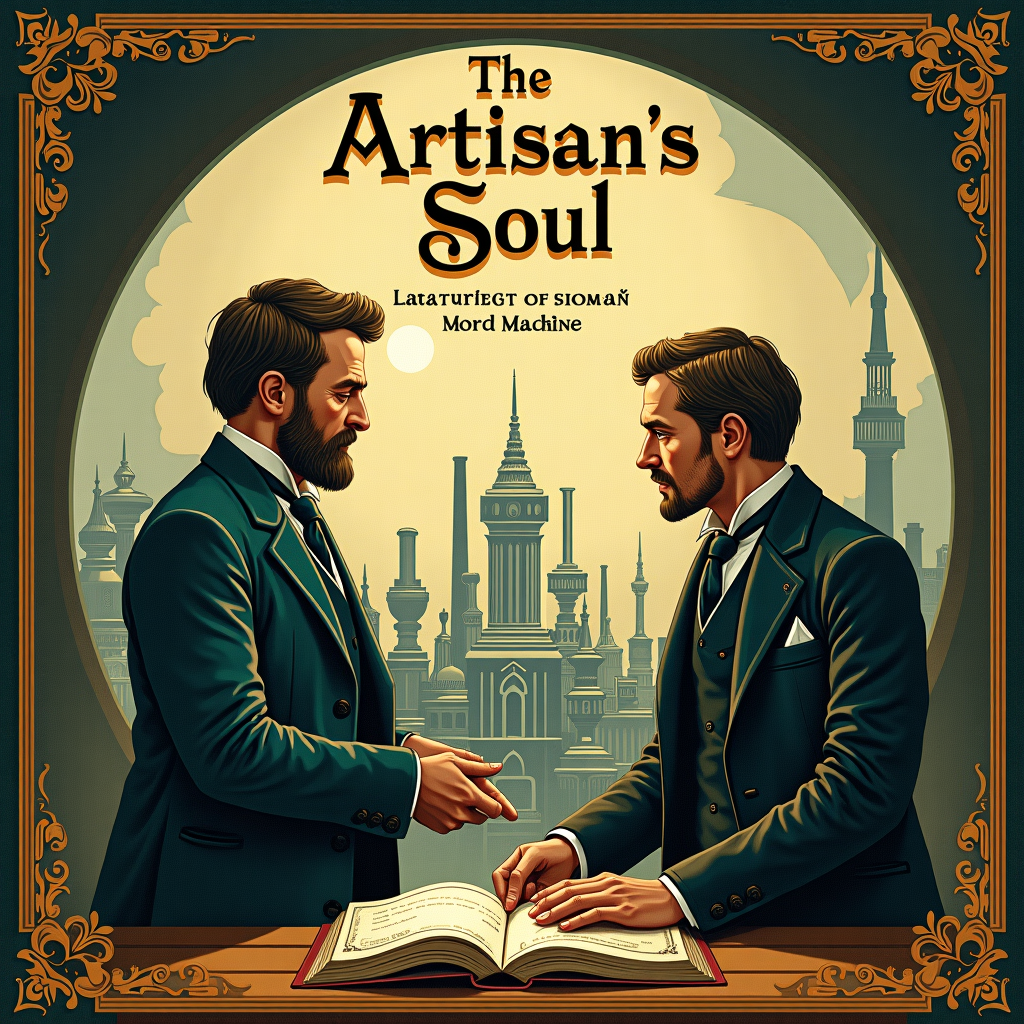
The Artisan's Soul: Crafting Meaning in the Machine Age
Humanist Wisdom for Finding Purpose in a World of Relentless Progress and Profit.
For professionals, creatives, and entrepreneurs feeling disconnected from their work and seeking to build a more meaningful and human-centric career and life.
Contents
- Foreword: The Smoke and the Soul – A Call to Reclaim Our Humanity
- Chapter 1: The Tyranny of the Clock and the Dignity of Labor (Thomas Carlyle)
- Chapter 2: The Gospel of Work and the Art of Life (John Ruskin)
- Chapter 3: Simplicity, Solitude, and the Soul's True Measure (Henry David Thoreau)
- Chapter 4: Art for Life's Sake: Crafting a Beautiful World (William Morris)
- Chapter 5: Culture, Anarchy, and the Pursuit of Perfection (Matthew Arnold)
- Chapter 6: The Kingdom of God is Within You: Labor, Love, and Non-Resistance (Leo Tolstoy)
- Chapter 7: Alienation and the Soul of the Worker (Karl Marx)
- Chapter 8: Beyond the Smokestacks: Crafting Your Own Renaissance
- Chapter 9: The Artisan's Manifesto: A Blueprint for a Humane Future
Foreword: The Smoke and the Soul – A Call to Reclaim Our Humanity
The acrid scent of woodsmoke still clings to my workshop, a comforting counterpoint to the distant, metallic tang of an unseen city. From my window, I watch the perpetual dance of smokestacks, their plumes a grim testament to an industry that promised liberation but often delivered only a different kind of servitude. They rise, these grey monuments to 'progress,' while beneath them, countless souls, like gears in a vast, indifferent machine, grind through days that feel increasingly hollow. We speak of 'quiet desperation' and 'burnout' as if they are modern maladies, novel afflictions of our hyper-connected age. But I tell you, these are but new names for an old wound, a spiritual erosion that began not with the glowing screen, but with the clatter of the power loom and the relentless tick of the factory clock.
This book is not a dusty historical tome, nor is it a nostalgic lament for a bygone era. It is a clarion call, a practical manual for navigating the soul-crushing currents of our mass-produced world, drawn from the wellspring of those who first witnessed humanity's entanglement with the machine. The 19th-century critics were not Luddites, smashing machines in blind rage. No, they were prophets, poets, and fierce defenders of the human spirit, who saw, with terrifying clarity, the Faustian bargain being struck. They understood that true wealth was not measured in commodities, but in the dignity of labor, the beauty of creation, and the richness of a life lived with purpose.
We stand at a crossroads, where the relentless pursuit of efficiency threatens to extinguish the very flame of our humanity. This journey, then, is an excavation – a digging through the accumulated debris of 'progress' to unearth the timeless wisdom of those who dared to question the cost of our advancements.
The Echo of the Loom: When Progress Became a Prison
Imagine, if you can, a world before the ceaseless hum of machinery, where the rhythm of life was dictated by the sun, the seasons, and the steady hand of the artisan. Then, suddenly, the steam engine roared, the factory gates opened, and the world irrevocably changed. What was initially hailed as a triumph of ingenuity quickly revealed its shadowed underbelly. The hand, once guided by skill and intuition, became an extension of the machine, performing repetitive tasks that drained the spirit and dulled the mind.
Consider the words of Thomas Carlyle, who, witnessing the industrial upheaval, declared with characteristic fire: "A sadder spectacle this than any of the old; the living artisan become a mere machine!" (Thomas Carlyle, Past and Present, 1843). Carlyle wasn't railing against technology itself, but against the dehumanization it wrought. He saw that when work became solely about output, devoid of creativity or personal investment, the worker himself became impoverished, not just in wages, but in spirit.
For us, today, this echoes in:
- The cubicle farm: Where 'productivity' is measured by screen time, not meaningful output.
- The gig economy: Where autonomy often masks precariousness and a race to the bottom.
- The endless scroll: Where consumption replaces creation, and 'connection' often feels isolating.
The initial shock of industrialization forced people to confront a fundamental question: What is the purpose of work? Is it merely a means to an end – a way to acquire more things – or is it an intrinsic part of what makes us human, a conduit for our creativity and our contribution to the world? The answers to these questions, first articulated by these 19th-century giants, are more urgent now than ever before.
Distinguishing True Wealth from Mere Riches
One of the most profound insights offered by these thinkers was the distinction between 'wealth' and 'riches.' We are inundated with messages that equate success with accumulation, with endless consumption. But what if, as John Ruskin passionately argued, this very pursuit strips us of what truly matters?
Ruskin, the fiery art critic and social reformer, penned these searing lines: "There is no wealth but life. Life, including all its powers of love, of joy, and of admiration. That country is the richest which nourishes the greatest number of noble and happy human beings." (John Ruskin, Unto This Last, 1860). This is not some abstract poetic musing; it is a radical economic philosophy. Ruskin saw that an economy built on exploitation, on the degradation of labor, or on the destruction of natural beauty, was fundamentally bankrupt, no matter how many goods it produced.
For us, struggling with the modern imperative to 'earn more, buy more,' Ruskin's challenge is direct:
- Re-evaluate your ledger: Are you accumulating possessions at the expense of experiences, relationships, or personal growth?
- Question the 'value' proposition: Does what you buy truly enrich your life, or does it merely fill a void created by soulless work?
- Invest in 'life': Prioritize time for creativity, connection, nature, and self-reflection – the true currencies of a rich existence.
The industrial revolution, in its relentless drive for efficiency, began to blur this line, equating production with prosperity, and consumption with contentment. Our task is to sharpen it once more, to reclaim a definition of wealth that is deeply human, not purely material.
The Artisan's Imperative: Crafting a Life of Purpose
William Morris, the towering figure of the Arts and Crafts movement, was not content merely to critique. He lived his philosophy, creating beautiful, handcrafted objects and advocating for a return to joyful, meaningful labor. He believed that the very act of making, when imbued with skill and love, was transformative, both for the maker and for society.
Morris famously declared: "I do not want art for a few, any more than education for a few, or freedom for a few." He sought to integrate beauty and meaning into everyday life, and into the work that sustains it. His vision was not to turn back the clock, but to re-inject soul into the process of creation, to make work itself a source of human flourishing, not merely a means to survival.
This is the artisan's imperative for our time:
- Seek mastery, not just efficiency: Cultivate skills that bring you joy and a sense of accomplishment, whether in your profession or your hobbies.
- Demand meaning in your labor: If your work feels utterly devoid of purpose, seek ways to infuse it with intention, or, if necessary, seek new avenues.
- Create, don't just consume: Engage in activities that require your hands, your mind, your unique perspective – be it gardening, writing, painting, coding, or carpentry.
The journey we embark on together is about more than just understanding history. It's about recognizing the timeless truths embedded in these critiques and applying them to our own lives. It's about finding the courage to step off the conveyor belt, to question the siren song of endless acquisition, and to reclaim the inherent human need to create, to connect, and to live a life rich in meaning, even amidst the clamor of the machine age.
Key takeaways
- 'Quiet desperation' is not new: It's a symptom of a deeper spiritual malaise born from dehumanized work.
- True wealth is 'life': Prioritize experiences, relationships, and personal growth over mere material accumulation.
- Work can be soul-enriching: Seek purpose and meaning in your labor, rather than seeing it as a necessary evil.
- The 19th-century critics are guides: Their insights offer a powerful framework for navigating modern challenges.
- Reclaim your agency: You have the power to infuse your life with intention and beauty, even in a mass-produced world.
Foreword: The Smoke and the Soul – A Call to Reclaim Our Humanity
The acrid scent of woodsmoke still clings to my workshop, a comforting counterpoint to the distant, metallic tang of progress. From my window, I watch the smokestacks clawing at the sky, monuments to an ambition both grand and, I fear, profoundly misguided. They churn out not just goods, but a pervasive, almost invisible miasma that seeps into our very souls: the quiet desperation, the gnawing sense of burnout, the feeling that life is less lived than merely endured. We are, many of us, caught in the relentless gears of a machine we barely understand, sacrificing our spirit on the altar of efficiency and endless accumulation.
This book is not a lament for a lost past, nor a naive call to dismantle the world as we know it. It is, rather, an urgent summons to introspection, a defiant whisper against the roar of the assembly line. It is a journey back to the foundational critiques of those radical intellectuals and master craftsmen of the 19th century who, like prophets gazing into a troubled future, saw the seeds of our current discontents being sown. They were not dusty historical figures; they were men of fiery conviction, their words forged in the crucible of a world convulsed by industrialization, their insights more vital now than ever. They understood, with a clarity that eludes many today, that true progress is not measured in output alone, but in the flourishing of the human spirit.
The Tyranny of the Clock and the Erosion of Soul
The industrial revolution, for all its marvels, introduced a new kind of tyranny: the tyranny of the clock. Time became a commodity, work a segmented, often meaningless endeavor. The artisan, who once conceived, designed, and executed a piece from start to finish, was replaced by a cog in a vast, dehumanizing mechanism. This fragmentation of labor, while boosting production, fractured the human spirit.
Consider the words of John Ruskin, the passionate art critic and social reformer, who railed against the soul-crushing nature of industrialized labor. He wrote in The Stones of Venice, "It is not the labour that is disgraceful, but the being false to its ends." Ruskin understood that when work loses its inherent purpose, when it becomes merely a means to an end (a paycheck, a promotion), it ceases to be ennobling and becomes instead a form of bondage. He saw the factory system as inherently degrading, arguing that "You must either make a tool of the creature, or a man of him." The choice, he insisted, was stark.
For us, today: Ruskin's challenge echoes in our cubicles and open-plan offices. How many of us feel like "tools," our creativity stifled, our efforts disconnected from a meaningful outcome?
- Practical Insight: Reflect on your daily tasks. Can you identify the true "end" of your work, beyond just completing it? How can you reconnect with that purpose, even in small ways? Perhaps it's understanding how your spreadsheet contributes to a child's education, or how your code streamlines a vital service. The "end" isn't always obvious, but it's always there, waiting to be found.
- Challenging Action: Advocate for greater autonomy in your role. Can you take on a project from conception to completion? Can you understand the broader impact of your contributions? The fight against being a "tool" begins with seeking wholeness in your work.
Distinguishing True Wealth from Mere Riches: A Moral Imperative
The 19th century witnessed an unprecedented accumulation of wealth, yet it also gave rise to profound social inequalities and spiritual impoverishment. Thomas Carlyle, the Scottish philosopher and historian, was a trenchant critic of this materialist obsession. He famously declared, "The wealth of a man is the number of things he can do without." This was not a call to asceticism, but a profound redefinition of value. True wealth, Carlyle argued, lay not in possessions, but in self-sufficiency, character, and the richness of one's inner life.
This sentiment was powerfully echoed by Henry David Thoreau, who, retreating to Walden Pond, demonstrated a radical alternative to the prevailing ethos. He meticulously detailed his efforts to live simply, to "live deliberately," and to confront "the essential facts of life." His profound observation, "The mass of men lead lives of quiet desperation," remains a chillingly accurate diagnosis of our modern condition, a direct consequence of mistaking accumulation for fulfillment.
For us, today: We are bombarded by messages equating consumption with happiness, success with endless acquisition.
- Practical Insight: Thoreau's experiment at Walden offers a powerful antidote. Take stock of your possessions and commitments. Which truly serve your "deliberate" life, and which are simply noise, draining your time, energy, and resources?
- Challenging Action: Practice a "digital Walden." Disconnect for a day, a weekend, or even an hour. Observe how much mental space is freed up when you consciously choose to "do without" constant digital input or material distractions. What new thoughts, ideas, or connections emerge? This isn't about deprivation, but about discerning what truly nourishes your soul.
The Call to Craft: Building a Life of Purpose and Beauty
Against the backdrop of industrial squalor and spiritual decay, figures like William Morris, the visionary artist, writer, and socialist, championed the rejuvenating power of craft. He saw beauty not as a luxury, but as a fundamental human necessity, and work as a source of joy, not drudgery. Morris, deeply influenced by Ruskin, believed that "apart from the desire to produce beautiful things, the leading passion of my life has been and is hatred of modern civilization." His "hatred" was not nihilistic; it was a fierce love for humanity's potential, for the joy of creation, and for a society where every worker could find dignity and satisfaction in their labor. He established workshops where skilled artisans created exquisite objects, demonstrating that utility and beauty could, and should, coexist.
For us, today: The machine age has made many of us consumers rather than creators, passive recipients rather than active shapers of our world.
- Practical Insight: Re-engage with the act of making. It doesn't have to be a grand artistic endeavor. It could be cooking a meal from scratch, mending a torn garment, tending a garden, or learning a new skill. The satisfaction of bringing something tangible into existence, of seeing the fruit of your own hands, is a powerful counter-narrative to the disposability of mass production.
- Challenging Action: Seek out opportunities to contribute to something beautiful, whether in your professional life or personal pursuits. Can you imbue your presentations with clarity and aesthetic appeal? Can you bring a sense of craftsmanship to your writing or coding? Morris's call is to make our world, and our work, more beautiful, more human.
This journey through the insights of the past is not about retreating from the present, but about re-arming ourselves with principles that allow us to live more fully, more authentically, and with greater purpose in the midst of the modern world. It is a call to awaken the artisan's soul within us all, to distinguish the true gold from the dross, and to forge a life that truly reflects our deepest values.
Key takeaways
- Modern malaise is not new: The "quiet desperation" and burnout we experience today were foreseen and critiqued by 19th-century thinkers.
- Reclaim purpose in work: Challenge the fragmentation of labor by seeking meaning and wholeness in your tasks, understanding their ultimate "ends."
- Redefine wealth: True wealth lies in character, self-sufficiency, and inner richness, not merely in accumulated possessions.
- Embrace craftsmanship: Reconnect with the joy of making and creating, bringing beauty and purpose into your daily life and work.
- Question "progress": Not all technological or material advancement leads to human flourishing; critical discernment is essential.
Chapter 1: The Tyranny of the Clock and the Dignity of Labor (Thomas Carlyle)
The clang of iron, the hiss of steam, the relentless grind of gears – these were the symphonies of a new age, an age that promised progress but delivered, for many, a profound spiritual erosion. From my workshop, the distant smokestacks cast long shadows, not just over the landscape, but over the very soul of humanity. We stand at a similar precipice today, surrounded by screens, enslaved by algorithms, and often, profoundly disconnected from the meaning of our days. It was in just such a moment of bewildering transformation that Thomas Carlyle, a man of thunder and fire, first raised his voice, a prophet crying out against the burgeoning idolatry of the machine and the ledger.
Carlyle saw, with searing clarity, how the industrial revolution was not merely changing how we worked, but what work itself meant. He watched as the rich tapestry of human endeavor, once woven with purpose and pride, was unraveled into mere threads of efficiency and profit. His words, though penned in the dust and din of the 19th century, echo with a chilling relevance for our own era of 'quiet desperation' and digital alienation.
The Cash Nexus: When Value Becomes Price
Carlyle’s most potent critique centered on what he termed the "cash-payment as the sole nexus" between human beings. He lamented the reduction of all human relationships, and especially the relationship between worker and work, to a transaction.
He wrote, with characteristic vehemence:
"Cash payment is not the sole nexus between man and man, how far from it! Cash payment is an inhumanity, an impiety, a diabolism. There is no longer any God; nay, there is no longer any man: for man is a Spirit, and if you slay his Spirit, you slay him."
This wasn't merely an economic observation; it was a spiritual lament. Carlyle understood that when the only measure of worth is monetary, the soul of labor withers. Our modern world, with its gig economy, its relentless pursuit of KPIs, and its pervasive belief that every moment must be monetized, is a direct heir to this "cash nexus." We are told to optimize, to scale, to leverage – all terms that strip away the human element, reducing our efforts to quantifiable outputs, divorced from intrinsic value.
Practical Challenge: For those feeling the chill of the "cash nexus" in their own lives:
- Identify Your "Soul-Sucking" Metrics: What are the quantifiable targets in your work that feel most arbitrary or dehumanizing? Are they truly measuring value, or just activity?
- Reclaim a Project for Pure Purpose: Dedicate a portion of your week (even an hour) to a task, project, or skill that brings you joy and meaning, irrespective of its monetary return or external recognition. This is your personal act of resistance against the tyranny of the ledger.
- Question the "Time is Money" Mantra: Carlyle would scoff at this. Is your time truly best spent chasing more money, or cultivating skills, relationships, and experiences that enrich your spirit, even if they don't directly add to your bank account?
The Dignity of Honest Toil: Beyond the Wage
Carlyle was not anti-work; quite the opposite. He was a fierce advocate for honest labor, for the dignity inherent in applying one's hands and mind to a task, and seeing it through to completion. He believed that true work, work imbued with purpose and skill, was a spiritual act, a means of self-realization.
He declared:
"Blessed is he who has found his work; let him ask no other blessedness. He has a work, a life-purpose; he has found it, and will follow it! How, as a free-flowing channel, at length abounding, and making all around him abound, will he hasten to his unknown goal!"
This isn't about the grandiosity of one's profession, but the integrity of one's effort. A shoemaker crafting a perfect pair of boots, a farmer tending his fields, a weaver at her loom – for Carlyle, these were acts of profound human dignity. The problem arose when the process of work became fragmented, when the worker lost connection to the product, and when the purpose was obscured by the relentless pursuit of profit. Today, in our hyper-specialized, often remote, and increasingly automated workplaces, this fragmentation is even more acute. Many never see the final outcome of their efforts, let alone the impact on a human being.
Practical Challenge: To rediscover the dignity of your toil:
- Trace the Lineage of Your Labor: If you work in a large organization, identify how your specific tasks contribute to the final product or service. Who benefits from your effort? How can you make that connection more tangible?
- Cultivate a Craft (Even a Hobby): Engage in an activity that allows you to see a project through from beginning to end, where you are responsible for every stage and can take pride in the final outcome. This could be gardening, woodworking, coding a personal project, writing, or cooking a complex meal from scratch.
- Seek Mastery, Not Just Efficiency: Instead of asking "How can I do this faster?", ask "How can I do this better?" Focus on the quality of your effort, the finesse of your skill, and the inherent satisfaction that comes from a job well done, regardless of external reward.
The Spiritual Emptiness of Work Divorced from Purpose
Carlyle saw the great industrial machine as a devourer of souls, leaving behind a spiritual emptiness that no amount of material wealth could fill. He understood that humans crave meaning, not just wages. When work becomes merely a means to an end – a way to pay bills, to acquire more things – it ceases to nourish the spirit.
He observed, with a heavy heart:
"Labour without joy is a mere drudgery, a weariness of the flesh and spirit. Man is not a machine, he has a soul, and that soul cries out for light and warmth." (Paraphrased from various writings on the 'condition of England' question, reflecting his consistent theme of spiritual deprivation in industrial labor).
This "weariness of the flesh and spirit" is the burnout we feel today, the quiet despair that settles in when our efforts seem meaningless, when our days are filled with tasks that fail to engage our deeper selves. The relentless pursuit of 'more' – more money, more possessions, more status – often masks a profound void within, a void born of work that lacks purpose and connection.
Practical Challenge: To infuse your work with purpose:
- Define Your "Why": Beyond the job description, what is the deeper reason you do what you do? How does your work contribute to something larger than yourself, even in a small way? If you can't find one, it's a signal to reassess.
- Seek Opportunities for Impact: Look for ways to connect your daily tasks to a positive outcome for others, for your community, or for a cause you believe in. Even small acts of service or mentorship can transform drudgery into purpose.
- Embrace the "Hero's Journey" of Your Work: Frame your challenges not as obstacles, but as opportunities for growth, learning, and making a meaningful contribution. Every craft, every endeavor, has its trials and its triumphs. See yourself as the protagonist in your own story of creation.
Key takeaways
- Beware the "Cash Nexus": Resist the reduction of all value to monetary terms; seek inherent worth beyond price.
- Reclaim the Dignity of Toil: Find pride and purpose in the quality of your effort and the mastery of your craft.
- Connect Work to Soul: Actively seek and cultivate meaning in your daily tasks to combat spiritual emptiness and burnout.
- Question "Progress": Not all advancement is truly good for the human spirit; discern between genuine growth and mere acceleration.
- Your Labor is Your Legacy: What you create, how you create it, and the spirit you bring to it, ultimately define your contribution to the world.
Chapter 3: The Gospel of Work and the Art of Life (John Ruskin)
The scent of saw-dust and drying ink still clings to my workshop, a testament to honest labor. Beyond my window, the chimneys of the behemoth factories belch their grey promises of 'progress' into an indifferent sky. They tell us of efficiency, of abundance, of a world made easy. But what, I ask you, is the cost of such ease? What becomes of the soul when the hand is severed from the mind, when the worker becomes but a cog in a grotesque machine? John Ruskin, that fierce prophet of beauty and truth, saw this unfolding horror with a clarity that still stings. He looked at the industrial age and recoiled, not from the machinery itself, but from the spiritual devastation it wrought upon humanity and the very fabric of our world.
The Degradation of the Operative: When Work Becomes Servitude
Ruskin’s indictment of industrial labor was not merely an aesthetic complaint; it was a profound moral and spiritual one. He witnessed the burgeoning factories transform skilled artisans into 'hands,' divested of their craft, their intellect, and their very humanity. "It is not that men are ill fed," he thundered, "but that they have no pleasure in the work by which they make their bread, and therefore look to wealth as the only means of pleasure." This is the core of his lament: the joy of creation, the inherent satisfaction of shaping raw material into something useful and beautiful, was being systematically expunged.
Consider the modern echo of this degradation. How many of us trudge to jobs stripped of meaning, where our contributions are invisible, our creativity stifled, and our days a monotonous cycle of tasks dictated by algorithms and spreadsheets? The factory floor may have been replaced by the open-plan office, the clanking loom by the ceaseless glow of a screen, but the spiritual impoverishment remains. We are told to specialize, to focus on a single, often minute, aspect of a larger process, never seeing the whole, never feeling the satisfaction of a complete creation.
- The Modern Echo:
- Specialization without Scope: Endless focus on a tiny part of a project, preventing a holistic understanding or appreciation of the final product.
- Algorithm-Driven Tasks: Work dictated by software, reducing human input to data entry or repetitive operations, stifling independent thought.
- Metrics Over Meaning: Performance measured by abstract numbers rather than the quality, impact, or intrinsic value of the work.
Ruskin implored us to recognize that "to make your work pleasant, you must make it intelligent." He argued that true work engages the whole person – hand, heart, and head. When we deny the worker this holistic engagement, we do not merely produce shoddy goods; we produce broken people. This is the chilling truth that stands before us today: are we, in our pursuit of efficiency and profit, manufacturing alienation on an unprecedented scale?
True Wealth vs. Mere Riches: The Soul's Ledger
For Ruskin, the pursuit of 'riches' – accumulation of material goods, often at the expense of others and of quality – was a dangerous delusion. He passionately distinguished this from 'wealth,' which he defined not by possession, but by life itself. "There is no wealth but life," he wrote in Unto This Last. "Life, including all its powers of love, of joy, and of admiration. That country is the richest which nourishes the greatest number of noble and happy human beings."
This is a radical redefinition, is it not? In a world obsessed with GDP, stock market indices, and personal net worth, Ruskin asks us to look beyond the ledger of currency to the ledger of human flourishing. Are our industries, our economies, our daily pursuits truly enriching human life, fostering love, joy, and admiration? Or are they, instead, consuming life, depleting our spirits, and eroding our capacity for genuine connection and wonder?
To embrace Ruskin’s concept of wealth is to:
- Re-evaluate your 'assets': Are the things you spend your time and energy acquiring – be it a larger house, a faster car, or more ephemeral status symbols – genuinely contributing to your 'life, including all its powers of love, of joy, and of admiration'? Or are they merely 'riches' that demand more of your precious life to maintain?
- Prioritize quality over quantity: Choose fewer, well-made, enduring items crafted with care over a multitude of cheap, disposable goods. This extends beyond material possessions to experiences, relationships, and even the thoughts you consume.
- Invest in human flourishing: Support businesses and practices that empower workers, produce beautiful and useful things, and contribute positively to communities and the environment. True wealth creation, by Ruskin's measure, means enabling others to live more fully.
The industrial age, and its modern iteration, promises us freedom through material abundance. Yet, so often, it delivers a gilded cage, where our time is sold for wages that buy us goods we barely need, leaving us perpetually wanting more, perpetually feeling less. Ruskin urges us to break this cycle, to measure our prosperity not by what we own, but by how we live, how we love, and what we create.
The Beauty of Imperfection: Cultivating the Handmade and Meaningful
Ruskin’s appreciation for the handmade and the meaningful was not a nostalgic longing for a bygone era, but a profound recognition of the inherent human need for beauty and authenticity. He saw the "imperfection" of handmade objects not as a flaw, but as a sign of life, of human touch, of the unique personality of the maker. "No good work whatever can be perfect," he declared, "and the demand for perfection is always a sign of a misunderstanding of the ends of art."
In our age of mass production, where every item is designed to be identical, flawless, and often disposable, this insight is more vital than ever. The pursuit of sterile perfection, often achieved through automated processes and cheap labor, strips objects of their soul. It denies us the quiet pleasure of seeing the subtle variations, the slight irregularities, the evidence of a human hand and mind at work.
- Embracing the Wabi-Sabi of Life:
- Seek out the unique: Choose artisan-made goods, support local craftspeople, or even try your hand at making things yourself. Experience the joy of objects infused with individual character.
- Value the story: Understand the provenance of your possessions. Who made it? How was it made? What resources went into it? This deepens your connection and appreciation.
- Resist the disposable: Repair, repurpose, and cherish what you have. This act of preservation is a rebellion against the fleeting nature of mass consumption and a testament to enduring value.
Ruskin's call to appreciate the handmade is a call to reconnect with the tangible world, to find beauty not in sterile uniformity, but in the vibrant, imperfect dance of human creation. It is an invitation to infuse our lives with intention, to surround ourselves with objects that speak of care and purpose, rather than just utility and fleeting trend. In doing so, we not only enrich our surroundings but, more importantly, we enrich our souls.
Key takeaways
- Reclaim the Joy of Work: Seek roles or create opportunities where your work engages your whole self – mind, hand, and heart – transforming labor from a burden into a source of intelligent pleasure.
- Redefine Wealth: Measure true prosperity not by material accumulation, but by the richness of your life, your capacity for love, joy, and admiration, and your contribution to the flourishing of others.
- Cultivate Authenticity: Actively choose and support handmade, unique, and meaningful objects and experiences over mass-produced, disposable uniformity, recognizing the beauty in imperfection and human touch.
- Question 'Progress': Critically examine the ethical and aesthetic costs of modern industrial and technological advancements, asking if they genuinely enhance human life or merely serve efficiency and profit at the expense of the soul.
Chapter 4: The Art of Life and the Gospel of Work (William Morris)
From the solitary pond of Thoreau, we turn our gaze to the bustling workshops and passionate pronouncements of William Morris, a man who, though born into comfort, dedicated his life to battling the ugliness and injustice wrought by the very "progress" our age still so blindly worships. Morris, a poet, artist, designer, and socialist, saw the deep interconnectedness of beauty, labor, and human dignity. He wasn't merely critiquing the factory; he was envisioning a world where every object, every task, could be a source of joy and meaning. He understood, profoundly, that the soul of a people is reflected in the work of their hands, and when that work is debased, so too are the lives of those who perform it.
The Degradation of Work and the Loss of Joy
Morris looked upon the industrial landscape of his time and saw not efficiency, but spiritual poverty. He lamented the transformation of skilled artisans into mere extensions of machines, their innate creativity stifled, their days filled with drudgery. For Morris, work was not merely a means to an end – a way to earn a wage – but a fundamental human need, a source of identity, and a path to fulfillment. When work becomes meaningless, life itself loses its luster.
Morris famously declared that we should strive for a world where:
"It is right and necessary that all men should have work to do which shall be worth doing, and be of itself pleasant to do; and which should be done under such conditions as would make it neither over-wearisome nor over-anxious."
Consider this profound statement. How many of us today can honestly say our work is "worth doing" and "pleasant to do"? How many feel "over-wearisome" or "over-anxious" at the end of each day, or even each hour? Morris wasn't advocating for idleness; he was arguing for meaningful labor, work that engages the mind, the hand, and the heart. The modern office cubicle, the endless data entry, the fragmented tasks of global supply chains – these are but new forms of the very alienation Morris fought against.
- Challenging the Modern Grind:
- Question Your "Worth": Does your daily labor genuinely contribute to something you value? Or is it merely a cog in a machine you don't understand, serving ends you don't believe in?
- Seek Pleasantness: Can you inject elements of joy, creativity, or genuine connection into your work? Even small acts of intentionality can transform a tedious task.
- Recognize the Weariness: Acknowledge when your work is truly draining your spirit, not just your body. This recognition is the first step toward change.
Beauty as a Moral Imperative
For Morris, beauty was not a luxury, but a necessity, intrinsically linked to the health of society and the soul of the individual. He saw the proliferation of shoddy, mass-produced goods as a symptom of a deeper malaise – a disregard for human well-being and a corruption of taste. When we surround ourselves with ugliness, when our homes and workplaces are devoid of thoughtful design and honest craftsmanship, we diminish our own lives.
Morris believed that:
"I do not want art for a few, any more than education for a few, or freedom for a few."
This wasn't just about aesthetics; it was a democratic ideal. Art, in its broadest sense – the art of making, the art of living – should be accessible to all. It should permeate our daily lives, enriching our experiences and elevating our spirits. The sterile, functional design that often dominates our modern world, from office buildings to household appliances, reflects a utilitarian mindset that strips life of its poetry.
- Cultivating a Beautiful Life:
- Curate Your Surroundings: Look around your home and workspace. What objects bring you joy? What is merely functional? Can you introduce more items that possess an inherent beauty, that tell a story, that were made with care?
- Support True Craft: Seek out and support artisans and creators who pour their soul into their work. Each purchase is a vote for a more humane economy.
- Engage with Creation: Take up a craft yourself – woodworking, knitting, gardening, writing. The act of creation, regardless of skill level, connects you to a fundamental human impulse and fosters an appreciation for beauty.
The Socialist Dream: Work as a Human Right and Joy
Morris's vision extended beyond individual actions to a complete societal transformation. He was a committed socialist, believing that true reform could only come from dismantling the capitalist system he saw as inherently exploitative and dehumanizing. His socialism was not a dry economic theory; it was a passionate plea for a society where every person could live a full, creative, and dignified life, free from the tyranny of profit and the degradation of meaningless labor.
His ideal was a society where:
"What business have we with art at all unless we can all live in it?"
This statement encapsulates his radical belief that art, beauty, and meaningful work should not be privileges, but fundamental rights, woven into the very fabric of society. He envisioned communities where people worked cooperatively, shared resources, and took pride in their collective creations. While the grand political visions of the 19th century have often faltered, the underlying humanistic impulse of Morris's thought remains profoundly relevant.
- Actions for a More Humane Future:
- Advocate for Meaningful Workplaces: Speak up in your own organization for practices that prioritize employee well-being, creative input, and a sense of purpose.
- Build Community: Engage in collaborative projects, support local initiatives, and foster connections that move beyond transactional relationships.
- Re-evaluate "Progress": Challenge the dominant narrative that equates technological advancement and economic growth with human flourishing. Ask what kind of "progress" truly serves the soul.
Key takeaways
- Work should be a source of joy and meaning, not merely a means to an end.
- Beauty is a moral imperative, essential for a healthy society and individual well-being.
- The degradation of work and the proliferation of ugliness are symptoms of a deeper societal malaise.
- We must strive for a world where meaningful work and beauty are accessible to all, not just a privileged few.
- Actively seeking and supporting craftsmanship, and engaging in creative pursuits ourselves, is a vital act of resistance against a mass-produced, soulless world.
Chapter 5: The Weight of the World, the Work of Our Hands (Leo Tolstoy)
The air in my workshop, thick with the scent of linseed oil and fresh-cut oak, often feels like a sanctuary from the relentless clatter beyond my walls. I hear the distant rumble of the trains, the ceaseless hum of the factories, and I see the smoke stacks staining the horizon. It's a symphony of so-called progress, a relentless march that, for all its promises of ease and abundance, seems to leave more souls broken than whole. We've spoken of Carlyle's scorn for idleness, Ruskin's plea for art in labor, Thoreau's quiet rebellion against the material. Now, we turn to a giant, a conscience of his age, who dared to ask: what is the true measure of a man's work, and what is the cost of our comforts? Leo Tolstoy, that titan of Russian letters, saw through the gilded cages of his own class, and in so doing, laid bare the profound moral crisis of modernity.
Tolstoy, unlike many of his contemporaries, lived his philosophy, often to the discomfort of those around him. He wrestled with the question of how one might live a truly Christian life in a world riddled with injustice and spiritual decay. He saw the burgeoning industrial age not as a triumph, but as a chasm opening between those who labored and those who consumed, a chasm deepened by the intellectual's detachment and the wealthy's willful blindness. For Tolstoy, the answer lay not in grand theories, but in the sweat of one's brow, in the honest toil that connected a man to the earth, to his neighbor, and to God.
The Tyranny of the Unearned Loaf
Tolstoy’s indictment of idleness wasn't born of a Puritanical work ethic, but from a profound sense of justice and spiritual necessity. He saw the leisure of the privileged as a direct burden on the backs of the working poor. His own struggles with this moral dilemma led him to reject his aristocratic life, to learn shoemaking, to plough his own fields. He understood, deeply, that true wealth was not accumulated possessions, but a life lived in accordance with ethical principles, free from the exploitation of others.
"I sit on a man's back, choking him and making him carry me, and yet assure myself and others that I am very sorry for him and wish to ease his lot by all possible means—except by getting off his back."
This searing image, from his essay "What Then Must We Do?", cuts to the quick. How many of us, even today, unknowingly or knowingly, sit upon the backs of others? Our cheap goods, our convenient services, our endless pursuit of leisure often come at a hidden cost: the silent suffering of those who produce them. This isn't a call to Luddite rebellion, but a profound challenge to examine the foundations of our own comfort.
- Practical Reflection:
- Trace the Chain: Take a common item you own – a shirt, a phone, a cup of coffee. Can you trace its origin? What labor went into it? What are the human and environmental costs hidden by its price tag?
- Re-evaluate "Necessity": How many of your "needs" are truly essential, and how many are simply desires fueled by a system that thrives on perpetual consumption? Tolstoy would argue that true fulfillment comes not from acquiring more, but from needing less and producing what you can with your own hands.
- The Work of Our Hands: Consider learning a practical skill – gardening, baking, mending, woodworking. The satisfaction of creating something useful, however small, can be a potent antidote to the alienation of a purely intellectual or managerial existence.
The Spiritual Poverty of Material Riches
Tolstoy observed that the more society accumulated material wealth, the more it seemed to lose its spiritual compass. The frantic pursuit of money, status, and possessions led to a profound inner emptiness. He believed that genuine happiness and meaning were found not in external accumulation, but in inner cultivation, in service to others, and in honest, productive labor. He saw the intellectual class, his own class, as particularly susceptible to this spiritual malaise, often theorizing about change while remaining detached from the physical realities of suffering.
"The business of life is not to get ahead of others, but to get ahead of ourselves."
This isn't a simplistic rejection of wealth itself, but a profound critique of the pursuit of wealth as an ultimate goal. It challenges the modern mantra of "hustle culture" and endless upward mobility. When our sole metric for success is financial gain or external validation, we become prisoners of a system that cares little for our souls. Tolstoy invites us to turn inward, to measure our progress not by our bank balance or our job title, but by the integrity of our character and the depth of our human connections.
- Practical Reflection:
- Define Your "Ahead": Beyond professional advancement, what does "getting ahead of yourself" truly mean for you? Is it mastering a new skill, cultivating patience, deepening a relationship, contributing to your community?
- The True Cost of "Success": What sacrifices are you making for your current definition of success? Is it your health, your relationships, your peace of mind, your sense of purpose? Tolstoy would urge us to question if the "success" is truly worth the spiritual price.
- Embrace the Mundane: Find beauty and purpose in the everyday tasks that often feel like burdens. Washing dishes, cleaning your home, preparing a meal – these can be acts of mindful labor, grounding us in the present and connecting us to the tangible world, rather than distractions from a deeper purpose.
The Call to Simple Living and Honest Labor
Tolstoy’s ultimate prescription was a radical simplicity, a return to manual labor, and a life lived in direct service and communion with fellow human beings. He didn't advocate for a return to a pre-industrial utopia, but for a fundamental reorientation of values. He believed that honest, physical work, far from being a curse, was a blessing, connecting us to our bodies, to the earth, and to the fundamental processes of life. It was through this connection that true meaning could be found, a meaning often obscured by the complexities and artificialities of modern existence.
"One can live magnificently in this world, if one knows how to work and how to love."
This quote, deceptively simple, encapsulates the Tolstoyan ideal. It's a rejection of the fragmented, specialized, and often sterile existence offered by industrial society. It's a call to integrate our lives, to find wholeness in the twin pillars of productive effort and genuine human connection. It's about finding joy not just in work, but through work – work that is meaningful, ethical, and contributes to the well-being of all.
- Practical Reflection:
- Integrate Work and Life: How can you bring more "love" into your "work," and more "work" (meaningful effort) into your "love" (relationships, community)? Can your professional skills be used for a cause you care deeply about?
- The Dignity of All Labor: Challenge the societal hierarchy of work. The person who cleans your office, who grows your food, who mends your clothes – their labor is as essential and dignified as any CEO's. Cultivate respect for all forms of honest toil.
- Craft Your Own Life: Tolstoy's life was an experiment in crafting a life aligned with his deepest values. What small, intentional changes can you make today to bring your own work and daily existence closer to your ideals of purpose, integrity, and connection?
Key takeaways
- Question the Source of Your Comforts: Acknowledge the often-hidden human and environmental costs embedded in our consumer choices.
- Redefine Success Beyond Accumulation: Seek fulfillment in personal growth, ethical living, and genuine connection, not solely in material wealth or external validation.
- Embrace Honest, Productive Labor: Find dignity and meaning in physical work, practical skills, and contributing tangibly to the world.
- Live as an Integrated Human Being: Strive for a life where work and love are not separate realms, but interwoven threads of a purposeful existence.
- Challenge the Tyranny of the Unearned Loaf: Understand that true freedom comes not from idleness, but from meaningful engagement and a rejection of exploitation.
Chapter 6: The Soul's True Wealth: Beyond the Ledger's Measure (John Ruskin)
The air in my workshop, thick with the scent of linseed oil and fresh-cut oak, often feels like a sanctuary against the distant thrum of the factories. Their chimneys, like blackened fingers pointing accusingly at the heavens, remind me daily of the world we’ve built, a world that often mistakes accumulation for accomplishment, and profit for purpose. Matthew Arnold, in his elegant way, pleaded for "sweetness and light," for a culture that nurtured the soul. But it was John Ruskin, the fiery prophet of beauty and truth, who laid bare the very foundation of our modern malaise: our perverse understanding of wealth itself.
Ruskin, an artist of language and a fierce advocate for the dignity of human labor, saw with terrifying clarity that the burgeoning industrial age was not merely producing goods, but twisting our very notion of what it meant to be rich. He understood that a society obsessed with what could be counted on a ledger sheet was rapidly losing sight of what truly enriched the human spirit. His words, penned amidst the grime and glory of Victorian England, resonate with an almost unbearable urgency today, as we drown in a sea of manufactured desires and digital distractions, still chasing a phantom prosperity.
The Pecuniary Fallacy: When Price Overrides Value
Ruskin’s magnum opus, Unto This Last, is not merely an economic treatise; it is a sermon, a passionate cry for a return to sanity. He challenged the very bedrock of classical economics, which reduced human beings to mere cogs in a machine and their labor to a commodity. "There is no wealth but life," he declared. This simple, profound statement should be carved above every corporate door, emblazoned on every financial report. Yet, we continue to measure our success, both individually and collectively, by metrics that actively diminish life.
Consider the modern "gig economy" worker, constantly chasing the next task, their worth reduced to an hourly rate or a completed delivery. Or the executive, lauded for maximizing shareholder value, often at the expense of environmental health, employee well-being, or the quality of the product itself. Ruskin saw this coming. He understood that when we divorce value from life, from beauty, from justice, we create a system that is inherently destructive.
Ruskin's critique isn't a call for asceticism or poverty; it's a demand for a richer, more profound understanding of what constitutes true prosperity. It asks us to look beyond the immediate transaction and consider the full human and ecological cost of our economic activities.
- Practical Challenge: How do you define "wealth" in your own life? Is it the number in your bank account, the size of your house, or the quality of your relationships, the health of your body, the richness of your experiences, the contribution you make to your community?
- Actionable Insight: Conduct a "wealth audit." List the things in your life that genuinely enrich you, that bring joy, meaning, and connection. Then, list the things you spend money on that don't contribute to that true wealth. Where are the disconnects?
The Degradation of Work: From Craft to Commodity
For Ruskin, the degradation of work was a central tragedy of industrialism. He saw how the division of labor, while efficient, severed the worker from the whole, turning skilled artisans into automatons. "It is not the labour that is divided, but the men," he lamented. This fragmentation of the human spirit, this reduction of complex beings into interchangeable parts, was an abomination to him.
We see this same fragmentation today, perhaps even more acutely. The endless scroll, the fragmented tasks, the "optimization" of every moment – all conspire to disconnect us from the holistic satisfaction of creation. How many of us finish a workday feeling a true sense of completion, of having brought something beautiful or meaningful into existence? More often, we feel drained, our contributions invisible, our efforts absorbed into a vast, impersonal machine.
Ruskin, like his contemporary William Morris, believed that work should be a source of joy, a means of expressing our innate creativity, and a path to personal growth. When work becomes merely a means to an end – a way to pay bills – it strips us of our humanity.
- Practical Challenge: Reflect on your own work. What aspects of it bring you genuine satisfaction and a sense of purpose? What aspects feel like mere drudgery?
- Actionable Insight: Seek opportunities to reclaim agency in your work. Can you take on a project that allows for more creative input? Can you connect with the end-user or the ultimate impact of your efforts? If your current work offers no such avenues, consider how you might cultivate a craft or passion outside of it that nourishes your soul and reminds you of the joy of creation.
The Beauty of Imperfection: Resisting the Mass-Produced Lie
Ruskin was a fierce defender of handcraft, not out of Luddite nostalgia, but because he saw in the "imperfection" of hand-made objects the very evidence of human touch, human thought, human effort. The perfect uniformity of machine-made goods, while perhaps efficient, was for him a symbol of spiritual impoverishment. "All that we call refinement of taste, consists in the power of perceiving high qualities in imperfection," he wrote.
In our age of mass production, where every object strives for identical flawlessness, we've lost this appreciation. We crave the pristine, the unblemished, the factory-fresh. But true beauty, like true life, often lies in the unique, the organic, the slightly irregular. The perfectly smooth plastic surface offers little to the soul compared to the grain of a well-worn wooden table or the subtle variations in a hand-thrown pot.
This isn't about rejecting technology; it's about discerning its proper place. It's about recognizing that not everything that can be mass-produced should be. It's about valuing the unique story embedded in an object crafted with care, over the sterile anonymity of a thousand identical copies.
- Practical Challenge: Look around your home or workspace. How many objects show the mark of a human hand or tell a unique story? How many are simply generic, mass-produced items?
- Actionable Insight: Consciously seek out and invest in things that are truly "made," rather than merely "produced." Support local artisans, repair rather than replace, and cultivate an appreciation for the character and history embedded in objects, rather than just their newness or efficiency.
Key takeaways
- Redefine Wealth: True wealth is measured not by accumulation, but by the richness of life, quality of relationships, and depth of experience.
- Reclaim Work's Purpose: Seek work that allows for creativity, purpose, and a holistic sense of completion, rather than mere fragmented tasks.
- Value the Human Touch: Appreciate the beauty and story in handcrafted, imperfect objects over the sterile uniformity of mass production.
- Beyond the Ledger: Challenge economic systems that prioritize profit over human well-being and environmental health.
Chapter 7: The Alienation of Labor and the Promise of Liberation (Karl Marx)
The stench of coal smoke, the clatter of looms, the relentless rhythm of the factory floor – these were the symphonies of a new age, an age that promised progress but delivered, for many, a profound spiritual poverty. We've journeyed through the critiques of Carlyle, Ruskin, Thoreau, Morris, Arnold, and Tolstoy, each offering a unique lens on the human cost of industrialization. Now, we turn to a figure who, though often misunderstood and misused, articulated with searing precision the very core of this modern malady: Karl Marx. He saw not just the symptoms, but the systemic disease underlying the industrial order, a disease he termed "alienation."
Marx, writing from the heart of industrial Europe, observed the transformation of human beings into appendages of machines, their creative potential crushed under the weight of repetitive tasks. He wasn't merely lamenting lost beauty or spiritual decay; he was dissecting the economic and social structures that produced such widespread human suffering. For Marx, the problem wasn't simply that work was unpleasant, but that it systematically stripped individuals of their humanity, their connection to their labor, their fellow beings, and even their true selves.
The Estrangement of Man from His Product
Imagine, if you will, the potter at his wheel, shaping the clay with skill and intention, seeing the finished pot as an extension of his own hands and mind. This is the essence of integrated labor. Now, consider the factory worker, tightening the same bolt, hour after hour, on an endless conveyor belt. What connection does this worker have to the finished product? What joy, what sense of creation, can be derived from such an act? Marx saw this disconnect as fundamental.
He wrote in his Economic and Philosophic Manuscripts of 1844: "The worker becomes poorer the more wealth he produces, the more his production increases in power and size. The worker becomes an ever cheaper commodity the more commodities he creates."
This isn't just about wages, though paltry wages were certainly part of the problem. It's about the very relationship between the creator and the created.
- For the modern artisan: Do you feel a genuine connection to what you produce? Does your work reflect your unique skill and vision, or is it merely a cog in a larger, impersonal machine?
- For the professional: Are you merely executing tasks dictated by others, or do you have agency in shaping the outcomes of your efforts? Does your work feel like an expression of your purpose, or just a means to a paycheck?
- For the entrepreneur: Are you building something with soul and substance, or are you chasing metrics and trends, producing something you yourself wouldn't truly value?
The challenge here is to reclaim ownership of our creative output, to imbue our work with our own spirit, rather than letting it become an alien thing that stands apart from us, even dominating us.
The Estrangement of Man from the Act of Production
Beyond the product itself, Marx argued that the very act of working in industrial capitalism was alienating. The worker no longer found fulfillment in the process; work became a means to an end – survival.
"Labour is external to the worker, i.e., it does not belong to his essential being; that in his work, therefore, he does not affirm himself but denies himself, does not feel content but unhappy, does not develop freely his physical and mental energy but mortifies his body and ruins his mind."
This powerful observation resonates deeply with the modern epidemic of burnout and quiet desperation. How many of us experience our jobs as something we must do, rather than something we want to do, or even something that brings us genuine joy and growth?
Consider:
- The loss of autonomy: Are you free to innovate, to experiment, to set your own pace, or are you dictated by external demands and algorithms?
- The absence of meaning: Does your daily grind contribute to a larger purpose that resonates with your values, or does it feel like a series of meaningless tasks?
- The suppression of creativity: Is your work a canvas for your ingenuity, or a cage that confines your potential?
To combat this, we must consciously seek out or create environments where the act of production itself is meaningful. This might involve renegotiating roles, seeking out collaborative projects, or even fundamentally rethinking what kind of work we are willing to engage in. It's about finding work that allows us to "affirm ourselves," rather than deny ourselves.
The Estrangement of Man from Species-Being and Other Men
Marx's most profound insight into alienation extended to our very human essence – our "species-being" – and our relationships with others. For Marx, what distinguishes humanity is our capacity for conscious, creative, and social labor. When work is alienated, it strips us of this fundamental human characteristic. We become less than fully human.
"Man is alienated from his species-being because he is alienated from productive life, from human life. For species-being is the true essence of man, and productive life is the active species-life. In estranging from man his own body, from nature as it exists outside him, from his spiritual essence, his human essence, alienation also estranges him from other men."
The factory floor, with its competitive pressures and hierarchical structures, often fostered division rather than community. Today, this can manifest in:
- Hyper-competition: Colleagues are seen as rivals, not collaborators, eroding trust and genuine connection.
- Isolation in the digital age: While superficially connected, many feel profoundly alone, engaging in work that offers little true human interaction or shared purpose.
- Commodification of relationships: Networking becomes a transactional exchange, rather than an organic building of community.
The call to action here is to rebuild genuine community, to see our work not just as individual endeavors, but as shared human projects. It means fostering environments where collaboration is valued over cutthroat competition, where empathy trumps efficiency, and where the collective good is considered alongside individual gain. It means recognizing that our humanity flowers most fully when we create and connect, not when we are isolated cogs.
Key takeaways
- Reclaim your product: Seek work where you feel a genuine connection to what you create and can imbue it with your personal stamp.
- Find purpose in the process: Strive for work that allows for autonomy, creativity, and personal growth, rather than feeling like a mere obligation.
- Cultivate community: Resist isolation and competition; seek out or build collaborative environments where human connection and shared purpose flourish.
- Challenge systemic alienation: Recognize that personal dissatisfaction often stems from broader systemic issues, empowering you to seek change.
- Define your "species-being": Understand what truly makes you feel human and pursue work that allows for the full expression of that essence.
Chapter 8: The Weight of Gold and the Poverty of Spirit (John Ruskin)
The air in my workshop, thick with the scent of pine and linseed oil, often carries the distant, acrid tang of industry. It’s a smell that, for all its modern promise, always brings to mind the words of John Ruskin. He was no mere aesthetician, pottering about with watercolors; he was a prophet, a furious, eloquent voice crying out against the spiritual desolation wrought by the very progress that filled the skies with smoke. Ruskin saw, with a clarity that still stings, that the pursuit of mere riches was not only debasing our landscapes but, more tragically, our very souls. He understood, as perhaps few do today, that true wealth is not measured in coin, but in the richness of life, the integrity of our work, and the beauty we cultivate.
While Marx dissected the mechanisms of alienated labor, Ruskin peered into the consequences of that alienation on the human spirit and the natural world. He witnessed the burgeoning industrial age not as a triumph, but as a tragic disfigurement of both man and nature, driven by a perverse devotion to material gain at the expense of all that is truly valuable. He saw the tyranny of the clock, the division of labor, and the relentless pursuit of profit as instruments that crushed the human spirit, replacing thoughtful craftsmanship with soulless toil, and genuine beauty with cheap imitation.
The True Cost of "Progress"
Ruskin, observing the relentless march of industrialization, understood that what we gained in material goods, we often lost in spiritual substance. He saw the hollowing out of communities, the pollution of rivers, and the endless, monotonous toil of factory hands as direct consequences of a society that had prioritized profit above all else. He famously declared:
"There is no wealth but life. Life, including all its powers of love, of joy, and of admiration. That country is the richest which nourishes the greatest number of noble and happy human beings; that man is richest who, having perfected the functions of his own life to the utmost, has also the widest helpful influence, both personal, and by means of his possessions, over the lives of others."
This isn't some romantic ideal; it's a stark economic truth that we've willfully ignored. We measure Gross Domestic Product, but what about Gross Domestic Happiness? Gross Domestic Beauty? Gross Domestic Meaning? Ruskin compels us to question the very definition of "progress" when it comes to human flourishing.
- The Illusion of Abundance: We are surrounded by more things than any generation before us, yet many feel a profound inner poverty. We consume, but are we truly nourished?
- The Price of Cheapness: The low cost of mass-produced goods often hides the true cost: exploited labor, environmental degradation, and the loss of skilled craftsmanship. We buy cheap, but we pay dearly in other ways.
- Redefining "Richness": Imagine a world where success isn't just about the size of your bank account, but the depth of your relationships, the beauty of your surroundings, and the joy you find in your daily work. This is the "wealth" Ruskin championed.
A Call to Action for Today: Stop chasing the phantom of endless acquisition. Instead, invest in experiences, in learning, in community, and in work that truly enriches your soul. Ask yourself: Does this purchase, this job, this pursuit, genuinely contribute to "life, including all its powers of love, of joy, and of admiration"? If not, what true wealth are you sacrificing?
The Dignity of Labor and the Degradation of the Workman
Ruskin, like Morris after him, championed the dignity of honest labor, particularly when it involved the hand and the mind working in concert. He mourned the division of labor, which, while efficient, severed the worker from the creative joy and intellectual engagement inherent in crafting a whole object. He saw the factory system as reducing human beings to mere cogs, stripping them of their individuality and their capacity for artistic expression.
"To make your shoe, you must be a shoemaker; to make your coat, you must be a tailor. But to make your soul, you must be a man."
This quote, while not directly from Ruskin, perfectly encapsulates his philosophy regarding the degradation of the worker. He believed that when work becomes mindless repetition, devoid of intellectual engagement or aesthetic purpose, it diminishes the worker's humanity. The industrial system, in its relentless pursuit of efficiency, asked workers to surrender their minds and their spirits at the factory gate, leaving them with nothing but fatigue and a meager wage.
- The Soul-Crushing Routine: Many modern jobs, while not physically demanding, are intellectually and emotionally draining due to their repetitive, meaningless nature. The spreadsheets, the endless emails, the performance metrics – do they allow for the "perfection of the functions of your own life"?
- The Loss of Craft: We've become a society of consumers rather than creators. The satisfaction of making something beautiful and useful with our own hands is a profound human need, often unmet in our automated world.
- The Value of the "Whole Man": Ruskin believed that education and work should cultivate the "whole man" – intellectually, morally, and aesthetically. When work fragments the self, it fragments society.
A Call to Action for Today: Seek out or create work that engages your whole self. Can you find ways to bring creativity, problem-solving, and a sense of completion to your current role? If not, consider how you might cultivate these aspects in your personal life through hobbies, volunteering, or even a side project. Reclaim the joy of making.
Beauty as a Moral Imperative
For Ruskin, beauty was not a luxury; it was a moral necessity, a sign of health in a society and in an individual soul. He saw the ugliness of industrial towns, the shoddy mass-produced goods, and the neglect of natural landscapes as symptoms of a profound spiritual sickness. He believed that to surround oneself with beauty, and to strive for beauty in one's work, was an act of worship and a testament to one's humanity.
"All that we call art, whether it be in architecture, sculpture, or painting, is but the expression of man's delight in God's work."
He argued that our environment shapes us. If we live in squalor, surrounded by the ugly, the cheap, and the disposable, our spirits will inevitably suffer. Conversely, a life lived amidst thoughtful design, natural splendor, and honest craftsmanship nurtures the soul.
- The Aesthetic Environment: Look around you. Is your workspace, your home, your city, designed to uplift or depress? The ubiquitous grey cubicle, the bland corporate architecture – these are not neutral; they actively diminish us.
- The Ethics of Design: Every object we consume has an aesthetic and ethical dimension. Is it made with care? Does it bring joy? Or is it merely functional, disposable, and forgettable?
- Cultivating the Eye: Ruskin urged us to truly see – to appreciate the intricate patterns of nature, the craftsmanship in an old building, the subtle interplay of colors. This active seeing is an antidote to the numbing uniformity of mass production.
A Call to Action for Today: Actively seek out and cultivate beauty in your life. This doesn't require wealth; it requires intention. Bring plants into your home, choose objects for their craftsmanship and story, spend time in nature, and strive for elegance and care in your own creations, however small. Let your surroundings be a testament to your values, not just your purchasing power.
Key takeaways
- True wealth is life itself: Prioritize experiences, relationships, and meaningful work over mere material accumulation.
- Reclaim the dignity of labor: Seek work that engages your mind, hands, and spirit, fostering a sense of purpose and completion.
- Cultivate beauty as a moral imperative: Surround yourself with thoughtful design and natural splendor, recognizing their power to uplift and nourish the soul.
- Question "progress": Continuously evaluate whether societal advancements truly enhance human flourishing or merely serve the relentless pursuit of profit.
Chapter 9: Beyond the Smokestacks: Crafting Your Own Renaissance
The acrid scent of coal smoke still lingers in the air, a phantom limb of an industrial age that, in many ways, never truly ended. We stand at a precipice, gazing out at a landscape dotted with the ghosts of Victorian factories, yet our own digital sweatshops hum with a new, more insidious rhythm. The titans of the 19th century—Carlyle, Ruskin, Thoreau, Morris, Arnold, Tolstoy, Marx—they saw the storm gathering. They cried out, not in despair, but in a fervent hope for a better way, a more human way. Their words, etched into the very fabric of industrial critique, are not dusty relics. They are urgent dispatches from a future they foresaw, a future we now inhabit.
This chapter is not merely a summary; it is a call to arms, a forging of tools for your own personal renaissance. It’s about recognizing the soul-killing mechanisms of our age and, with deliberate, defiant strokes, crafting a life that nourishes the spirit, not merely the bottom line.
Identifying the Chains: Recognizing Soul-Killing Work
The first step in any liberation is recognizing the chains that bind us. The 19th-century critics, each in their own way, illuminated the myriad forms of unfreedom disguised as progress.
The Tyranny of the Clock (Carlyle): We are still enslaved by the relentless tick-tock, the arbitrary divisions of time that dictate our worth. Carlyle, in his searing indictments of industrial society, lamented the loss of organic, purpose-driven labor. He saw work reduced to a measurable unit, devoid of intrinsic meaning. "All true Work is sacred," he declared, "in all true Work, were it but true hand-labour, there is something of divineness."
- Modern Translation: Does your work feel like a treadmill, a series of tasks to be completed for the sake of completion, rather than a genuine contribution? Are you constantly chasing deadlines, feeling a sense of urgency without true purpose? This is the clock’s tyranny.
- Actionable Insight: Begin to reclaim your time. Can you negotiate flexible hours? Can you dedicate a portion of your day to work that genuinely excites you, even if it's 'unbillable'? Can you define your own metrics of success beyond hours logged or tasks checked off?
The Dehumanization of Specialization (Marx): Marx, witnessing the division of labor in nascent factories, saw how workers were alienated from the product of their hands, from the process of creation, and ultimately, from themselves. The assembly line, in its endless quest for efficiency, fragments the human spirit.
- Modern Translation: Are you a cog in a vast, impersonal machine, performing a tiny, repetitive function that offers no view of the whole? Do you feel disconnected from the ultimate impact or purpose of your efforts? This is Marx’s alienation.
- Actionable Insight: Seek opportunities to understand the larger context of your work. Can you collaborate across departments? Can you take on projects that allow you to see a product or service through from conception to completion? If your current role offers no such scope, consider how you might develop a 'side-craft' or personal project that allows for holistic creation.
The Pursuit of False Wealth (Ruskin): Ruskin, with his deep moral conviction, railed against a society that valued accumulation over genuine well-being. He argued that "There is no wealth but life." He saw the industrial obsession with production as a moral decay, leading to a poverty of spirit even amidst material abundance.
- Modern Translation: Are you driven by the endless pursuit of more—more money, more possessions, more status—at the expense of your health, relationships, or inner peace? Do you equate your net worth with your self-worth? This is the siren song of false wealth.
- Actionable Insight: Regularly audit your values. What truly brings you joy and fulfillment? Is your work aligned with these values, or is it a means to acquire things that ultimately leave you empty? Practice distinguishing between 'riches' (material accumulation) and 'wealth' (a rich and meaningful life).
Cultivating a Personal Ethic of Craftsmanship
Against the backdrop of industrial degradation, our critics offered a radical alternative: a return to craftsmanship, not merely as a skill, but as a way of life.
The Joy of Creation (Morris): William Morris, a master craftsman himself, believed that "apart from the desire to produce beautiful things, the leading passion of my life has been and is hatred of modern civilization." He championed the joy found in thoughtful, purposeful creation.
- Actionable Insight: Find your craft, whether it's pottery, coding, writing, gardening, or problem-solving. Dedicate time to it. Focus on the process, the quality, and the inherent satisfaction of making something well. Let this personal craft be a sanctuary and a reminder of your innate capacity for creation.
Living Deliberately (Thoreau): Thoreau’s sojourn at Walden Pond was a profound experiment in intentional living. He urged us to "simplify, simplify." His critique wasn't against work itself, but against unthinking labor that consumed life without enriching it.
- Actionable Insight: Practice deliberate living. Examine your choices: what you consume, how you spend your time, who you engage with. Can you declutter your physical and digital spaces? Can you create moments of solitude and reflection to reconnect with your inner compass? This is not about deprivation, but about intentionality.
The Pursuit of Perfection (Arnold): Matthew Arnold, while sometimes elitist in his cultural critiques, nonetheless advocated for "the study of perfection" and an "impartial and Hellenic spirit." He believed in striving for the best, not for external reward, but for the inherent good of the endeavor.
- Actionable Insight: Apply a spirit of excellence to everything you do, not for external validation, but for your own satisfaction. This means paying attention to detail, learning continuously, and pushing your own boundaries. This is not perfectionism as anxiety, but as a commitment to quality and growth.
Building Communities of Meaning
The individual journey is vital, but none of these thinkers believed in isolated salvation. They understood that true change required collective effort, a reweaving of the social fabric.
Brotherhood and Shared Labor (Tolstoy): Tolstoy, in his radical embrace of Christian anarchism, advocated for manual labor and community, seeing in them a path to spiritual truth and a rejection of exploitative systems. He believed in living "not for one's own advantage, but for the good of all."
- Actionable Insight: Seek out or create communities that share your values. This could be a professional network focused on ethical practices, a local group dedicated to sustainable living, or even a book club discussing these very ideas. Collaborate, share skills, and support each other in forging alternative paths.
The Dignity of All Labor (Ruskin/Morris): Both Ruskin and Morris envisioned societies where all labor, from the humblest to the most sophisticated, was valued and afforded dignity. They dreamed of a world where beauty was accessible to all, and where work was a source of joy, not drudgery.
- Actionable Insight: Advocate for humane working conditions, fair wages, and meaningful work within your own sphere of influence. Support businesses that prioritize ethical production and employee well-being. Use your voice, your choices, and your purchasing power to chip away at the structures that dehumanize labor.
Key takeaways
- Identify the forms of alienation: Recognize how the "tyranny of the clock," "dehumanizing specialization," and "pursuit of false wealth" manifest in your own life and work.
- Cultivate your personal craft: Reclaim the joy of creation through deliberate, purposeful work, whether as a profession or a passion project.
- Live deliberately: Simplify your life, make conscious choices, and create space for reflection to align your actions with your deepest values.
- Strive for excellence: Embrace a spirit of craftsmanship and continuous learning, focusing on quality and intrinsic satisfaction.
- Build meaningful communities: Connect with like-minded individuals and advocate for humane, ethical practices in work and society.
Chapter 10: The Unfinished Symphony: Sustaining the Artisan's Soul
The scent of pine and linseed oil hangs heavy in my workshop as the last embers of the day’s forge glow, a warm counterpoint to the distant, relentless pulse of the city. We have journeyed through the wisdom of those who, from amidst the grime and clamor of the first industrial age, cried out for something more, something human. Their voices, though separated by a century and a half, resonate with an almost terrifying clarity in our own age of digital alienation and relentless consumption. Chapter 9 laid out a manifesto, a blueprint for reclaiming our lives. Now, we must ask: how do we sustain this fragile, precious artisan's soul amidst the ceaseless hum of the machine? How do we keep the fire lit when the world conspires to douse it?
The Daily Resistance: Cultivating the Inner Workshop
The fight for the artisan's soul is not a single, grand battle, but a thousand small acts of daily resistance. It is in the conscious choices we make, the habits we cultivate, and the boundaries we erect against the encroaching tide of the trivial and the fleeting. Our 19th-century mentors understood this profoundly. They saw how the industrial system, with its division of labor and its relentless pace, sought to fragment not just the work, but the worker himself.
Consider John Ruskin, who warned us against the "deathful operation of the machine" and the "separation of the man from his work." He wasn't advocating for a return to some pastoral idyll, but for a reunification of hand, head, and heart. For us, in our networked, always-on world, this means:
- Reclaiming focused time: Designate periods of deep work, free from digital distractions. Turn off notifications. Close unnecessary tabs. Treat this time as sacred, a sanctuary for creation. As Thoreau found solace in Walden Pond, we must find our own internal Walden, however small.
- Embracing deliberate slowness: Resist the urge to rush. Allow processes to unfold naturally. Whether it's crafting a report, designing a product, or simply preparing a meal, infuse it with care and attention. William Morris, with his dedication to traditional craft, would have us remember that true beauty often emerges from patience.
- Nurturing sensory engagement: Disconnect from screens and reconnect with the tangible world. Feel the texture of wood, the warmth of a mug, the weight of a book. These small acts ground us and remind us of the richness of physical experience, a stark contrast to the flat, digital simulacra that dominate our lives.
The Community of Craft: Finding Your Guild
No artisan works in a vacuum, nor should they. The industrial age, in its drive for efficiency, often isolated workers, stripping them of collegiality and shared purpose. Our challenge is to consciously rebuild these connections, to forge communities that nourish the soul and support our commitment to meaningful work.
Karl Marx, despite his focus on broader economic structures, keenly observed the alienation that arises when individuals are severed from their fellow producers and the product of their labor. He noted how "the worker becomes poorer the more wealth he produces." While his solutions were systemic, the personal implication for us is clear: we must seek out and cultivate relationships that affirm our humanity and our creative spirit.
- Seek out kindred spirits: Connect with others who share your values, who are also striving for authenticity and meaning in their work. This could be through online forums, local meetups, or professional associations that prioritize craft over mere output.
- Share your process, not just your product: Be open about your struggles and triumphs. True connection emerges from vulnerability, not from a curated facade of effortless success. This fosters a sense of solidarity and mutual respect.
- Mentor and be mentored: The transmission of knowledge and skill is a vital part of any craft tradition. Share what you know, and humbly seek wisdom from those who have walked the path before you. This reciprocal exchange enriches everyone involved.
The Unending Apprenticeship: A Life of Learning and Growth
The artisan's journey is an unending apprenticeship. The moment we believe we have mastered our craft, we cease to be true artisans. The world changes, techniques evolve, and our understanding deepens. The 19th-century critics, despite their lamentations about industrial decline, were deeply committed to intellectual and spiritual growth. Matthew Arnold, for instance, championed "the best that has been thought and said in the world," advocating for a continuous pursuit of perfection in all aspects of life.
- Embrace continuous learning: Never stop exploring new ideas, skills, and perspectives. Read widely, experiment fearlessly, and remain curious. This keeps your mind agile and your spirit vibrant, preventing the stagnation that can afflict those trapped in repetitive, unchallenging work.
- Reflect and refine: Regularly step back from your work and assess it critically. What went well? What could be improved? This reflective practice is crucial for growth and for maintaining a high standard of craftsmanship.
- Redefine "success": In a world obsessed with metrics and external validation, redefine success on your own terms. Is it the quality of your work? The joy you derive from it? The positive impact you have on others? Leo Tolstoy, in his emphasis on inner spiritual development, would remind us that true wealth resides within.
The smokestacks still rise, perhaps not coal-fired, but digital, broadcasting their insistent demands. Yet, the artisan's soul, once awakened, cannot be easily subdued. It is a quiet rebellion, a persistent whisper in the clamor, a beacon guiding us towards a life of purpose, beauty, and profound human connection. The symphony of a well-lived life is never truly finished; it is a continuous improvisation, a testament to our enduring capacity to create, to connect, and to thrive against the grain.
Key takeaways
- Cultivate deliberate habits: Reclaim focused time, embrace slowness, and engage your senses to resist digital overwhelm.
- Build a supportive community: Seek out kindred spirits, share your process, and engage in mentorship to foster connection.
- Embrace lifelong learning: Continuously learn, reflect on your work, and redefine success on your own terms.
- The artisan's path is a daily commitment: It's a series of small, conscious choices that sustain your creative and human spirit.
Published by Dungagent — https://dungagent.com More niche guides: https://dennwood18.gumroad.com