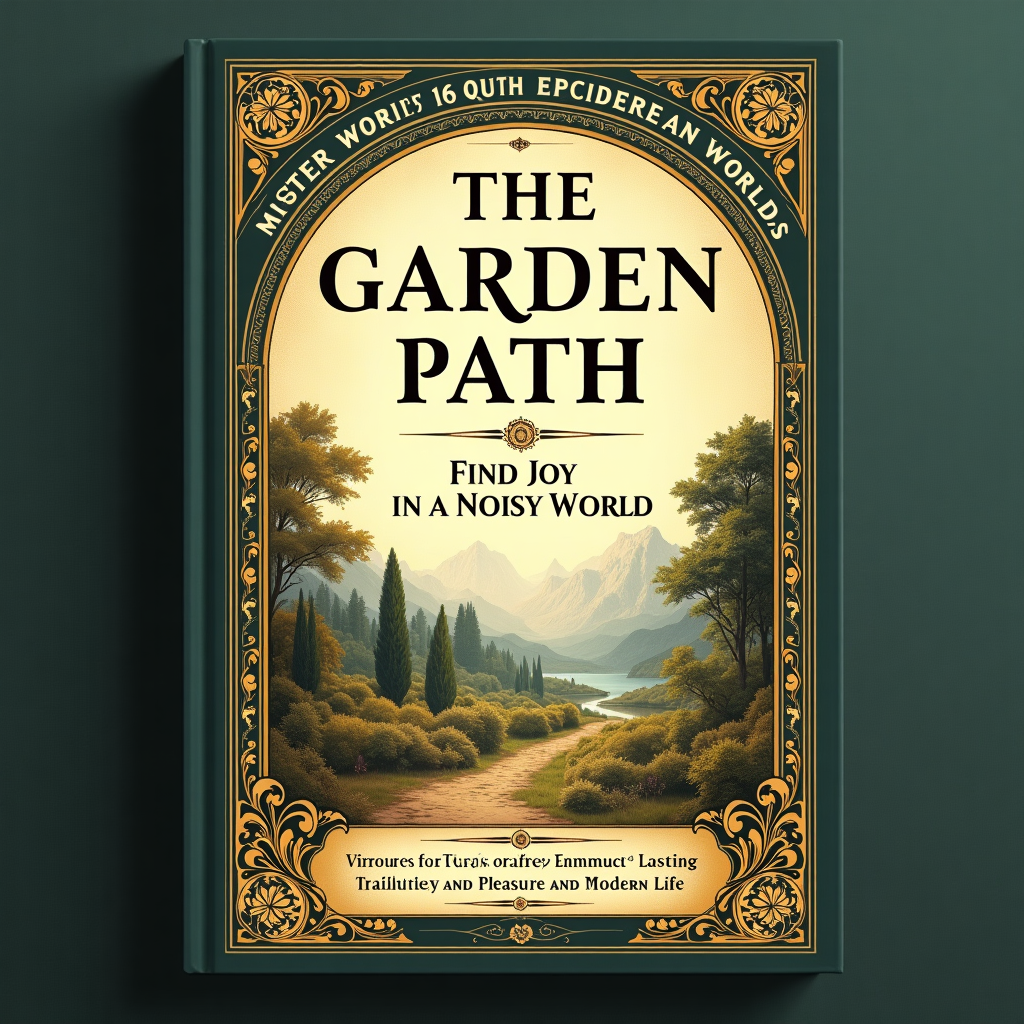
The Garden Path: Find Joy in a Noisy World
Epicurean Wisdom for Attaining Lasting Tranquility and Pleasure in Modern Life
For individuals feeling overwhelmed by modern demands and digital noise, seeking a philosophical framework for cultivating lasting happiness and peace of mind.
Contents
- Welcome to the Garden: Reclaiming True Pleasure
- The Art of Contentment: Mastering Desires
- Friendship: The Richest Harvest
- Fear Not: Conquering the Anxieties of Life and Death
- The Body and Mind: Seeking 'Aponia' and 'Ataraxia'
- Simple Pleasures: The Sweetness of Moderation
- Wisdom and Philosophy: The Path to Clarity
- The Sage's Outlook: Living with Grace and Gratitude
- Cultivating Your Own Garden: Practical Steps for Modern Life
- The Enduring Legacy: A Timeless Path to Peace
Welcome to the Garden: Reclaiming True Pleasure
In our bustling world, where notifications ping, headlines scream, and the relentless pursuit of "more" often leaves us feeling less, it's easy to lose our way. We’re told to hustle harder, buy newer, and scroll endlessly, all in the elusive chase for happiness. But what if lasting contentment isn't found in the relentless clamor, but in a quiet turning away? What if the secret to a life well-lived has been waiting for us, patiently, for over two millennia, nestled within a philosophy misunderstood and often maligned?
Imagine, for a moment, stepping out of the noise. Leaving behind the endless to-do lists, the curated social media feeds, and the pressure to perform. Instead, you find yourself walking along a shaded path, the air gently scented with herbs, the soft murmur of conversation your only companion. This is the Garden – the ancient school of Epicurus, a place not of austere denial, but of careful cultivation, where the seeds of tranquility were sown.
For too long, the word "Epicurean" has conjured images of lavish feasts and unrestrained indulgence. We picture overflowing goblets and decadent banquets, a philosophy dedicated to fleeting physical pleasures. Yet, this couldn't be further from the truth. Epicurus and his followers sought something far more profound: ataraxia, a state of serene freedom from disturbance, and aponia, the absence of physical pain. They understood that true pleasure wasn't found in excess, which often brings discomfort and anxiety, but in a thoughtful, moderate approach to life, rooted in friendship, reflection, and quiet contentment. This ancient wisdom offers a powerful antidote to the anxieties of our fast-paced lives, reminding us that lasting contentment is truly within reach.
Dispelling the Myth: Pleasure Beyond Indulgence
The biggest hurdle in understanding Epicureanism is often its association with hedonism. Let's clarify: Epicurus certainly believed that pleasure was the ultimate good, but he defined pleasure in a way that radically differed from the popular imagination. For him, the highest pleasure was not a thrill or a rush, but a calm, steady state of being free from pain and mental agitation.
Consider the difference between a fleeting sugar rush and the sustained satisfaction of a nourishing meal shared with loved ones. The former offers a brief spike followed by a crash, while the latter provides deep, enduring contentment. Epicurus understood this distinction profoundly.
- The Absence of Pain: "We call pleasure the beginning and end of the blessed life. For we recognize pleasure as the primary and innate good; from it we begin every choice and avoidance, and to it we return, using the feeling as the standard by which we judge every good." – Epicurus. He wasn't advocating for wild abandon, but for a life carefully constructed to minimize physical suffering and mental distress.
- Mental Tranquility over Physical Excess: "When we say, then, that pleasure is the goal, we do not mean the pleasures of the profligate or the pleasures of sensuality, as some ignorant persons think, or those who do not agree with us or have misinterpreted our doctrines, but freedom from pain in the body and from trouble in the mind." – Epicurus. This is the core message: true pleasure is a state of peaceful equilibrium.
- The fleeting nature of intense pleasure: Lucretius, a Roman poet who eloquently presented Epicurean philosophy, observed that even the most intense physical pleasures quickly diminish and can lead to dissatisfaction if pursued relentlessly. "For as much as the nature of things itself shows that all these things are vain, and as it were a burden on the spirit, which ever wants to be free from them." – Lucretius.
The True Pillars of a Joyful Life
So, if not endless feasting, what did Epicurus advocate for? He pointed to simpler, more reliable sources of joy that are entirely within our control. These pillars form the bedrock of an Epicurean life:
Friendship (Philia): This was paramount. Epicurus believed that the greatest contributor to happiness was a circle of trusted friends. In the Garden, students lived together, shared meals, and engaged in philosophical discourse. These relationships provided security, comfort, and intellectual stimulation.
- "Of all the means to ensure happiness throughout the whole life, by far the most important is the acquisition of friends." – Epicurus.
- "The wise man is an excellent neighbor, and if he has a friend, he will call him a god." – Hermarchus.
- "We must not only help friends but also those who are not friends." – Epicurus. This speaks to a broader sense of goodwill and community.
Freedom (Eleutheria): Epicurus encouraged a life of self-sufficiency, free from political ambition, public life, and excessive financial dependence. This didn't mean poverty, but rather a moderate lifestyle that allowed for independence from the whims of others and the pressures of society.
- "Live unknown." – Epicurus. This famous dictum encouraged a quiet, private life, away from the spotlight and its accompanying anxieties.
- "We must free ourselves from the prison of public affairs and politics." – Philodemus. The goal was to avoid the stress and disappointment often associated with public life.
Thought (Logismos): Critical thinking, philosophical inquiry, and understanding the nature of the world were essential for Epicurean tranquility. By understanding the causes of fear (like fear of death or divine retribution), one could dispel them.
- "It is impossible to live a pleasant life without living prudently, honorably, and justly; and it is impossible to live prudently, honorably, and justly without living a pleasant life." – Epicurus. Prudence, or phronesis, was considered the greatest virtue, guiding all choices towards pleasure in the Epicurean sense.
- "The study of philosophy is not a luxury, but a necessity." – Epicurus. This wasn't about abstract academic pursuits, but practical wisdom for living.
The Garden as an Antidote to Modern Anxieties
In an age dominated by social media's curated perfection, consumerism's endless demands, and the burnout of 'hustle culture,' the Epicurean path offers a profound alternative. It reminds us that:
- True wealth is not material: It's found in a calm mind and rich relationships.
- Freedom comes from within: Not from external validation or endless acquisition.
- Joy is often found in simplicity: A quiet meal, a good conversation, the absence of worry.
Horace, a Roman poet who was deeply influenced by Epicureanism, beautifully captured this spirit: "Carpe diem, quam minimum credula postero" – "Seize the day, trusting as little as possible in tomorrow." This isn't a call to recklessness, but a gentle reminder to find contentment in the present, to appreciate what is truly good and lasting, and to let go of needless anxieties about the future.
As we journey through this book, we'll explore these themes in depth, discovering how the wisdom of the Garden can help us cultivate a life of profound peace and lasting joy, even amidst the noise of the 21st century.
Key takeaways
- Epicureanism defines true pleasure not as indulgence, but as ataraxia (freedom from mental disturbance) and aponia (absence of physical pain).
- The common misconception of Epicureanism as hedonistic excess is inaccurate; it advocates for moderation and thoughtful living.
- The primary sources of lasting joy, according to Epicurus, are friendship, freedom (self-sufficiency), and philosophical thought.
- This ancient philosophy offers a powerful framework for navigating modern anxieties by focusing on inner tranquility over external pursuits.
- Cultivating simple pleasures and meaningful connections leads to a more fulfilling and less stressful existence.
Welcome to the Garden: Reclaiming True Pleasure
In a world that often feels like a relentless stream of notifications, endless to-do lists, and the constant hum of expectation, it's easy to feel adrift. We’re told to hustle harder, buy more, and project an image of effortless perfection. Yet, beneath the surface, many of us yearn for something simpler, something more enduring than fleeting thrills or the fleeting validation of a digital 'like'. We seek, perhaps unknowingly, a quiet harbor in the storm.
Imagine, for a moment, stepping away from that clamor. Picture a serene garden, shaded by ancient trees, where the air is still and the only sounds are the gentle rustle of leaves and the murmur of quiet conversation among friends. This isn't just a fantasy; it’s a powerful metaphor for an ancient philosophy that, remarkably, offers a profound antidote to the anxieties of our 21st-century lives. This is the Garden of Epicurus, and it invites us to reclaim a truer, deeper understanding of pleasure.
For centuries, the very name Epicurus has been, perhaps unfairly, synonymous with lavish feasts and unbridled indulgence. Yet, nothing could be further from the truth of what he and his followers actually taught. Epicureanism, at its heart, is a philosophy of gentle moderation, deep friendship, and the quiet pursuit of wisdom, all aimed at achieving a state of profound tranquility known as ataraxia. It's about finding freedom from fear and disturbance, recognizing that the highest pleasures are often the simplest, and that true wealth lies not in accumulation, but in contentment.
This journey into the Garden is an invitation to pause, to breathe, and to consider how timeless wisdom can help us navigate the complexities of today. It’s about discovering that lasting contentment is not a distant peak, but a path we can begin walking today, right where we are.
Beyond the Misconception: True Pleasure, True Peace
The common image of Epicurus as a glutton living in luxury is a persistent caricature, one that misses the profound subtlety of his teachings. He was not advocating for reckless indulgence, but rather for a careful discernment of what truly brings lasting happiness and what merely leads to fleeting satisfaction followed by discomfort or regret. For Epicurus, pleasure was primarily the absence of pain and mental disturbance.
Consider how often we chase after things we believe will make us happy – a bigger house, a fancier car, the latest gadget. Yet, once acquired, the initial thrill often fades, leaving us perhaps no more content, and sometimes even more burdened by new anxieties. Epicurus understood this cycle intimately. He taught that the greatest pleasures are not those that excite the senses intensely, but those that bring a steady, calm satisfaction.
Here's what Epicurus himself had to say about pleasure:
"When we say that pleasure is the goal, we are not speaking of the pleasures of the profligate or of the pleasures of sensuality, as some ignorant persons suppose, but freedom from pain in the body and from trouble in the mind." – Epicurus, Letter to Menoeceus
This distinction is crucial. True Epicurean pleasure isn't about excess; it's about finding equilibrium. It's about recognizing that a simple meal shared with friends can bring more profound joy than an extravagant banquet eaten alone. It's about appreciating the quiet satisfaction of good health and a clear mind.
The Antidote to Modern Anxieties
In our age of relentless connectivity and consumerism, the wisdom of the Garden offers a powerful counter-narrative.
- Social Media Noise: We are constantly bombarded with curated images of others' lives, often leading to comparison, envy, and a sense of inadequacy. Epicureanism reminds us to cultivate genuine, deep friendships rather than superficial connections, and to find contentment in our own circumstances.
- Consumerism's Grip: The pressure to constantly acquire new things, to keep up with trends, creates a treadmill of desire that is never truly satisfied. Epicurus advocated for simple living, understanding that true security comes from needing less, not having more.
- Hustle Culture Burnout: The glorification of endless work and constant productivity often leads to exhaustion and a feeling of being perpetually behind. The Epicurean emphasis on moderation and tranquility encourages us to prioritize well-being and find balance, recognizing that a peaceful mind is far more valuable than endless striving.
As Epicurus's student, Metrodorus of Lampsacus, wisely observed:
"Remember that, while you are deferring, life is running away." – Metrodorus of Lampsacus (as quoted by Seneca)
This isn't an invitation to idleness, but a gentle nudge to live thoughtfully, to savor the present, and to recognize that happiness is not a destination to be reached after achieving certain external goals, but a way of living that can begin now.
The Pillars of a Tranquil Life
So, what does this practical philosophy look like in daily life? It rests on a few fundamental pillars:
- Moderation in all things: Not asceticism, but a careful balance. Enjoying good food and drink, but not to the point of discomfort. Seeking comfort, but not luxury that brings anxiety.
- Friendship: Cultivating deep, trusting relationships. The Epicureans lived in communities, often sharing meals and philosophical discussions. They believed that true friendship was one of the greatest sources of security and joy. As Epicurus wrote:
"Of all the means to ensure happiness throughout the whole life, by far the most important is the acquisition of friends." – Epicurus, Principal Doctrines
- Knowledge and Understanding: Freeing oneself from fear, especially the fear of death and the gods, through rational inquiry. Understanding the natural world helps dispel superstition and anxiety. Lucretius, a Roman Epicurean poet, dedicated his masterpiece De rerum natura (On the Nature of Things) to explaining the universe in Epicurean terms, aiming to free humanity from fear through knowledge.
- Self-Sufficiency and Simplicity: Reducing desires to what is natural and necessary, thereby lessening dependence on external factors and the anxieties they bring. This doesn't mean deprivation, but rather appreciating the simple gifts of life.
The wisdom of the Garden path is not about grand gestures or dramatic transformations. It's about a quiet reorientation, a gentle shift in perspective that allows us to find profound joy in the everyday, to cultivate peace from within, and to navigate the noise of the world with a calm and resilient spirit. It’s a reminder that the highest pleasures are often the simplest, and that freedom from fear and disturbance is the greatest wealth we can possess.
Key takeaways
- Epicureanism is a philosophy of ataraxia (tranquility) and aponia (absence of bodily pain), not hedonistic indulgence.
- True pleasure is primarily the absence of pain and mental disturbance, found in moderation, friendship, and knowledge.
- The Garden offers an antidote to modern anxieties like social media pressures, consumerism, and burnout culture.
- Lasting contentment comes from cultivating deep friendships, living simply, and freeing oneself from fear through understanding.
- Reclaiming true pleasure means prioritizing inner peace and genuine connections over external achievements and material accumulation.
The Art of Contentment: Mastering Desires
In our busy world, it often feels as though we are caught in a current, constantly being swept towards the next thing we are told we need. From the latest smartphone to a new trend in wellness, the messages are clear: to be happy, to be complete, you must acquire more, experience more, achieve more. This endless pursuit can leave us feeling perpetually restless, never quite satisfied, always looking over the horizon for what’s next. But what if the secret to contentment wasn't in gaining more, but in understanding what truly fulfills us, and what simply distracts us?
The ancient Epicureans, with their gentle wisdom, understood this dynamic profoundly. They recognized that much of our unease stems not from a lack of resources, but from an unexamined relationship with our own desires. Imagine a quiet garden, where the sun warms your skin, and a simple meal nourishes you. In such a place, the clamor of external demands fades, and a deeper sense of peace emerges. This isn't about austerity or self-denial; it's about a clear-eyed discernment, a gentle inquiry into what truly brings us lasting tranquility—what the Epicureans called ataraxia, freedom from disturbance.
Epicurus himself offered a profoundly liberating framework for understanding our desires, distinguishing between them not to suppress them, but to master them. This understanding can be a powerful antidote to the anxieties of the 21st century, helping us navigate the noise of social media, the pressure of consumerism, and the burnout from 'hustle culture'. It is a path to finding true sufficiency, right here, right now.
Unpacking Our Desires: Natural, Necessary, and Vain
Epicurus categorized desires into three distinct types, providing a map for navigating the complex landscape of our wants. By carefully considering each, we can begin to untangle what truly serves our well-being from what merely binds us to an endless cycle of dissatisfaction.
Natural and Necessary Desires: These are fundamental to our survival and comfort. Think of hunger, thirst, shelter, and the warmth of companionship. Satisfying these desires brings genuine relief from pain and discomfort, leading to a profound sense of well-being. They are easily fulfilled and, once met, allow for a state of calm.
- "The cry of the flesh is not to be hungry, not to be thirsty, not to be cold. For if one has these, and is confident of having them, one might contend even with Zeus for happiness." – Epicurus
- Consider: How often do we truly pause to appreciate the simple satisfaction of a nourishing meal, a cool drink, or the comfort of a safe home? In a world of endless choices, these basic fulfillments are often overlooked.
Natural but Unnecessary Desires: These desires are natural, in that they relate to pleasure, but are not essential for avoiding pain or survival. Examples include gourmet food instead of simple sustenance, luxurious clothing instead of adequate cover, or lavish homes instead of functional shelter. While they can bring pleasure, pursuing them often involves effort, expense, and potential disappointment if they are not met. They don't remove pain, but add a layer of optional pleasure.
- "He who least needs tomorrow, will most gladly greet tomorrow." – Epicurus (Fragment 14)
- Consider: The craving for a specific brand of coffee, or a particular fashion item. These bring momentary delight, but their absence doesn't cause suffering, and their pursuit can often lead to unnecessary stress or debt.
Unnatural and Unnecessary (Vain) Desires: These are artificial desires, often instilled by societal pressures, advertising, or comparison with others. They have no natural limit and can never be truly satisfied, leading to a perpetual state of wanting. Examples include desires for immense wealth, power, fame, or extravagant luxury. These desires are often sources of anxiety, competition, and disturbance, pulling us away from inner peace.
- "Empty is the argument of the philosopher by which no human suffering is therapeutically treated. For just as there is no profit in medicine if it does not expel the diseases of the body, so there is no profit in philosophy either, if it does not expel the suffering of the mind." – Epicurus (Fragment 221)
- "The wise man, though he will not be a slave to luxury, will not be a stranger to it when it comes his way." – Horace (Epistles I.17)
- Consider: The relentless pursuit of 'likes' on social media, the yearning for a celebrity lifestyle, or the insatiable drive for more and more money beyond what is needed for comfort and security. These are bottomless pits that trap us in a cycle of craving.
Cultivating Sufficiency: The Path to Freedom
The Epicurean approach is not about renouncing all pleasure but about understanding which pleasures truly contribute to our tranquility and which merely create further agitation. By focusing on satisfying our natural and necessary desires, we free up immense mental and emotional energy.
- Simplicity in Eating and Drinking: Epicurus famously advocated for simple meals, finding profound pleasure in bread, water, and cheese. This wasn't about deprivation, but about savoring the fundamental joys of nourishment without the complications of excess.
- "Send me some cheese, so that when I want to feast I may do so." – Epicurus (Letter to a Friend)
- This isn't to say never enjoy a fine meal, but to recognize that true satisfaction doesn't depend on it.
- The Value of Friendship: Among the most necessary of desires, Epicurus placed friendship. Genuine connection, mutual trust, and shared conversation were considered essential for a tranquil life, far more valuable than material possessions.
- "Of all the means which wisdom acquires for ensuring happiness throughout the whole of life, by far the most important is friendship." – Epicurus (Principal Doctrines 27)
- Mindful Consumption: In a consumer-driven world, understanding these categories empowers us to make conscious choices. Before acquiring something new, we can ask ourselves: Is this natural and necessary? Natural but unnecessary? Or is it a vain desire being fueled by external pressures? This simple inquiry can be profoundly liberating.
- "Wealth consists not in having great possessions, but in having few wants." – Epicurus (Vatican Sayings 77)
By mastering our desires, we gain control over our inner landscape. We become less susceptible to the incessant demands of the external world and more attuned to the quiet joys that are always available to us. This is the art of contentment: recognizing that freedom from fear and disturbance is the greatest wealth, and that the highest pleasures are often the simplest.
Key Takeaways
- Differentiate between natural/necessary, natural/unnecessary, and vain desires to understand their true impact on happiness.
- Prioritize satisfying natural and necessary desires for genuine relief from pain and lasting tranquility.
- Recognize that vain desires, often fueled by external pressures, lead to perpetual dissatisfaction and anxiety.
- Cultivate a sense of sufficiency by appreciating simple pleasures and the value of fundamental needs being met.
- Embrace friendship and genuine human connection as a cornerstone of lasting well-being, surpassing material pursuits.
Friendship: The Richest Harvest
In a world humming with digital connections, where our screens flicker with countless 'friends' and 'followers,' it's easy to mistake quantity for quality. We scroll through curated lives, feeling both connected and, paradoxically, more alone than ever. The ancient Epicureans, living in a time without the internet's clamor, understood a profound truth that resonates deeply today: genuine friendship is not merely pleasant, but absolutely essential for a tranquil and joyful life. They saw it not as a fleeting distraction, but as the very bedrock of our well-being, a sanctuary from the anxieties of the world.
Epicurus himself recognized that while we can cultivate inner peace through self-sufficiency, true security and the deepest joys are found in the embrace of others. His "Garden" was not just a school of thought; it was a community, a living testament to the power of shared life. Here, individuals gathered not to debate abstract theories in isolation, but to live out their philosophy side-by-side, supporting each other through life's inevitable challenges. This vision offers a gentle invitation to re-evaluate our own relationships, seeking depth over breadth, and cultivating those precious bonds that truly nourish the soul.
The Foundation of Security and Joy
For Epicurus, friendship was more than just companionship; it was a practical necessity for ataraxia, or freedom from disturbance. Think of it: when you face a difficult decision, a personal loss, or simply need a listening ear, who do you turn to? It is often a trusted friend, someone who offers comfort, perspective, and unwavering support. This sense of security, knowing you are not alone, was paramount.
Epicurus articulated this beautifully:
"Of all the means to ensure happiness throughout the whole life, by far the most important is the acquisition of friends." – Epicurus, Principal Doctrines, 27
This isn't about transactional relationships or accumulating allies for personal gain. It's about a mutual exchange of care and trust that acts as a buffer against life's uncertainties. Imagine the relief of knowing you have someone who will stand by you, not out of obligation, but out of genuine affection. This profound sense of belonging reduces fear, eases anxieties, and allows us to face the world with greater courage.
The Epicureans understood that human beings are social creatures. While they advocated for self-sufficiency in terms of mastering desires, they never suggested a path of isolation. On the contrary, they saw chosen friendships as an extension of the self, a chosen family that provides comfort and intellectual stimulation.
Cultivating Deep Connections in a Fragmented World
In our hyper-connected age, authentic friendship can feel like a rare commodity. We have thousands of digital acquaintances, yet often yearn for the quiet intimacy of a deep conversation. The Epicurean approach encourages us to be deliberate and discerning in our friendships, prioritizing quality over quantity.
Here’s how we can apply their wisdom:
- Prioritize Presence: Put down your phone. Turn off notifications. When you are with a friend, be truly present. Listen actively, engage genuinely, and let them feel your undivided attention. This simple act builds intimacy far more effectively than any shared social media post.
- Share Vulnerabilities: True friendship flourishes in an atmosphere of trust and openness. Be willing to share your true self, your fears, and your joys. It's in these moments of vulnerability that genuine bonds are forged.
- Offer Mutual Support: Friendship is a two-way street. Be there for your friends in times of need, just as you would hope they would be there for you. This reciprocal care deepens the relationship and reinforces the sense of security.
- Engage in Meaningful Activities: Instead of just passively consuming content together, engage in activities that foster conversation and shared experience. Cook a meal, go for a walk, read a book together, or discuss ideas that stimulate your minds.
Metrodorus of Lampsacus, a close disciple of Epicurus, emphasized the profound comfort found in such relationships:
"It is nobler to confer a benefit than to receive one, for the former implies self-sufficiency, the latter dependence." – Metrodorus of Lampsacus (as quoted by Seneca, Epistulae Morales, 9.17)
While this might seem to contradict the idea of mutual benefit, Metrodorus highlights the joy and strength that comes from being able to give, showcasing the self-assuredness that true friendship fosters. It's not about being indebted, but about the robust capacity to care for others.
Lucretius, a later Roman Epicurean, beautifully captured the essence of shared human experience and the comfort it brings:
"It is sweet, when on a great sea the winds trouble the waters, to gaze from the land on the great struggles of another." – Lucretius, De Rerum Natura, Book II, 1-2
While perhaps not directly about friendship, this quote speaks to the human tendency to find solace in perspective, and true friends offer us that perspective, helping us navigate our own storms by sharing their insights and presence.
The Joy of Shared Life
The Epicurean Garden was a place where friends not only supported each other but also found immense joy in shared simple pleasures. They understood that the richest experiences are often those enjoyed in good company, whether it's a simple meal, a quiet conversation under the stars, or the shared pursuit of knowledge.
Hermarchus, another follower of Epicurus, reflected on the deep satisfaction derived from these bonds:
"One must not only have friends, but also have the courage to trust them." – Hermarchus (as quoted by Seneca, Epistulae Morales, 3.2)
This underscores the active choice and vulnerability required to cultivate truly deep connections. It's a testament to the belief that the rewards far outweigh any perceived risks.
The Roman poet Horace, who was influenced by Epicurean thought, often celebrated the joys of friendship and good company:
"What better than a cheerful friend?" – Horace, Satires, Book I, 5, 44
This simple line encapsulates the profound happiness that genuine friendship brings. It's the laughter, the shared understanding, the quiet comfort of knowing you are truly seen and valued.
In a world that often pushes us towards isolation and competition, the Epicurean emphasis on friendship reminds us that our greatest wealth often lies in the people we choose to share our lives with. These are the relationships that provide comfort, stimulate our minds, and offer a profound sense of belonging, making the journey of life not just bearable, but truly joyful.
Key takeaways
- Friendship is essential for ataraxia (tranquility) and security.
- Prioritize a few deep, meaningful relationships over many superficial ones.
- Cultivate presence, vulnerability, and mutual support in your friendships.
- Share simple pleasures and intellectual stimulation with trusted companions.
- True friends offer comfort, perspective, and a sanctuary from life's anxieties.
Fear Not: Conquering the Anxieties of Life and Death
In our bustling 21st-century world, it often feels as though anxiety is a constant companion. We fret over our careers, our finances, our health, the opinions of others, and the relentless stream of bad news from every corner of the globe. These worries, though cloaked in modern specifics, are echoes of ancient fears—the fear of the unknown, of suffering, and ultimately, of our own mortality. Epicurus, with his profound understanding of human nature, recognized these fundamental anxieties as significant barriers to ataraxia, or tranquility. He offered not a fleeting distraction, but a powerful, four-part remedy, a philosophical medicine cabinet for the soul known as the tetrapharmakos. Let's explore how this ancient wisdom can help us dissolve the irrational terrors that plague our present-day lives.
The Four-Part Cure for a Troubled Mind
Epicurus understood that many of our deepest disturbances arise from misconceptions. By addressing these directly, he sought to liberate us from unnecessary suffering.
Do not fear the gods. In Epicurus's time, the Olympian gods were often depicted as capricious, vengeful beings who intervened in human affairs, demanding sacrifices and punishing transgressions. This created widespread fear and superstition. Epicurus, however, proposed a different view. He believed that if gods exist, they are beings of perfect bliss and tranquility, entirely unconcerned with human affairs. They neither reward nor punish. They are models of ideal happiness, not sources of dread.
Imagine the relief this brought to people living under the shadow of divine wrath! For us, in a more secular age, this teaching might translate to freedom from any external, judgmental force that dictates our worth or happiness. It's an invitation to release the burden of seeking approval from an imagined higher power or from the often equally demanding "gods" of social media and public opinion.
"The blessed and immortal being has no troubles himself and brings no trouble upon any other being, so that he is not affected by anger or gratitude, for all such things are signs of weakness." – Epicurus, Principal Doctrines, 1
Do not fear death. This is perhaps the most profound and comforting aspect of Epicurean philosophy. The fear of death, Epicurus argued, is irrational because death is simply the cessation of sensation. When we are alive, death is not present. When death is present, we are not. Therefore, death is nothing to us. Our consciousness, our ability to feel pleasure or pain, ceases with the dissolution of the body.
Consider the immense mental energy we expend worrying about what happens after death, or the pain of dying. Epicurus invited us to reclaim that energy for living. If there is no afterlife of torment or reward, then our focus should be entirely on making the most of the life we have, free from this ultimate dread.
"Accustom yourself to believing that death is nothing to us, for good and evil exist only in sensation, and death is the privation of sensation." – Epicurus, Letter to Menoeceus
"Death, therefore, the most awful of evils, is nothing to us, seeing that, when we are, death is not come, and, when death is come, we are not." – Epicurus, Letter to Menoeceus
"For where we are, death is not; where death is, we are not." – Lucretius, De rerum natura, Book III
Pain is easy to endure. While Epicurus acknowledged that pain exists, he distinguished between acute, short-lived pain and chronic, debilitating pain. He argued that intense pain is usually brief, and mild pain is tolerable. If pain is truly overwhelming and prolonged, it often leads to death, which, as we've just discussed, is nothing to us. This perspective encourages us to face discomfort with a calm resolve, understanding its nature and limits.
In our modern lives, we often catastrophize about future discomforts—a difficult conversation, a challenging project, a physical ailment. Epicurus reminds us to assess pain rationally. Is it truly unbearable, or is our fear of it magnifying its actual impact? By understanding that pain, too, has its boundaries, we can reduce our anxiety about suffering.
"Continuous bodily pain does not last long; instead, pain, if extreme, is present for a very short time, and even that degree of pain which barely exceeds the pleasure in the body does not last for many days. Illnesses of long duration contain an excess of pleasure over pain." – Epicurus, Vatican Sayings, 4
"He who says that all things happen of necessity can make no criticism of him who says that not all things happen of necessity." – Hermarchus, from Plutarch, Against Colotes (This quote, while not directly about pain, speaks to the freedom from fatalism that Epicurean thought encourages, allowing us to actively manage our perceptions of suffering.)
What is good is easy to obtain. The final part of the tetrapharmakos reminds us that the things truly necessary for happiness—freedom from pain and mental disturbance—are readily available. We don't need immense wealth, lavish feasts, or constant entertainment. Simple pleasures, good food, shelter, and above all, friendship, are sufficient. This stands in stark contrast to the consumerist narratives that tell us we need more, better, and newer things to be happy.
This teaching is a powerful antidote to the pressures of consumerism and the 'hustle culture' that drives us to constantly acquire and achieve. It invites us to pause, look around, and appreciate the abundance of simple goods that already surround us, and the profound richness of human connection.
"The wise man is happy even on the rack." – Metrodorus of Lampsacus, from Seneca, Epistles, 66.45 (This extreme example highlights the Epicurean belief that tranquility is an internal state not easily disturbed by external circumstances, even pain, as the good of wisdom and freedom from fear remains.)
"For it is not the stomach that is insatiable, as is commonly said, but the false opinion that the stomach needs an unlimited amount of food." – Epicurus, Vatican Sayings, 59
"For it is not drinking and continuous parties, nor sexual pleasures, nor the enjoyment of fish and other delicacies of a luxurious table, which produce the pleasant life, but sober reasoning, searching out the grounds of every choice and avoidance, and banishing those beliefs through which the greatest tumults take possession of the soul." – Epicurus, Letter to Menoeceus
By internalizing these four truths, we can begin to dismantle the mental prisons of fear and worry that so often overshadow our days. The path to a tranquil mind is not about avoiding life's challenges, but about understanding them for what they truly are, and realizing that within us lies the capacity for profound peace.
Key takeaways
- Release irrational fears: Many anxieties are based on misconceptions about gods, death, or suffering.
- Death is nothing to us: When we exist, death is not; when death exists, we do not.
- Pain is manageable: Intense pain is brief; mild pain is tolerable.
- True good is accessible: Happiness comes from simple pleasures, not endless acquisition.
- Live fully in the present: Free from fear, we can savor the beauty of life right now.
The Body and Mind: Seeking 'Aponia' and 'Ataraxia'
In our journey through the Garden, we've spoken of pleasure not as fleeting indulgence, but as a deeper, more enduring state of being. Now, we turn our gaze inward, to the very vessels that carry us through life: our bodies and our minds. In a world that often celebrates extremes – extreme diets, extreme workouts, extreme mental "hustle" – the Epicureans offered a path of profound simplicity and balance. Their wisdom reminds us that true well-being isn't found in constant stimulation or relentless pursuit, but in the gentle cultivation of two profound states: aponia, freedom from bodily pain, and ataraxia, freedom from mental disturbance.
Imagine aponia not as the absence of all sensation, but as the quiet hum of a body at ease, free from the pangs of hunger, thirst, or illness that could be avoided. It's the comfort of a well-rested body, nourished appropriately, and allowed to move with natural grace. And ataraxia? This is the deep, undisturbed calm of a mind unburdened by irrational fears, anxieties about the future, or the clamor of external expectations. It's the feeling of inner peace that allows you to truly be present, to savor the simple joys, and to navigate life's inevitable challenges with equanimity. These aren't abstract ideals; they are tangible states of being, within reach, if we simply learn to listen to our true needs rather than the insistent demands of the outside world.
Nurturing the Body: The Path to Aponia
The Epicureans understood that our physical state profoundly impacts our mental tranquility. A body in distress makes a calm mind a distant dream. Yet, their approach to nurturing the body was far from austere or punishing. It was about intelligent moderation, understanding our limits, and recognizing that the highest physical pleasure is simply the absence of pain and discomfort. This isn't about denying ourselves pleasure, but about discerning which pleasures lead to lasting well-being and which lead to eventual pain or regret.
Consider the simple act of eating. In our modern world, food is often a source of anxiety, guilt, or overindulgence. The Epicureans, however, saw it as a means to sustain life and enjoy simple flavors, without excess.
"I spit on the pleasures of luxury, and on the enjoyments of banquets, not because they are evil in themselves, but because they are followed by troubles." - Epicurus
This isn't a condemnation of a delicious meal, but a gentle reminder that the lasting trouble (indigestion, guilt, health issues) often outweighs the fleeting thrill of overindulgence. To cultivate aponia in our bodies, we can consider:
- Mindful Consumption: Eating to satisfy hunger, not to escape boredom or stress. Choosing nourishing foods that feel good to our bodies, rather than chasing every new dietary trend.
- Adequate Rest: Recognizing sleep not as a luxury, but as a fundamental need for physical restoration and mental clarity.
- Gentle Movement: Engaging in physical activity that brings joy and strengthens the body, without pushing it to the point of injury or exhaustion, which can lead to pain.
- Avoiding Excess: Whether it's too much food, too much alcohol, or too much screen time, understanding that extremes often lead to physical discomfort and disturbance.
"The beginning and root of all good is the pleasure of the stomach; even wisdom and culture must be referred to this." - Epicurus
This famous quote, often misinterpreted, highlights that satisfying our most basic physical needs (freedom from hunger, thirst, cold) is the foundation upon which higher pleasures like wisdom and culture can be built. A body free from pain is the canvas for a mind free from disturbance.
Cultivating the Mind: The Path to Ataraxia
While aponia addresses the body, ataraxia is the domain of the mind. It's the state of inner calm, free from the turbulent waves of anxiety, fear, and irrational desires that so often plague us in the 21st century. Social media, constant news cycles, and the pressure to 'keep up' can feel like a relentless assault on our mental peace. The Epicureans, however, offered powerful tools to shield our minds and cultivate a quiet inner sanctuary.
"The disturbed mind is never at peace, but wanders from place to place, seeking what it cannot find, and finds what it cannot endure." - Lucretius
This sentiment resonates deeply today. Our minds, when unchecked, can become restless wanderers, amplifying worries and seeking external solutions to internal disquiet. To cultivate ataraxia, we can focus on:
- Philosophical Reflection: Regularly examining our beliefs, especially about fear, death, and the gods, to dismantle irrational anxieties. Understanding what is truly within our control and what is not.
- Limiting External Noise: Consciously curating our mental input. This means being selective about the news we consume, the social media we engage with, and the conversations we participate in. Just as we wouldn't consume unhealthy food, we should be mindful of unhealthy mental input.
- Cultivating Realistic Desires: As we explored in Chapter 2, understanding the difference between natural and necessary desires (easily satisfied) and vain desires (insatiable) is crucial for mental peace. Wanting what we already have is a profound source of contentment.
- Embracing Friendship and Community: As discussed in Chapter 3, the deep bonds of friendship provide emotional support and a sense of belonging, shielding us from loneliness and mental distress.
"The wise man is not disturbed by thoughts of what he does not possess, but takes pleasure in what he does possess." - Metrodorus of Lampsacus
This simple truth is a powerful antidote to consumerism and the 'comparison trap.' Ataraxia comes from within, from a mind that appreciates its present blessings rather than lusting after absent ones. It's the quiet joy of sufficiency, knowing that you have enough.
The Interwoven Nature of Body and Mind
It's vital to remember that aponia and ataraxia are not separate pursuits, but deeply interconnected states. A body wracked with pain makes mental tranquility difficult, and a mind consumed by anxiety can manifest in physical symptoms. The Epicurean approach is holistic, understanding that true flourishing arises when both body and mind are nurtured with wisdom and moderation. They remind us that the greatest wealth is not an abundance of possessions, but freedom from pain and disturbance.
"For it is not continuous drinking and reveling, nor the sexual life, nor the enjoyment of fish and other delicacies of a luxurious table, which produce a pleasant life; but sober reasoning, searching out the grounds of every choice and avoidance, and banishing those beliefs through which the greatest tumults take possession of the soul." - Epicurus
This quote perfectly encapsulates the Epicurean ideal: a life not of ascetic denial, but of intelligent choice, leading to a profound and lasting peace for both body and mind. By making conscious decisions about what we consume, how we rest, how we move, and what we allow into our mental landscape, we actively build a foundation for both aponia and ataraxia in our lives, finding quiet strength amidst the noise.
Key takeaways
- Aponia (freedom from bodily pain) and Ataraxia (freedom from mental disturbance) are the core Epicurean goals for well-being.
- Achieving aponia involves moderation in diet, adequate rest, and gentle physical activity, avoiding excesses that lead to discomfort.
- Cultivating ataraxia requires philosophical reflection, limiting mental noise, managing desires, and nurturing strong friendships.
- Body and mind are interconnected; true peace stems from nurturing both with wisdom and balance.
- The highest pleasures are often the simplest: the absence of pain and fear, allowing for profound contentment.
Simple Pleasures: The Sweetness of Moderation
In a world that constantly whispers, and often shouts, that happiness is found in more – more possessions, more experiences, more complexity – it's easy to feel as though we're perpetually falling short. The curated perfection of social media feeds, the relentless advertising, and the pressure to keep up can leave us feeling depleted, always striving for the next big thing. Yet, what if the secret to profound joy isn't in accumulation, but in appreciation? What if true richness lies not in extravagance, but in the elegance of simplicity?
Epicurean wisdom offers a gentle counter-narrative to this modern clamor. It invites us to pause, to look around, and to rediscover the profound joy that resides in the ordinary, in the accessible, and in the quiet contentment that arises when we choose moderation. This isn't about austerity or deprivation; it's about a conscious, liberating choice to savor what truly nourishes us, rather than chasing fleeting thrills that leave us wanting more. It's about understanding that the highest pleasures are often the simplest, and that a life lived within our means, attuned to the beauty of the everyday, is a life of genuine abundance.
This ancient perspective on moderation isn't just a philosophical ideal; it's a practical pathway to reclaiming your peace in a demanding world.
The Delights of Enough
The Epicureans understood that true pleasure isn't amplified by excess; it's often diminished by it. Imagine a delicious meal: the first few bites are exquisite, full of flavor and satisfaction. But if you continue to eat far beyond satiety, the pleasure fades, replaced by discomfort. The same principle applies to almost every aspect of life. When we have just enough, we are free to appreciate it fully. When we have too much, the very abundance can become a burden, creating new anxieties about maintenance, loss, or the pressure to acquire even more.
Epicurus himself championed this approach, not out of a sense of duty, but because he genuinely believed it led to a happier life. He found joy in simple meals shared with friends, in the comfort of a warm cloak, and in the intellectual stimulation of conversation.
"I am thrilled with pleasure in the body when I live on bread and water, and I spit on luxurious pleasures, not because they are bad in themselves, but because of the discomforts that follow them." – Epicurus
This isn't a call to self-denial, but a radical invitation to savor. When we consciously choose simplicity, we open ourselves to a deeper appreciation for things we might otherwise take for granted:
- A warm cup of tea on a quiet morning.
- The comfort of a good book.
- A walk in nature, noticing the changing seasons.
- The laughter of a friend over a modest meal.
- The feeling of a job well done.
These are the moments that truly enrich our lives, and they require very little, if any, material expenditure. They demand only our presence and our willingness to appreciate.
Freedom from the Fetters of Excess
One of the most powerful benefits of embracing moderation is the profound sense of freedom it confers. When our happiness isn't tied to acquiring the latest gadget, the biggest house, or the most exclusive experiences, we are liberated from the endless cycle of desire and disappointment. We become less susceptible to external pressures and the constant comparison that fuels so much modern anxiety.
Lucretius, a Roman poet and follower of Epicurus, eloquently described how this freedom from insatiable desires allows us to live more contentedly:
"For it is not by gold or purple garments, or shining lamps, or splendid banquets, or by drink that a man is set free from care, but by a sound mind and a pure heart." – Lucretius
Consider the practical implications of this freedom:
- Financial Peace: When we live within our means and find joy in what we have, financial stress diminishes. We are less likely to accumulate debt or feel enslaved by work just to maintain an extravagant lifestyle.
- Time Abundance: Less emphasis on acquiring and maintaining material possessions means more time for what truly matters: relationships, personal growth, hobbies, and rest.
- Mental Clarity: The constant pursuit of 'more' often clutters our minds with worries, comparisons, and dissatisfaction. A simpler life fosters a clearer, more tranquil mental landscape.
Hermarchus, another Epicurean, emphasized this practical aspect:
"The wise man will not be afraid of poverty, nor will he seek to be rich, for he knows how little is needed for happiness." – Hermarchus
This understanding allows us to redefine what "wealth" truly means. It's not about the size of our bank account, but the richness of our inner life, the strength of our friendships, and the tranquility of our minds.
Cultivating a Taste for the Simple
Developing an appreciation for the simple isn't a passive process; it's a conscious cultivation, a gentle retraining of our desires. In a world designed to distract us, we must actively choose to slow down and notice.
Here are a few ways to cultivate this taste for simple pleasures:
- Mindful Consumption: Before buying something new, ask yourself: Does this genuinely enhance my life or will it just add to clutter and complexity? Can I find joy in what I already possess?
- Digital Detox Moments: Regularly step away from screens. Engage with the physical world around you. Read a physical book, go for a walk without your phone, or simply sit in silence.
- Savoring Everyday Rituals: Turn routine tasks into opportunities for mindfulness. Enjoy the process of preparing a meal, cleaning your space, or tending to a garden.
- Gratitude Practice: Regularly reflect on the simple things you are grateful for – the warmth of your home, the taste of clean water, the sound of birdsong. As Philodemus suggested, "Pleasure is the absence of pain." Appreciating the absence of discomfort and the presence of basic comforts is a powerful source of contentment.
Horace, though not strictly an Epicurean, embodied many of their ideals, particularly in his celebration of rustic simplicity and the contentment found in a modest life. His odes often praise the quiet joys of the countryside over the anxieties of urban ambition.
"Happy the man, and happy he alone, / He who can call today his own: / He who, secure within, can say, / 'Tomorrow do thy worst, for I have lived today.'" – Horace
To live today, fully and contentedly, is the ultimate goal of embracing simple pleasures. It is a pathway to a life unburdened by insatiable wants, rich in genuine satisfaction, and deeply at peace.
Key takeaways
- True Epicurean pleasure is found in moderation, not extravagance.
- Embracing simplicity liberates us from the endless cycle of desire and dissatisfaction.
- Financial peace and time abundance are natural outcomes of a moderate lifestyle.
- Actively cultivate an appreciation for everyday joys through mindfulness and gratitude.
- The greatest wealth is not material possessions, but inner tranquility and rich relationships.
Wisdom and Philosophy: The Path to Clarity
In our hurried modern world, "philosophy" often conjures images of weighty tomes and academic debates, far removed from the everyday rhythm of life. Yet, for Epicurus and his followers, philosophy was anything but abstract. It was a vital, practical tool, a compass for navigating the often turbulent seas of existence. It wasn't about accumulating obscure knowledge, but about cultivating clarity of thought, sharpening our reason, and understanding the world in a way that genuinely served our well-being.
Imagine a bustling marketplace, full of vendors shouting their wares, each claiming theirs is the essential item you need. This is not unlike the constant clamor of modern life – social media trends, advertising slogans, political soundbites – all vying for our attention, telling us what to desire, what to fear, what to believe. Philosophy, in the Epicurean sense, is the quiet wisdom that allows us to step back from this noise, to discern what truly matters, and to make choices that lead to peace rather than perpetual striving. It’s about becoming our own calm, discerning guide amidst the chaos.
This ancient wisdom offers a powerful antidote to the overwhelm of the 21st century, helping us cut through the noise of misinformation and societal pressures to guide us towards choices that genuinely serve our happiness.
The Physician of the Soul
Epicurus famously believed that philosophy should be a "medicine for the soul." Just as a physician diagnoses and treats bodily ailments, philosophy was meant to diagnose and treat the disturbances of the mind – fear, anxiety, irrational desires, and false beliefs. It was a therapeutic practice aimed at achieving ataraxia, that profound state of tranquility.
Consider the common anxieties that plague us today:
- The fear of missing out (FOMO): Social media constantly presents idealized versions of others' lives, leading us to believe we are lacking or missing out on essential experiences.
- Consumerist pressure: Advertising relentlessly tells us that happiness is just one purchase away, fueling an endless cycle of desire and dissatisfaction.
- Burnout from 'hustle culture': The belief that our worth is tied to constant productivity and achievement, leading to exhaustion and a loss of joy in simple living.
Epicurean philosophy offers a framework to examine these pressures with clear eyes. It invites us to ask: Is this desire truly natural and necessary for my happiness? Or is it a "vain desire," manufactured by external forces, leading only to disturbance?
As Epicurus himself taught:
"Vain is the word of that philosopher by whom no suffering of man is healed."
This isn't about intellectual acrobatics; it's about practical application. It's about using reason to dismantle the false beliefs that cause us distress.
Cultivating Intellectual Virtues
To be a "philosopher" in the Epicurean sense wasn't to be cloistered in an ivory tower, but to actively engage with the world through reason and critical thought. This meant cultivating certain intellectual virtues:
- Clear Thinking: The ability to distinguish between true and false beliefs, between what is within our control and what is not.
- Reasoned Judgment: Making decisions based on rational assessment of consequences, rather than impulsive reactions or societal dictates.
- Self-Sufficiency of Mind: Developing an inner resourcefulness that makes us less dependent on external validation or material possessions for our happiness.
- Understanding of Nature: For Epicurus, understanding the natural world (physics) was crucial because it dispelled superstitious fears about gods, fate, and death, which were major sources of human anxiety.
Lucretius, a Roman Epicurean, beautifully articulated how understanding the nature of the universe could free us from fear:
"For as children are afraid of everything in the dark, so we sometimes dread in the light things no more to be feared than those which children imagine in the dark and tremble at the thought of."
By understanding the atomic nature of the universe and the mortality of the soul, one could overcome the fear of divine retribution or an afterlife of suffering. This wasn't a cold, mechanistic view, but a liberating one. It meant that this life, here and now, was the only one we had, and thus the most precious to cultivate for tranquility.
The Wisdom of Discernment
One of the most profound applications of Epicurean philosophy is in the art of discernment – knowing what to pursue and what to avoid to achieve ataraxia and aponia. Metrodorus of Lampsacus, a close disciple of Epicurus, emphasized the importance of this practical wisdom:
"He alone has discovered the art of living who has learned how to enjoy pleasure and how to avoid pain."
This isn't just about simple hedonism, but about intelligent, long-term decision-making. It’s about understanding that some immediate pleasures lead to greater pain, and some temporary discomforts lead to lasting peace.
For instance:
- Avoiding toxic relationships: While loneliness can be painful, a relationship filled with drama and conflict is far more disturbing to one's tranquility.
- Moderating consumption: The fleeting pleasure of excessive food or drink often leads to physical discomfort and mental regret.
- Rejecting endless ambition: The constant pursuit of more wealth or status, while offering temporary highs, often leads to anxiety, jealousy, and burnout.
Horace, a Roman poet influenced by Epicureanism, captured this sentiment beautifully, advocating for a balanced, thoughtful approach to life:
"He whose life is blameless and free from crime, needs not the darts of the Moor, nor the bow, nor the poisoned quiver."
This speaks to a life lived with integrity and clarity, where one's choices, guided by wisdom, naturally lead to a state of inner security and freedom from external threats or internal anxieties. The path to clarity, then, is not through more information, but through better discernment, enabling us to truly choose the experiences that nourish our peace.
Key takeaways
- Epicurean philosophy is a practical tool for living well, providing a "medicine for the soul" to heal mental disturbances.
- It encourages us to use reason to cut through societal noise and identify which desires truly contribute to our happiness.
- Cultivating intellectual virtues like clear thinking and reasoned judgment helps us make wise choices.
- Understanding the natural world can dispel irrational fears, freeing us to focus on cultivating tranquility in this life.
- The wisdom of discernment allows us to choose pleasures that lead to lasting peace and avoid pains that disturb our tranquility.
The Sage's Outlook: Living with Grace and Gratitude
Imagine a person who moves through the world with an unshakeable calm, whose inner peace remains undisturbed whether the sun shines or a storm rages. This is the ideal of the Epicurean sage, not a mythical figure, but a human being who has cultivated a profound understanding of what truly matters, freeing themselves from needless anxieties and embracing life with a deep, quiet joy. The sage isn't untouched by life's difficulties, but possesses a resilience, a wisdom, that allows them to meet challenges not with despair, but with a grounded acceptance and a focus on what remains good.
This outlook is a beacon in our noisy world, showing us that true strength lies not in endless striving or accumulation, but in a cultivated inner landscape of tranquility and a profound appreciation for the simple, enduring gifts of existence. By understanding the characteristics of this serene perspective, we can begin to weave its threads into the fabric of our own lives, finding grace even amidst chaos.
Cultivating Inner Resilience
The Epicurean sage understands that not everything is within our control. Life inevitably presents us with discomforts, losses, and unexpected turns. Rather than resisting these realities, the sage develops a form of mental fortitude, recognizing that our response to external events is where our true power lies. This isn't about stoicism in the sense of suppressing emotion, but about a clear-eyed acceptance and a focus on what can be salvaged, learned, or appreciated. It's about finding the inner calm to weather any storm, knowing that the greatest disturbances often come from within, from our fears and unmet desires, rather than from external circumstances.
This resilience is built upon:
- A Clear Understanding of What is Necessary: The sage distinguishes between natural and necessary desires (like food, water, shelter, friendship) and those that are unnatural and unnecessary (like fame, lavish feasts, endless wealth). By focusing on the former, they build a stable foundation that is less susceptible to external ups and downs.
- A Focus on the Present Moment: Anxiety often stems from dwelling on the past or worrying about the future. The sage, by contrast, is skilled at anchoring themselves in the present, finding contentment in what is available right now.
- The Practice of Remembering Past Pleasures: When faced with current difficulties, an Epicurean sage might recall moments of joy or tranquility, understanding that such experiences are a lasting possession that cannot be taken away. As Epicurus himself noted, "When we are in pain, we remember past pleasures, and when we are happy, we remember past pains." This perspective helps to balance the scales of experience.
The wisdom of the sage teaches us that our peace is not dependent on a perfect world, but on our cultivated response to the world as it is.
"The wise man is happy even on the rack." — Epicurus (Letter to Menoeceus)
"Do not spoil what you have by desiring what you have not; remember that what you now have was once among the things you only hoped for." — Epicurus
The Grace of Gratitude and Simplicity
Perhaps one of the most beautiful aspects of the sage's outlook is a profound sense of gratitude. Having stripped away the pursuit of fleeting, complex pleasures, they find immense joy in the simple, everyday occurrences that often go unnoticed. A shared meal with friends, the warmth of the sun, the quiet contemplation of nature – these become sources of deep and abiding satisfaction. This isn't a forced optimism, but a genuine appreciation born from a clear understanding of life's true value and the fleeting nature of existence.
Consider these ways gratitude manifests in the sage's life:
- Appreciation for Friendship: As we’ve explored, friendship is paramount in Epicurean thought. The sage cherishes their companions, understanding that these bonds are a source of security, comfort, and shared joy that money cannot buy.
- Contentment with Moderation: Rather than constantly seeking more, the sage finds fulfillment in enough. This moderation frees them from the endless cycle of wanting and enables them to savor what they have.
- Mindfulness of Natural Wonders: The beauty of the natural world, the changing seasons, the intricate workings of the cosmos – these are not just background noise but sources of wonder and contemplation for the sage. Lucretius, a devoted follower of Epicurus, spent an entire epic poem, De Rerum Natura, marveling at the universe and encouraging others to do the same.
This intentional focus on gratitude for the simple and readily available aspects of life is a powerful antidote to the consumerist cravings and social media comparisons that plague our modern minds.
"He who has forgotten how to live well does not know how to die well." — Epicurus (Vatican Sayings, 14)
"It is not so much our friends' help that helps us as the confidence of their help." — Epicurus (Principal Doctrines, 27)
"The greatest fruit of self-sufficiency is freedom." — Epicurus (Principal Doctrines, 40)
Living with Purpose and Serenity
The sage's outlook isn't passive; it is an active choice to live thoughtfully and deliberately. It means choosing tranquility over turmoil, understanding over ignorance, and genuine connection over superficial engagement. They understand that wisdom is not merely accumulated knowledge, but a way of living that consistently leads to 'ataraxia' – freedom from disturbance. This purposeful living allows them to navigate the complexities of the world with an inner compass set firmly on peace.
This involves:
- Continuous Self-Reflection: Regularly examining one's desires, fears, and beliefs to ensure they align with the pursuit of tranquility.
- Prudent Decision-Making: Weighing the long-term consequences of actions, choosing paths that lead to enduring peace rather than fleeting excitement.
- A Serene Acceptance of Mortality: As explored in previous chapters, the sage confronts the reality of death not with dread, but with a calm understanding that it is a natural part of life, freeing them to live more fully in the present.
The sage embodies a life lived with intentionality and grace, demonstrating that true wealth lies in a tranquil mind and a grateful heart, a profound lesson for anyone seeking calm in a chaotic age.
"Never fear the future. He who has lived well in the present has a good future." — Hermarchus, from a letter quoted by Philodemus
"Live for the moment, for the future is uncertain." — Horace (Odes 1.11, though reflecting a common Epicurean sentiment)
"The wise man neither rejects life nor fears death." — Metrodorus of Lampsacus
Key takeaways
- The Epicurean sage achieves enduring tranquility through resilience, gratitude, and purposeful living.
- Resilience is cultivated by understanding what is truly necessary and focusing on the present.
- Gratitude for simple pleasures and deep friendships is a cornerstone of the sage's contentment.
- Living with grace means making deliberate choices that prioritize inner peace over external demands.
- This ancient wisdom offers a powerful framework for navigating modern anxieties with calm and clarity.
Cultivating Your Own Garden: Practical Steps for Modern Life
We've walked together through the tranquil paths of the Garden, exploring the profound yet simple wisdom that Epicurus and his followers offered to a world similarly bustling and sometimes bewildering. We've seen how true pleasure isn't found in excess, but in the gentle art of contentment, in the warmth of friendship, and in freedom from fear. Now, as our journey nears its end, it's time to bring these timeless insights home, to weave them into the fabric of our modern lives, and to begin cultivating our own personal Garden of tranquility amidst the noise.
This isn't about grand gestures or radical renunciations. It's about small, intentional shifts, a subtle reorientation towards what truly nourishes our souls. It’s about recognizing that the greatest wealth isn't what we accumulate, but what we are free from – the anxieties, the insatiable desires, the constant demands on our attention. Just as a gardener carefully tends their plot, pulling weeds and nurturing tender shoots, we too can tend to our inner landscape, choosing what to cultivate and what to let go.
The beauty of Epicurean thought lies in its practicality, its groundedness in human experience. It doesn't ask us to become hermits or ascetics, but to live fully, wisely, and joyfully in the world as it is. It invites us to be discerning, to question the prevailing narratives of happiness, and to discover the quiet, profound satisfaction that comes from living in harmony with our deepest needs. This final chapter offers concrete suggestions, pathways to integrate this ancient wisdom into your daily rhythm, allowing you to experience the lasting calm and joy that Epicurus promised.
Mindful Consumption in a Material World
In an age of endless advertisements and instant gratification, the Epicurean call for moderation feels more vital than ever. Our screens are flooded with invitations to buy, to upgrade, to keep pace. But true contentment, as we've learned, doesn't lie in the acquisition of more, but in the appreciation of enough.
- Practice Intentional Purchasing: Before buying something new, pause and ask yourself: "Does this truly contribute to my well-being, my peace of mind, or my comfort? Or is it merely a fleeting desire fueled by external pressure?"
- Epicurus wisely noted, "The wealth required by nature is limited and is easy to procure; but the wealth required by vain fancies is endless."
- Embrace the Joy of Simplicity: Find pleasure in what you already possess. Can a favorite mug bring as much joy as a new gadget? Can a walk in nature be more satisfying than a shopping spree?
- Horace, a Roman poet influenced by Epicureanism, often celebrated the virtues of a modest life, advising, "He is rich who is satisfied with what he has."
- Declutter Your Space: A cluttered environment often reflects a cluttered mind. Regularly clearing out unnecessary items can create a sense of spaciousness and lightness, making room for clarity and peace.
Reclaiming Your Attention: Digital Detox and Real Connections
Our digital devices, while offering convenience, often become conduits for social comparison, information overload, and endless distractions – the very antithesis of Epicurean tranquility. Reclaiming our attention is one of the most powerful steps we can take.
- Schedule Digital Silence: Designate specific times each day or week when you completely disconnect from screens – no social media, no news feeds, no emails. Use this time for reading, nature, hobbies, or simply quiet reflection.
- Curate Your Digital Environment: Unfollow accounts that trigger anxiety, comparison, or envy. Seek out content that is uplifting, informative, or genuinely entertaining, rather than merely distracting.
- Prioritize In-Person Connections: Make a conscious effort to nurture your real-world friendships. Schedule regular meet-ups, phone calls, or shared activities.
- Epicurus famously stated, "Of all the means which wisdom acquires to ensure happiness throughout the whole of life, by far the most important is the possession of friends."
- Hermarchus, a student of Epicurus, emphasized the importance of shared experiences, noting "the greatest help one can give to another is to be a friend."
- Engage in Mindful Communication: When you are with friends or family, practice active listening. Put your phone away and give them your full, undivided attention.
Cultivating Inner Peace: Reflection and Gratitude
The Garden isn't just an external space; it's an internal sanctuary. Cultivating inner peace requires regular reflection and a conscious effort to appreciate the good in our lives.
- Practice Daily Reflection: Take a few moments each day to review your thoughts and feelings. What brought you joy? What caused disturbance? What could you do differently tomorrow?
- Philodemus, an Epicurean philosopher, encouraged self-examination to identify and eliminate sources of distress, emphasizing the importance of "rational choice and avoidance."
- Keep a Gratitude Journal: Regularly list things you are grateful for, no matter how small. This shifts your focus from what's lacking to what you already possess.
- Metrodorus of Lampsacus, a close disciple of Epicurus, often spoke of the profound joy found in "remembering past goods."
- Embrace the Power of Nature: Spend time outdoors. The quiet rhythm of nature—a walk in a park, sitting by a tree, watching the clouds—can be incredibly restorative and a powerful antidote to modern stress.
- Engage in Contemplative Practices: Whether it's meditation, deep breathing exercises, or simply sitting in quiet contemplation, these practices can help calm the mind and foster a sense of inner stillness.
- Lucretius, a Roman Epicurean, beautifully described the peace found in philosophical understanding: "How sweet it is, when on the great sea the winds are lashing the waters, to gaze from the land on the great struggles of another!" – not out of malice, but from the calm vantage point of having found tranquility.
Key takeaways
- Mindful Consumption: Question desires, appreciate enough, and declutter for inner calm.
- Digital Disconnection: Schedule screen-free time and prioritize real-world connections.
- Inner Cultivation: Practice daily reflection, gratitude, and spend time in nature.
- Friendship First: Actively nurture your friendships as the primary source of lasting joy.
- Embrace Simplicity: Find profound pleasure in the simple, accessible joys of life.
The Enduring Legacy: A Timeless Path to Peace
As our gentle walk through the Garden draws to a close, we find ourselves at a vantage point, looking back at the path we’ve traveled and forward to the life that awaits. We began this journey seeking an antidote to the clamor of our modern world – the relentless scroll, the ceaseless demands, the subtle anxieties that often overshadow the quiet joys. What we’ve discovered, through the wisdom of Epicurus and his followers, is not a complex doctrine, but a beautifully simple approach to living, profoundly relevant even after two millennia.
The enduring legacy of Epicureanism is its unwavering focus on what truly matters for human flourishing: tranquility of mind (ataraxia), freedom from bodily pain (aponia), and the deep satisfaction found in genuine connection and thoughtful living. It’s a philosophy that invites us to step away from the endless external chase and turn our gaze inward, to cultivate a rich inner life that no external storm can truly disturb. This ancient wisdom isn't a relic of the past; it is a living, breathing guide for navigating the complexities of the 21st century, offering a powerful counter-narrative to the pressures of consumerism, hustle culture, and digital noise. It reminds us that the highest pleasures are often the simplest, and that true freedom lies in liberation from fear and disturbance.
Reclaiming Our Inner Sanctuary
In a world that constantly bombards us with messages of scarcity and inadequacy, Epicureanism offers a profound sense of sufficiency. It teaches us to find contentment not in accumulating more, but in desiring less, and in appreciating what we already possess. This isn't about austerity; it's about clarity – understanding that true happiness isn't bought, but cultivated.
Consider the constant pressure to "keep up" or to achieve ever-greater external markers of success. Social media often paints a picture of unattainable perfection, fueling comparison and dissatisfaction. The Epicurean path, however, encourages us to define success on our own terms, centered on peace of mind and meaningful relationships. It’s a quiet rebellion against the external din, an invitation to build an inner sanctuary where genuine joy can flourish.
Metrodorus of Lampsacus, one of Epicurus’s closest companions, reminds us of the importance of this inner focus:
"He who has made a bad choice for himself has made a bad choice for himself."
This succinct statement underscores our personal responsibility in shaping our contentment. We choose what we pursue, what we value, and ultimately, what brings us peace or disturbance. The power to cultivate our own happiness truly lies within our grasp.
The Power of Gentle Living
The principles we’ve explored—moderation, friendship, the pursuit of wisdom, and the conquering of fear—are not arduous tasks, but gentle invitations to a more fulfilling way of life.
- Moderation liberates us from the tyranny of excessive desires, showing us that the enjoyment of simple things far surpasses the fleeting thrill of overindulgence. It’s about savoring, not gorging.
- Friendship stands as the cornerstone of a happy life, providing a wellspring of joy, support, and shared understanding that no material possession can ever replicate.
- Wisdom and Philosophy equip us with the tools to understand the world, to distinguish true needs from empty desires, and to navigate life’s challenges with grace.
- Conquering Fear—especially the fear of death and the gods—frees us from ancient anxieties that still manifest in modern worries about control, loss, and the unknown.
This gentle approach is not passive; it is an active choice to steer our lives toward tranquility. It’s a conscious decision to prioritize mental peace over external validation, deep connections over superficial acquaintances, and quiet contemplation over constant stimulation.
As Philodemus, a later Epicurean, noted:
"For it is not the things that come from without that disturb men, but the opinions they have about them."
This profound insight is perhaps more relevant today than ever. In an age of information overload, our internal narratives and interpretations of events hold immense power. Cultivating an Epicurean mindset means consciously choosing perspectives that foster calm, rather than anxiety, recognizing that our inner world is largely within our control.
Cultivating Your Own Garden in the Modern World
The "Garden" of Epicurus was a physical place, but it was also a metaphor for a way of living – a secluded space where like-minded individuals could pursue wisdom and friendship, free from the distractions and pressures of the city. Today, your "Garden" might not be a physical plot of land, but a mental space you cultivate.
- Establish boundaries: Learn to say no to commitments that don't align with your values or that drain your energy. Protect your time for rest, reflection, and meaningful connection.
- Curate your digital environment: Unfollow accounts that trigger comparison or negativity. Seek out content that inspires, informs, or brings you genuine joy.
- Prioritize real-world connections: Make time for face-to-face interactions with friends and loved ones. These are the true sources of lasting happiness.
- Practice mindful consumption: Be intentional about what you buy, what you eat, and how you spend your leisure time, choosing quality and true pleasure over fleeting trends.
- Embrace quiet time: Schedule moments of solitude for reflection, reading, or simply being present without distraction.
The enduring message of Epicureanism is one of empowerment. It reminds us that profound happiness is not a distant goal, but a present possibility, accessible to all who choose to cultivate it with wisdom and intention. The path to peace is not found in a grand revolution, but in the quiet, consistent practice of living well, day by day.
Horace, a Roman poet influenced by Epicurean thought, beautifully captured this sentiment:
"Carpe diem, quam minimum credula postero." (Seize the day, trusting as little as possible in the future.)
While often misconstrued as an invitation to reckless indulgence, in the Epicurean context, "Carpe Diem" is a call to appreciate the present moment, to find joy in what is available now, and to release anxieties about an uncertain tomorrow. It's an invitation to live fully and mindfully, today.
This ancient wisdom, refined over centuries, offers a timeless path to peace, reminding us that the greatest wealth is a tranquil mind, the truest pleasure is found in simplicity, and the deepest joy springs from genuine human connection. Your journey in the Garden may conclude here, but the path to a more serene and joyful life has just begun.
Key takeaways
- True Epicureanism is about cultivating inner peace (ataraxia) and freedom from pain (aponia), not hedonistic indulgence.
- The philosophy provides a powerful counter-narrative to modern pressures like consumerism and social media burnout.
- Prioritizing moderation, deep friendships, and wisdom are essential for lasting happiness.
- Cultivating an "inner garden" through intentional choices and mindful living is key to modern serenity.
- The greatest wealth is a tranquil mind, and the highest pleasures are often the simplest.
Published by Dungagent — https://dungagent.com More niche guides: https://dennwood18.gumroad.com