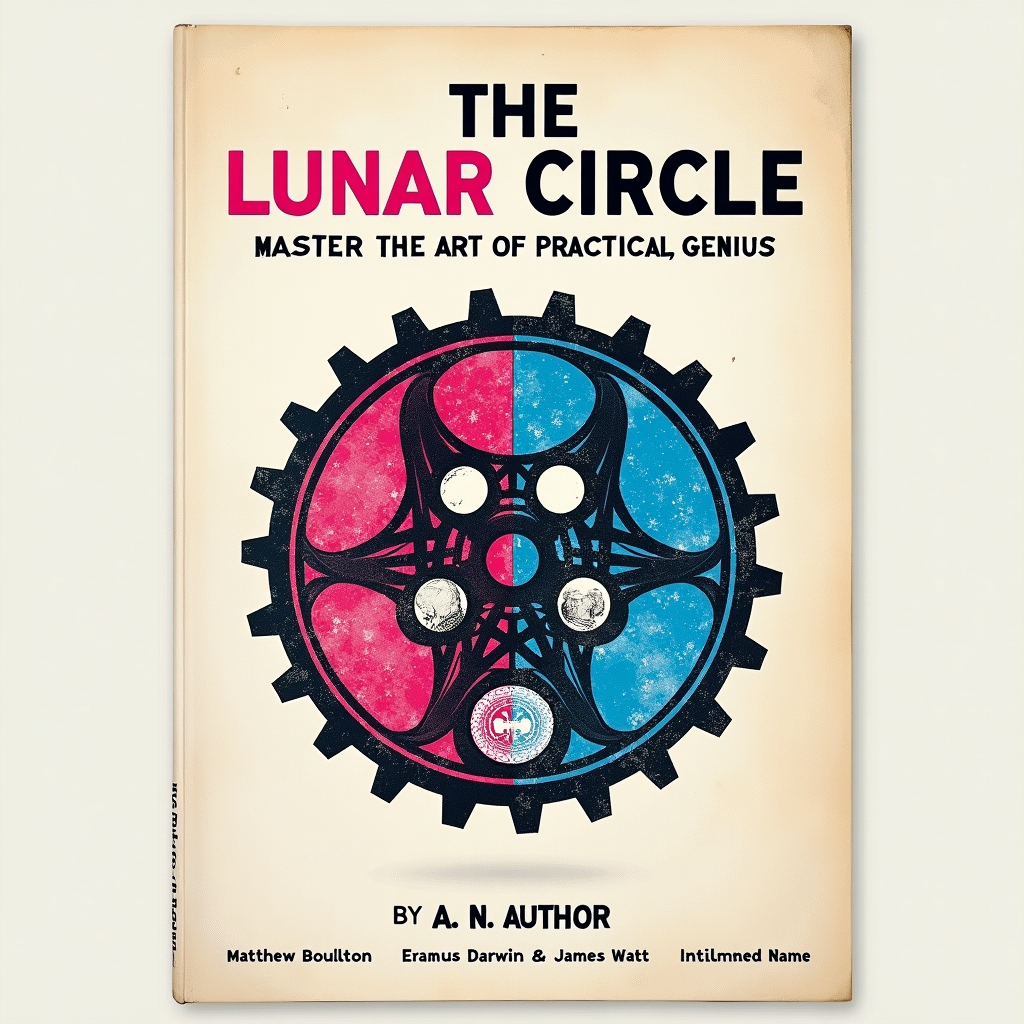
The Lunar Circle: Master the Art of Practical Genius
Wisdom from the 18th-century minds who fused science, industry, and ambition to remake the world.
For entrepreneurs, engineers, product managers, and creative professionals who want to break down silos and apply interdisciplinary thinking to solve complex problems.
Contents
- The Spark of Association: Forging Your Own Lunar Circle
- The Pragmatic Visionary: Matthew Boulton's Blueprint for Enterprise
- The Engine of Progress: James Watt and the Relentless Pursuit of Improvement
- The Art of Experimentation: Joseph Priestley's Unbounded Curiosity
- Form and Function: Josiah Wedgwood's Revolution in Design and Production
- The Polymathic Perspective: Erasmus Darwin's Web of Knowledge
- The Catalyst: James Keir and the Alchemy of Practical Chemistry
- The Unsung Mentor: William Small's Quiet Influence on Genius
- Beyond the Workshop: Scaling Impact and Building Legacy
- Your Own Enlightenment: Sustaining the Lunar Spirit in the Modern Age
The Spark of Association: Forging Your Own Lunar Circle
The clatter of carriage wheels, the scent of coal smoke mingling with fresh-turned earth, the hum of passionate debate spilling from a grand house in the Midlands – this was the Lunar Circle. We, the members of the Lunar Society, were no mere dilettantes. We were men of action, of industry, of insatiable curiosity. And our secret, my friends, was not individual brilliance alone, but the sheer, electrifying power of association. We didn't just understand this; we lived it. We breathed it. And tonight, I invite you to breathe it with us.
The world today, much like our own in the nascent dawn of the Industrial Revolution, is brimming with complex challenges. You, the entrepreneur wrestling with market disruption; the engineer perfecting a new material; the product manager seeking that elusive 'next big thing'; the creative professional yearning for fresh inspiration – you are all, in spirit, our contemporaries. You face the same fundamental need: to move beyond isolated genius and harness the collective force that transforms ideas into impact.
The Crucible of Minds: More Than the Sum of Our Parts
Consider Matthew Boulton, that magnificent force of nature, standing amidst the controlled chaos of his Soho Manufactory. He wasn't simply a businessman; he was an orchestrator of talent. He understood that true value lay not just in a single invention, but in the system that brought it to life. He famously declared, "I sell here, sir, what all the world desires to have – Power." But this 'power' wasn't just the steam engine James Watt was perfecting under his roof; it was the power of collaboration, of diverse minds converging on a common goal.
This is the very essence of the Lunar Circle. It wasn't a formal institution with rigid hierarchies. It was a fluid, dynamic gathering of kindred spirits who met under the full moon (to better see the way home, of course!). We were chemists, physicians, poets, manufacturers, botanists. And when a problem arose – say, how to improve the firing of Josiah Wedgwood’s ceramics, or how to distill a particular chemical for Joseph Priestley’s experiments – it wasn't just one man's burden. It became a collective puzzle, each mind bringing its unique lens.
Cultivating Your Own 'Moonlit' Gatherings
How, then, do you, in your own sphere, recreate this spark of association? It begins with intentionality. You must actively seek out the 'unlikelies' – those whose perspectives seem farthest from your own, yet whose intellectual curiosity burns just as brightly.
Here’s how we did it, and how you can too:
Identify Your Intellectual 'Magnets': Who are the individuals in your orbit – professional or personal – who possess a keen intellect, a drive to solve problems, and a willingness to engage outside their immediate discipline? They might be:
- A software developer with a passion for ancient philosophy.
- A marketing expert who moonlights as a amateur botanist.
- A financial analyst with an unusual hobby like competitive sailing.
- The key is their breadth of interest and their depth of thought in at least one area.
Define a Shared, Compelling Challenge (Even a Hypothetical One): While we often discussed our immediate industrial and scientific challenges, sometimes the most profound breakthroughs came from simply exploring a fascinating concept.
- Action: Instead of just "brainstorming," frame it as "Let's explore the fundamental principles underlying X, and how they might apply to Y."
- Example: Erasmus Darwin, physician and grandfather to Charles, might discuss the mechanics of animal locomotion, and James Watt, the engineer, might then ponder how those biological principles could inform the design of a new machine. It's about cross-pollination, not direct problem-solving initially.
Create an Environment of Psychological Safety and Intellectual Generosity: No idea was too outlandish, no question too foolish within our circle. Joseph Priestley, who often challenged established scientific dogma, was celebrated for his experiments, not chastised for his perceived heresies.
- Action: Actively foster a culture where:
- Critique is constructive, not dismissive.
- Questions are encouraged, not feared.
- Credit is shared, not hoarded.
- The goal is collective understanding and progress, not individual glory.
- Action: Actively foster a culture where:
Embrace the 'Serendipitous Collision': The magic often happens when an idea from one field accidentally bumps into a problem from another. William Small, our quiet but brilliant physician, might offer an insight into human physiology that sparks a manufacturing efficiency idea for Josiah Wedgwood.
- Action: Structure your gatherings (be they weekly meetings, monthly dinners, or virtual calls) to allow for unstructured conversation.
- Tactics: Start with a brief "what's on your mind" round-robin, follow with a focused discussion, and then leave ample time for free-ranging debate. The "coffee break" or "dinner table" conversations are often where the real connections are made.
- Action: Structure your gatherings (be they weekly meetings, monthly dinners, or virtual calls) to allow for unstructured conversation.
The Return on Association: Tangible Results
The fruits of our Lunar Circle were not merely intellectual satisfaction. They were tangible, revolutionary. James Watt's steam engine, refined and commercialized by Boulton, powered the world. Wedgwood’s pottery, improved with scientific rigor, graced tables across Europe. Priestley's discoveries in gases laid foundations for modern chemistry.
Your 'Lunar Circle' can yield similar results. By actively seeking out and nurturing diverse intellectual connections, you will:
- Uncover novel solutions: A problem that seems intractable from one perspective may yield easily to an insight from another.
- Accelerate innovation: The cross-pollination of ideas acts as a catalyst, sparking new possibilities faster than isolated efforts.
- Build resilience: A diverse team can adapt more readily to unforeseen challenges, drawing on a wider array of knowledge and skills.
- Foster a culture of continuous learning: Everyone grows when exposed to different ways of thinking and problem-solving.
Remember, the greatest leaps forward are rarely made in solitude. They are forged in the vibrant, sometimes chaotic, always exhilarating crucible of shared intellect. Go forth, my friends, and light your own moonlit fires!
Key takeaways
- Collective genius is paramount: Individual brilliance is amplified exponentially through diverse collaboration.
- Intentionality in association: Actively seek out and connect with individuals from disparate fields.
- Foster psychological safety: Create an environment where all ideas and questions are valued, encouraging open debate.
- Embrace serendipity: Structure interactions to allow for unplanned, cross-disciplinary insights.
- Focus on tangible results: The goal is to transform shared knowledge into practical, impactful solutions.
The Spark of Association: Forging Your Own Lunar Circle
The clatter of carriage wheels still echoes in my mind, the scent of coal smoke mingling with the crisp night air. Another glorious evening with the Lunar Men, minds afire, spirits soaring! We’ve just parted ways, our bellies full of good food and our heads brimming with ideas that will, mark my words, reshape the very fabric of our world. You see, what we practice here in Birmingham isn’t mere conviviality; it’s an alchemy of intellect, a forge where individual sparks become a roaring inferno of innovation. And it’s an alchemy you, too, can master.
Our secret? Association. The deliberate, passionate gathering of diverse minds, not to agree, but to provoke, to challenge, to illuminate. It’s what allowed Matthew Boulton, that indefatigable entrepreneur, to declare with such conviction, "I sell here, Sir, what all the world desires to have – Power." He wasn’t just selling steam engines; he was selling the outcome of brilliant minds like James Watt's, amplified by the commercial acumen of his own, and the manufacturing genius of countless others. This wasn't a solo act; it was a symphony of practical genius, and it’s within your grasp to conduct your own.
The Crucible of Collision: Why Diversity Fuels Breakthroughs
Think of our monthly dinners. You might find a chemist like Joseph Priestley, who unravelled the mysteries of gases, sitting next to a botanist and physician like Erasmus Darwin, who charted the intricate dance of life. Then there’s Josiah Wedgwood, the master potter, discussing new glazes while James Keir, the industrial chemist and geologist, describes a novel method for alkali production. Do you imagine they simply chatted about the weather? Nonsense! They interrogated each other, cross-pollinated ideas, and found common ground in the most unexpected places.
This is not about being a polymath yourself – though we certainly encourage a broad curiosity! – but about assembling a polymathic circle.
Here's how to begin forging your own crucible:
- Identify Complementary Igniters: Don't seek out echoes of yourself. If you're a technologist, seek out an artist. If you're a marketer, find an engineer. The friction of different perspectives is where new ideas are born.
- Action: Make a list of three people in your professional or personal network whose expertise is wildly different from your own, yet whose work you admire. What unique lens do they bring?
- Define a Shared Horizon, Not a Shared Path: Our discussions weren't always about a single project. Often, it was a grander ambition: to understand the world, to improve industry, to push the boundaries of what was possible. This shared purpose allowed individual contributions to coalesce into something greater.
- Action: What's a big, audacious problem in your industry or organization that no single discipline can solve? This is your "shared horizon."
- Embrace the "What If?" and "How So?": Priestley's experiments with "airs" seemed purely academic to some, but they sparked practical applications for others. Darwin’s botanical observations informed his medical practice and philosophical musings. The best conversations move from abstract possibility to concrete implication.
- Action: When you next meet with a diverse thinker, challenge yourself to ask at least three "what if" questions and three "how so" questions about their area of expertise.
The Pragmatist's Proving Ground: Turning Talk into Tangible Results
It’s one thing to have brilliant conversations; it’s another entirely to translate those insights into actual progress. The Lunar Society wasn’t a mere debating club; it was a launchpad for industries, inventions, and enlightenment. We were, above all, pragmatists.
Consider James Watt, whose genius for steam power was undeniable. But it was Boulton who provided the capital, the factory, and the sheer force of will to bring Watt’s designs to fruition. As Watt himself wrote to Boulton, "I have been so much accustomed to neglect and disappointment that I am not now surprised at anything." It was the circle that provided the momentum, the belief, and the resources to overcome such frustrations.
To ensure your circle produces tangible results:
- Assign a "Boulton": Every great idea needs a champion, an entrepreneur who can see the commercial or practical application and drive it forward. This isn't about hierarchy but about leadership in execution.
- Action: In your nascent circle, identify who has the entrepreneurial drive to push an idea from concept to reality. It might rotate depending on the project.
- Cultivate a Culture of Experimentation: Wedgwood, ever the innovator, was constantly experimenting with new clays, glazes, and firing techniques. His motto was "All things are possible." This spirit of iterative improvement is vital.
- Action: Encourage your group to embrace small, rapid experiments. What's the smallest step you can take to test a hypothesis generated from your discussions?
- Document and Disseminate: Our discussions often led to letters, papers, and even patents. The knowledge wasn't kept secret; it was shared, debated, and built upon. William Small, our quiet coordinator, ensured the flow of information.
- Action: Establish a simple method for capturing key insights, decisions, and action items from your discussions. A shared digital document, a simple notebook, anything that prevents ideas from evaporating.
Sustaining the Flame: The Rhythmic Gathering
Our meetings were monthly, timed with the full moon, to light our way home across the unlit roads of 18th-century England. This regularity was crucial. It created anticipation, fostered continuity, and ensured that ideas didn't wither on the vine.
Your Lunar Circle needs its own rhythm.
- Consistency is King: Whether weekly, bi-weekly, or monthly, establish a predictable cadence. This builds momentum and strengthens relationships.
- Keep it Focused, Yet Flexible: Have a loose agenda, perhaps a prompt or a specific problem to discuss, but allow for serendipitous detours. The most profound insights often emerge from unexpected tangents.
- Foster Trust and Psychological Safety: Our discussions were often robust, but they were always rooted in mutual respect. This trust allows for vulnerability, honest critique, and the sharing of half-formed ideas. No idea is too outlandish to be explored.
Key Takeaways
- Collective genius surpasses individual brilliance: Actively seek out and engage diverse perspectives.
- Shared purpose, not just shared tasks, drives collaboration: Define a grander ambition for your circle.
- Pragmatism transforms ideas into impact: Assign leadership for execution and embrace experimentation.
- Regular, focused gatherings sustain momentum: Establish a consistent rhythm for your circle.
- Cultivate trust and openness: Create a safe space for bold ideas and honest critique.
The Pragmatic Visionary: Matthew Boulton's Blueprint for Enterprise
Ah, the clinking of glasses has barely faded from our last Lunar gathering, and already my mind races with the possibilities! We spoke of the spark of association, of finding kindred spirits who ignite new ideas. But what good is a spark if it doesn't catch fire and forge something new, something useful? This, my friends, is where our esteemed Matthew Boulton steps onto the stage, not merely as a businessman, but as an architect of industry, a visionary grounded in the bedrock of practical execution. He understood, as we must, that grand visions are but whispers in the wind without the meticulous hand of the craftsman and the shrewd eye of the marketeer.
From Speculation to Substance: Boulton's Engine of Progress
We often marvel at the brilliance of an invention, the sudden flash of insight that transforms the world. But behind every such marvel, there stands a Boulton, asking: "How do we make this work? How do we make it profitable? How do we make it available to the world?" Consider the steam engine. Watt, a genius, undoubtedly. But it was Boulton, with his boundless energy and his unwavering belief, who truly brought it to fruition. He famously declared, regarding his partnership with Watt, "I have been a partner with Watt for many years, and I have never known him to do a foolish thing." This isn't just a testament to Watt's intellect; it’s a profound insight into Boulton’s own genius for partnership. He didn’t just invest capital; he invested faith, time, and his formidable organizational prowess.
How do we, in our own endeavors, emulate this?
- Identify the Unspoken Need: Boulton didn't just see a better engine; he saw the need for reliable power across every industry. He peered beyond the immediate invention to the systemic problem it could solve.
- Actionable Insight: Don't just develop a product; understand the deep-seated frustrations or aspirations it addresses. Spend time not just on user interviews, but on "problem interviews." What are the latent pain points your innovation could alleviate?
- Cultivate Complementary Strengths: Watt was the brilliant, often introverted, inventor. Boulton was the extroverted, practical organizer and salesman. They were two halves of an incomparable whole.
- Actionable Insight: Actively seek partners whose skills and temperament perfectly balance your own. If you are the visionary, find your pragmatist. If you are the meticulous technician, find your charismatic champion. This isn't about cloning yourself; it's about completing yourself. As James Keir, our brilliant chemist and manufacturer, often reminded us, the best alloys are stronger than their individual components.
- Invest in Infrastructure, Not Just Ideas: Boulton built Soho Manufactory, a marvel of its age, a factory designed for efficiency and precision. He understood that the environment itself shapes the output.
- Actionable Insight: Don't just fund projects; fund the systems and processes that enable those projects to flourish. This might mean investing in better tools, streamlined workflows, or even a dedicated "innovation lab" within your organization.
The Art of the Market: From Invention to Indispensability
It wasn't enough for Boulton that the steam engine worked; it had to be desired. He was a master of market creation, turning a complex piece of engineering into an indispensable tool for progress. He understood that the story behind the product was as important as the product itself.
- Educate the Market: Many potential customers didn't understand the benefits of steam power. Boulton became an evangelist, demonstrating its efficiency and reliability.
- Actionable Insight: Don't assume your audience understands the value of your innovation. Craft compelling narratives, create clear demonstrations, and speak in terms that resonate with their immediate needs and long-term aspirations. Think of Priestley's fervent demonstrations of gases – he didn't just discover oxygen, he showed its properties in captivating ways!
- Ensure Quality and Reliability: Boulton knew that long-term success depended on trust. His engines were built to last, backed by his reputation.
- Actionable Insight: Prioritize quality and reliability above all else. A brilliant innovation that constantly fails will quickly be abandoned. Build robust testing protocols and stand behind your work with unwavering commitment. Josiah Wedgwood, our pottery master, built an empire on precisely this principle of consistent quality.
- Adapt and Diversify: While the steam engine was his crowning achievement, Boulton's Soho Manufactory produced a vast array of goods, from ornamental objects to coinage. He understood the need to adapt to changing markets and leverage his manufacturing capabilities.
- Actionable Insight: Don't put all your eggs in one basket. Continuously explore adjacent markets or applications for your core competencies. What other problems can your established expertise solve? As Erasmus Darwin, our playful botanist, might observe, a diverse ecosystem is a resilient one.
The Lunar Spirit: Collective Genius in Action
What truly set Boulton apart, and what we must carry forward, is this spirit of collaborative genius. He wasn't afraid to surround himself with intellects far surpassing his own in specific fields. He gathered us, the Lunar Men, not to be told what to do, but to engage in vigorous debate, to cross-pollinate ideas, and to collectively push the boundaries of what was possible. As William Small, our quiet but profound medical mind, always reminded us, true understanding often comes from examining a problem from multiple angles.
- Foster an Environment of Open Inquiry: Encourage questions, even seemingly foolish ones. Create a safe space for experimentation and failure.
- Embrace Interdisciplinary Dialogue: Actively bring together individuals from diverse backgrounds and expertise. The magic happens at the intersections.
- Champion the "Why Not?" Mentality: Boulton never asked "Why?" in a way that sought to shut down an idea, but rather "Why not?" – challenging assumptions and seeking pathways forward.
Key takeaways
- Vision requires vigorous execution: Grand ideas are only the first step; meticulous planning and implementation are crucial for tangible results.
- Strategic partnerships are paramount: Seek out individuals with complementary skills and temperaments to create a more robust and capable team.
- Market understanding drives innovation: Don't just invent; understand the deep-seated needs and desires of your potential audience, then educate and adapt to them.
- Quality and reliability build lasting trust: A superior product, consistently delivered, forms the bedrock of long-term success and market leadership.
- Cultivate a collaborative ecosystem: Embrace diverse perspectives and foster open inquiry to continuously spark new ideas and overcome challenges.
The Engine of Progress: James Watt and the Relentless Pursuit of Improvement
The ale is still on my breath, the echo of laughter still ringing in my ears from last night’s Lunar gathering. But amidst the boisterous conversation and the clinking of glasses, one voice often rose, measured and sharp, dissecting the very fabric of the world around us. That, my friends, was James Watt. He wasn’t one for grand pronouncements, but for grand improvements. His steam engine, you see, wasn't born fully formed, a divine gift. No, it was forged in the crucible of relentless refinement, a testament to the idea that true genius often lies not in the initial spark, but in the unwavering dedication to fanning that spark into a roaring inferno.
We often laud the inventor, the one who conceives the wholly new. But Watt reminds us that the improver is just as vital, perhaps even more so, for it is they who take a nascent idea and make it practical, efficient, profitable. Consider the Newcomen engine – a marvel of its age, certainly, but a prodigal consumer of coal. Watt, with his keen eye for thermodynamics (a word not yet coined, but a principle he understood instinctively), saw not just a machine, but a challenge. He saw waste, and he saw opportunity.
The Art of Iterative Mastery: Watt's Methodical Approach
Watt’s brilliance wasn't a flash; it was a steady, focused beam. He didn't just tinker; he analyzed. He broke down the problem into its constituent parts, much like Dr. Priestley dissecting a gas, isolating each element to understand its function.
"I can think of nothing else," Watt wrote, consumed by the problem of the steam engine's inefficiency. This wasn't obsession for its own sake, but a deep, driving curiosity to understand why something worked, and crucially, how it could work better.
How do we apply Watt's methodical pursuit of improvement to our own endeavors?
- Deconstruct the 'Engine': What are the core components of your project, product, or process? Where are the inefficiencies? Is it a bottleneck in your workflow, a flaw in your design, or a communication breakdown in your team? Break it down into manageable segments.
- Quantify the Problem: Watt measured everything: steam pressure, fuel consumption, cylinder temperature. He didn't rely on guesswork. Can you measure the impact of your inefficiencies? Customer churn, production costs, time spent on a task? As Matthew Boulton often declared, "I sell here, sir, what all the world desires to have – POWER." But Watt ensured that power was delivered with minimal waste.
- Isolate and Innovate: Watt's crucial insight was the separate condenser. He realized that cooling the steam within the main cylinder was the fundamental flaw. By separating the condensing process, he drastically reduced heat loss and fuel consumption.
- Action: Identify the single biggest point of friction or waste in your system. Can you isolate it? Can you devise a separate, more efficient mechanism to handle that specific function? This might mean a new tool, a redesigned process, or even delegating a specific task.
- Test and Refine Relentlessly: Watt didn't stop at the separate condenser. He went on to develop the parallel motion, the centrifugal governor, and the sun and planet gear. Each was an improvement, building upon the last, transforming a crude machine into the beating heart of the Industrial Revolution.
- Action: Don't consider your solution final. Implement, measure, gather feedback, and then iterate. What worked? What didn't? How can it be further optimized? This is the spirit of continuous improvement, the very engine of progress.
The Power of Collaboration: Boulton & Watt's Symphony of Strength
While Watt was the meticulous genius of mechanics, it was Matthew Boulton who understood how to bring that genius to the world. Boulton, ever the astute businessman, saw the potential not just in Watt's invention, but in Watt himself. He didn't just provide capital; he provided infrastructure, a vision, and a relentless drive for quality.
"I have been thinking a great deal about you and your engine," Boulton wrote to Watt, "and am of opinion that the best and most likely method of proceeding… is to establish a manufactory near to this place." This wasn't merely an offer; it was a blueprint for a partnership, a blending of scientific rigor with commercial acumen.
- Complementary Skills: Watt focused on the internal workings, the intricate dance of steam and metal. Boulton focused on the external, the market, the manufacturing, the sales. Who are the Boulton to your Watt? Who are the Keirs, the Darwins, the Priestleys in your circle who can provide different perspectives and skills to elevate your work?
- Shared Vision, Defined Roles: While their strengths differed, their ultimate goal was aligned: to make Watt's engine a ubiquitous and profitable force. Clearly define roles and responsibilities within your team or partnership. Let each member excel in their domain, while contributing to the overarching objective.
- Quality as a Cornerstone: Wedgwood, our esteemed potter, understood that quality was not a luxury but a necessity. Boulton and Watt, building on this principle, ensured their engines were not only powerful but reliable. This dedication to excellence built trust and established their dominance.
Beyond the Machine: Applying Watt's Legacy to Modern Endeavors
The principles Watt embodied transcend the steam engine. Whether you are developing software, designing a product, streamlining an organization, or even crafting a piece of art, the pursuit of efficiency and continuous improvement is paramount.
Consider Dr. Erasmus Darwin, who meticulously observed natural processes, seeing efficiency in the evolution of species. Or Joseph Priestley, constantly refining his experiments, isolating new elements by careful, iterative method. The lesson is universal:
- Embrace the 'Unfinished': No project is ever truly "finished"; it is merely ready for its next iteration. The world changes, needs evolve, and your "engine" must adapt.
- Seek Feedback, Not Just Praise: Our Lunar Society dinners were brutal in their honesty. Ideas were dissected, challenged, and often improved through rigorous debate. Cultivate a circle where constructive criticism is valued.
- The Marginal Gains Add Up: Watt's improvements, individually, might seem minor to the casual observer. But cumulatively, they transformed the world. Don't dismiss small optimizations; they are the bedrock of revolutionary impact.
Key Takeaways
- Innovation is Iterative: True progress often comes from relentless refinement, not just initial invention.
- Deconstruct & Quantify: Break down problems into measurable components to identify inefficiencies.
- Isolate & Optimize: Pinpoint crucial bottlenecks and create targeted solutions for maximum impact.
- Collaborate Strategically: Partner with individuals whose skills complement yours, sharing a common vision.
- Prioritize Continuous Improvement: Never consider a solution final; always seek the next iteration of excellence.
The Art of Experimentation: Joseph Priestley's Unbounded Curiosity
The clinking of glasses, the lively debate, the air thick with the scent of lamp oil and the crackle of new ideas – that’s the spirit we carry from our Lunar Society dinners. And few embody that spirit more profoundly than our dear Priestley. He, with his unassuming manner and insatiable mind, reminds us that the greatest leaps forward aren't born of certainty, but of a profound, almost playful, curiosity. He wasn’t just a chemist; he was a philosopher, a theologian, a grammarian. He saw the world as an endless series of questions, each answer leading to a dozen more. It's this boundless inquiry, this willingness to poke and prod and challenge, that we must cultivate in our own endeavors.
Priestley's great insight, that "the more we know, the more we discover our ignorance," isn’t a lament; it’s a powerful call to action. It's the intellectual fuel that propelled us, the Lunar Men, forward. It tells us that true mastery isn't about having all the answers, but about continually refining the questions. It's about seeing every "failure" not as a dead end, but as a signpost pointing toward a more fruitful path. This isn't ivory-tower theorizing; it's the very bedrock of practical innovation.
Embracing the "What If?" Culture
Priestley didn't set out to "discover oxygen." He was simply curious about "airs." He experimented with bell jars, candles, and mice, observing, recording, and questioning. He was driven by a relentless "what if?" This is the core of an experimental mindset. It's about creating a safe space – be it a laboratory, a workshop, or a whiteboard session – where every assumption can be challenged, and every wild idea can be tested.
Consider how this played out in our varied pursuits:
- For the Entrepreneur (à la Boulton): Matthew Boulton, ever the astute businessman, understood that innovation was a continuous process, not a one-off event. He would often say, "I sell here, what all the world desires to have – Power." But that power wasn't static; it was constantly being refined, improved, and adapted. His partnership with Watt wasn't just about manufacturing; it was about endless experimentation with engine designs, materials, and applications. Boulton didn't fear a prototype that didn't quite work; he saw it as data, as a step closer to the market-defining solution.
- Actionable Advice:
- Allocate Experimentation Budgets: Dedicate a portion of resources (time, money, personnel) specifically for projects with uncertain outcomes. Label it "Priestley's Pot."
- Encourage "Pre-mortems": Before launching a significant initiative, imagine it has failed. What went wrong? This proactive "failure analysis" helps identify and mitigate risks early, fostering a culture where potential missteps are openly discussed, not hidden.
- Promote Cross-Functional "Air Swaps": Just as Priestley experimented with different "airs," encourage regular, informal exchanges of ideas between different departments or teams. What might a marketing expert learn from an engineer about customer pain points, and vice-versa?
- Actionable Advice:
The Iterative Loop: Learn, Adapt, Refine
Priestley's experiments were rarely definitive. He would observe, form a hypothesis, test it, and then, based on the results, refine his understanding and design the next experiment. This iterative loop is the engine of true progress. It’s not about finding the perfect solution on the first try, but about systematically eliminating imperfect ones.
Think of Josiah Wedgwood, who revolutionized pottery. He didn't just stumble upon Jasperware. He meticulously experimented with countless clay formulations, firing temperatures, and glazes. He was relentless in his pursuit of perfection, viewing each broken pot as a lesson learned. As he once declared, "I have made it my unalterable rule to try a thousand experiments before I give up one I have in hand." This wasn't stubbornness; it was the embodiment of the iterative loop.
- Actionable Advice:
- Implement Rapid Prototyping Cycles: Embrace "minimum viable products" (MVPs) or prototypes that can be quickly tested and iterated upon. The goal isn't perfection, but learning.
- Establish Feedback Mechanisms: Create clear, low-friction channels for gathering feedback – from customers, internal teams, or even simulated environments. Make sure this feedback directly informs the next iteration.
- Document Learnings, Not Just Outcomes: It's not enough to record whether an experiment "succeeded" or "failed." Document why. What surprising observations were made? What new questions arose? This builds a collective knowledge base for future innovation.
Cultivating Intellectual Humility and Open-Mindedness
Perhaps Priestley's most profound lesson is the value of intellectual humility. He was always open to new evidence, even when it challenged his own firmly held beliefs. He famously clung to his phlogiston theory for some time, but his genuine curiosity ultimately led him to acknowledge the observations that disproved it. This willingness to be wrong, to admit ignorance, is a superpower.
Our friend Erasmus Darwin, a man of staggering intellect, exemplified this. He was a physician, a botanist, an inventor, and a poet. He didn't silo his knowledge; he allowed insights from one field to illuminate another. He understood that boundaries were often artificial. His grandson, Charles, would later build upon this very foundation of open-minded observation.
- Actionable Advice:
- Challenge Your Own Assumptions: Regularly question the foundational beliefs of your projects or industry. Ask: "What if the opposite were true?" or "What if this accepted truth is actually a limiting belief?"
- Seek Out Dissenting Voices: Actively invite perspectives that challenge your own. Create a culture where constructive disagreement is valued, not suppressed. As our esteemed James Keir, the chemist and industrialist, might have said, "Truth is best discovered by discussion and comparison of opinions."
- Practice "Beginner's Mind": When approaching a new problem or learning a new skill, try to shed preconceived notions and approach it with the fresh, unbiased curiosity of a novice. This allows for truly novel insights.
Key Takeaways
- Embrace Ignorance as a Catalyst: See "not knowing" as an invitation to explore, not a barrier. Priestley’s "the more we know, the more we discover our ignorance" is your guiding principle.
- Systematize Experimentation: Design small, iterative tests to validate assumptions and gather data, rather than aiming for perfect, large-scale launches.
- Value Learning Over Success: Every outcome, positive or negative, provides valuable insights. Document the "why" behind results to build collective knowledge.
- Cultivate Intellectual Humility: Be willing to challenge your own beliefs and actively seek out diverse perspectives that can broaden your understanding.
Form and Function: Josiah Wedgwood's Revolution in Design and Production
The clinking of glasses has barely subsided, the lingering scent of experimental gas still hangs faintly in the air, and yet my mind, like a newly fired kiln, is already glowing with the insights from our last Lunar gathering. Tonight, the discussions, fueled by Wedgwood's latest triumphs, revolved around a principle that, I daresay, underpins all true innovation: the exquisite dance between form and function. Josiah, bless his industrious soul, understood this better than any man I know. He didn't just make pots; he engineered desire. He didn't just design; he industrialized beauty.
We, my dear fellow innovators, often fall into the trap of thinking creativity is an ethereal, unquantifiable thing, separate from the gritty mechanics of production. Nonsense! Wedgwood proved, with every perfectly formed teacup and every exquisitely detailed medallion, that art and industry are not merely compatible but synergistic. He saw the whole enterprise, from the clay pit to the duchess's drawing-room, as a single, interconnected system.
From Earth to Elegance: Engineering Aesthetic Desire
Wedgwood's genius wasn't just in making beautiful things; it was in making beautiful things consistently and at scale. He recognized that the nascent middle class, eager to emulate the gentry, craved elegance previously reserved for the very wealthy. But how to deliver it? Not through artisanal caprice, but through systematic innovation.
He began, like any good scientist, with the raw materials. He didn't just accept the clay; he experimented with it, like Priestley with his gases, to understand its properties. He sought the perfect mixture, the optimal firing temperature, the glazes that would elevate common earth to something extraordinary. We heard Matthew Boulton, ever the pragmatic businessman, remark, "I sell here, Sir, what all the world desires to have – POWER." Wedgwood, in his own way, sold power too – the power of refinement, the power of taste, now within reach.
Here's how we can apply this "engineered elegance" to our own ventures:
- Systematic Material Innovation: Don't just accept your inputs. Can you refine them? Can you combine them in novel ways? Wedgwood spent years perfecting his creamware and jasperware. What are your foundational "clays"?
- Standardization for Scaled Beauty: Wedgwood introduced molds, not to stifle creativity, but to replicate it flawlessly. This allowed skilled artisans to focus on intricate details, knowing the underlying form was perfect. Where can you standardize processes to ensure consistent quality and free up creative energy for true innovation?
- Design for Manufacturability: From the outset, Wedgwood designed his pieces with production in mind. He knew the limitations of the kiln, the properties of the glaze, the skill of his workers. Are you designing products that are not only desirable but also efficiently produceable? This is where the engineer and the artist must sit at the same table.
The Tyranny of Fashion and the Art of its Mastery
"Fashion is a great tyrant," Wedgwood once observed, "but a gentle and benevolent one." He understood that while trends dictated demand, true mastery lay in shaping those trends, not merely following them. He didn't just react to what people wanted; he showed them what they wanted, often before they knew it themselves. This required a keen understanding of human psychology, a touch of showmanship, and an unwavering commitment to quality.
Consider his "Etruria" works, a factory designed not just for production but as a statement, a testament to his vision. He understood that the environment in which a product is made influences its perceived value. And his meticulous marketing, including the famous "Queen's Ware," named with royal endorsement, cemented its desirability.
How can we master the "tyranny of fashion" today?
- Anticipate, Don't Just React: Wedgwood studied classical art, understood emerging tastes, and even commissioned artists to create new designs. What signals are you observing in your market? Are you looking beyond immediate trends to underlying shifts in consumer values and aspirations?
- Educate and Elevate Taste: Wedgwood didn't just sell pottery; he sold a lifestyle, an ideal of domestic elegance. Are you merely selling a product, or are you articulating a vision, a better way of living or working, that your product embodies?
- Strategic Branding and Association: The royal seal wasn't just a marketing gimmick; it was an endorsement of quality and prestige. Who are the "royalty" in your industry? How can you align your brand with trusted voices and institutions? Dr. Erasmus Darwin, ever the astute observer of nature, might say it's about understanding the "fitness" of your product within its social ecosystem.
The Lunar Circle's Influence: Cross-Pollination of Ideas
It's impossible to speak of Wedgwood's genius without acknowledging the fertile ground of our Lunar Society. James Watt, with his precision engineering, undoubtedly influenced Wedgwood's quest for consistent quality. Joseph Priestley's experimental rigor, his willingness to test and re-test, mirrored Wedgwood's painstaking development of new glazes and clay bodies. Even James Keir, with his vast knowledge of chemical processes, would have offered invaluable insights into the composition of materials.
The beauty of our gatherings, you see, is that a discussion about steam engines might spark an idea for a new pottery technique, or a debate on botany might inspire a marketing strategy. This cross-pollination of ideas, this intellectual promiscuity, is the true engine of progress. We don't just solve problems; we redefine them through the lens of another discipline.
For your own "Lunar Circle," I implore you to:
- Actively Seek Diverse Perspectives: Don't just consult those in your immediate field. Invite engineers to your marketing meetings, designers to your production planning, scientists to your strategic discussions.
- Encourage "Analogy Thinking": When faced with a challenge, ask: "How would a botanist solve this?" "What would a chemist do?" "How does an artist approach this problem?" This breaks down mental barriers and unlocks novel solutions.
- Foster a Culture of Openness and Experimentation: Just as we, around Boulton's dinner table, freely share our failures and our nascent ideas, so too must your team. The next great breakthrough often hides in the seemingly unrelated observation.
Wedgwood's legacy isn't just in his beautiful wares; it's in the blueprint he left for integrating disparate elements – art, science, business – into a cohesive, revolutionary whole. He showed us that true innovation isn't about choosing between form or function, but about mastering their profound and profitable union.
Key takeaways
- Integrate Design with Production: Design products not just for aesthetics, but also for efficient, scalable manufacturing, ensuring quality and consistency.
- Master, Don't Just Follow, Fashion: Understand underlying trends and consumer psychology to anticipate demand and shape market preferences, rather than merely reacting to them.
- Leverage Cross-Disciplinary Insights: Actively seek diverse perspectives and encourage "analogy thinking" to break down silos and spark novel solutions from unexpected sources.
- Systematize for Scaled Excellence: Apply scientific rigor to material development and standardize processes to replicate quality and free up creative energy.
- Build a Holistic Brand Experience: Consider every aspect of your product, from raw material to customer perception, as part of a unified, desirable offering.
The Polymathic Perspective: Erasmus Darwin's Web of Knowledge
Our latest gathering at Soho House, fueled by good wine and even better conversation, once again affirmed a truth as clear as a newly polished lens: true progress springs from minds that refuse to be confined. And who better embodies this spirit than our own Erasmus Darwin? A physician who penned epic poems on botany, an inventor who mused on the origins of life – Darwin wasn’t merely learned, he was a living, breathing network of knowledge. He saw the threads connecting disparate fields, anticipating insights that would take others centuries to grasp. We, the Lunar Men, understood that progress wasn't about digging deeper into a single rut, but about casting a wide net, drawing in diverse observations, and weaving them into something entirely new.
The Grand Tapestry: Weaving Ideas from Unlikely Sources
Consider Darwin's approach. He didn't just practice medicine; he observed the natural world with an almost obsessive curiosity. He saw patterns in plant growth that informed his understanding of human physiology. He applied mechanical principles to biological systems. This wasn't intellectual dilettantism; it was a deliberate strategy for innovation. As Darwin himself noted, "The world has been much indebted to the invention of new tools and machines, for the great improvements in arts and manufactures." He wasn't just speaking of physical tools, but intellectual tools – the frameworks and insights gleaned from one discipline, then applied to another.
How do we, in our own endeavors, cultivate such a grand tapestry of understanding?
- Cross-Pollinate Your Information Diet: Don't just read industry reports. Dive into history, philosophy, natural sciences, even poetry. You might find a design principle from ancient architecture that inspires a new software interface, or a biological process that offers a solution for supply chain optimization.
- Seek Out Diverse Perspectives: Surround yourself with people who think differently. Our Lunar Society thrived because Priestley, the chemist, debated with Boulton, the manufacturer, and Darwin, the physician-botanist. Each brought a unique lens to common problems, revealing unseen facets.
- Embrace the "Beginner's Mind": When exploring a new field, temporarily set aside your expert assumptions. Ask the fundamental questions. This fresh perspective can often unearth breakthroughs that seasoned practitioners overlook.
The Power of Analogy: Darwin's Evolutionary Foresight
Darwin’s most profound insights often stemmed from drawing powerful analogies. His anticipations of evolutionary theory, for instance, didn't come from a deep dive into genetics (a field yet to be conceived), but from observing the selective breeding of animals and the adaptation of plants to different environments. He saw the underlying principles at play across seemingly distinct domains.
As James Keir, our fellow Lunar Man and chemist, once wrote, "The most useful discoveries have often been made by accidental observation." But it's not truly accidental; it's the prepared mind, the mind that has built a robust web of knowledge, that recognizes the significance of an "accidental observation" and can connect it to a broader pattern.
To harness the power of analogy in your own work:
- Deconstruct Problems: Break down a complex challenge into its core components. Is it a problem of efficiency? Adaptation? Communication?
- Scan for Parallels: Once you identify the core problem, look for analogous situations in entirely different fields. If you're struggling with team collaboration, how do ant colonies manage complex tasks? If your product needs to adapt to changing user needs, how do organisms adapt to environmental shifts?
- Translate and Apply: Don't just identify the analogy; translate the solution or principle from the analogous field back to your own. What specific mechanisms or strategies can be borrowed and recontextualized?
Building Your Own Intellectual Ecosystem
The strength of Darwin's genius, and indeed of our entire Lunar Society, lay in the continuous exchange of ideas. We weren't just individuals pursuing our own interests; we were an intellectual ecosystem, each member enriching the soil for the others.
Matthew Boulton understood this well when he said, "I sell here, Sir, what all the world desires to have – POWER." But it wasn't just mechanical power; it was intellectual power, amplified by the collaborative genius of our circle.
To build your own intellectual ecosystem:
- Curate Your Circle: Actively seek out colleagues, mentors, and even casual acquaintances who possess diverse expertise and a willingness to engage in open-ended discussion.
- Foster a Culture of Curiosity: Encourage questions, even seemingly naive ones. Create an environment where exploring "what if?" scenarios is celebrated, not dismissed.
- Document and Share: Just as Darwin published his observations and poems, make a habit of articulating your insights and sharing them with your circle. The act of explaining often clarifies your own understanding and sparks new ideas in others.
Erasmus Darwin's legacy isn't just a list of inventions or theories; it's a testament to the boundless potential of a mind that dares to connect, to synthesize, and to see the underlying unity in the apparent diversity of the world. Let us, too, cultivate such a mind.
Key takeaways
- Actively seek out knowledge from disparate fields to cross-pollinate your thinking and uncover novel solutions.
- Cultivate a "beginner's mind" when exploring new disciplines to challenge assumptions and identify fresh perspectives.
- Leverage analogy by deconstructing problems and finding parallel solutions in entirely different domains.
- Build an intellectual ecosystem by surrounding yourself with diverse thinkers and fostering open, curious dialogue.
- Document and share your insights to clarify your own understanding and spark new ideas within your circle.
The Catalyst: James Keir and the Alchemy of Practical Chemistry
The clinking of glasses, the lively debate, the hum of discovery – that's the intoxicating atmosphere we, the Lunar men, thrive upon. Just last night, the conversation swirled around the latest advancements in chemistry, and as ever, James Keir’s name arose, a testament to his unique genius. Keir, a man whose mind was as sharp as the acids he so deftly handled, wasn't content with mere theoretical understanding. No, for Keir, knowledge was a tool, a lever to move the world. He was the quintessential 'catalyst,' a substance that facilitates a reaction without being consumed by it, transforming raw elements into something profoundly new and valuable. His work in glass manufacturing, alkali production, and even the very composition of materials, stands as a gleaming example of how rigorous scientific inquiry, applied with entrepreneurial zeal, can forge an entirely new industrial landscape.
We often speak of 'great ideas,' but Keir showed us that even the most brilliant concept remains inert without the practical means to bring it to fruition. He understood, as few others did, the profound connection between the laboratory bench and the factory floor. Our challenge, and indeed our opportunity, is to emulate this spirit. To become catalysts in our own fields, transforming nascent ideas and raw materials into tangible, impactful outputs.
From Speculation to Specification: Keir's Chemical Precision
Keir’s genius lay in his ability to dissect a problem, understand its fundamental chemical components, and then systematically re-engineer a solution. He didn't just know chemistry; he used it. Consider the challenges of glassmaking in his era. Impurities, inconsistencies, and inefficiencies plagued the industry. Keir, with his deep understanding of mineralogy and chemical reactions, approached these as solvable equations.
The Lunar Lesson: We, as modern practitioners, must cultivate a similar precision in our thinking. It's not enough to identify a problem; we must understand its constituent parts, its underlying mechanisms.
- Deconstruct the 'Black Box': Just as Keir would analyze a mineral sample for its chemical composition, we must break down complex problems into their fundamental elements. What are the inputs? What are the processes? What are the desired outputs?
- Identify the Limiting Factors: Keir understood that a missing element or an impurity could derail an entire industrial process. What are the bottlenecks in your current project or system? What single factor, if optimized, would unlock significant progress?
- Design for Predictability: Keir's goal was to make chemical processes repeatable and reliable. How can you introduce greater predictability and consistency into your own work or product development? Can you standardize processes, create clearer specifications, or refine your feedback loops?
As Matthew Boulton, our indefatigable entrepreneur, often declared, "I sell here, Sir, what all the world desires to have – POWER." Keir provided the chemical power, the precise formulations that allowed industries to produce goods with unprecedented quality and scale. He made the invisible, chemical forces, visible and controllable for commercial gain.
The Alchemist of Alkali: Turning Theory into Industrial Scale
Keir's most notable contribution was perhaps his pioneering work in alkali production. At a time when soda ash was primarily sourced from kelp and wood ash – inconsistent and often expensive – Keir sought a more reliable, scalable chemical process. He experimented tirelessly, refining methods for producing alkali from common salt, laying groundwork for later industrial revolutions. This wasn't abstract science; this was a direct response to a pressing industrial need.
The Lunar Lesson: True catalysis isn’t just about understanding; it’s about scaling that understanding to meet real-world demands.
- Connect the Lab to the Market: Keir saw a direct line from his chemical experiments to the needs of the soap, glass, and textile industries. What are the unmet needs in your market that your unique knowledge or expertise could address? Don't just innovate for innovation's sake; innovate to solve a problem.
- Embrace Iteration and Refinement: Keir's success wasn't a single flash of insight; it was a relentless series of experiments, adjustments, and improvements. How can you build a culture of continuous iteration into your own work? Are you testing your assumptions, gathering data, and refining your approaches based on real-world feedback?
- Think Beyond the Immediate Application: While Keir focused on alkali for immediate industrial needs, his discoveries had ripple effects across countless other industries. How might your current efforts, even if focused on a specific problem, have broader applications or unlock future opportunities?
Joseph Priestley, our brilliant chemist of gases, once mused, "The more we know of the works of God, the more we shall admire them." Keir, while admiring the works of nature, also sought to replicate and improve upon them through human ingenuity, turning common materials into industrial gold.
Building Your Own Catalytic Toolkit
Keir's example isn't just a historical footnote; it's a blueprint for action. He showed us that the most profound impact often comes from those who can bridge the gap between theoretical understanding and practical application.
- Cultivate Interdisciplinary Fluency: Keir was a chemist, a geologist, a manufacturer, and a scholar. The more languages you speak across different disciplines, the more connections you can make and the more novel solutions you can forge. How can you intentionally seek out knowledge from fields outside your immediate expertise?
- Prioritize Experimentation with Purpose: Keir's experiments were not random; they were hypothesis-driven, aimed at solving specific industrial problems. What are the key hypotheses you need to test in your own work? How can you design experiments to yield actionable insights, not just interesting data?
- Document and Disseminate: While Keir was a man of action, he also published his findings, contributing to the collective knowledge. How are you documenting your learning, your successes, and your failures? How can you share these insights to elevate those around you, fostering a 'Lunar Circle' effect?
Our esteemed Dr. Erasmus Darwin, ever the observer of nature's grand design, noted that "The world has been much improved by the arts of printing, of glass, and of war." Keir, through his mastery of chemistry and manufacturing, was a prime mover in two of those very arts, profoundly improving the world by making the previously impossible, industrially feasible.
Key takeaways
- Deconstruct problems chemically: Break down complex challenges into their fundamental components to identify leverage points for intervention.
- Scale knowledge to meet market needs: Don't just understand; apply and scale your expertise to solve pressing real-world problems.
- Embrace iterative refinement: Success comes from continuous experimentation, testing, and improvement, not a single stroke of genius.
- Cultivate interdisciplinary fluency: Draw insights from diverse fields to forge novel connections and innovative solutions.
- Document and share your findings: Contribute to the collective knowledge base, fostering a culture of collaborative progress.
The Unsung Mentor: William Small's Quiet Influence on Genius
The clink of glasses, the lively debate, the hum of discovery – these are the sounds of our Lunar Society gatherings. And while names like Boulton, Watt, and Wedgwood often take the stage, let us not forget the quiet orchestrators, the intellectual conductors who, like the precise gears in Watt's engine, ensure the whole mechanism runs smoothly. Tonight, we raise a toast to William Small, the physician, educator, and philosopher whose subtle yet profound influence shaped so many of our endeavors. He was the very embodiment of the "Inspired Pragmatist" before we even coined the term! Small showed us that true genius isn't always in the grand pronouncement, but often in the insightful question, the gentle nudge, the patient explanation that unlocks a new path for another.
We, the members of this Circle, understand intrinsically that no great feat is achieved in isolation. Just as Priestley needs his apparatus and Boulton his factory, so too do we all need the intellectual scaffolding provided by trusted advisors. Small exemplified the power of mentorship, demonstrating how a singular mind, dedicated to nurturing others, can amplify the collective genius of an entire generation. His influence wasn't about dictating, but about illuminating. It wasn't about ego, but about enablement. It was about creating fertile ground where the seeds of innovation, once planted, could truly flourish.
The Architect of Intellectual Growth: Small's Guiding Hand
Small's genius lay not in inventing a new engine or discovering a new gas, but in his ability to cultivate the intellectual landscape for others. He arrived in Birmingham from America, already a man of wide learning, having taught natural philosophy at William and Mary College. He quickly became the intellectual linchpin of our nascent society.
Consider James Watt, grappling with the profound challenges of his steam engine. Watt, a man of immense talent, often found himself bogged down by practical difficulties and financial anxieties. Who did he turn to for counsel, for a sympathetic ear, for a clear-headed perspective? William Small. Watt himself acknowledged Small's invaluable role, writing after Small’s passing, "Dr. Small's death was a heavy loss to me, for he was my only or one of my few intimate friends."
This is the essence of true mentorship: a trusted confidante who understands your struggles, celebrates your victories, and, most importantly, helps you see solutions you might have overlooked. Small wasn't just a sounding board; he was a catalyst. He helped Watt refine his thinking, navigate complex problems, and maintain his resolve.
- Actionable Insight: Seek out your "William Small." Identify individuals in your field, or even outside of it, who possess wisdom, experience, and a genuine desire to see others succeed. These are not just people you admire; they are people you can confide in, who offer objective feedback, and who challenge your assumptions constructively.
Cultivating Your Own Circle of Counsel
Small's influence wasn't limited to Watt. He was a close friend and advisor to Matthew Boulton, helping him navigate the complexities of establishing Soho Manufactory. He engaged with Erasmus Darwin on medical and scientific matters, and undoubtedly offered insights to Priestley's chemical explorations. His impact was pervasive because he embodied a rare combination of intellect, empathy, and discretion.
As Matthew Boulton himself, the great orchestrator of our society, understood, "I sell here, sir, what all the world desires to have – Power." Small, in his own way, provided a different kind of power: the power of clarity, of encouragement, and of intellectual rigor.
How do we, in our own time, replicate this invaluable dynamic?
- Be a Generous Listener: Small was known for his ability to listen intently. He didn't just wait for his turn to speak; he truly absorbed. This is fundamental. To provide meaningful advice, you must first deeply understand the challenge.
- Offer Diverse Perspectives: Small’s broad knowledge base allowed him to connect disparate ideas – a chemical principle to an engineering problem, a botanical observation to a philosophical quandary. This cross-pollination of ideas is the hallmark of the Lunar Society.
- Prioritize Trust and Discretion: The confidence placed in Small by figures like Watt speaks volumes. Mentorship thrives on trust. Private conversations must remain private, fostering an environment where vulnerability and honest intellectual wrestling can occur without fear of judgment.
- Focus on Empowering, Not Directing: Small's role was to guide, not to dictate. He helped others find their solutions, rather than simply providing his own. This fosters independent thinking and builds resilience.
Becoming a Mentor and a Mentee: A Two-Way Street
The beauty of the Lunar Circle model is its reciprocity. While Small was a mentor to many, he was also a participant in a vibrant intellectual exchange. We all learned from each other. James Keir, the skilled chemist, often shared his insights, as did Priestley with his experiments. Josiah Wedgwood, ever the innovator, brought his keen understanding of materials and manufacturing.
Erasmus Darwin, with his boundless curiosity, understood the interconnectedness of all things. He might have observed, "It is not the strongest of the species that survives, nor the most intelligent, but the one most responsive to change." This adaptability extends to our intellectual development. We must be responsive to the insights of others, and equally, provide those insights to our peers.
- For the Aspiring Mentor: Look for opportunities to share your experience. Is there someone in your team or network who could benefit from your perspective on a particular challenge? Offer your time and expertise.
- For the Aspiring Mentee: Don't wait to be "chosen." Proactively seek out individuals whose wisdom you admire. Frame your requests clearly, respecting their time, and be prepared to articulate your challenges and what type of guidance you're seeking. Remember, a specific question often yields a more valuable answer than a vague plea for help.
The legacy of William Small reminds us that true progress is a collaborative endeavor. It’s built not just on individual brilliance, but on the intellectual generosity and mutual support that binds a community together. Let us all strive to be both a William Small and a James Watt – a wise counselor and an eager learner – continuously enriching our own capabilities and those of our respective circles.
Key takeaways
- Seek out intellectual scaffolding: Identify and cultivate relationships with trusted advisors who can offer objective perspectives and constructive criticism.
- Embrace reciprocity in mentorship: Be both a seeker of wisdom and a provider of guidance within your own professional network.
- Prioritize trust and active listening: Effective mentorship relies on a foundation of confidence and the ability to truly understand the mentee's challenges.
- Foster an environment of empowerment: Guide others to discover their own solutions rather than simply providing answers, building their resilience and independent thought.
- Cultivate diverse perspectives: Leverage the breadth of knowledge within your circle to connect disparate ideas and unlock novel solutions.
Beyond the Workshop: Scaling Impact and Building Legacy
Our monthly gatherings, fueled by good food and better conversation, were never merely for intellectual sport. We, the Lunar Men, understood that the true measure of an idea lay not in its cleverness, but in its impact. We sought to move beyond the workshop bench, beyond the laboratory flask, and bring our innovations to the wider world. This, my friends, is where practical genius truly shines: in scaling impact and forging a legacy. It's not enough to invent; we must disseminate, adapt, and endure.
The Engine of Dissemination: From Idea to Industry
How does a brilliant notion, hatched over a shared meal, transform into something that alters the very fabric of society? It requires a deliberate strategy of dissemination, a relentless drive to move from prototype to production, from concept to commerce.
Consider Matthew Boulton, the very embodiment of the pragmatic visionary. His maxim, oft-repeated around our table, was clear: "I sell here, Sir, what all the world desires to have – POWER." He wasn’t content with merely having a better steam engine; he understood the imperative of making it available. Boulton knew that Watt’s engine, as revolutionary as it was, needed a robust infrastructure to truly take hold.
- Standardization and Production: We didn't just build one engine; we built many. Boulton, with Watt, established Soho Manufactory as a beacon of precision engineering, ensuring each engine met rigorous standards.
- Business Model Innovation: Rather than selling engines outright, Boulton often leased them, charging a portion of the fuel savings. This removed the high upfront cost barrier for many potential buyers, accelerating adoption.
- Global Reach: Boulton's ambition stretched far beyond Birmingham. He actively pursued markets across Britain and even continental Europe, understanding that scaling meant reaching everyone.
Actionable Insight: Look at your groundbreaking idea. How can you standardize its production? What business model innovations can you employ to make it accessible? How can you think beyond your immediate market to ensure its widest possible reach? The greatest inventions remain curiosities without a robust engine of dissemination.
Cultivating a Legacy: Beyond the Individual
Our legacy, we knew, was not just in our individual achievements, but in the collective advancement we fostered. It was about creating a ripple effect, inspiring future generations to build upon our foundations. This required more than just invention; it demanded education, advocacy, and a commitment to continuous improvement.
Erasmus Darwin, ever the polymath, understood the interconnectedness of all things. His work on botany, zoology, and even poetry, served to educate and inspire. He didn't just discover; he explained and shared. His grand vision was to illuminate the natural world for all.
- Education as Empowerment: Darwin's writings, like Zoonomia and The Botanic Garden, were not just scientific treatises; they were accessible works that broadened public understanding and ignited curiosity. We, as a group, frequently shared our findings in public lectures and publications.
- Advocacy for Progress: We actively championed new ideas, from canals to gas lighting, understanding that infrastructural improvements were vital for societal advancement. We used our influence to advocate for policies that supported innovation.
- Mentorship and Succession: While not always explicit, the very nature of our circle fostered mentorship. William Small, though often in the background, profoundly influenced us all, demonstrating the power of quiet guidance. We encouraged younger minds, knowing they would carry the torch.
Actionable Insight: How are you actively educating others about your work? Beyond your immediate sphere, how are you advocating for the principles or technologies you believe in? Who are you informally mentoring, and how are you investing in the next generation of innovators? A true legacy is not just what you do, but what you enable others to do.
The Enduring Impact: Sustaining Innovation Through Change
The world, we observed, is in constant flux. To build a lasting legacy, our innovations had to be adaptable, capable of evolving with new knowledge and changing needs. This required a spirit of continuous improvement and a willingness to embrace new paradigms.
Josiah Wedgwood, the master potter, exemplified this perfectly. His pursuit of perfection was relentless, but he wasn't afraid to pivot or adopt new technologies. He famously declared, "I have always found that by taking pains, I can do anything I wish." This "taking pains" was not just about quality, but about constant refinement and adaptation.
- Feedback Loops and Iteration: Wedgwood meticulously gathered customer feedback, constantly refining his designs and processes. He understood that the market, and indeed, scientific discovery, provided invaluable data for improvement.
- Embracing New Materials and Methods: While rooted in pottery, Wedgwood was always open to new chemical processes (often discussed with Joseph Priestley and James Keir) and mechanical advancements to improve his wares. He saw potential in every new discovery.
- Branding and Storytelling: Wedgwood didn't just sell pottery; he sold a vision of elegance and quality. He understood that a strong brand, built on consistent excellence and a compelling narrative, would ensure enduring appeal.
Actionable Insight: How are you actively soliciting feedback on your innovations? What new materials, technologies, or methodologies are emerging that could enhance your work? How are you telling the story of your creation in a way that resonates and builds lasting loyalty? True legacy isn't static; it's a living, evolving entity.
Key takeaways
- Disseminate with Purpose: Don't hoard your genius. Actively strategize to make your innovations accessible and widely adopted through clever business models and broad market reach.
- Cultivate Collective Growth: Your legacy extends beyond your individual achievements. Educate, advocate, and mentor to empower others and ensure your work fuels future progress.
- Embrace Continuous Evolution: The world changes, and so must your innovations. Build in feedback loops, embrace new methods, and tell a compelling story to ensure lasting impact and relevance.
Your Own Enlightenment: Sustaining the Lunar Spirit in the Modern Age
Ah, my friends! We’ve journeyed through bustling workshops, vibrant laboratories, and spirited dinner tables, witnessing the very crucible of innovation. We’ve seen how a motley crew of thinkers, doers, and dreamers, bound by a shared hunger for knowledge and its application, reshaped an entire age. Now, as the gears of the 18th century recede, the question thrums in the air: how do we ignite that same Lunar Spirit in our own time? The challenges we face today – from climate change to technological disruption – are no less daunting than the ones that spurred our Society to action. They demand the same audacious curiosity, the same relentless pursuit of improvement, and above all, the same collaborative genius. This isn't a historical curiosity, dear reader; it's a blueprint for your future.
Forging Your Modern Lunar Circle
The core strength of our Society lay not just in individual brilliance, but in the friction of minds. We understood that true breakthroughs rarely happen in a vacuum. Matthew Boulton, ever the shrewd orchestrator, knew this instinctively. He famously declared, regarding his partnership with Watt, "I sell here, Sir, what all the world desires to have – POWER." But that power wasn't just in the steam engine; it was in the collective intellect, the shared problem-solving.
To forge your own modern Lunar Circle, consider these actionable steps:
- Seek Diverse Minds, Deliberately: Don't just gather people who agree with you. Actively seek out those with different disciplines, backgrounds, and perspectives. An engineer, a designer, a marketer, a philosopher – imagine the sparks that fly!
- Cultivate a Culture of Open Inquiry: Encourage questions, even the "foolish" ones. Priestley, in his relentless experimentation with gases, epitomized this. He wasn't afraid to be wrong; he was afraid of not knowing. Foster an environment where assumptions are challenged and ideas are freely exchanged without judgment.
- Define a Shared "Problem Worth Solving": Our Society coalesced around the pressing issues of the day – industrial efficiency, scientific understanding, societal improvement. What are the grand challenges facing your team, your company, your industry? A clear, compelling problem acts as a powerful gravitational force, drawing diverse talents together.
- Embrace Regular, Informal Exchange: Our monthly dinners were legendary. The beauty was in the unstructured conversation, the spontaneous connections. Replicate this with regular "brainstorm breakfasts," "innovation lunches," or even virtual "discovery hours." The goal isn't a formal agenda, but the free flow of ideas.
The Art of Applied Curiosity
Curiosity, unbounded and unburdened by disciplinary silos, was the very oxygen of our Lunar Society. Erasmus Darwin, who saw connections between everything from botany to medicine, exemplified this polymathic approach. He explored the natural world with an insatiable hunger, weaving observations into grand theories. For him, "Nature, with one hand, grants us knowledge, and with the other, bestows on us the power to apply it." This isn't just about accumulating facts; it's about seeing patterns, asking "why," and then, crucially, "what if?"
Here’s how to cultivate applied curiosity in your endeavors:
- "What if we tried...?" Mentality: Encourage experimentation. James Watt's relentless pursuit of efficiency for his steam engine, continually refining and improving, is a testament to this. He was never satisfied with "good enough." Can you apply a principle from one domain to another? Could a biological process inspire a new algorithm?
- Observe and Deconstruct: Wedgwood, a master of both art and industry, meticulously studied ancient pottery and then innovated upon it, transforming a humble material into high art and mass production. How can you observe a challenge in your field, break it down into its constituent parts, and then reconstruct it with fresh eyes?
- Read Broadly, Connect Deeply: Don't just consume content within your niche. Dive into history, philosophy, art, and even seemingly unrelated scientific fields. The unexpected connections you make will be your unique advantage. Remember James Keir, the chemist, who understood the practical applications of his theories, collaborating with Boulton and Watt. He didn't just study chemistry; he applied it.
- "Show, Don't Just Tell": The Lunar Men were inveterate tinkerers and demonstrators. Priestley's experiments were often spectacles. We didn't just discuss theories; we proved them through practical application. How can you prototype, test, and demonstrate your ideas quickly, turning abstract concepts into tangible realities?
Legacy Through Impact: Building for the Future
Our lasting impact wasn't merely in our inventions or discoveries, but in the method we pioneered: a collaborative, interdisciplinary approach to problem-solving. William Small, the quiet mentor, understood the power of nurturing talent and connecting individuals, laying the groundwork for future generations. Our legacy is not a static monument, but a dynamic, evolving process.
To ensure your efforts create a lasting impact, consider:
- Mentorship and Knowledge Transfer: Who are you bringing into your circle? How are you sharing your insights and experiences? The Lunar Society was a vibrant ecosystem of learning, with older members guiding younger ones.
- Document and Disseminate: Don't let your breakthroughs remain isolated. Share your findings, your processes, and your lessons learned. This isn't just about patents; it's about advancing collective knowledge.
- Focus on "Progress, Not Perfection": The Industrial Revolution wasn't built in a day, nor was it perfect from the start. It was a continuous cycle of iteration and improvement. Embrace that journey.
- Think Beyond the Immediate Horizon: What are the long-term implications of your work? How can your innovations contribute to a better future, not just for your immediate stakeholders, but for society at large?
The Lunar Spirit is not a relic of the past; it is a vital, living force, waiting to be rekindled in each of us. Go forth. Form your circles. Ask audacious questions. Experiment fearlessly. And together, let us illuminate the path forward, just as we did centuries ago.
Key takeaways
- Deliberately assemble diverse teams to foster interdisciplinary friction and spark new ideas.
- Cultivate a culture of open inquiry and experimentation, embracing "what if" and rapid prototyping.
- Define compelling, shared problems that draw varied talents together.
- Prioritize informal knowledge exchange to encourage spontaneous connections and insights.
- Focus on applying curiosity to real-world challenges, turning knowledge into tangible results.
Published by Dungagent — https://dungagent.com More niche guides: https://dennwood18.gumroad.com