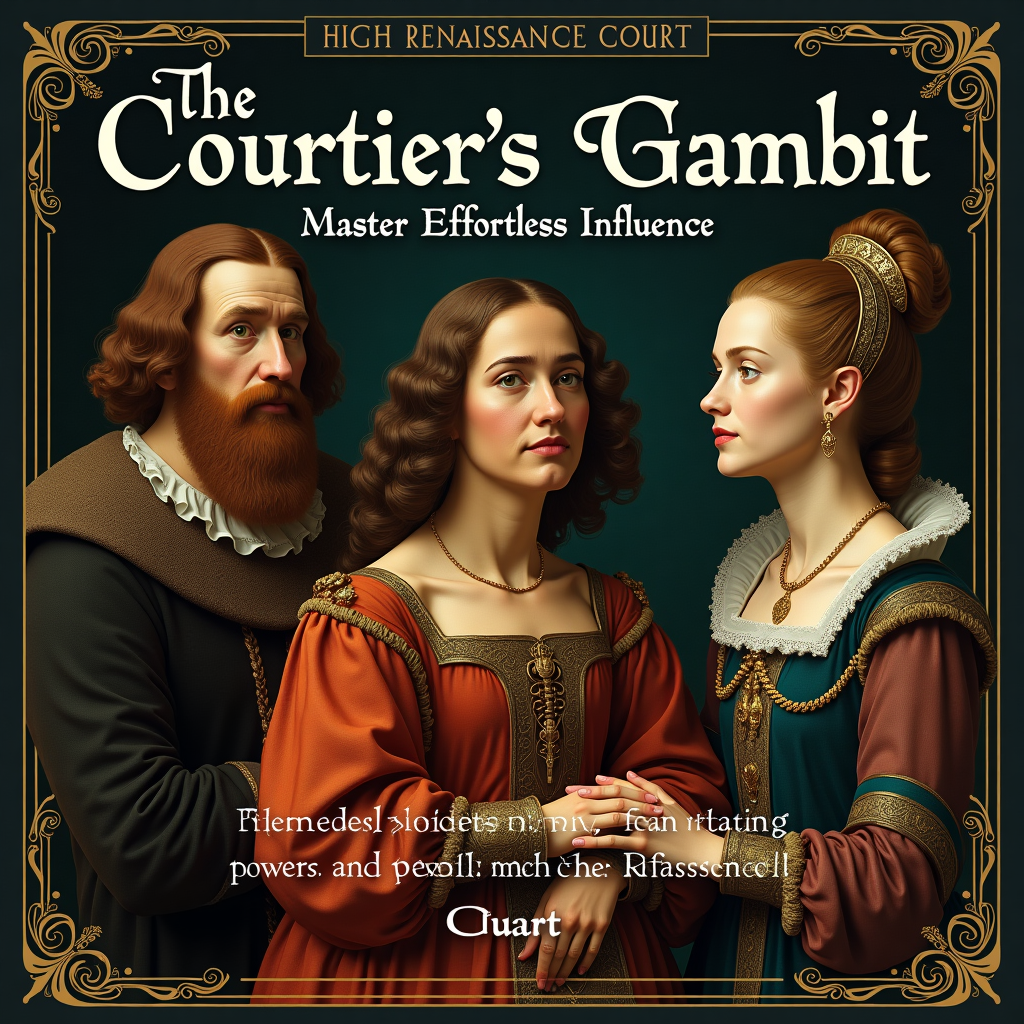
The Courtier's Gambit: Master Effortless Influence
Timeless Secrets for Navigating Power, Politics, and People from the Renaissance Court
Ambitious professionals in competitive modern fields seeking to master the subtle arts of social intelligence, influence, and strategic self-presentation.
Contents
- I. The Mask and the Mirror: Crafting Your Persona
- II. The Serpent's Tongue: The Art of Persuasion and Discretion
- III. The Lion and the Fox: Understanding Power Dynamics
- IV. The Queen's Gambit: Strategic Leadership and Authority
- V. Sprezzatura: The Art of Effortless Mastery
- VI. The Philosopher's Stone: Cultivating Wisdom and Judgment
- VII. The Explorer's Compass: Innovation and Calculated Risk
- VIII. The Essayist's Reflection: Self-Knowledge and Adaptability
- IX. The Grand Design: Orchestrating Your Legacy
- X. The Modern Courtier: Mastering the Contemporary Arena
I. The Mask and the Mirror: Crafting Your Persona
In the glittering, treacherous salons of the High Renaissance, where a whisper could elevate or annihilate, one's outward presentation was not merely a matter of vanity, but a vital instrument of survival and ascent. To navigate these gilded cages, one needed more than mere talent; one required artifice, a carefully constructed persona that spoke volumes before a single word was uttered. Forget the quaint notion of simply "being yourself." That, my dear friend, is a luxury few can afford, least of all those who aspire to shape their world.
Consider the courtier, a figure designed to move with grace through a labyrinth of power. His very existence was a performance, a masterful display of sprezzatura, that exquisite art of making the difficult appear effortless. Baldassare Castiglione, that most discerning observer of human nature, understood this profoundly. In his seminal work, The Book of the Courtier, he laid bare the mechanics of influence, revealing how an individual could command respect and affection, even from those whose interests were diametrically opposed. "To practice in everything a certain nonchalance," Castiglione advised, "so as to conceal all art and make whatever one does or says appear to be without effort and almost without any thought about it."
This, then, is our starting point: the deliberate cultivation of an image, a strategic self-fashioning that allows you to control the narrative surrounding your presence. In our modern arenas—be they boardrooms, digital forums, or high-stakes negotiations—the principles remain unchanged. Your first impression is not merely good or bad; it is indelible, a strategic advantage or a silent impediment.
The Art of Effortless Authority: Sprezzatura in Action
The essence of sprezzatura lies in the paradoxical act of intense preparation manifesting as spontaneous elegance. It is not about deception, but about selective revelation. Think of the seasoned diplomat who, under immense pressure, delivers a witty retort that disarms his opponent. This is not accidental brilliance; it is the culmination of years of study, observation, and mental rehearsal, presented as if conjured from thin air.
How does one achieve this seemingly magical effect?
Master the Fundamentals: Before you can appear effortless, you must first be profoundly competent. A musician who improvises beautifully has spent countless hours perfecting scales and theory. A leader who speaks extemporaneously with clarity has likely internalized their subject matter to an extraordinary degree. As Castiglione suggested, "Therefore, we may say that true art is that which does not seem to be art." This means:
- Deep Subject Matter Expertise: Know your field inside and out. Anticipate questions, objections, and opportunities.
- Polished Communication: Practice your delivery, your tone, your body language. Record yourself, seek feedback.
- Strategic Preparation: Understand the context, the players, and the desired outcome of every interaction.
Conceal the Toil: Once mastery is achieved, the next step is to hide the scaffolding. No one wants to see the sweat and strain. This is where the "certain nonchalance" comes into play.
- Maintain Composure: Even when the stakes are high, project an aura of calm control. This signals confidence and competence. Remember Queen Elizabeth I, who, facing myriad threats throughout her reign, maintained an iron will beneath a veneer of regal composure.
- Speak with Precision, Not Ponderousness: Avoid jargon or overly technical language when simplicity will suffice. The goal is clarity and impact, not to prove your intellect by making others feel dense.
- Embrace Understatement: A subtle gesture, a knowing glance, a quiet confidence often carries more weight than ostentatious display. Sir Francis Bacon, a master of subtle influence, observed, "Certainly, the speaking in a perpetual hyperbole is comely in nothing but in love." Overstatement betrays effort.
The Machiavellian Mirror: Reflecting Power
While Castiglione teaches us how to be admired, Niccolò Machiavelli reminds us that admiration alone is insufficient without the underlying bedrock of power. Your persona, therefore, must not only charm but also subtly project authority. "It is much safer to be feared than loved," Machiavelli famously asserted in The Prince, "if one of the two must be wanting." While we are not advocating for tyranny, the core principle remains: your image must convey strength and capability.
Consider these facets of projecting power through your persona:
Command Presence: This is not about being aggressive, but about occupying your space with dignity and purpose.
- Posture and Demeanor: Stand tall, make eye contact, and move with deliberation. A slumped posture or fidgeting betrays insecurity.
- Voice Modulation: Speak with a clear, resonant voice that projects confidence. Avoid uptalk or hesitancy.
- Strategic Silence: Knowing when to pause, to listen intently, or to allow silence to hang in the air can be a powerful tool, signaling thought and control.
Curate Your Associations: The company you keep, and the narratives you allow to be associated with you, profoundly shape your image.
- Choose Your Allies Wisely: Align yourself with individuals and organizations that enhance your reputation and capabilities.
- Manage Your Digital Footprint: In our modern age, your online persona is an extension of your physical one. Ensure it reflects the authority and grace you wish to project.
- Leverage Endorsements (Subtly): A well-placed mention from an influential figure, or a subtle nod to a significant achievement, can bolster your credibility without appearing self-aggrandizing. Sir Walter Raleigh, ever the astute courtier, understood the power of royal favor in burnishing his image.
The Art of the Strategic Withdrawal: Knowing when to step back, to maintain a degree of mystery, can enhance your allure and perceived power. As Michel de Montaigne mused, "We are never at home, we are always beyond." A consistent, predictable presence can sometimes diminish impact. A judicious absence, however, can make your return more potent. Don't always be available; cultivate a sense that your time and attention are valuable commodities.
Key takeaways
- Your persona is a deliberate construct, not an accidental byproduct. Invest time in shaping how you are perceived.
- Sprezzatura is the art of concealing effort through mastery, projecting effortless grace and competence.
- Balance charm with authority; be both admired and respected.
- Command presence through demeanor, voice, and strategic use of silence.
- Curate your associations and manage your visibility to enhance your influence.
I. The Mask and the Mirror: Crafting Your Persona
In the glittering, treacherous corridors of the High Renaissance court, where a misplaced word could spell ruin and a whispered rumor could unravel a dynasty, one’s outward presentation was not merely a matter of vanity; it was an existential imperative. The very air vibrated with ambition, and every gesture, every turn of phrase, was scrutinized for its hidden meaning. To navigate such a world, to not merely survive but to thrive, demanded a mastery of self-fashioning – an art form that, though centuries old, remains astonishingly relevant to the competitive arenas of our modern age. This, my friend, is where we begin our journey into the subtle craft of effortless influence.
Castiglione, that most elegant of chroniclers, understood this better than anyone. His Courtier was not a mere etiquette manual; it was a blueprint for psychological warfare, cloaked in silk and courtesy. He taught that the true master of the court, the one who would rise above the fray, must possess sprezzatura – that elusive grace
II. The Serpent's Tongue: The Art of Persuasion and Discretion
In the echoing halls of power, words are not mere sounds; they are currency, they are weapons, and they are shields. To master the court, whether it be of princes or of boardrooms, one must understand the delicate alchemy of language – how to distill intent into influence, and how to guard one's true counsel with the vigilance of a dragon. Castiglione, ever the connoisseur of grace, understood that true persuasion lay not in bluster, but in an almost imperceptible art. Machiavelli, on the other hand, saw words as instruments to be wielded with precision, sometimes even with deception, in the relentless pursuit of advantage.
The Subtle Art of the Silver Tongue
The true master of influence speaks not to command, but to guide; not to impose, but to inspire. This is the essence of sprezzatura applied to rhetoric – making the profound seem simple, the complex accessible, and the persuasive effortless. Castiglione, in his Book of the Courtier, advises that a gentleman "must have a graceful manner of speaking, and must avoid affectation in everything, especially in speech." This is not merely about eloquence; it is about authenticity, or at least, the appearance of it.
Consider the modern executive, presenting a contentious strategy to a skeptical board. The clumsy orator bombards them with data, while the astute courtier frames the narrative, drawing them in with a compelling vision.
- The Power of Framing: Instead of stating, "We must cut costs by 15%," a skilled communicator might say, "To unlock new growth opportunities and secure our future, a strategic realignment of resources, amounting to a 15% optimization, is imperative." The message is the same, but the framing shifts from punitive to aspirational.
- The Art of the Indirect: Direct confrontation can breed resistance. Sometimes, the most potent arguments are those that are not explicitly stated but are allowed to blossom in the listener's own mind. Sir Francis Bacon, a master of observation, noted that "knowledge is power." Applied to persuasion, this means providing the right information in the right way, allowing others to discover the conclusion you intend.
- The Illusion of Shared Discovery: A truly persuasive individual doesn't lecture; they facilitate. They ask questions that lead to the desired answer, guiding the conversation so subtly that the other party believes they have arrived at the conclusion independently. This fosters ownership and commitment, far more potent than mere compliance.
Discretion: The Armor of the Ambitious
While the silver tongue may win battles, discretion is the fortress that protects your kingdom. In the treacherous courts of old, a whispered secret could mean ruin, and a carelessly spoken word, death. Machiavelli, ever the pragmatist, understood that "a prince never lacks legitimate reasons to break his promise." While we do not advocate for duplicity in the modern sphere, we must acknowledge the wisdom in guarding one's true intentions and vulnerabilities.
Queen Elizabeth I, a monarch who navigated a court rife with intrigue, was renowned for her ability to keep her own counsel, often speaking in riddles or deferring decisions until the opportune moment. Her discretion was a key to her longevity and power.
- The Value of Strategic Silence: Not every thought needs to be voiced, not every opinion shared. Silence can be a powerful tool, conveying thoughtfulness, control, and even a hint of undisclosed knowledge. It creates space for others to speak, revealing their own hand.
- The Art of the Ambiguous Response: When pressed for information you are not yet ready to disclose, a gracefully ambiguous response can be a lifeline. "That is an excellent point, one we are exploring with great care," or "My focus right now is ensuring the foundational elements are robust before we articulate the full strategic roadmap."
- Guarding Your Ambitions: In a competitive environment, openly declaring every ambition can invite unnecessary obstacles. Share your vision strategically, with allies you trust, and only when the timing is ripe. As Sir Walter Raleigh, a man intimately familiar with the perils of court, learned, "He that cannot dissemble, cannot reign." While "reign" might be too strong a word for modern corporate life, the sentiment of carefully managing perceptions of one's aspirations remains profoundly relevant.
Michel de Montaigne, a keen observer of human nature, cautioned against the folly of revealing too much: "The most manifest sign of wisdom is a constant cheerfulness." While not directly about discretion, it speaks to the emotional control necessary to maintain an unreadable facade, preventing others from exploiting your inner state.
The Calculated Reveal: Timing and Trust
The power of discretion is not absolute silence, but rather the calculated decision of when and to whom to reveal. Trust is a scarce commodity, earned through consistent behavior and reciprocal confidences. A true courtier understands that sharing vulnerability or sensitive information is a strategic act, not an impulsive one.
- Identify Your Inner Circle: Not everyone is an ally. Discern those few individuals with whom genuine trust can be built, and even then, understand the limits of that trust.
- Test the Waters: Before sharing truly sensitive information, test the loyalty and discretion of others with less critical details. Observe their reactions, their ability to keep confidences, and their motivations.
- The Reciprocal Exchange: Trust is often built through a mutual exchange of confidences. Be prepared to offer a piece of your own counsel or vulnerability when seeking the same from another, but always with a clear understanding of the potential risks.
In the dance of influence, the discerning individual learns that words, both spoken and withheld, are instruments of immense power. To speak with impact, to persuade without seeming to, and to guard your counsel as closely as your ambitions – these are the hallmarks of the modern courtier, navigating the serpent's tongue with grace and strategic intent.
Key takeaways
- Effortless Persuasion: Cultivate sprezzatura in communication, making influence appear natural and guiding others to your desired conclusions.
- Strategic Silence: Understand that withholding information and maintaining discretion can be as powerful as speaking, protecting your interests and revealing others'.
- Guarded Ambition: Do not broadcast every aspiration; selectively share your vision with trusted allies at opportune moments to avoid unnecessary opposition.
- Calculated Trust: Build a discerning inner circle, testing loyalty before revealing sensitive information, and engaging in reciprocal exchanges of confidence.
- Machiavellian Prudence: While not advocating deception, acknowledge the pragmatic wisdom in carefully managing perceptions and protecting your strategic advantage.
III. The Lion and the Fox: Understanding Power Dynamics
My dear protégé, we have spoken of the polished veneer, the silken words that charm and persuade. But let us now draw back the velvet curtain further, into the very engine room of power, where the gears grind and the stakes are far more… consequential. While Castiglione teaches us the art of the dance, Machiavelli, bless his pragmatic soul, reveals the true nature of the ballroom floor – often slick with ambition, sometimes with blood. To master effortless influence, one must not merely play the courtier; one must understand the very architecture of the court itself, discerning where the true power resides, and how it shifts like the tides.
"Men are always more easily deceived, when they are trying to deceive others," Machiavelli observed in his sagacious Discourses. This is not merely an observation; it is a profound insight into the human condition, particularly within hierarchical structures. The ambitious, blinded by their own stratagems, often become the most vulnerable. Your task, then, is not to be deceived, nor to be easily caught in your own deceptions, but to navigate this intricate web with the clarity of a strategist and the grace of a master puppeteer.
The Anatomy of the Court: Unmasking the Power Brokers
Every organization, every social milieu, is a court. There are the visible monarchs – the CEOs, the founders, the declared leaders. But beneath them, and often around them, lies a complex constellation of influence. Your first task is to map this constellation.
- Identify the de jure power: These are the individuals with official titles, the ones whose authority is formally recognized. Their pronouncements carry weight, and their decisions are often final. Yet, their power is not always absolute.
- Uncover the de facto power: These are the true power brokers, whose influence often transcends their official position. They might be:
- The trusted advisor: The individual whose counsel the monarch values above all others. Think of a chief of staff, a long-serving mentor, or even a spouse whose opinion holds sway. Sir Francis Bacon, a man who rose to Lord Chancellor, understood this, advising, "He that is only real, had need have exceeding great parts of virtue; as the stone had need to be rich, that is set without foil." True influence often comes from being that invaluable, unvarnished counsel.
- The network weaver: The one who connects disparate factions, holds crucial information, and can rally support or opposition with a whisper. They are the conduits of the court's nervous system.
- The gatekeeper: Those who control access to the monarch or key resources. A skilled executive assistant, a project manager, or even a long-standing secretary can wield astonishing power by filtering information and controlling schedules.
- Observe the flow of deference: Watch not just who speaks, but who listens. Note who is approached for advice before a decision is made, and whose presence shifts the dynamic of a room. The true locus of power is often revealed by the subtle gestures of respect and attention.
When to Roar, When to Prowl: The Lion and the Fox
Machiavelli's most enduring counsel on power is his famous dictum: "A prince, therefore, being compelled knowingly to adopt the beast, ought to choose the fox and the lion; because the lion cannot defend himself against snares and the fox cannot defend himself against wolves. Therefore, it is necessary to be a fox to discover snares and a lion to terrify wolves." This is not a quaint historical analogy; it is a timeless strategic imperative.
- Be the Fox (Cunning and Discreet):
- To Discover Snares: This is the realm of intelligence gathering. Before any significant move, understand the landscape. Who benefits from your failure? Who has a hidden agenda? The fox observes, listens, and gleans information discreetly.
- To Navigate Treachery: When facing subtle opposition, political traps, or veiled attacks, direct confrontation is often a fool's errand. The fox employs subtlety, misdirection, and carefully timed maneuvers. As Montaigne sagely noted, "The greatest thing in the world is to know how to belong to oneself." Maintain your inner counsel, and do not reveal your full hand prematurely.
- Example: When a rival subtly undermines your project in meetings, the fox doesn't immediately expose them. Instead, they gather evidence, build alliances, and perhaps subtly highlight the rival's inconsistencies to others, allowing doubt to spread organically.
- Be the Lion (Bold and Decisive):
- To Terrify Wolves: When faced with overt threats, challenges to your authority, or situations demanding clear leadership, hesitation is fatal. The lion projects strength, confidence, and an unwavering resolve. This is when you must be direct, assertive, and leave no doubt as to your position.
- To Seize Opportunity: Sometimes, a bold, decisive move is required to capitalize on a fleeting opportunity or to break a deadlock. The lion doesn't dither; it acts.
- Example: When a crucial decision needs to be made under pressure, and others are wavering, the lion steps forward, articulates a clear path, and takes responsibility. This is not recklessness, but calculated courage. Queen Elizabeth I, facing the Spanish Armada, knew the power of the lion's roar, famously declaring at Tilbury, "I know I have the body but of a weak and feeble woman; but I have the heart and stomach of a king, and of a king of England too."
The mastery lies in the seamless transition between these two archetypes. The novice is either always the lion, inviting constant conflict, or always the fox, seen as indecisive. The master, however, reads the room, discerns the nature of the challenge, and chooses the appropriate beast for the moment, always with an air of effortless command.
The Art of Strategic Alliances and Discreet Neutrality
No one thrives in isolation. Just as a Renaissance prince built alliances with other states, you must cultivate relationships within your court.
- Cultivate Reciprocity: Think not just of what others can do for you, but what you can offer them. A true alliance is built on mutual benefit. Sir Walter Raleigh, a man who navigated the treacherous waters of the Elizabethan court, understood that influence was a currency to be exchanged.
- Identify Shared Interests: Seek out those whose goals align with yours, even if their methods differ. These are your natural allies.
- Master Discreet Neutrality: There will be factions, rivalries, and conflicts that do not directly involve you. The wise courtier does not take sides unnecessarily. Maintaining a neutral stance, at times, preserves your credibility and allows you to mediate or leverage both sides later. However, be wary of being perceived as indecisive or disloyal. Your neutrality must be strategic, not passive.
Key takeaways
- Map the true power structure: Look beyond official titles to identify de facto power brokers and understand the flow of deference.
- Master the Lion and the Fox: Be cunning and discreet to discover snares, and bold and decisive to overcome overt challenges.
- Cultivate strategic alliances: Build relationships based on mutual benefit and shared interests.
- Employ discreet neutrality: Avoid unnecessary involvement in conflicts, preserving your influence for when it truly matters.
- Always maintain your composure: Whether roaring or prowling, the greatest power is projected through effortless control.
IV. The Queen's Gambit: Strategic Leadership and Authority
Ah, the delicate dance of leadership, particularly when one must command not just respect, but devotion, in a world often predisposed to doubt. We have spoken of the crafting of persona, the subtle art of persuasion, and the stark realities of power dynamics. Now, let us turn our gaze to a figure who, with every calculated gesture and every carefully chosen word, redefined what it meant to lead: Queen Elizabeth I. She was, in essence, the ultimate courtier, playing the grandest game of all with an unparalleled blend of sprezzatura and Machiavellian acumen. To master effortless influence, one must understand how to wear the crown, even if that crown is merely the invisible one of authority in your chosen domain.
The Theatricality of Power: Image as an Instrument
Elizabeth understood, perhaps better than anyone before or since, that governance was as much a performance as it was policy. Her public appearances were meticulously orchestrated spectacles, designed to inspire awe, loyalty, and a sense of shared destiny. This was not vanity, my friend, but pure, unadulterated strategy. She curated her image as a Virgin Queen, married to her people, an embodiment of national identity. This allowed her to transcend the limitations of her gender in a patriarchal age, transforming what might have been a weakness into an unassailable strength.
Consider her famous speech to the troops at Tilbury in 1588, facing the imminent threat of the Spanish Armada: "I know I have the body but of a weak and feeble woman; but I have the heart and stomach of a king, and of a king of England too." Here, she masterfully acknowledged her physical form, only to assert a spirit far grander, a spirit intrinsically linked to the very essence of England. This is not mere rhetoric; it is the strategic deployment of self-perception.
- Actionable Insight: How do you present yourself when the stakes are highest? Is your "uniform" – be it attire, demeanor, or even your digital footprint – communicating the authority and resolve you wish to project? Remember, as Castiglione observed, "In all things, to make a show of effortlessness and to conceal all art and to make whatever one does or says appear to be without effort and almost without thought." Your strength should seem inherent, not strained.
The Art of the Inner Circle: Loyalty and Calculated Trust
Elizabeth was surrounded by formidable intellects and ambitious men, yet she managed to keep them not just in line, but fiercely loyal. Her genius lay in her ability to discern talent, nurture it, and bind it to her cause. She knew when to bestow favor, when to offer a pointed warning, and when to simply allow a rival to exhaust themselves. Sir Francis Bacon, a keen observer of power, noted that "knowledge itself is power." Elizabeth possessed this knowledge, not just of books, but of human nature. She understood the motivations, the ambitions, and the fears of those around her.
She did not seek to micromanage souls, as her oft-quoted remark suggests: "I have no desire to make windows into men's souls." This was not indifference, but a profound understanding of the limits of direct control. Instead, she focused on outward actions and allegiances, trusting her judgment and the counsel of a select few, such as William Cecil, Lord Burghley. Her court was a complex web of alliances and rivalries, yet at its center, she remained the undisputed arbiter, the ultimate source of patronage and punishment.
- Actionable Insight:
- Cultivate your Burghley: Identify a trusted advisor, a clear-eyed strategist who can offer unvarnished truth, even when it is unwelcome.
- Master the "soft touch": Learn to delegate effectively, empowering your team while maintaining ultimate oversight. Your authority should be felt, not constantly asserted. Allow your people the space to flourish, and their loyalty will deepen.
- Read the room (and the hearts within it): Develop an acute sense of political intuition. Who genuinely supports your vision? Who is merely paying lip service? Your ability to discern true allies from fair-weather friends is paramount.
Pragmatism and Resolve: The Unwavering Hand
While Elizabeth cultivated a magnificent image, her reign was defined by hard-nosed pragmatism. She navigated religious schisms, foreign invasions, and domestic conspiracies with a steely resolve that would make Machiavelli himself nod in approval. She understood that sentimentality had no place in the affairs of state, or indeed, in any arena where true influence is sought. When faced with the execution of Mary, Queen of Scots, a decision fraught with both political and personal peril, she prevaricated, absorbed counsel, and ultimately acted with a cold, calculated decisiveness necessary to secure her own throne.
Michel de Montaigne, writing contemporaneously, spoke of the importance of "judgement" in navigating life's complexities. Elizabeth's reign was a testament to this, demonstrating an extraordinary capacity for strategic decision-making, often under immense pressure. Her diplomacy was a constant calibration of power and persuasion, knowing when to stand firm and when to concede a minor point to win a larger victory.
- Actionable Insight:
- Define your non-negotiables: In any negotiation or strategic endeavor, know precisely what you absolutely must achieve and what you are willing to yield. This clarity is your compass.
- Embrace "virtù": As Machiavelli taught, cultivate the strength, courage, and decisive action required to overcome obstacles and achieve your objectives. This is not ruthlessness for its own sake, but the necessary resolve to lead effectively.
- Learn from delay: Elizabeth often used procrastination as a tool, allowing situations to mature, or adversaries to reveal their full hand. Sometimes, the most powerful action is no action at all, but rather strategic patience.
Key takeaways
- Image is strategic: Your external presentation is a powerful tool for projecting authority and shaping perception.
- Loyalty is cultivated, not demanded: Earn devotion through careful discernment, empowerment, and a judicious balance of reward and consequence.
- Decisiveness is paramount: While grace is admirable, true leadership demands a pragmatic, unwavering hand when critical decisions are required.
- Know your people, but not their souls: Focus on observable actions and allegiances, trusting your judgment of character.
V. Sprezzatura: The Art of Effortless Mastery
Ah, sprezzatura. The very heart of the courtier's art, and perhaps the most misunderstood. It is not mere nonchalance, nor is it a feigned disinterest. No, my friend, it is the sophisticated illusion of ease, the masterful concealment of effort, so that all your accomplishments appear to spring from an innate grace, a natural talent, rather than the sweat and toil that, I assure you, went into their cultivation. In the glittering, treacherous world of the Renaissance court, where a misstep could mean ruin and a graceful gesture could win a kingdom, sprezzatura was the ultimate currency.
"I have found by experience that it is an almost universal rule that in all things difficult to do, the greater the effort, the more disagreeable and ungraceful the result," observed Baldassare Castiglione in The Book of the Courtier. This, then, is the core of our lesson: to make the difficult appear effortless. For what is truly admired? The strained grunting of the laborer, or the elegant flourish of the master craftsman whose creation seems to have simply materialized from his fingertips?
The Architecture of Effortless Grace
Consider the modern boardroom, the competitive pitch, or the high-stakes negotiation. The one who appears flustered, over-rehearsed, or visibly straining to recall a fact, immediately loses ground. The one who delivers complex information with a calm, unhurried precision, answering challenges as if they were anticipated, exudes an authority that is both captivating and disarming. This is sprezzatura in action.
How does one build such an edifice of grace?
Mastery as Foundation: Before one can feign effortlessness, true effort must be expended. You cannot pretend to be a virtuoso if you have not spent countless hours practicing. As Sir Francis Bacon, that keen observer of human nature, might have advised, "Knowledge is power." Only when you possess a deep understanding of your subject, your craft, or your field, can you improvise with confidence and deviate from the script without stumbling.
- Actionable Advice: Dedicate yourself to foundational mastery. Understand not just what to do, but why it works. This deep comprehension allows for flexibility and improvisation, key components of sprezzatura.
The Art of Concealment: The true artist of sprezzatura never lets the audience see the strings. The late nights, the meticulous preparation, the numerous drafts – these are for your private consumption. In public, present only the polished gem.
- Example: Imagine a presentation where you've anticipated every possible question. Instead of rattling off canned answers, you pause, consider, and then deliver a response that feels spontaneous and perfectly tailored, even though you practiced it extensively.
Cultivating Calm Under Pressure: The courtier knew that the true test of character came not in triumph, but in adversity. Queen Elizabeth I, a master of public image, famously declared, "I know I have the body but of a weak and feeble woman; but I have the heart and stomach of a king, and of a king of England too." Her ability to project unwavering resolve in the face of immense pressure was a testament to her cultivated sprezzatura.
- Actionable Advice: Practice mindfulness and stress reduction techniques. Learn to control your physiological responses to pressure. A calm demeanor, even when your internal world is in turmoil, projects immense power and confidence.
The Subtle Performance: Distinguishing the Elite
The true mark of sprezzatura is not just doing something well, but doing it with a certain flair, a personal touch that makes it uniquely yours, yet without drawing undue attention to the effort. It is the subtle gesture, the perfectly timed pause, the knowing glance that communicates more than words.
"For in all things, to make show of it is to make an end of it," wrote Michel de Montaigne, capturing the essence of sprezzatura's understated power. The moment you try to appear effortless, the illusion crumbles.
The Graceful Recovery: Slips and errors are inevitable. The difference between the dilettante and the master of sprezzatura lies in the recovery. Rather than dwelling on a mistake or apologizing profusely, the courtier acknowledges it with a slight smile, a brief, self-deprecating jest, and moves on seamlessly, often turning the moment into an opportunity to showcase resilience or wit.
- Example: A momentary lapse in memory during a speech. Instead of stammering, you might say with a wry smile, "Ah, my mind, like a good wine, sometimes requires a moment to breathe before revealing its full flavor," and then continue without missing a beat.
The Power of Understatement: In a world clamoring for attention, the one who speaks softly, who offers incisive observations rather than bombastic declarations, often commands more respect. Sir Walter Raleigh, a man of daring and intellect, knew the power of the well-chosen word, delivered with quiet conviction.
- Actionable Advice: Resist the urge to over-explain or boast. Let your actions and your carefully chosen words speak for themselves. The less you try to impress, the more impressive you become.
The Illusion of Spontaneity: While much of your performance is meticulously planned, it must appear entirely spontaneous. This requires not just practice, but a deep understanding of human psychology and social dynamics. You must be able to read the room, adapt on the fly, and respond as if the perfect retort or insight simply occurred to you in that very moment.
- Machiavellian Insight: While Castiglione focused on outward grace, Machiavelli would remind us that even this grace can be a tool. "A prince, therefore, must be careful that nothing ever escapes his lips that is not full of the five qualities already mentioned, and to all who see and hear him, he should appear to be all mercy, all faithfulness, all integrity, all humanity, and all religion." The appearance, in the realm of power, is often more potent than the reality. Sprezzatura, then, becomes the elegant veneer over a calculated and strategic mind.
Key takeaways
- Mastery Precedes Effortlessness: True sprezzatura is built upon a foundation of deep competence and diligent preparation.
- Conceal Your Labor: The illusion of ease is shattered the moment your audience perceives your strenuous effort.
- Cultivate Calm Resilience: Maintain composure under pressure; your ability to recover gracefully from missteps is a hallmark of true finesse.
- Embrace Understatement: Let your achievements speak for themselves; the most impactful presence is often the most subtly delivered.
- Strategic Spontaneity: Plan meticulously, but execute with an air of improvisation, adapting to the moment with cultivated grace.
VI. The Philosopher's Stone: Cultivating Wisdom and Judgment
My dear acolyte, we have journeyed through the intricate dance of persona, the subtle art of persuasion, and the stark realities of power. We have admired the effortless grace of sprezzatura, that most coveted of attributes. Yet, all these finely honed tools, all these elegant maneuvers, are but instruments. They require a guiding hand, a discerning mind. For what good is the sharpest dagger if wielded by a blind man?
Sir Francis Bacon, that titan of intellect, understood this implicitly. He saw the world not as a tapestry of ancient dogma, but as a vast, intricate puzzle awaiting careful dissection. He championed a new way of seeing, of understanding, of knowing. His pronouncements, though delivered centuries ago, echo with a profound relevance for those who navigate the labyrinthine corridors of modern influence. "Knowledge itself is power," he declared, a truth as immutable as the stars. But it is not merely the accumulation of facts; it is the application of those facts, the alchemy of raw data into potent insight. This chapter, then, is about forging your own philosopher's stone – the intellectual acuity that transforms observation into advantage, and raw information into strategic wisdom.
The Art of Empirical Observation: Reading the Room and the World
Consider the Renaissance courtier. His survival, his ascent, depended not just on charming words or a graceful bow, but on an almost preternatural ability to read the shifting currents of favor, the subtle flickers of emotion, the unspoken alliances. This was empirical observation long before Bacon codified it. Today, the boardrooms and digital forums are no less demanding.
To truly cultivate wisdom, you must first learn to see. Not just to look, but to truly perceive. Bacon, in his Novum Organum, laid the groundwork for systematic inquiry, urging us to shed preconceptions and embrace direct experience. For you, this means:
- Become a data collector: Every meeting, every casual conversation, every email exchange is a piece of data. Who spoke first? Who deferred? What was left unsaid? What patterns emerge in behavior, in communication styles?
- Challenge assumptions: Just as Bacon implored his contemporaries to question ancient authorities, you must question your own biases. Do you assume a colleague's silence is disinterest, or could it be careful consideration? Does a competitor's aggressive stance stem from strength, or from desperation?
- Observe the periphery: The most critical information often resides not in the spotlight, but in the shadows. The quiet interjection, the brief glance, the subtle shift in posture – these can reveal more than a direct declaration. As Sir Walter Raleigh, that shrewd adventurer and courtier, once remarked, "Whosoever desires to rise must learn to stoop." Sometimes, stooping means paying attention to the seemingly insignificant.
This is not idle curiosity; it is strategic intelligence gathering. It is the raw material from which sagacity is forged.
Refining Judgment: The Alchemy of Insight
Once you have gathered your observations, the true work begins: the alchemical process of transforming raw data into refined judgment. This is where the wisdom lies, in the ability to project, to anticipate, to understand the likely consequences of actions—both yours and others'. Machiavelli, ever the realist, understood that accurate judgment was paramount. His advice was never about blind adherence to morality, but about the clear-eyed assessment of what is, and what will be.
"For a prince, it is necessary to know how to use the nature of both the beast and the man," Machiavelli famously wrote in The Prince. This speaks directly to the need for nuanced judgment, understanding the primal forces at play beneath the veneer of civility. How do we cultivate this?
- Seek diverse perspectives: Surround yourself not with echoes of your own thoughts, but with voices that challenge, that offer alternative viewpoints. This intellectual friction hones your own understanding.
- Practice scenario planning: Before making a significant decision, mentally simulate the potential outcomes. What are the best-case, worst-case, and most likely scenarios? Who benefits? Who is disadvantaged? What are the second and third-order effects?
- Learn from history (and mistakes): Both your own and others'. Every misstep, every unexpected triumph, holds a lesson. Michel de Montaigne, that master of self-reflection, penned essays that were, in essence, profound explorations of human nature and judgment. He understood that true wisdom often came from the examination of experience. "The most manifest sign of wisdom is a constant cheerfulness," he noted, implying that a clear mind, unburdened by confusion, finds a certain serenity in its judgments.
This process of refining judgment is continuous. It is never static. The world evolves, and so too must your understanding of it.
The Objective Truth: Informing Strategy with Reality
Ultimately, the philosopher's stone allows you to discern objective truth, or at least to approach it as closely as humanly possible. This pursuit of truth, unvarnished by wishful thinking or self-deception, is the bedrock of effective strategy. Queen Elizabeth I, a monarch who navigated treacherous political waters with unparalleled acumen, relied on a network of spies and advisors to provide her with unvarnished intelligence. She understood that a leader blinded by flattery or false information was a leader destined for ruin. Her famous axiom, "I know I have the body of a weak and feeble woman; but I have the heart and stomach of a king," speaks to her resolute commitment to facing reality, however daunting.
To inform your strategies with objective truth:
- Embrace data, not dogma: In an age of information overload, distinguish between verifiable facts and mere opinion. Question the source, the methodology, the underlying agenda.
- Confront uncomfortable realities: It is tempting to gloss over flaws, to dismiss inconvenient truths. But a strategy built on delusion is a house of cards. Be courageous enough to acknowledge weaknesses, threats, and uncomfortable market realities.
- Prioritize clarity over comfort: Your role, as a modern courtier, is to bring clarity to complex situations, even when that clarity is not what others wish to hear. This is where your judgment, forged in the crucible of observation, becomes invaluable.
By consistently seeking objective truth, you equip yourself not merely with knowledge, but with the profound wisdom to act decisively and effectively, to shape your destiny rather than merely react to it.
Key takeaways
- Cultivate relentless observation, treating every interaction as valuable data.
- Refine judgment through diverse perspectives, scenario planning, and learning from experience.
- Prioritize objective truth to inform strategy, even when uncomfortable.
- Understand that knowledge, when applied discerningly, is the ultimate power.
- Embrace the continuous pursuit of intellectual acuity as your philosopher's stone.
VII. The Explorer's Compass: Innovation and Calculated Risk
The world, my dear protégé, has always belonged to the bold. From the sun-drenched courts of Florence to the uncharted waters of the New World, it is the individual who dares to look beyond the known horizon, to challenge the established currents, who ultimately shapes the future. We speak not of recklessness, mind you, but of a finely tuned instinct for opportunity, a strategic audacity. Think of Sir Walter Raleigh, that quintessential Elizabethan courtier, poet, and explorer. His life was a testament to the pursuit of the unknown, a grand gamble played out on the global stage. He understood, as few before him, that the true measure of a man lay not in avoiding risk, but in mastering it.
Machiavelli, ever the pragmatist, offered a stark, yet illuminating, perspective on the role of chance. "Fortune," he wrote, "is a word for the blind concurrence of events, is not a thing that has any power of itself." This is not an invitation to fatalism, but a profound directive: fortune, though it may appear capricious, yields to the prepared mind and the decisive hand. It is the raw material upon which true innovation is forged. Your modern corporate landscape, with its dizzying pace of change and cutthroat competition, is but a new ocean to navigate, replete with its own hidden reefs and glittering treasures. Your compass, then, must be calibrated for both innovation and calculated risk.
Charting Uncharted Waters: Identifying Opportunity
Raleigh's voyages to Guyana were not born of idle curiosity but of a meticulous study of maps, reports, and the prevailing winds of ambition. He sought not merely gold, but glory, and the expansion of English power. In your world, the "gold" might be market share, a breakthrough product, or a strategic alliance. The "glory" might be a reputation for visionary leadership, a significant professional advancement.
How, then, do you identify these nascent opportunities amidst the clamor of the everyday?
- Cultivate Peripheral Vision: The most valuable insights often reside at the edges of your current focus. Raleigh didn't just look to established trade routes; he considered the whispers of new lands, the unverified accounts of vast wealth. In your context, this means:
- Listening to dissenting voices in meetings.
- Paying attention to nascent trends dismissed by the majority.
- Engaging with colleagues outside your immediate department or industry.
- Reading widely, beyond your professional silo.
- Embrace Discomfort: True innovation rarely emerges from comfort zones. Raleigh faced incredible hardship and uncertainty on his expeditions. Similarly, you must be willing to:
- Challenge long-held assumptions within your organization.
- Propose ideas that initially seem outlandish or too ambitious.
- Seek out projects that stretch your capabilities and demand new skills.
- Analyze the "Why Not?": Many opportunities are overlooked because of ingrained resistance or fear of failure. Instead of asking "Why should we do this?", inquire, "Why shouldn't we do this?" This flips the script, forcing a justification for inaction rather than for action. Queen Elizabeth I, though cautious, understood that inaction could be as perilous as ill-conceived action. Her support for figures like Raleigh, despite their occasional missteps, showcased a willingness to back ventures that promised future advantage.
Navigating the Tempest: Managing Uncertainty
Uncertainty is the constant companion of the innovator. Raleigh's expeditions were fraught with the perils of the sea, unpredictable weather, and hostile encounters. Yet, he persevered, adapting his plans, and maintaining his resolve. Your "tempests" might manifest as market volatility, technological disruption, or unforeseen competitive moves.
- Scenario Planning, Not Prediction: As Sir Francis Bacon, a contemporary of Raleigh, astutely observed, "Knowledge is power." While you cannot predict the future, you can anticipate a range of possible futures. Develop robust contingency plans:
- Outline best-case, worst-case, and most-likely scenarios for any significant initiative.
- Identify critical decision points and pre-determine your responses.
- Build flexibility into your strategies, allowing for rapid pivots.
- The Power of Small Bets: Raleigh didn't commit his entire fortune to a single, grand expedition. He often sought support, diversified his ventures, and learned from smaller-scale explorations before launching larger ones. In your professional life:
- Test new ideas on a smaller scale, with limited resources, before full commitment.
- Gather feedback early and often, using it to iterate and refine.
- View pilot programs as learning opportunities, not just miniature versions of the final product.
- Cultivate Resilience: The path of innovation is rarely smooth. There will be setbacks, criticisms, and outright failures. Raleigh faced imprisonment and eventual execution, yet his legacy endured. Montaigne, ever the introspective philosopher, noted, "The value of life lies not in the length of days, but in the use we make of them." Your ability to bounce back, to learn from mistakes, and to maintain your conviction despite adversity, is paramount. This is where the inner strength of a true leader shines.
The Decisive Stroke: Acting with Sprezzatura
Ultimately, innovation and calculated risk demand decisive action. All the planning and preparation in the world are meaningless without the courage to execute. Yet, as Castiglione taught us, this execution must be imbued with sprezzatura – that effortless grace that masks the immense effort and careful thought beneath.
- Clarity of Vision, Simplicity of Message: When presenting a bold new idea or advocating for a risky venture, your message must be crystal clear. Raleigh, despite his complex plans, could articulate the promise of the New World in compelling terms to his queen.
- Distill complex ideas into easily digestible narratives.
- Focus on the core benefits and the strategic imperative.
- Anticipate objections and address them proactively, but succinctly.
- Confidence, Not Arrogance: There is a fine line between self-assurance and hubris. A confident innovator inspires trust; an arrogant one breeds resentment. Your demeanor should convey competence and conviction, while remaining open to feedback and acknowledging potential challenges.
- Maintain composed body language and a steady gaze.
- Speak with authority, but listen with humility.
- Attribute success to the team, and shoulder responsibility for setbacks.
- The Moment of Truth: There comes a point where analysis must yield to action. This is the moment of truth for the explorer, the courtier, the innovator. Raleigh knew when to hoist the sails. You, too, must recognize when the time for deliberation is over and the time for execution has arrived. This requires:
- Trusting your judgment, honed by experience and careful consideration.
- Accepting that perfect information is a myth; decisions are often made with incomplete data.
- Committing fully to the chosen course, inspiring others to follow.
The modern courtier, much like Raleigh, must be a perpetual explorer, forever scanning the horizon for new opportunities, meticulously charting a course through uncertainty, and acting with a decisive grace that belies the profound thought and courage beneath. This is the essence of effortless influence in an era of constant change.
Key takeaways
- Embrace the "Why Not?": Actively seek out and challenge assumptions, looking for opportunities in overlooked areas.
- Strategize for Uncertainty: Develop robust scenario plans and utilize "small bets" to test ideas and mitigate risk.
- Cultivate Resilience: Learn from setbacks and maintain conviction in the face of adversity, understanding that failure is a part of innovation.
- Act with Decisive Sprezzatura: Present bold ideas with clarity, confidence, and an effortless grace that masks the underlying effort and risk.
VIII. The Essayist's Reflection: Self-Knowledge and Adaptability
My dear protégé, we have spoken of the masks we wear, the whispers we master, and the effortless grace that defines the truly influential. Yet, all these stratagems, however artfully deployed, are but instruments. To wield them with true purpose, one must first understand the hand that holds them, and the intricate machinery of the human heart they seek to sway. It is here that we turn to Michel de Montaigne, that astute observer of the human condition, who, from the quietude of his tower, penned reflections more potent than any treatise on statecraft. For Montaigne understood that the grandest theatre of power is often found within oneself.
"The most universal quality is diversity," Montaigne mused, a deceptively simple observation that unlocks profound truths for those who navigate the treacherous currents of ambition. In the modern court, where alliances shift like desert sands and reputations are forged and shattered in the blink of an eye, understanding this inherent diversity – in others and, crucially, in oneself – is not merely a virtue; it is a vital intelligence.
The Unexamined Life: Cultivating Introspection
Before one can hope to influence the world, one must first understand the landscape of one's own soul. Montaigne, in his relentless self-scrutiny, offers a blueprint for this essential excavation. He did not seek to impose rigid doctrines but rather to explore the labyrinthine workings of his own mind, his prejudices, his strengths, his bewildering contradictions. "To compose our character is our business, not to compose books, and to win, not battles and provinces, but order and tranquility in our conduct," he wrote.
Consider this not as a retreat from the world, but as a strategic reconnaissance. In the high-stakes arenas of today, where every move is scrutinized and every word weighed, a deep understanding of your own motivations, biases, and emotional triggers is your most potent armor.
- Journaling as a Mirror: Emulate Montaigne. Dedicate time, perhaps at the close of each day, to reflect not merely on what transpired, but on how you reacted. Document moments of success and failure, and critically examine the underlying reasons for both. What assumptions did you make? What emotions drove your decisions?
- Solicit Honest Counsel: Just as a monarch relies on trusted advisors, seek out individuals who will offer unvarnished feedback, even if it stings. This requires humility, a quality often in short supply among the ambitious, but one that is essential for true growth. As Sir Francis Bacon noted, "The greatest trust between man and man is the trust of giving counsel."
- Observe Your Reactions: Pay close attention to your internal responses in challenging situations. Do you become defensive? Overly aggressive? Do you shy away from confrontation? Recognizing these patterns allows you to anticipate and, ultimately, to moderate them, presenting a more composed and deliberate front to the world.
The Chameleon's Art: Adapting to Diversity
Montaigne's insight into diversity extends beyond the self to the wider human panorama. Each individual, each team, each organization possesses a unique blend of motivations, fears, and aspirations. The truly effective courtier – or CEO, or diplomat – understands that a one-size-fits-all approach is a recipe for irrelevance.
"We are all patchwork, and so shapeless and diverse in composition that each bit, each moment, plays its own game," Montaigne observed. This is not a call for insincerity, but for strategic flexibility. Just as a skilled chess player adapts their strategy to the opponent's moves, so too must you tailor your approach to the specific individuals and circumstances you encounter.
- Active Listening and Observation: Before you speak, listen. Before you act, observe. What are the unspoken anxieties of your team? What are the true drivers behind your client's demands? Queen Elizabeth I, a master of statecraft, was renowned for her ability to listen intently, absorbing information and assessing intentions before revealing her own hand.
- Empathy as a Tool: Put yourself in the other's shoes. What are their pressures? Their ambitions? Their insecurities? Understanding these allows you to frame your proposals, your critiques, and your requests in a way that resonates with their particular perspective. This is not weakness; it is a profound strength, as Machiavelli himself understood that effective rulers must "know how to assume the character of the fox to recognize traps, and that of the lion to frighten wolves."
- Strategic Code-Switching: Learn the dialects of influence. With some, a direct, data-driven approach will be most effective. With others, a more nuanced, relationship-focused dialogue will yield results. The ability to seamlessly shift your communication style without losing your core integrity is a hallmark of sophisticated influence. Sir Walter Raleigh, a man who navigated the treacherous waters of the Elizabethan court, understood that one must "frame your mind to the time."
The Humility of Knowing: Embracing Intellectual Modesty
Finally, Montaigne champions intellectual humility. He understood that true wisdom lies not in claiming absolute knowledge, but in acknowledging the vastness of what one does not know. "I speak truth, not so much as I would, but as much as I dare; and I dare a little more as I grow older." This profound modesty, far from diminishing your authority, actually enhances it. It signals a mind open to learning, capable of growth, and unwilling to be confined by dogma.
In the modern world, where certainty is often mistaken for strength, the ability to admit error, to adjust one's perspective in the face of new evidence, and to genuinely seek out diverse viewpoints is a rare and powerful asset. It builds trust, fosters collaboration, and ultimately leads to more robust and adaptable strategies.
- Challenge Your Own Assumptions: Regularly question your ingrained beliefs and the assumptions that underpin your decisions. What if you're wrong? What alternative perspectives exist?
- Seek Out Dissenting Voices: Actively encourage and listen to those who hold different views. Do not surround yourself with echoes; seek out voices that challenge and refine your thinking.
- Embrace Iteration: Understand that perfection is a myth. The most effective strategies are not carved in stone but are living, evolving entities, constantly refined through feedback and adaptation.
Key takeaways
- Introspection is a strategic imperative: Understand your own motivations, biases, and emotional triggers to wield influence effectively.
- Diversity demands adaptability: Tailor your approach to individuals and situations, embracing empathy and strategic code-switching.
- Intellectual humility builds trust: Acknowledge what you don't know, challenge assumptions, and actively seek out dissenting viewpoints.
- Montaigne's wisdom underpins sprezzatura: True effortlessness comes from a deep, self-aware understanding of self and others, allowing for graceful and effective adaptation.
IX. The Grand Design: Orchestrating Your Legacy
My dear protégé, we have journeyed through the intricate tapestry of the courtier's arts, from the sculpted persona to the subtle dance of power. Now, we arrive at the very summit of ambition: the Grand Design. For what is the point of mastering the mask and the mirror, the lion and the fox, if not to construct something enduring? The ultimate aim of the discerning courtier, then as now, is not merely to survive, nor even simply to thrive, but to leave an indelible mark – to orchestrate a legacy that resonates long after the final bow.
Consider the fleeting nature of favor, the shifting sands of power. A reputation, once tarnished, is a difficult thing to polish anew. Conversely, a well-tended legacy acts as a bulwark against the caprices of fortune. This is the long game, played with patience and foresight, where every action, every subtle gesture, is a brushstroke on the canvas of your future remembrance.
The Architect of Your Own Pantheon
The Renaissance, a crucible of genius, understood this implicitly. Men and women of ambition did not merely exist; they built. They sculpted their image, not just for the present gaze, but for the judgment of history.
As Castiglione, that master of grace, advised in The Book of the Courtier, the true mark of a gentleman was not merely in his deeds, but in how those deeds were perceived. He speaks of the need for "a certain nonchalance… that conceals art and delivers what is done and said as if it had been done without effort and almost without thought." This, my friend, is the essence of legacy-building. Your grand achievements, your significant contributions – they must appear not as the result of desperate striving, but as the natural outflowing of your inherent excellence.
How does one achieve this effortless grandeur in the modern age?
- Cultivate a Signature Style: Just as Queen Elizabeth I carefully curated her image through fashion, speech, and public appearances, you too must develop a distinctive professional persona that is both authentic and aspirational. What is your unique contribution? What qualities define your approach?
- Strategic Endorsements: Understand the power of association. Who do you align yourself with? Whose praise do you seek? Sir Francis Bacon, a man who understood the mechanics of reputation, noted, "A man's fortune is in his own hands." This extends to the company he keeps and the alliances he forges. Seek out mentors and collaborators who elevate your standing.
- The Art of the Well-Placed Gesture: True influence often lies not in grand pronouncements, but in small, consistent acts of generosity, insight, or support. These build a reservoir of goodwill, a quiet currency that pays dividends over time. Remember, the finest reputations are not shouted; they are whispered.
Defending Your Monument: Vigilance and Adaptation
Even the most meticulously crafted legacy is vulnerable. The slings and arrows of misfortune, the whispers of rivals, the shifting tides of public opinion – all can erode your monument. Here, we turn to Machiavelli, not for cruelty, but for a bracing dose of realism. He understood that power, and by extension, reputation, must be defended. "It is better to be feared than loved," he famously wrote in The Prince, "if you cannot be both." While we do not advocate for fear, we acknowledge the necessity of strategic vigilance.
- Anticipate and Mitigate: Be aware of potential threats to your reputation. What are your vulnerabilities? What narratives might arise that could undermine your standing? Proactively address weaknesses and preemptively counter negative perceptions.
- Controlled Disclosure: Not every success, not every struggle, needs to be aired publicly. Michel de Montaigne, that master of self-reflection, understood the value of privacy: "To compose our character is our chief business." Control the narrative by carefully curating what information you release about yourself and your endeavors.
- Adapt and Reframe: The world changes, and so too must your approach. A rigid adherence to an outdated image can be detrimental. When faced with setbacks, as Sir Walter Raleigh famously endured, learn to adapt. Reframe challenges as opportunities for growth, demonstrate resilience, and use adversity to strengthen your narrative, not dismantle it.
The Echo of Excellence: Shaping Future Perceptions
Ultimately, the grand design is about shaping not just what you achieve, but how you are remembered. It is the conscious cultivation of an echo that resonates through the corridors of time. Your legacy is not merely a summary of your accomplishments; it is the story you tell about yourself, meticulously crafted and consistently reinforced.
Consider the enduring influence of figures like Leonardo da Vinci or Michelangelo. Their genius was undeniable, but their legacy was also shaped by their patrons, their biographers, and the cultural narrative they inhabited. You, too, are both artist and subject in this grand endeavor.
- Mentor and Inspire: Share your knowledge, uplift others. A legacy built on mentorship is a powerful one, demonstrating not just capability but generosity of spirit.
- Document and Articulate: Ensure your contributions are recognized and recorded. This doesn't mean boasting, but rather ensuring that your impact is clearly articulated and understood by those who matter. Write, speak, present – make your mark visible.
- Embrace the Long View: Understand that true legacy is not built overnight. It is the sum of countless deliberate choices, small victories, and lessons learned. It requires patience, persistence, and an unwavering commitment to excellence, always delivered with that inimitable sprezzatura.
Key takeaways
- Legacy is an active construction, not a passive outcome.
- Cultivate a distinctive, effortless style that masks ambition.
- Proactively defend your reputation through strategic vigilance and controlled disclosure.
- Shape your narrative by mentoring, documenting, and embracing the long view.
- The ultimate art is to be remembered not just for what you did, but for how you did it.
X. The Modern Courtier: Mastering the Contemporary Arena
My dear protégé, we arrive now at the culmination of our journey, a moment to distill the timeless elixir of influence into a potent draught for your modern palate. The courts of today, though bereft of velvet and ermine, are no less intricate, no less perilous, and no less rewarding for those who master their unspoken rules. Corporate boardrooms, digital networks, and the relentless theatre of personal branding are but new stages for old dramas. The principles we have explored – the grace of Castiglione, the pragmatism of Machiavelli, the wisdom of Bacon, and the introspection of Montaigne – are not relics; they are instruments of precision, awaiting your skilled hand.
The Digital Ballroom: Sprezzatura in the Age of Screens
Consider the digital realm, that vast, shimmering ballroom where reputations are forged and shattered in an instant. Here, sprezzatura is not merely an aesthetic; it is a strategic imperative. The art of making difficult things appear effortless, of concealing your toil, is paramount.
Castiglione, in The Book of the Courtier, observed, “For true art is that which does not seem to be art; nor must one be more careful of anything than of concealing it, because if it is discovered, all credit and little esteem are lost.” In the digital age, this translates to:
- Curated Authenticity: Your online presence, whether personal or professional, must feel natural, unforced. The meticulously crafted LinkedIn profile, the insightful yet seemingly spontaneous tweet, the effortlessly elegant presentation – these are all products of hidden effort. Avoid the overt display of struggle; let your achievements speak with quiet authority.
- Strategic Understatement: When offering advice or sharing insights, do so with a light touch. Do not boast of your knowledge; demonstrate it through subtle contributions that elevate the discourse. As Queen Elizabeth I, a master of political sprezzatura, once said, "I have no desire to make windows into men's souls." Similarly, avoid transparent attempts to impress; let your value emerge organically.
- The Illusion of Ease: Whether mastering a new software or navigating a complex virtual meeting, project an air of calm competence. Practice diligently, prepare exhaustively, but once in the arena, let your actions flow as if unbidden. This fosters trust and admiration, marking you as a natural leader.
Navigating the Corporate Labyrinth: Machiavelli's Realism and Bacon's Insight
The modern corporate environment is a labyrinth of alliances, rivalries, and shifting power dynamics. Here, Machiavelli's stark realism and Bacon's profound insights into human nature are your most reliable compasses.
Machiavelli, ever the pragmatist, advised, “It is better to be feared than loved, if you cannot be both.” While direct fear is rarely advisable in today's professional settings, the underlying principle remains: command respect. Your colleagues and superiors must understand your capabilities and your resolve.
- Understand the Power Map: Identify who holds true influence, not just formal authority. Observe alliances, discreetly gather intelligence, and discern the true motivations behind decisions. Sir Francis Bacon, in his Essays, noted, "Knowledge itself is power." Apply this by thoroughly understanding the political landscape before making your move.
- Strategic Alliances: Cultivate relationships not just for camaraderie, but for strategic advantage. Identify individuals whose interests align with yours, or whose support could be crucial in future endeavors. Be a valuable ally, but never a naive one.
- Calculated Risk: Machiavelli understood that inaction can be the greatest risk. When opportunity presents itself, or when a threat emerges, be prepared to act decisively. However, as Sir Walter Raleigh, a man familiar with the perils of court, famously remarked, "Whoso desires to appear a good man in the world must be so indeed, and not merely seem so." Ensure your actions, however bold, are rooted in competence and integrity.
The Inner Council: Montaigne's Introspection and Your Personal Brand
Finally, let us turn to the most vital court of all: the one within yourself. Montaigne's relentless self-examination is not an indulgence but a strategic necessity for enduring influence. Your personal brand, your reputation, is the sum of who you are and what you project.
Montaigne, in his Essays, declared, "I study myself more than any other subject." This deep introspection is the bedrock of true authenticity and adaptability.
- Know Thyself, Truly: Understand your strengths, weaknesses, motivations, and biases. This self-awareness allows you to leverage your advantages and mitigate your liabilities. It prevents you from being swayed by external pressures or adopting a persona that is unsustainable.
- Adaptability through Reflection: The modern world changes at a dizzying pace. Regularly reflect on your experiences, learn from your successes and failures, and adjust your strategies accordingly. This constant recalibration ensures your influence remains relevant and potent.
- The Narrative of Self: Your personal brand is not just a resume; it's a living narrative. What story are you telling through your actions, your words, your choices? Ensure this narrative is consistent, compelling, and authentically reflects your values and aspirations. It is the silent, yet most powerful, testament to your influence.
The modern courtier, armed with these insights, is not merely a survivor but a master of their domain. You are now equipped to not just navigate, but to shape the currents of influence, to lead with grace, and to leave an indelible mark. Go forth, my friend, and exert your effortless influence.
Key takeaways
- Sprezzatura in the digital age requires curated authenticity and strategic understatement to project effortless competence.
- Machiavellian realism necessitates understanding the true power dynamics and forming strategic alliances within corporate structures.
- Baconian wisdom emphasizes knowledge as power, urging a thorough understanding of the professional landscape.
- Montaigne's introspection is crucial for self-awareness, adaptability, and crafting an authentic, compelling personal brand.
- Effortless influence is achieved by integrating these timeless principles into a cohesive strategy for modern challenges.
Published by Dungagent — https://dungagent.com More niche guides: https://dennwood18.gumroad.com