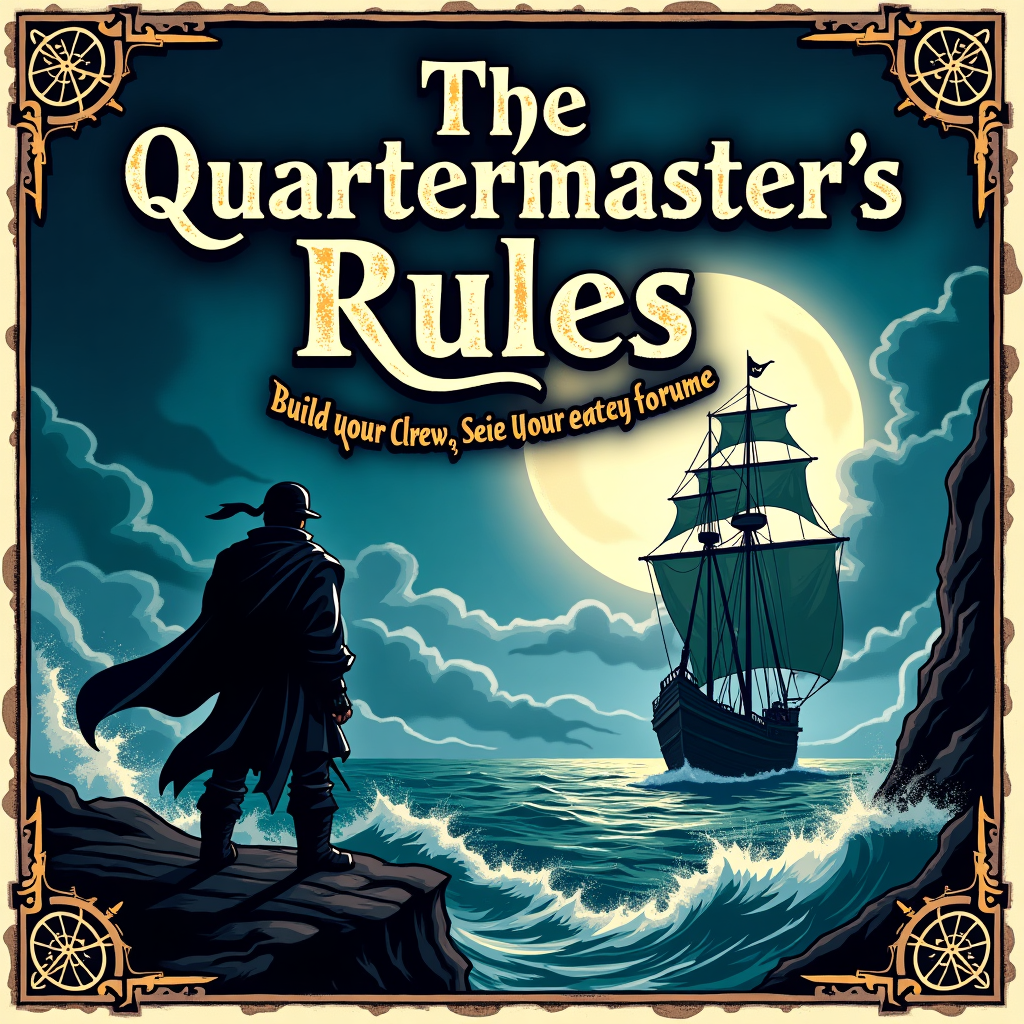
The Quartermaster's Rules: Build Your Crew, Seize Your Fortune
Pirate wisdom for navigating risk, building unbreakable alliances, and living by your own code.
For entrepreneurs, freelancers, and rebels in the corporate world seeking to break convention, build their own 'crew,' and claim their independence.
Contents
- Chapter 1: Hoisting the Colors – Branding Your Rebellion
- Chapter 2: The Articles of Agreement – Crafting Your Code
- Chapter 3: 'A Merry Life and a Short One' – Defining Your Risk Appetite
- Chapter 4: The Quartermaster's Ledger – Equity and Incentives
- Chapter 5: 'No Prey, No Pay' – The Hustle and the Hunt
- Chapter 6: The Unconventional Leaders – Blackbeard's Aura and Bellamy's Vision
- Chapter 7: The Iron Willed – Anne Bonny and Mary Read's Tenacity
- Chapter 8: Negotiation and Confrontation – The Art of the Parley
- Chapter 9: Mutiny and Loyalty – Managing Your Crew's Allegiance
- Chapter 10: Dropping Anchor – Sustaining Your Radical Freedom
Chapter 1: Hoisting the Colors – Branding Your Rebellion
Before a single cannonball left its perch, before a cutlass was drawn from its sheath, there was the flag. Not just any flag, mind you, but a declaration. A promise. A threat. You think branding is some newfangled corporate buzzword? We were doing it with skull and crossbones centuries ago, and we did it with a clarity and effectiveness that would make your modern marketing gurus weep. This wasn't about pretty colors; it was about psychological leverage, a visual contract with the world. Your venture, whatever it may be, needs its own Jolly Roger.
The Signal: More Than Just a Cloth in the Wind
The moment that black flag unfurled, sailing into view on the horizon, it spoke volumes. It told merchant captains that their choices were few: surrender and live, or fight and likely perish. It told the Royal Navy that they were dealing with men and women who had discarded society's rules. And crucially, it told potential recruits that here was a different path, a dangerous but potentially rewarding one, far from the lash of the merchant service.
Consider the sheer, unadulterated efficiency of it. A single image, instantly recognizable, conveying a complex message without a single word. That's the power you're aiming for. Your brand isn't just a logo; it's the sum total of expectations, fears, and hopes you generate.
- Clarity of Intent: What do you offer? What problem do you solve? Who are you for, and who are you absolutely not for? Our flag made it brutally clear: we were for plunder, for freedom, and for anyone willing to stake their life on it.
- Psychological Warfare: The skull and crossbones weren't just decorative. They were a vivid reminder of mortality, a visual shorthand for the consequences of resistance. What visual cues can your brand employ to convey your unique value proposition and deter competition?
- Beacon for the Disaffected: For the oppressed, the indebted, the ambitious with no upward mobility, the Jolly Roger was a symbol of opportunity. It promised a chance to rewrite their stars. Your brand needs to resonate with those who are looking for what you offer, those who feel underserved or misunderstood by the status quo.
Crafting Your Own Insignia of Independence
The exact designs of the Jolly Roger varied, as much as our captains varied in temperament. Blackbeard, with his smoldering fuses in his beard, understood theatrics. Bartholomew Roberts, a man of surprising discipline, knew the value of a clear message. Each variation, however subtle, reinforced the core message while adding a unique flourish.
- Bartholomew 'Black Bart' Roberts was known for a flag depicting himself standing with a flaming sword, confronting Death, or, in some accounts, standing on two skulls, one labeled 'Barbados' and the other 'Martinique' – a direct threat to the governors who opposed him. This wasn't just a skull and crossbones; it was a personal declaration of war, a specific target.
- Application: Don't be afraid to personalize your brand. What unique aspect of your vision or mission can be woven into your identity? Who are you directly challenging or serving?
- 'Calico' Jack Rackham's design, a skull with two crossed cutlasses beneath it, was simple, memorable, and communicated immediate danger. It was a clear, unambiguous symbol of conflict.
- Application: Simplicity often trumps complexity. Can your brand be distilled into an iconic, easily understood image or phrase?
- Edward 'Blackbeard' Teach's flag, reportedly a horned skeleton holding an hourglass and piercing a bleeding heart with a spear, was a terrifying vision. It conveyed a sense of impending doom and the swift passage of time for those who dallied.
- Application: What is the urgency or deeper meaning behind your offering? How can your brand communicate the consequence of not engaging with you?
"If there be a hell, then I'm sure it's here." While Henry Every's specific flag designs are debated, this sentiment attributed to him encapsulates the defiant, all-or-nothing attitude that defined the pirates and their brand. It was a conscious rejection of the established order, a willingness to embrace the 'hell' of outlaw status for the 'heaven' of freedom and riches. Your brand, too, must embody a core belief, a stance that sets you apart.
The Unwritten Code: Consistency and Reputation
A flag, however striking, is just a piece of cloth without consistent action behind it. The reputation of a pirate crew, and by extension, their flag, was built on how they treated those who resisted and those who surrendered. A reputation for brutality, or conversely, for fairness (within their own twisted code), preceded them, making the flag's appearance all the more potent.
"I am a free prince, and I have as much authority to make war on the whole world as he who has a hundred ships at sea." While not a direct quote from 'Black Bart' Roberts, this sentiment attributed to him perfectly illustrates the radical self-belief and declared autonomy that underpinned his entire operation. His brand wasn't just a flag; it was a philosophy, a declaration of independence.
- Deliver on Your Promise: If your brand promises innovation, deliver it. If it promises reliability, be reliable. A flag that promises swift action but is followed by hesitation or incompetence quickly loses its power.
- Control the Narrative: We couldn't control what the authorities said about us, but we certainly controlled the narrative with those we encountered directly. Your brand's story is yours to tell, consistently and authentically.
- Build Trust (or Fear): Whether you aim to inspire trust or a healthy respect for your capabilities, consistency in action is paramount. For us, it was often fear that greased the wheels of commerce. For you, it's likely trust.
Key takeaways
- Your brand is your flag: a clear, concise visual and philosophical statement.
- It serves as both a beacon for your allies and a deterrent to your opposition.
- Draw inspiration from historical figures like Roberts or Rackham for powerful, memorable iconography.
- Consistency in action reinforces your brand's message and builds its reputation.
- Your brand should embody your core beliefs and declare your independence.
Chapter 1: Hoisting the Colors – Branding Your Rebellion
Before a single cannonball left its perch, before a cutlass tasted blood, there was the flag. Not just a piece of cloth, mind you. It was the declaration, the promise, the threat. It told the world precisely who we were and what we stood for. This wasn't about mere intimidation; it was a masterclass in psychological warfare, a signal of intent that often decided the outcome before a single shot was fired. Your venture, no matter how grand or how small, needs a banner, a clear, compelling identity that resonates and commands.
The Psychology of the Skull and Bones
Imagine a merchantman, laden with silks and spices, sighting a distant sail. The anxiety begins with the shape of the canvas, but it truly takes hold when the colors are run up. The Jolly Roger wasn't just a skull and crossbones; it was a carefully crafted message. It screamed, "Resistance is futile, cooperation is rewarded, and defiance means ruin." It was a brand that promised swift action, and, crucially, a defined set of consequences.
Consider the pragmatic brilliance of Bartholomew Roberts, a man who, by all accounts, had a keen understanding of motivation and fear. He wasn't just a brute; he was a strategic operator. His articles, the code by which his crew lived and plundered, were meticulously designed to maintain order and maximize efficiency. And his flag? A stark image of himself standing with a flaming sword next to a skeleton, and another skeleton holding an hourglass, signifying the limited time of his enemies. It was a direct, unambiguous warning.
"I have been a pirate for two years, and in that time have taken over 400 ships. I never lost a battle to any man, nor ever will." - Bartholomew 'Black Bart' Roberts (attributed, though exact wording varies in historical accounts, the sentiment of his success and defiance is consistent)
This wasn't about being subtle. It was about defining the terms of engagement. For the merchant, it meant: "Surrender your cargo, and you might keep your life. Fight, and you lose both." For the crew, it was a symbol of their shared rebellion, their defiance of the established order. Your brand needs that same clarity. What is your promise? What is your threat (or rather, what are the negative consequences of ignoring you)?
Beyond the Black Flag: Signaling Intent and Building Loyalty
The Jolly Roger wasn't just for scaring the opposition; it was a beacon. For those oppressed by tyrannical captains, exploited by merchants, or simply seeking a life beyond the rigid constraints of society, the black flag represented freedom, opportunity, and a radical form of democracy. Samuel Bellamy, known as ‘Black Sam,’ understood this. He didn't just take ships; he offered an alternative.
"They brand us pirates, but it is they who plunder the poor by the law, and we plunder the rich by our own courage." - Samuel 'Black Sam' Bellamy (often paraphrased, but the core sentiment expressed in accounts of his interactions with captives)
This wasn't just branding for external effect; it was internal messaging. It rallied the crew, reminding them of their shared purpose and their collective grievance against the system. Your brand, your mission statement, your company culture – these are your internal Jolly Rogers. They must inspire loyalty, define shared values, and articulate the 'why' behind your venture.
- Clarity of Message: Is your brand instantly recognizable? Does it convey your core principles without needing a lengthy explanation?
- Emotional Resonance: Does your brand evoke a feeling? Fear, hope, excitement, rebellion?
- Promise and Consequence: What does engaging with your brand promise? What are the implications of not engaging?
- Internal Alignment: Does your team understand and believe in the brand's message? Does it guide their actions?
Even the most fearsome figures understood the power of their image. Edward Teach, 'Blackbeard,' cultivated an almost mythical persona with lit fuses in his beard and a fearsome array of weapons. His brand was pure terror, a psychological weapon that often saw ships surrender without a fight. He didn't just have a flag; he was the brand. His very appearance was a living Jolly Roger.
The Power of a Unique Identity
In a sea of competitors, blending in is a death sentence. The pirates understood this instinctively. While many flew variations of the skull and crossbones, each notorious captain often had their own distinct emblem. 'Calico' Jack Rackham's flag, with its two crossed cutlasses beneath a skull, was simple, memorable, and uniquely his. It spoke of swift, decisive action.
Your brand needs that same distinctiveness. What makes you different? What is your unique selling proposition, your 'secret sauce'? This isn't about being loud for the sake of it; it's about being memorable and communicating your value proposition efficiently.
- Differentiate or Die: In a crowded market, a generic brand is invisible. What makes your 'flag' stand out?
- Consistency is Key: Once you hoist your colors, fly them proudly and consistently. Every interaction, every product, every service should reinforce your brand identity.
- Adapt and Evolve, But Stay True: While the core message should remain, a brand can evolve. The pirates adapted their tactics, but their underlying declaration of independence remained constant.
Think of Anne Bonny and Mary Read. They defied every convention of their time, operating in a world utterly dominated by men. Their very existence, their participation in the brutal life of piracy, was a brand statement in itself. They were living proof that rules could be broken, and that courage knew no gender. Their legacy, though not tied to a specific flag, is a testament to the power of a radical, undeniable identity.
Key takeaways
- Your brand is your declaration: clear, concise, and compelling.
- The Jolly Roger was a masterclass in psychological warfare and signaling intent.
- A strong brand both intimidates external threats and inspires internal loyalty.
- Differentiation and consistency are paramount in establishing a memorable identity.
- Your brand isn't just a logo; it's the sum of your actions and your reputation.
Chapter 2: The Articles of Agreement – Crafting Your Code
You think you’re a maverick, a lone wolf? Understand this: even the most solitary predator benefits from a well-defined pack. The seas were a lawless expanse, yet the most enduring pirate crews didn't operate in chaos. They thrived on meticulously crafted social contracts, known as the Articles of Agreement. These weren't mere rules; they were the bedrock of their enterprise, defining everything from profit sharing to dispute resolution. Forget the romanticized notions of wild abandon; these documents were radical business strategies, ensuring cohesion and motivation in an environment where a single misstep meant the gallows.
The Social Contract: Beyond the Plank
Modern corporations draw up lengthy legal documents, often designed to protect the entity more than the individual. Pirate articles, by contrast, were fundamentally about the crew. They were a revolutionary form of direct democracy, predating many of the so-called enlightened constitutions by centuries. These weren’t dictated from on high; they were debated, agreed upon, and signed by every member. This buy-in was crucial. When every man and woman knew the rules and had a hand in shaping them, compliance wasn't a matter of fear, but of mutual interest.
Consider the practicalities. Life at sea was brutal, resources scarce, and loyalty a fragile commodity. Without a clear framework, mutiny was a constant threat. The Articles addressed this head-on, creating a transparent system for rewards and punishments. This wasn’t about being "nice"; it was about cold, hard efficiency. A disgruntled crew is an unproductive crew, and an unproductive crew doesn’t bring in the plunder.
Actionable Insight: Before you launch your next venture, before you even hire your first associate, sit down and draft your own "Articles of Agreement." What are the non-negotiables? How will profits be shared? What are the expectations for effort and contribution? Make it a collaborative process, not a dictatorial decree. When your team helps write the rules, they own them.
Equity and Incentives: The Quartermaster’s Calculus
The most striking feature of many pirate articles was the precise allocation of shares. This wasn't some vague promise of future riches. It was a mathematical guarantee, laid out for all to see. From the Captain to the cabin boy, everyone knew their stake. This wasn’t altruism; it was brilliant incentive design.
Bartholomew "Black Bart" Roberts, a man known for his strict discipline and surprising success, had some of the most detailed articles recorded. His system ensured that bravery and skill were rewarded, but also accounted for those who suffered injury in the line of duty.
- "Every man shall have an equal vote in affairs of moment, have equal title to the fresh provisions, or strong liquors, at any time seized, and shall use them at pleasure, unless a scarcity makes it necessary, for the good of all, to vote a retrenchment." – This wasn't just about sharing; it was about shared governance and resource management, a democratic approach to scarcity.
- "If any man shall lose a joint in time of engagement, he shall have 400 pieces of eight; if a limb, 800." – This wasn't charity; it was a form of insurance, guaranteeing that those who risked their bodies for the collective good would be cared for. It removed a significant disincentive to fight bravely.
This meticulous approach to compensation fostered a sense of fairness. No one felt cheated, and everyone understood the direct link between their effort and their reward. Compare this to modern companies where executive bonuses are opaque and disproportionate, breeding resentment and disengagement.
Actionable Insight: Transparency in compensation and incentives is paramount. Don't hide behind vague promises or complex formulas. Define clear metrics for success and tie rewards directly to them. Implement a system that acknowledges both individual contribution and collective risk. This fosters trust and ensures everyone is pulling in the same direction.
Discipline and Dispute Resolution: Maintaining Order in Anarchy
The freedom of the pirate life was often misunderstood as an absence of rules. Nothing could be further from the truth. While they rejected the oppressive laws of empires, they established their own, often brutal, codes of conduct. These articles weren't just about what you gained; they were about what you couldn't do.
- No desertion: Abandoning the ship or crew was a capital offense. Loyalty was non-negotiable.
- No fighting on board: Disputes were to be settled ashore, often through duels. This prevented internal conflicts from jeopardizing the mission.
- No gambling for high stakes: While gambling was common, excessive losses could ruin a man and destabilize the crew.
- No unauthorized lights after 8 pm: A seemingly minor rule, but crucial for stealth and maintaining operational security.
These rules, however harsh, served a purpose: to maintain order and focus on the primary objective – successful raids. When disputes arose, the Articles often stipulated a council of the crew, a form of peer-based arbitration. This prevented a single individual from wielding absolute power and ensured that justice, as defined by the crew, was served.
Actionable Insight: Every organization needs boundaries. Clearly define what is acceptable and what is not. Establish a transparent process for addressing conflicts and breaches of conduct. Don't let petty grievances fester; they can sink your ship faster than any storm. Empower your team to participate in resolving disputes, fostering a sense of shared responsibility for maintaining order.
Key Takeaways
- Co-creation of rules fosters ownership: Involve your team in drafting your operational guidelines.
- Transparency in rewards motivates: Clearly define compensation and incentive structures for all.
- Fairness isn't charity, it's strategy: Equitable distribution of resources and benefits ensures long-term commitment.
- Discipline protects the mission: Establish clear boundaries and a process for dispute resolution to maintain focus.
- A strong social contract is your anchor: It provides stability and direction in turbulent environments.
Chapter 3: 'A Merry Life and a Short One' – Defining Your Risk Appetite
The comfortable path, the one lined with predictable salaries and corporate ladders, offers a certain kind of security. But for those who feel the itch of true ambition, the gnawing desire for something more, that path often feels like a gilded cage. To break free, to build something truly your own, you must first confront the monster under the bed: risk.
Bartholomew 'Black Bart' Roberts, a man who traded the rigid discipline of a naval officer for the boundless horizon of piracy, understood this equation better than most. He famously declared, "In an honest service there is commonly low pay, hard fare, and short allowance, but in this, plenty and satiety, pleasure and ease, liberty and power." This wasn't merely a boast; it was a cold, pragmatic calculus comparing the known hardships of a conventional life with the potential, albeit dangerous, rewards of a life lived on one's own terms. He saw the 'honest service' as a slow, inevitable death of the spirit, while the 'merry life' offered a chance at true living, however brief. Your own journey to autonomy will demand a similar, unflinching assessment of what you are willing to wager for what you truly desire.
The True Cost of 'Security'
Before you can embrace risk, you must first understand the insidious cost of avoiding it. Many are lured by the promise of 'security,' a siren song that often leads to intellectual stagnation and financial mediocrity. Consider the merchant sailor, bound by contract, paid a pittance, and subject to the whims of cruel captains and distant owners. Their lives were 'secure' only in their predictable misery.
- Opportunity Cost: Every decision to play it safe is a decision not to pursue a potentially lucrative or fulfilling endeavor. What innovative idea languishes because you fear failure? What market opportunity passes you by because you’re unwilling to challenge the status quo?
- Erosion of Agency: A life lived in constant deference to external authorities – a boss, a corporation, societal expectations – slowly strips away your ability to make independent choices. You become a cog, easily replaced.
- The Illusion of Control: The corporate world offers the illusion of safety, but layoffs, market downturns, and shifts in company strategy can pull the rug out from under you at any moment. True control comes from building your own ship, not from being a passenger on someone else's.
Samuel 'Black Sam' Bellamy, whose brief but spectacular career ended tragically, nevertheless articulated the stark choice: "They vilify us, the scoundrels, when there is only this difference, that they rob the poor under the cover of law, forsooth, and we plunder the rich under the cover of our own courage." He recognized that the 'legal' system of his day was merely a different form of plunder, less honest in its hypocrisy. Your 'honest service' might be less overtly exploitative, but it still demands a portion of your life, your energy, and your potential, often for a fraction of its true worth.
Calibrating Your Compass: Defining Acceptable Risk
Once you acknowledge the hidden costs of playing it safe, the question becomes: how much risk is too much? This isn't about reckless abandon; it's about strategic calculation.
- Identify Your 'Worst Case': What is the absolute worst outcome if your venture fails? Can you survive it? Can you bounce back? For pirates, the worst case was often death or capture; for you, it might be financial setback, reputational damage, or a return to a less desirable job. Understand it, quantify it, and prepare for it.
- Assess Your Resources: What capital (financial, intellectual, social) do you have to deploy? A well-provisioned ship with an experienced crew can take on greater risks than a leaky sloop with greenhorns. Leverage your strengths.
- Calculate the Reward: What is the potential upside? Is it merely incremental improvement, or is it a step-change in your freedom, wealth, or impact? The bigger the prize, the more risk often becomes justifiable. Henry Every, who pulled off one of the greatest heists in history, understood the immense reward that justified his audacious gamble.
- Mitigate, Don't Eliminate: Risk cannot be entirely eliminated, but it can be managed. Just as a good Quartermaster ensures the ship is sound and the powder dry, you must build redundancies, contingency plans, and a strong support network. Edward 'Blackbeard' Teach, despite his fearsome reputation, was known for his strategic thinking and careful planning, not just brute force. His flaming beard and intimidating appearance were as much about psychological warfare as they were about raw power, a calculated risk to avoid actual combat.
Consider the female pirates, Anne Bonny and Mary Read. They faced not only the risks inherent to piracy but also the profound societal condemnation of their gender. Their very existence as pirates was a radical act of defiance, a testament to their willingness to risk everything for a life of their own choosing. Their reward? Not just plunder, but a fierce, undeniable autonomy that few women of their era could ever dream of. Their story is a powerful reminder that sometimes, the greatest risks yield the greatest freedoms.
The Quartermaster's Gambit: When to Go All In
There comes a point in any great endeavor when hedging your bets is no longer a viable strategy. You've done your research, weighed the odds, and prepared for the storm. Now, it's time to commit.
- The Point of No Return: Recognize when you've invested too much to turn back. This isn't about sunk cost fallacy; it's about acknowledging the momentum you've built and the resources you've already committed. To retreat now would be to squander everything.
- Decisive Action: Hesitation kills more ventures than outright failure. Once the course is set, steer with conviction. 'Calico' Jack Rackham, though not the most successful pirate, understood the importance of decisive action once a target was sighted.
- Embrace the Consequences: If you've truly defined your risk appetite, then you've made peace with the potential downsides. This acceptance frees you to act boldly, without the paralysis of fear. Your courage in the face of uncertainty will inspire your crew and intimidate your adversaries.
The 'merry life' Roberts spoke of wasn't necessarily a long one, but it was lived. It was a life of agency, of choosing one's own destiny, however fleeting. That, for many, is a far greater treasure than any guaranteed pension.
Key takeaways
- True security often comes at the cost of autonomy and potential.
- Quantify your worst-case scenario and build resilience against it.
- Strategic risk assessment is not reckless; it's calculated and informed.
- Know when to commit fully and act with unwavering conviction.
- The greatest rewards are often found beyond the comfortable confines of convention.
Chapter 4: The Quartermaster's Ledger – Equity and Incentives
You’ve got your flag, your rules, and a stomach for the storm. But a ship doesn't run on bravado alone. It runs on food, powder, and the promise of a full pocket. My job wasn't just to ration biscuits; it was to ensure every soul aboard, from the cabin boy to the captain, understood their stake in the venture. Without that understanding, without the cold, hard proof of fair play, your crew is just a collection of individuals waiting for a better offer. This isn't charity; it's the bedrock of any successful enterprise built on shared risk.
The Unwritten Contract: Beyond the Articles
The Articles set the rules of engagement, but the Ledger, that was the true measure of trust. We weren't just sharing stolen goods; we were distributing the spoils of collective effort, often with a transparency that would make most modern corporations blush. Think of it as a radical form of profit-sharing, where every hand, every cutlass swing, every hour spent aloft, directly translated into a tangible return. This wasn't some convoluted bonus scheme; it was direct, immediate, and utterly clear.
Consider the words of Bartholomew "Black Bart" Roberts, a man who knew a thing or two about motivating a crew: "If there be any quarrels, they are to be ended on shore, by sword or pistol." While this speaks to dispute resolution, it underscores a fundamental principle: the ship’s business, the shared business, was paramount. Internal strife, left unchecked, would devour the profits. Our system, often more democratic than the navies we preyed upon, ensured that disputes over shares were rare, because the system itself was designed for fairness.
- Transparency as Currency: Every capture, every piece of cargo, was inventoried. There was no 'secret fund' for the captain, no hidden bonuses for the officers. The crew knew exactly what had been taken and, more importantly, how it would be divided. This eliminated speculation and built confidence.
- Performance-Based Rewards: Wounds sustained in battle were compensated. Disability meant a larger share, an early form of insurance. This wasn't about sentimentality; it was about acknowledging and valuing the risks taken by individuals for the collective good. It ensured that even those who paid the highest price were not forgotten, fostering a sense of security and loyalty.
- The Quartermaster's Hand: My role was to oversee this distribution, to ensure no man was cheated, and no captain grew too rich at the expense of the crew. It was a check on absolute power, a safeguard against the very tyranny many of us had fled.
Incentivizing Loyalty: The Pirate's Share
The typical pirate share system was a masterclass in incentivizing collective success. The captain often received two shares, the quartermaster one and a half, and other officers slightly more than a common sailor. But crucially, the common sailor still received a full share. This wasn't a hierarchical pyramid; it was a tiered flat structure, rewarding leadership and responsibility without disenfranchising the backbone of the enterprise.
Samuel "Black Sam" Bellamy, known for his democratic approach, famously stated, "I am a free prince, and I have as much authority to make war on the whole world as he who has a hundred sail of a ship at sea." This sentiment, while grand, reflected a deeper truth among pirates: a shared sense of ownership and autonomy. Every man, in his own way, felt like a "free prince" with a stake in the venture.
Here's how you apply this:
- Define Clear Contribution Tiers: Not everyone does the same job. Acknowledge this, but don't create vast chasms. Define what warrants a larger share (leadership, specialized skills, extraordinary risk) and make those criteria explicit.
- Ensure a Strong Base Share: The majority of your "crew" needs to feel adequately rewarded for their fundamental contribution. If the base share is too low, motivation plummets, and your talent will jump ship.
- Reward Shared Success, Not Just Individual Glory: While individual heroics were noted, the true payout came from the successful capture of a prize. This fostered teamwork, as everyone's fortune was tied to the overall outcome. No one wanted a slack hand on deck, because it directly impacted their own pocket.
The Ledger's Discipline: Managing Scarcity and Abundance
My ledger wasn't just about dividing gold; it was about managing all resources. Powder, shot, food, water – these were all finite. I had to ensure we had enough for the next fight, enough to last the next voyage. This meant discipline, even in times of plenty.
When a rich prize was taken, the temptation was always to squander. But a good quartermaster understood that today's excess could be tomorrow's famine. This foresight, this disciplined approach to resources, was crucial for long-term survival, especially when operating far from any friendly port.
- Strategic Reserves: Always maintain reserves. Whether it's capital, inventory, or skilled personnel, don't deplete your resources completely after a big win. The next challenge is always on the horizon.
- Resource Allocation for Future Growth: Some spoils weren't divided but reinvested – repairs for the ship, new cannons, better supplies. This "reinvestment" was openly discussed and agreed upon, demonstrating a collective commitment to the enterprise's longevity.
- The Cold Reality of Limitations: Even with the most democratic system, hard choices had to be made. Sometimes, resources were scarce, and it was my job to communicate that reality and manage expectations. Better a clear, albeit difficult, truth than a festering resentment born of perceived unfairness.
Key takeaways
- Transparency builds trust and reduces internal conflict.
- Equitable profit-sharing, not just wages, fuels collective ambition.
- Reward individual contribution while prioritizing overall team success.
- Strategic resource management is vital for long-term sustainability.
- Clear communication about both abundance and scarcity maintains crew morale.
Chapter 5: 'No Prey, No Pay' – The Hustle and the Hunt
In the gilded cages of modern enterprise, they speak of "performance-based incentives" and "results-driven cultures." We called it 'No Prey, No Pay.' A simple axiom, born of necessity and forged in the crucible of hunger. You don't eat if you don't hunt. You don't get rich if you don't seize. This wasn't some motivational poster slogan; it was the bedrock of our existence, the unvarnished truth of the open sea. This chapter isn't about romanticizing the chase; it's about dissecting the ruthless efficiency of those who understood that opportunity rarely knocks twice, and that fortune favors the bold, but only if the bold are also prepared, observant, and utterly relentless.
The Scent of Gold: Market Analysis on the High Seas
Before a cutlass was drawn or a cannon fired, there was the hunt. Not for a specific target, but for the idea of a target. This was market analysis, pure and unadulterated. We didn't have spreadsheets, but we had intelligence networks: disgruntled sailors, merchants in taverns, captured captains desperate to save their skins. They spoke of routes, cargo, naval patrols, and the general state of trade. This wasn't guesswork; it was strategic reconnaissance.
Consider Henry Every, the man who vanished into legend with a king's ransom. He didn't just stumble upon the Mughal emperor's treasure fleet. He knew it was coming. He understood the seasonal trade winds, the established shipping lanes, and the value of goods flowing from the East. He didn't just want a ship; he wanted the ship.
- Identify Your Trade Routes: What are the established paths your competitors follow? Where do the most valuable resources or customers congregate?
- Listen to the Disgruntled: Discontented employees, disillusioned customers, former associates – they hold invaluable intelligence about vulnerabilities and opportunities.
- Track the Winds of Change: Economic shifts, technological advancements, political unrest – these are the trade winds that can either carry you to fortune or dash you against the rocks. Every's success was rooted in his understanding of the East India Company's practices and the Mughal Empire's wealth. He didn't just react; he anticipated.
Seizing the Moment: The Art of the Opportunistic Maneuver
Once the target was identified, hesitation was death. The window of opportunity on the high seas was fleeting. A change in wind, the appearance of a warship, a sudden storm – any could turn a king's fortune into a watery grave. This demanded quick decision-making, daring execution, and an almost instinctual ability to adapt.
Bartholomew 'Black Bart' Roberts, a man of surprising discipline for a pirate, understood this. He was known for his audacious raids, often striking multiple targets in rapid succession. His philosophy wasn't about waiting for the perfect conditions; it was about creating them, or exploiting them as they arose.
"In an honest service there is thin commons, low wages, and hard labour; in this, plenty and satiety, pleasure and ease, liberty and power; and who would not balance creditor on this side, when all the hazard that is run for it, at worst, is only a sour look or two from a judicial pig, and an uneasy turn at the gallows?" – Bartholomew 'Black Bart' Roberts
This wasn't just bravado; it was a cold, hard assessment of risk versus reward. He saw the opportunity in the inherent inequities of the system and seized it.
- Decisive Action: Once an opportunity is clear, move swiftly. Over-analysis is the death of initiative.
- Adaptability: The plan rarely survives first contact. Be prepared to pivot, to change tack, to exploit unexpected developments.
- Calculated Risk: Understand the downside, but don't let fear of it paralyze you. As Black Bart noted, the "hazard" was often outweighed by the potential "plenty and satiety."
Relentless Drive: The Pursuit of Objectives
The pirate's life was not one of leisure. It was a constant cycle of pursuit, engagement, and consolidation. There was no 'quitting time,' no 'weekend.' The horizon was always beckoning, and the next meal, the next prize, was always out there. This fostered a relentless drive, a hunger that kept crews sharp and focused.
Even after a successful haul, the drive remained. The fear of being caught, the need to resupply, the lure of further riches – these kept the engines churning. Edward 'Blackbeard' Teach, for all his theatricality, was a master of psychological warfare and sustained pressure. He didn't just capture; he dominated. His fearsome reputation was a tool to ensure compliance and minimize resistance, allowing him to achieve his objectives with greater efficiency. He understood that a consistent, intimidating presence could be as effective as cannon fire.
- Maintain Momentum: Success breeds success, but also complacency. Keep pushing, keep innovating.
- Cultivate a 'Hunter's Mentality': The hunt is never truly over. There's always a new challenge, a new market, a new competitor.
- Strategic Intimidation (Branding): While we no longer hoist literal Jolly Rogers, a strong brand and a reputation for uncompromising effectiveness can clear obstacles before they even arise. Blackbeard's beard and lit fuses weren't just for show; they were a masterclass in psychological advantage, making targets surrender before a fight even began.
Key takeaways
- Success stems directly from relentless pursuit of identified opportunities.
- Intelligence gathering and market analysis are critical precursors to effective action.
- Decisive, adaptable execution is paramount when opportunities arise.
- Cultivate a 'hunter's mentality' and never lose your drive, even after success.
- A strong reputation can be your most powerful weapon in achieving objectives.
Chapter 6: The Unconventional Leaders – Blackbeard's Aura and Bellamy's Vision
The sea, unlike the rigid monarchies ashore, had no truck with inherited titles or velvet-clad privilege. On a pirate ship, leadership wasn't a birthright; it was a performance, a strategic choice, and often, a gamble. The captain was less a benevolent monarch and more a CEO, constantly balancing the demands of his shareholders – the crew – against the existential risks of the enterprise. Two figures, in particular, stand out in their mastery of this volatile equation: Edward 'Blackbeard' Teach, a master of psychological warfare, and Samuel 'Black Sam' Bellamy, a visionary who articulated a profound sense of injustice. Their methods were disparate, yet both achieved fierce loyalty and remarkable success, proving that the path to command is paved with more than just a cutlass.
The Art of Intimidation: Blackbeard's Calculated Terror
In a world where reputation preceded you like a storm front, Blackbeard understood the power of a legend. He wasn't just a pirate; he was a brand, meticulously crafted to instill terror in his enemies and unquestioning obedience in his crew. His secret wasn't brute force alone, but a calculated, theatrical presentation of it. He curated an image that was not just fearsome but almost supernatural, a living embodiment of the Devil himself. This wasn't about being a bully; it was about creating an insurmountable psychological barrier.
Imagine the modern entrepreneur, facing down established giants or navigating cutthroat markets. Blackbeard teaches us that sometimes, your presence, your reputation, and the sheer audacity of your vision can be your most potent weapon.
"If there was any other way to get to Heaven but by going to sea, I would not be a pirate." – Edward 'Blackbeard' Teach, quoted by Captain Charles Johnson in A General History of the Pyrates.
This isn't a quote about piety; it's a statement of absolute commitment, a declaration that for him, the sea, and by extension, piracy, was the only path to a kind of salvation or ultimate freedom. It speaks to the deep, almost spiritual conviction that drove men to these extreme lives.
Blackbeard's tactics for cultivating this aura of invincibility included:
- Visual Branding: His lit fuses in his beard and hair before battle, the multiple pistols, the grimacing visage – these were not random acts. They were deliberate elements of his personal brand, designed to disorient and terrify. What is your 'lit fuse'? How do you visually represent your unwavering resolve and unique approach?
- Controlled Unpredictability: While fearsome, Blackbeard was rarely wantonly cruel to his own crew or to those who surrendered. His terror was a tool, not a default state. He knew when to be terrifying and when to be pragmatic. This cultivated an edge of unpredictability that kept everyone on their toes, fostering respect born of apprehension.
- The Illusion of Power: He made his forces seem larger, his intentions more severe, than they often were. This psychological advantage frequently led to surrender without a fight, conserving resources and minimizing risk. How can you project strength and confidence that deters competition and attracts allies, even when your resources are limited?
Blackbeard's leadership wasn't about being loved; it was about being obeyed. He understood that fear, strategically deployed, could be a more reliable motivator than camaraderie, especially in high-stakes environments.
The Power of Shared Grievance: Bellamy's Eloquent Rebellion
In stark contrast to Blackbeard’s theatrical intimidation, Samuel 'Black Sam' Bellamy offered a different kind of leadership: one rooted in shared ideology and a powerful narrative of justice. Bellamy didn't rely on fear; he relied on conviction, on articulating the deep-seated resentments that drove many to piracy. He was the charismatic orator, the ideologue who framed their illicit enterprise as a righteous rebellion against an unjust system.
For those looking to build a movement, to inspire loyalty beyond mere financial incentive, Bellamy's approach offers profound lessons. It's about tapping into a collective desire for change, for a better way.
"They vilify us, the scoundrels, who are only robbing the rich to give to the poor, and who, with courage, are making war on their kings and their princes, and on the whole world, for the freedom of the sea." – Samuel 'Black Sam' Bellamy, as quoted in A General History of the Pyrates.
This quote, delivered to a captured Captain Beer, is a masterclass in reframing. Bellamy doesn't just admit to piracy; he elevates it to a noble cause. He positions his crew as freedom fighters, egalitarian heroes challenging the established order. This wasn't just rhetoric; it was a foundational principle that resonated deeply with men who had suffered under harsh naval discipline and exploitative merchant captains.
Bellamy's leadership hallmarks included:
- Articulating a Vision: He didn't just offer plunder; he offered a philosophy. He painted a clear picture of who their enemy was (the oppressive elite) and what they were fighting for (freedom, equity, a better life). What is the 'why' behind your venture? Can you articulate a vision that transcends mere profit?
- Egalitarian Appeal: While still the captain, Bellamy fostered an environment where crew members felt respected and heard. His rhetoric of "robbing the rich to give to the poor" wasn't just for show; it was reflected in the internal workings of his ship, where prize shares were often more equitable than on other vessels.
- Moral Authority (Self-Proclaimed): By positioning themselves as champions of the oppressed, Bellamy instilled a sense of moral superiority in his crew. This shared belief in their 'righteousness' fostered immense cohesion and resilience. How can you imbue your team with a sense of purpose that goes beyond individual gain?
Bellamy's charisma wasn't about being scary; it was about being inspiring. He proved that a powerful narrative, deeply felt and eloquently expressed, could rally a crew to extraordinary lengths.
The Hybrid Approach: Adaptability in Leadership
While Blackbeard and Bellamy represent two distinct poles of leadership, the most effective leaders often incorporate elements of both. There are times for the stern, unyielding hand that instills discipline and respect through authority, and times for the inspiring, collaborative voice that rallies a team through shared purpose.
Consider the pragmatic genius of Bartholomew 'Black Bart' Roberts, who, despite his strict Articles, was renowned for his success and the loyalty he commanded. He understood that a clear framework, combined with consistent application and a reputation for bold action, was paramount.
"A short life and a merry one shall be my motto." – Bartholomew 'Black Bart' Roberts, quoted by Captain Charles Johnson in A General History of the Pyrates.
This is not a statement of reckless abandon, but a declaration of intent. It's about living fully, taking risks, and embracing the chosen path without apology. It speaks to a leader who understands the inherent dangers but chooses to face them with unflinching resolve, inspiring his crew to do the same. This motto, like Bellamy's philosophy or Blackbeard's aura, was a core part of Roberts's brand, communicating his leadership ethos succinctly and powerfully.
Effective leadership, especially in unconventional environments, requires:
- Situational Awareness: Knowing when to project an iron will and when to foster democratic discussion.
- Authenticity (of a sort): Even Blackbeard's theatrics were authentically him in their execution. Your leadership style must feel genuine to your team.
- Clear Expectations: Whether through fear or inspiration, the crew must know what is expected of them and what the consequences (or rewards) will be.
The sea demands adaptability. The modern world, with its rapid changes and complex challenges, demands no less from its leaders.
Key takeaways
- Leadership is a performance and a strategic choice: Cultivate a leadership style that suits your enterprise and your personality.
- Leverage psychological advantage: Whether through intimidation (Blackbeard) or inspiration (Bellamy), understand how to influence perceptions and motivate action.
- Articulate a compelling vision: Give your crew (team) a reason to fight beyond mere remuneration, a shared purpose or grievance.
- Adapt your approach: The most successful leaders know when to be firm and when to be inclusive, balancing authority with shared purpose.
- Embrace your chosen path with conviction: Your unwavering belief in your mission will be contagious.
Chapter 7: The Iron Willed – Anne Bonny and Mary Read's Tenacity
The world, then as now, was eager to put you in a box. To tell you who you were, what you could do, and where you belonged. Most complied, of course. Easier to drift with the tide than to swim against it. But a few, a very few, looked at those expectations and simply… laughed. They didn't ask for permission; they took it. They didn't just break the glass ceiling; they shattered it with a cutlass.
Beyond the Veil: Proving Your Mettle
Imagine the sheer audacity. Two women, not just on a pirate ship, but fighting alongside men, commanding respect not through charm or manipulation, but through sheer, unadulterated ferocity. Anne Bonny and Mary Read didn't just exist; they excelled. They carved out their place not by being "allowed" but by being undeniably effective. This isn't about gender; it's about competence in the face of ingrained prejudice.
Their story is a masterclass in proving your worth when the world expects you to fail. For the modern entrepreneur, freelancer, or corporate rebel, the challenge remains: how do you demonstrate value when the default assumptions are against you?
- Actionable Competence: They didn't talk about being tough; they were tough. They were observed in combat, often the last ones fighting when the men faltered. Their skill wasn't theoretical; it was bloody and undeniable.
- Your takeaway: Don't just claim expertise; demonstrate it. Deliver results. Let your work speak louder than any title or credential.
- Strategic Adaptability: They adopted the guise of men when necessary, not out of weakness, but out of strategic necessity to gain a foothold. Once established, their true identities, though known, became secondary to their combat prowess.
- Your takeaway: Understand the landscape. Sometimes, you need to play by the rules to get in the game, then rewrite them once you're a player. This isn't compromise; it's tactical maneuvering.
- Unwavering Resolve: When capture was imminent, historical accounts suggest they fought with a desperate courage that shamed their male counterparts. This wasn't bravado; it was a deep-seated refusal to yield.
- Your takeaway: Tenacity is your most valuable asset. When others falter, your resolve to push through the hardest moments will define your success.
The Power of Being Underrated
The common perception of women in that era, especially on a pirate ship, was one of fragility or domesticity. Anne and Mary weaponized this underestimation. Their opponents, perhaps expecting easy prey, were met with an unexpected and brutal resistance. This element of surprise was a critical advantage.
"I am sorry to see you there, but if you had fought like a man, you need not have been hanged like a dog." – Mary Read, speaking to 'Calico' Jack Rackham at his trial.
This cutting remark, delivered with a gallows noose looming, encapsulates their philosophy. It wasn't about being a woman despite being a pirate; it was about being a pirate, full stop, and demanding the same standard of courage and commitment from everyone, regardless of what society dictated.
- Leverage Expectations: If your competition dismisses you because of your size, your youth, your background, or any other superficial trait, let them. Use their underestimation as a blind spot you can exploit.
- Define Your Own Metrics: They didn't seek validation from the established order. Their measure of success was survival, loot, and the respect of their direct crewmates in the thick of battle.
- Your takeaway: Stop chasing external validation. Define what success means for you and your "crew," and pursue it relentlessly.
- Confrontation as Clarity: Mary Read's words to Rackham weren't just a taunt; they were a brutal summation of their code. They weren't afraid to call out weakness, even in their captain, because their survival depended on everyone pulling their weight.
- Your takeaway: Don't shy away from difficult conversations or holding your team accountable. Clarity, even harsh clarity, builds a stronger, more resilient unit.
Legacy of Defiance: Breaking the Mold
Anne Bonny and Mary Read were not just anomalies; they were pioneers. They demonstrated that the rules of engagement, both societal and literal, could be rewritten by those brave enough to challenge them. Their story resonates because it's about more than just piracy; it's about self-determination.
They didn't ask for a seat at the table; they took a cutlass and carved their own. Their existence proved that courage, skill, and an iron will transcend all artificial barriers.
- Authenticity Over Conformity: They lived as pirates, fought as pirates, and were judged as pirates. They didn't try to fit into a mold that wasn't theirs.
- Your takeaway: Your unique perspective and approach are your strengths. Don't dilute them to appease the status quo.
- The Power of Partnership: While fiercely independent, they also operated as a formidable duo, reinforcing each other's resolve and effectiveness.
- Your takeaway: Even lone wolves benefit from strategic alliances. Find your trusted partners who share your vision and complement your strengths.
- Enduring Impact: Decades, even centuries later, their names are still spoken. Not because they were the richest or the most powerful, but because they defied expectations and left an indelible mark on history.
- Your takeaway: True legacy isn't built on fleeting trends but on challenging norms and demonstrating radical capability.
Key takeaways
- Demonstrate your worth through undeniable action and results, especially when facing skepticism.
- Leverage being underestimated; turn perceived disadvantages into strategic advantages.
- Cultivate unwavering resolve and hold yourself and your team to the highest standards of commitment.
- Define your own metrics of success and pursue them relentlessly, free from external validation.
- Embrace authenticity and don't be afraid to challenge established norms with your unique approach.
Chapter 8: Negotiation and Confrontation – The Art of the Parley
The world, then as now, was a vast, chaotic market. You didn’t always want to burn it down; sometimes, you just wanted a better price, or safe passage, or to acquire a particularly valuable cargo without wasting powder and lives. The smart pirate, the one who saw beyond the immediate glint of gold, understood that brute force was a blunt instrument. There were subtler ways to get what you wanted, to bend situations to your will without firing a shot. This was the art of the parley, a dance of intimidation and diplomacy, a calculated gamble where the stakes were often life and death, but the goal was always advantage.
The Looming Shadow: Intimidation as Negotiation
Before you even opened your mouth, your reputation, your colors, your very presence spoke volumes. The Jolly Roger, as we discussed, wasn't just a flag; it was a psychological weapon. It broadcasted intent, a promise of swift, brutal efficiency if ignored. This wasn't about being a bully; it was about establishing the terms of engagement before a single word was exchanged. For the modern rebel, this is about your brand, your track record, and the undeniable force of your conviction.
Consider Blackbeard, Edward Teach. He cultivated an image of terrifying invincibility, braiding slow-burning fuses into his beard, appearing wreathed in smoke and fire. He rarely had to fight to the death. The sheer spectacle was often enough.
"If there was no hell, he would have created one, that he might be the sole monarch of it." – From Captain Charles Johnson's A General History of the Pyrates, describing Blackbeard.
This wasn't just theatrics; it was a strategic investment in psychological warfare. He understood that a reputation for ruthlessness, coupled with a willingness to back it up, was a powerful currency. For you, this means:
- Build a Formidable Reputation: Let your work, your integrity, and your unwavering commitment to your vision precede you. People should know you mean business.
- Strategic Display of Strength: You don't need a fiery beard, but you do need to understand your unique selling proposition, your past successes, and the resources you command. Don't hide your capabilities; let them be known, even if subtly.
- Controlled Aggression: The threat of action is often more potent than the action itself. Knowing when to escalate and when to hold back is crucial.
The Blade's Edge: Bluffing and Strategic Engagement
Not every pirate was Blackbeard. Many, like 'Calico' Jack Rackham, were less fearsome but no less cunning. Rackham, often underestimated, understood that a well-executed bluff could save lives and ammunition. He often relied on a show of force, even when his crew was small or his ship outmatched. The idea was to project an overwhelming advantage, to make the opponent believe the cost of resistance was too high.
This is where the art of the parley truly begins. You present your terms, backed by the implicit threat of what happens if they're not met. But you're also listening, gauging, looking for the opponent's weaknesses and their breaking point.
"He was a good seaman, but no fighter, and usually left the fighting to his women, Anne Bonny and Mary Read." – A common historical sentiment about 'Calico' Jack Rackham, highlighting his reliance on others and his less direct approach to combat.
Rackham’s approach, while not always brave, was undeniably pragmatic. He understood delegation and strategic positioning. For you:
- Know Your Leverage: What do you have that the other party wants or fears losing? This could be your expertise, your network, your unique solution, or the consequences of not dealing with you.
- Project Confidence, Even When Undermanned: If you're freelancing against a large corporation, or a startup against an established giant, your confidence in your offering and your ability to deliver is paramount. Don't reveal all your cards.
- Set Clear Demands: Before any parley, know precisely what you want. Be articulate and unwavering in stating your terms.
- Be Prepared to Walk Away: The most powerful negotiating tactic is the ability to say no. If the deal isn't right, or the terms are unacceptable, severing ties, even temporarily, can often bring the other party back to the table with a better offer.
The Truce and the Treasure: Securing Advantageous Deals
The ultimate goal of a parley wasn't destruction; it was acquisition. Whether it was a ship full of goods, a ransom, or simply safe passage, the pirate sought to maximize gain while minimizing risk. Bartholomew 'Black Bart' Roberts, known for his strict discipline and success, often offered terms before resorting to violence. He understood that a merchant ship, if captured without a fight, was more valuable intact. His focus was always on the bottom line, the efficiency of the operation.
"A short life and a merry one shall be my motto." – Bartholomew 'Black Bart' Roberts, though often misinterpreted, this quote speaks to a clear, albeit fatalistic, philosophy of living life on his own terms. His actions showed a preference for efficiency in achieving those terms.
Roberts' approach illustrates the power of clear objectives and decisive action. For you, this means:
- Define Your "Win": What does a successful negotiation look like for you? Is it a higher fee, better terms, a specific clause, or a long-term partnership?
- Seek Mutual Benefit (When Possible): While pirates were rarely altruistic, an intact ship was better than a sunken one. Look for solutions where both parties feel they've gained something, even if you’ve gained more. This builds trust for future engagements.
- Solidify Agreements: Once terms are met, ensure they are clearly documented and understood by all parties. No room for ambiguity.
- Maintain Your Edge: Even after a successful parley, remain vigilant. The world is constantly shifting. Your reputation, your leverage, and your readiness to adapt are your ongoing defenses.
Key takeaways
- Your reputation and brand are powerful tools for pre-negotiation intimidation.
- Strategic bluffing and a calculated show of force can often achieve your objectives without direct conflict.
- Always know your leverage and be prepared to walk away if the terms are not favorable.
- The goal of negotiation is to secure maximum advantage with minimum expenditure of resources.
Chapter 9: Mutiny and Loyalty – Managing Your Crew's Allegiance
Every captain, no matter how fearsome or charismatic, slept with one eye open. The sea, like the market, is an unforgiving place, and a crew, like any team, can turn on you faster than a squall. Loyalty isn't given; it's earned, maintained, and constantly re-earned. The threat of mutiny wasn't just a dramatic turn of phrase; it was a potent, ever-present force that shaped leadership on the high seas. Understanding this dynamic is crucial for anyone building a team today, whether in a startup, a creative collective, or a movement. It's about knowing when to be the iron fist and when to offer the open hand.
The Delicate Balance: Respect, Reward, and Discipline
The pirate ship was a microcosm of a radical democracy, albeit one governed by the whims of profit and survival. Unlike the brutal hierarchies of naval vessels, a pirate captain's authority was often conditional, granted by the crew and revocable. This meant leadership wasn't about birthright or rank, but about demonstrated competence and a shared vision for prosperity.
Think of it as managing a high-stakes, decentralized organization. Your crew are your stakeholders, and their buy-in is paramount.
Competence over Charisma: While figures like Blackbeard certainly leveraged charisma, their lasting authority stemmed from their ability to deliver results – successful raids, abundant loot. A leader who consistently fails to put food on the table, or worse, endangers the crew needlessly, will quickly find their authority eroded. Your team will follow you through hell and high water if they believe you know the way out.
Fair Dealing and Transparency: The Articles, as discussed in Chapter 2, were the bedrock of this fairness. They codified everything from division of spoils to rules of engagement. Any deviation, any perceived favoritism, could ignite discontent. The Quartermaster, more than anyone, was the arbiter of this fairness. They ensured the wounded received their due compensation, that the loot was divided according to the agreed-upon terms, and that punishments, when necessary, were meted out fairly. This transparency built trust.
The Power of the Purse (or the Chest): As detailed in Chapter 4, the promise of equitable reward was the primary motivator. When the rewards dried up, or were seen as unfairly distributed, loyalty wavered. This isn't just about money; it's about recognition, opportunity, and a sense of shared success. If your team isn't seeing the fruits of their labor, they'll seek greener pastures, or worse, overthrow the current management.
When the Winds Shift: Addressing Discontent and Preventing Mutiny
Mutiny wasn't always a sudden explosion; it often simmered, a slow burn of grievances and dissatisfaction. Astute leaders recognized these signs and acted decisively.
Consider the words attributed to Bartholomew 'Black Bart' Roberts, a captain renowned for his success and strict adherence to his own Articles: "In an honest service there is thin commons, low wages, and hard labour. In this, plenty and satiety, pleasure and ease, liberty and power; and who would not rather choose to be a commander than a common slave, who, without concern, may go where he pleases, and make his fortunes without any control?" This wasn't merely a recruitment pitch; it was a constant reaffirmation of the pirate's creed, a reminder of the alternative, and a subtle warning against internal strife. He offered a clear value proposition, and his crew, by and large, respected it.
Here’s how you navigate those rough waters:
Listen to the Whispers: A good leader, or a good Quartermaster, kept their ear to the ground. Dissatisfaction often starts with grumbling, with small acts of defiance, with a decline in morale. Ignoring these early warning signs is akin to ignoring a leak in the hull; eventually, the ship will sink. Regular, informal check-ins, an open-door policy, and a genuine interest in your crew's well-being can surface issues before they fester.
Decisive Action, Not Impulsivity: When faced with open defiance, indecision is fatal. A captain who hesitated, or showed weakness, invited further challenges. This doesn't mean resorting to immediate violence. Often, a clear, firm reassertion of authority, coupled with a reminder of the Articles and the shared mission, was enough. Sometimes, though, a swift, public demonstration of consequence was necessary to restore order. This is the difficult art of leadership: knowing when to be compassionate and when to be unyielding.
The Art of the Scapegoat (and the Second Chance): Sometimes, a single malcontent could poison the well. Isolating and dealing with such individuals, either by expulsion (being marooned) or by swift punishment, could prevent wider unrest. However, many pirate captains, understanding the value of a skilled hand, also offered second chances for minor infractions, reinforcing the idea that allegiance was valued, even if mistakes were not tolerated. It's about preserving the team, not just punishing the individual.
Building a Culture of Shared Purpose
Ultimately, the most effective antidote to mutiny was a strong sense of shared purpose and identity. The Jolly Roger (Chapter 1) was more than a flag; it was a declaration. The Articles (Chapter 2) were more than rules; they were a social contract.
Consider the words of Samuel 'Black Sam' Bellamy, known for his more egalitarian approach: "I am a free prince, and I have as much authority to make war on the whole world as he who has a hundred sail of ships and an army of 100,000 men in the field." This wasn't just bravado; it was a statement of shared defiance against oppressive systems. He articulated a vision of radical freedom and self-determination that resonated deeply with his crew, many of whom were former slaves or exploited sailors.
To build this kind of allegiance in your own "crew":
Articulate a Compelling Vision: Why are you doing what you're doing? What greater purpose does your work serve? Beyond profit, what freedom, what impact, what change are you striving for? This is the emotional glue that binds a team together when times are tough.
Foster a Sense of Ownership: Pirates were often partners in a venture, not mere employees. Their share of the loot, their voice in decisions (within the bounds of the Articles), and their direct contribution to success fostered a powerful sense of ownership. How can you empower your team to feel like owners of the mission, not just cogs in a machine?
Celebrate Victories (and Learn from Defeats) Together: Shared experiences, both triumphs and tribulations, forge strong bonds. A successful raid, a narrow escape, a difficult project completed – these moments, when acknowledged and processed collectively, reinforce team identity and resilience.
Key takeaways
- Authority is earned, not given: Your competence and fairness are the bedrock of your leadership.
- Transparency and equitable reward are non-negotiable: Clear rules and fair distribution prevent resentment.
- Listen actively and address discontent early: Small grievances can escalate into major problems if ignored.
- Decisiveness in crisis is paramount: Leaders must act firmly to maintain order and respect.
- Cultivate a shared purpose and vision: Inspire loyalty by articulating a cause greater than individual gain.
Chapter 10: Dropping Anchor – Sustaining Your Radical Freedom
The sea, like any market, eventually shifts. The winds that filled your sails can turn against you, the currents that carried you forward can drag you down. The Golden Age of Piracy, for all its audacious freedom, was never meant to last forever. Empires learned to adapt, navies grew stronger, and the price on a pirate's head became too tempting to ignore. But the decline of an era doesn't diminish the lessons learned during its ascent. This final chapter isn't about the end of the journey, but about how to sustain the independence you’ve fought so hard to seize. It's about recognizing the tides of change and navigating them, ensuring that the legacy you build—your radical freedom—endures.
The Inevitability of Change: Adapt or Perish
No business model, no matter how revolutionary, is immune to obsolescence. The very success of the pirate enterprise bred its downfall, as governments, once indifferent, were forced to act. Your radical freedom, once established, will inevitably draw attention, and with it, competition, regulation, or outright opposition. Those who failed to adapt, who clung to outdated strategies or underestimated the shifting power dynamics, often met a swift and brutal end.
Consider the fate of many. Edward Teach, Blackbeard, for all his terrifying mystique, met his end in a violent confrontation with the Royal Navy. His brand was potent, his tactics fearsome, but he underestimated the resolve of a determined foe.
"If I should not cause any terror, I would not be Blackbeard." - Edward 'Blackbeard' Teach
Blackbeard understood the power of psychological warfare, but even that wasn't enough when the tide turned. The lesson is clear: your fearsome reputation can only carry you so far. You must be prepared to evolve your strategy, to find new waters, or to secure your position when the hunter becomes the hunted.
- Diversify your portfolio: Pirates often buried treasure, a primitive form of asset diversification. What are your long-term investments beyond the immediate score?
- Monitor the horizon: Stay vigilant for emerging threats or opportunities. The world isn't static, and neither should your approach be.
- Know when to parley, and when to fight: Not every challenge requires a broadside. Diplomacy, even for pirates, had its place.
The Price of Freedom: Legacy and Reputation
The ultimate success of your venture isn't just about the wealth accumulated, but the legacy you leave behind. For many pirates, that legacy was a short, violent memory. For a select few, like Henry Every, it was a disappearing act, a successful exit from the game with their fortune intact. Every, after one of the most lucrative hauls in history, vanished from the historical record, rumored to have lived out his days in quiet luxury. He understood that sometimes, the greatest victory is knowing when to walk away.
"I am a free prince, and I have as much authority to make war on the whole world as he who has a hundred sail of ships and an army of 100,000 men in the field." - Henry Every
Every's quote encapsulates the spirit of radical self-determination, but his subsequent actions demonstrated a profound understanding of risk management and long-term sustainability. He didn't seek perpetual conflict; he sought a decisive victory and a secure future. Your "radical freedom" isn't truly free if it’s constantly under threat, requiring endless struggle. It must eventually lead to a state of self-sufficiency where you dictate your own terms, rather than constantly reacting to external pressures.
- Define your "enough": What does true financial independence look like for you? When is the time to consolidate your gains?
- Build an exit strategy: Even if you never intend to leave, having a plan for succession or divestment is crucial for long-term viability.
- Protect your reputation: While pirates reveled in their infamy, a truly sustainable enterprise often requires a more nuanced public image, even if that image is only for your trusted inner circle.
The Endurance of Principles: Beyond the Booty
The Golden Age ended, but the core principles of radical self-determination, democratic governance (within the crew), and equitable distribution of wealth that defined pirate life continued to resonate. They influenced future rebellions, labor movements, and even the very concept of individual liberty. The true legacy wasn't the gold, but the idea.
Samuel Bellamy, 'Black Sam,' often spoke of the hypocrisy of the established order. His words, though spoken centuries ago, still echo the frustrations of many who feel exploited by systems larger than themselves.
"They brand us villains, the scoundrels who plunder the poor, but what are they, the merchants who fleece the poor at every turn, the kings who wage wars for profit, but pirates in fine clothes?" - Samuel 'Black Sam' Bellamy
Bellamy's critique wasn't just about taking wealth; it was about challenging the legitimacy of the system itself. Your radical freedom isn't merely about personal gain; it's about proving that alternative models of success, leadership, and equity are not only possible but sustainable. It's about demonstrating that you can build your own ship, chart your own course, and thrive outside the confines of conventional wisdom.
- Codify your values: Just as the Articles of Agreement bound a pirate crew, your core values should guide your decisions and define your enterprise.
- Mentor the next generation: Pass on your hard-won knowledge. True legacy isn't just what you build, but who you empower.
- Stay true to your compass: In an ever-changing world, your internal compass—your mission and values—will be your steadiest guide.
The sea is vast, and the opportunities limitless for those with the courage to seize them. But courage alone won't keep your ship afloat indefinitely. It requires foresight, adaptability, and an unshakeable commitment to the principles that define your radical freedom. Drop anchor when necessary, but always be ready to hoist sail again, for the journey of true independence is a continuous one.
Key takeaways
- Adaptability is paramount: The world changes; your strategies must too. Clinging to old ways guarantees obsolescence.
- Plan for the long haul: Beyond immediate gains, consider your legacy, your exit strategy, and the sustainability of your independence.
- Values are your anchor: Your core principles will guide you through turbulent waters and ensure your freedom endures beyond mere profit.
- Empowerment is succession: True leadership involves cultivating the next generation of independent thinkers and doers.
Published by Dungagent — https://dungagent.com More niche guides: https://dennwood18.gumroad.com