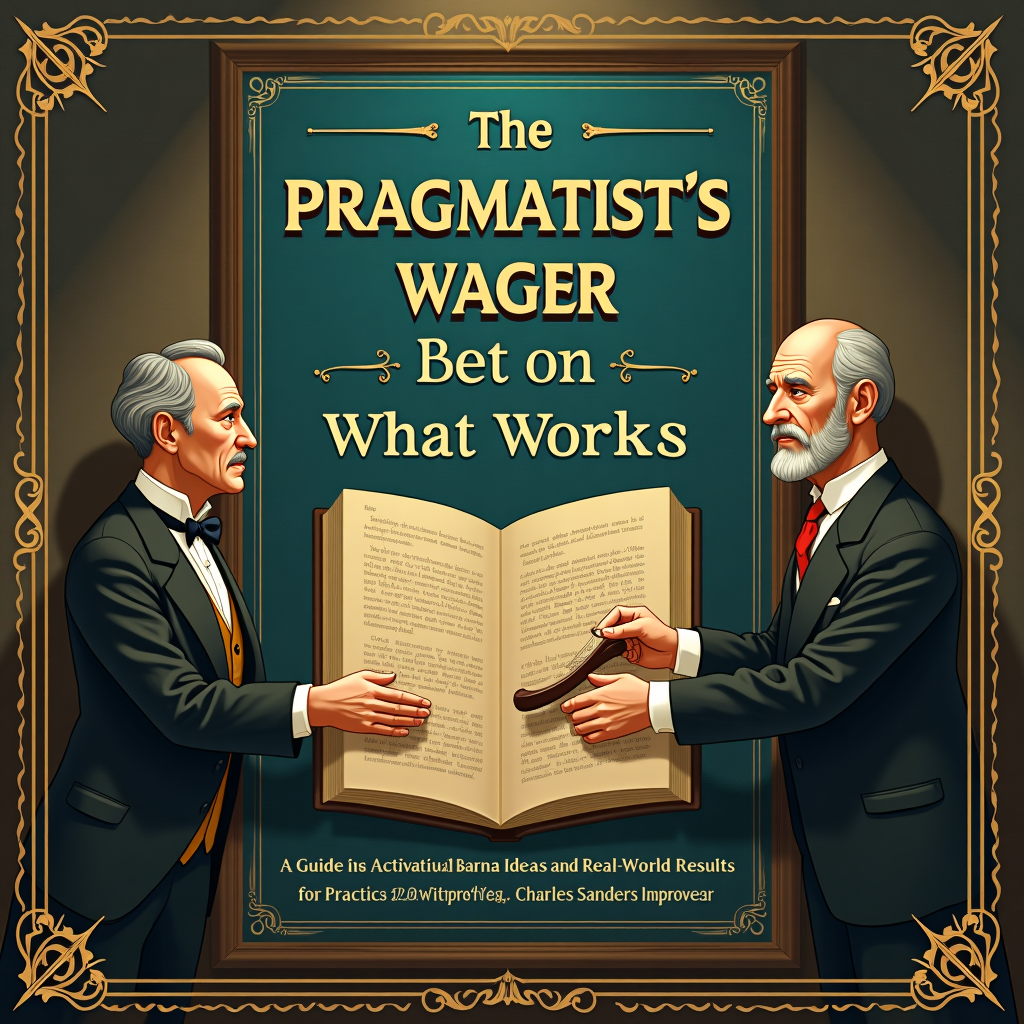
The Pragmatist's Wager: Bet on What Works
A Guide to Actionable Ideas and Real-World Results for Practical Self-Improvers
Practical self-improvers, entrepreneurs, and leaders who are tired of abstract theory and want a philosophical framework for taking effective action.
Contents
- Chapter 1: Ditching Analysis Paralysis for Actionable Beliefs
- Chapter 2: Designing Your Experiments: Truth as a Working Hypothesis
- Chapter 3: Education that Equips: Learning by Doing, Not Just Knowing
- Chapter 4: The Law of Life: Evolving Your Strategies for Success
- Chapter 5: Social Impact as a Hypothesis: Testing Ideas in Community
- Chapter 6: The Habit Loop: Cultivating Effective Routines for Growth
- Chapter 7: The Community of Inquiry: Collaborative Problem-Solving
- Chapter 8: Rethinking Experience: From Passive Observation to Active Learning
- Chapter 9: The 'Bad Man' and the Bottom Line: What Consequences Really Teach
- Chapter 10: Pragmatism in Practice: Your Personal Hull House for Action
Chapter 1: Ditching Analysis Paralysis for Actionable Beliefs
Ever find yourself stuck in an endless loop? You've got a big decision to make – a new business venture, a career pivot, a crucial project launch. You research, you strategize, you pore over data, you run scenarios. And then you do it all again. The problem isn't a lack of information; it's an inability to pull the trigger. You're waiting for absolute certainty, for some cosmic green light that never seems to appear. Meanwhile, opportunities pass you by, and momentum grinds to a halt. This isn't just procrastination; it's analysis paralysis, and it's a productivity killer.
So, what's the takeaway here? How do we break free from this mental quicksand? William James, one of the founding fathers of American Pragmatism, offers a radical solution. He challenges us to stop waiting for perfect knowledge and instead embrace what he called the "will to believe."
The "Will to Believe": A Hypothesis for Action
James wasn't talking about blind faith or wishful thinking. Far from it. He was addressing situations where evidence is incomplete, where a decision must be made, and where inaction itself is a choice with consequences. Consider this:
"Our passional nature not only lawfully may, but must, decide an option between propositions, whenever it is a genuine option that cannot by its nature be decided on intellectual grounds; for to say, under such circumstances, 'Do not decide, but leave the question open,' is itself a passional judgment… and is just as much a choice as deciding for or against the proposition." – William James, The Will to Believe
Let's unpack that. James is telling us that in situations where the data doesn't give us a clear answer, where waiting for more information is simply not an option (because the opportunity will disappear, for instance), our "passional nature"—our gut, our values, our desire for a certain outcome—must step in. To refuse to decide is still a decision, and often the worst one. It's a choice to stay put, to let things stagnate.
Think about it this way:
- Genuine Option: This isn't about deciding whether the sky is blue. It's about choices where the outcome isn't predetermined or scientifically provable before you act.
- Intellectual Grounds Insufficient: You've done your homework. You've consulted the experts. The data is ambiguous, or there are compelling arguments on both sides.
- Inaction is a Choice: Staying on the fence isn't neutral. It's a decision to maintain the status quo, which might be exactly what you need to avoid.
The "will to believe" isn't about believing something is true without evidence. It's about acting as if something is true, as a hypothesis, to see if it becomes true or yields useful results. It's about taking a calculated bet.
Betting Your Life (or Your Project) on What Works
This isn't about reckless abandon. It's about framing your choices as experiments. Instead of asking, "Is this absolutely, 100% guaranteed to work?" (a question that often leads to paralysis), the pragmatist asks, "What's my best hypothesis? What's the next logical step, even if it's imperfect? How can I test this belief in the real world?"
John Dewey, another key pragmatist, emphasized the experimental nature of knowledge:
"The experimental method is the only method which has produced any great results in any field." – John Dewey, Reconstruction in Philosophy
Dewey's point is that knowledge isn't static; it's something we make through action and observation. You don't just know something will work; you try it, you observe the results, and then you adjust. This is the core of the pragmatist's wager: bet on ideas that move you forward, then test their "cash value" in the real world.
Here's how to apply this to your own analysis paralysis:
- Identify the "Genuine Option": What's the decision you're stuck on where inaction is costing you?
- Acknowledge Intellectual Limits: Be honest. Have you genuinely run out of useful new information, or are you just seeking reassurance?
- Formulate Your Hypothesis: What's the most promising path forward, even if it's not perfect? This is your "belief" or your "wager."
- Example: "I believe launching this MVP with limited features (Hypothesis A) will give us more valuable user feedback than spending another 6 months perfecting it (Hypothesis B)."
- Define the "Cash Value" Test: How will you know if your hypothesis is working? What are the measurable outcomes?
- Example: For Hypothesis A, "Cash Value" might be 100 unique user sign-ups within 30 days, or 5 actionable bug reports.
- Take the Plunge (Action!): Implement your chosen hypothesis. This is where the "will to believe" kicks in – you act as if this is the right path, not because you're certain, but because it's the best available bet.
- Observe and Adjust: Don't just act and walk away. Gather data, analyze the results against your "cash value" metrics, and be prepared to pivot. This isn't about being right; it's about making progress.
The real question is, does it work? Does shifting from a quest for certainty to a willingness to experiment lead to better outcomes? The pragmatists would argue unequivocally yes, because it prioritizes action and learning over endless deliberation. It's about making progress, not just being perfectly prepared.
Key takeaways
- Analysis paralysis stems from a quest for absolute certainty that rarely exists.
- William James's "will to believe" means taking action on a hypothesis when intellectual grounds are insufficient and inaction is costly.
- Inaction is itself a choice; embracing a "passional judgment" can be necessary for progress.
- Frame your decisions as experiments, defining clear "cash value" tests for your hypotheses.
- The goal isn't to be perfectly right upfront, but to take action, learn, and adjust.
Chapter 1: Ditching Analysis Paralysis for Actionable Beliefs
Ever find yourself stuck in a loop? You've got a big decision to make – a new project, a career pivot, a crucial conversation. You research, you analyze, you make pro/con lists that stretch for miles. You talk to everyone, read everything. And then? Nothing. You're still there, right where you started, paralyzed by the sheer volume of information and the fear of making the "wrong" choice. The perfect moment never arrives, the perfect data point remains elusive, and the perfect plan is always one more revision away.
This isn't just procrastination; it's analysis paralysis, a modern epidemic that keeps good ideas from ever seeing the light of day. We've been conditioned to believe that we need absolute certainty before we can act. We wait for the universe to hand us a guaranteed outcome, a foolproof strategy. But what if that certainty never comes? What if waiting is, in itself, a choice with its own set of consequences?
This is precisely where William James, the father of American psychology and a giant of Pragmatism, steps in. He looked at this very human dilemma and offered a radical, yet profoundly practical, solution. He understood that sometimes, we simply have to make a leap.
The "Will to Believe" as an Action Hypothesis
James wasn't advocating for blind faith or wishful thinking. Far from it. His famous essay, "The Will to Believe," is often misunderstood. It's not about believing anything you want. It's about recognizing that in certain crucial situations, where evidence is inconclusive and inaction is itself a choice, choosing to believe a hypothesis can be the only way to gather the evidence needed to prove or disprove it.
Here's the core idea, in James's own words:
"Our passional nature not only lawfully may, but must, decide an option between propositions, whenever it is a genuine option that cannot by its nature be decided on intellectual grounds; for to say, under such circumstances, 'Do not decide, but leave the question open,' is itself a passional decision—just like deciding yes or no—and is attended with the same risk of losing the truth."
So, what's the takeaway here? When you're facing a "genuine option"—meaning it's live (you actually care about the outcome), forced (you can't avoid choosing), and momentous (the stakes are high)—and the intellect alone can't give you a definitive answer, you must make a choice. And choosing not to choose? That's still a choice, and it carries its own risks.
Think about it:
- Launching a new product: You've done market research, built prototypes, surveyed potential users. But there are always unknowns. Do you wait for 100% certainty that it will be a hit, or do you launch, learn, and iterate? James would say, "Bet on it."
- Taking a new job that's a stretch: The role is exciting, but you're not sure if you have all the skills. Do you wait until you've mastered every single requirement, or do you believe in your ability to learn and adapt, and jump in?
- Committing to a relationship: You can analyze compatibility forever. At some point, you choose to believe in the potential, invest your effort, and see if it works.
The "will to believe" isn't about blind optimism; it's about using belief as a tool to generate data. It's a hypothesis for action. You act as if your belief is true, and then you observe the consequences.
Betting Your Life on Ideas: The "Cash Value" Test
For James, the "truth" of an idea wasn't some abstract, eternal concept. It was something far more practical. He challenged us to ask: "What concrete difference does it make to anyone's actual life if this idea be true rather than false?" This is his famous "cash value" test.
"True ideas are those that we can assimilate, validate, corroborate and verify. False ideas are those that we cannot."
How can we put this to work on Monday morning?
- Identify your paralysis point: Where are you currently stuck, over-analyzing a decision where inaction is costing you?
- Formulate a "belief hypothesis": What's the most promising path forward, even if you don't have all the answers? Frame it as a belief: "I believe that launching this MVP will give us crucial customer feedback." Or, "I believe that taking this challenging role will accelerate my growth."
- "Bet your life" on it (or at least your next 3 months): This doesn't mean irreversible commitment. It means acting as if that belief is true for a defined period. Allocate resources. Take the first concrete steps.
- Observe the "cash value": What are the real-world consequences of your actions? Is the product getting traction? Are you learning and growing in the new job? Is the relationship deepening? Does your hypothesis demonstrate its usefulness? This is your data.
- Adjust and iterate: If the "cash value" isn't there, if the belief isn't proving useful in action, then you adjust your belief, your hypothesis, and your actions. This isn't failure; it's learning.
The real question is, does it work? Does acting on a belief, even when certainty is absent, lead to better outcomes than perpetual analysis? James would argue that it's the only way to move forward in a world of imperfect information. It's about exchanging the illusion of perfect knowledge for the reality of effective action.
The Pragmatic Experiment: A Call to Action
Pragmatism isn't a philosophy to be studied; it's a philosophy to be lived. It's an invitation to run experiments with your own life. When faced with a genuine option, and the data isn't all there, make a choice. Believe in a path forward, act on that belief, and then diligently observe the results.
This isn't about ignoring evidence; it's about generating it. It's about recognizing that sometimes, the only way to truly know if something works is to try it. And if it doesn't work, you learn, adjust, and try something else. That's the pragmatic wager: betting on what works, and being willing to change your bet when it doesn't.
Key takeaways
- Analysis paralysis is a pervasive problem, often stemming from the false expectation of absolute certainty before action.
- William James's "will to believe" suggests that in certain critical, genuine options, choosing to believe a hypothesis and acting on it is necessary to gather evidence.
- This isn't blind faith but a strategic use of belief as an "action hypothesis."
- The "cash value" of an idea is its practical usefulness and verifiable consequences in the real world.
- To overcome paralysis, formulate a belief hypothesis, "bet" on it through action, observe the real-world results, and iterate based on what works.
Chapter 2: Designing Your Experiments: Truth as a Working Hypothesis
Ever feel like you’re drowning in data, endless articles, podcasts, and expert opinions, but still can't figure out what to do? You’ve got information overload, decision paralysis, and a nagging sense that you’re missing the signal in all the noise. You’re looking for "the truth" about your next move, your next product, or your next personal habit, and it feels like a moving target.
This is where Charles Sanders Peirce steps in, not as a philosopher in an ivory tower, but as a systems architect for your thinking. Peirce, often called the founder of Pragmatism, wasn't interested in truth as some abstract, unchangeable ideal. He was interested in how we arrive at beliefs that actually help us navigate the world. For Peirce, what we call "truth" isn't a static destination; it's the conclusion we reach when our inquiries have run their course, and our beliefs are stable enough to act upon.
He wrote, “The opinion which is fated to be ultimately agreed to by all who investigate, is what we mean by the truth, and the object represented in this opinion is the real.”
So, what's Peirce telling us here? He's saying that truth isn't something you find pre-packaged. It’s what emerges from a process of persistent, shared investigation. It’s a consensus built on evidence, not dogma. And crucially, it's fated to be agreed upon – meaning, if we keep testing, keep experimenting, we’ll eventually converge on something that works.
How can we put this to work on Monday morning? We stop hunting for the answer and start designing experiments.
Framing Your Challenges as Hypotheses
Let’s be honest: most of us approach problems like we're searching for a magic bullet. We want a definitive answer, a guaranteed solution. Peirce flips that. He says, look, your current understanding, your best guess, your proposed solution – that's not "truth." That's a hypothesis. It's a working theory, a belief you hold provisionally, ready to be tested.
Think about it:
- Problem: My team isn't communicating effectively.
- Old Approach: "We need better communication tools!" (Declaration, not a hypothesis).
- Peirce's Approach: "If we implement daily 15-minute stand-up meetings (Hypothesis), then team communication will improve, leading to fewer misunderstandings and faster project completion (Predicted Outcome)."
See the difference? The second approach isn't a pronouncement; it’s an experiment waiting to be run. It has measurable outcomes. It’s designed for feedback.
Here’s how to translate your problems into testable hypotheses:
- Identify the problem: Be specific. "My sales are low" is too vague. "Our conversion rate from website visitor to lead is below industry average" is better.
- Propose a solution (your hypothesis): What do you think will solve it? "If we redesign the landing page with a clearer call to action..."
- Predict the outcome: What specific, measurable change do you expect to see? "...then our conversion rate will increase by 10% within one month."
- Define your metrics: How will you know if it worked? "We'll track conversion rates using Google Analytics before and after the change."
This isn't just academic. This is how successful startups iterate, how scientists make breakthroughs, and how you can stop spinning your wheels. The real question is, does it work?
The Rigor of Inquiry: Testing Your Beliefs
Peirce wasn’t just about having hypotheses; he was about rigorous inquiry. He believed that true belief wasn’t just what you felt strongly about, but what could withstand the assault of doubt and evidence.
This means you can’t just form a hypothesis and then look for evidence that confirms it (that’s confirmation bias, and it’s a killer). You have to actively seek to disprove it, to find where it breaks down.
Let's run the experiment:
Imagine your hypothesis: "If I wake up an hour earlier every day, I'll be more productive."
- Initial Test: Try it for a week. Track your productivity. Feel more productive? Great.
- Rigor Check: Are you actually getting more done, or just feeling busier? Are you sacrificing sleep quality? Is your energy crashing mid-afternoon? What if you're just shifting your unproductive time to an earlier slot?
- Alternative Hypotheses: What if the problem isn't when you wake up, but how you use your time? Or what if you just need better sleep hygiene?
This iterative process of testing, observing, refining, and sometimes discarding your hypothesis is the core of Peirce’s "truth as a working hypothesis." You’re not married to your initial idea. You're married to finding what works.
This isn't about being wishy-washy. It's about being adaptable. It’s about not letting your ego get in the way of useful information. When your hypothesis fails, you haven't failed; you've learned something valuable. You've eliminated one less-than-optimal path. That's progress.
The Community of Inquiry: Learning from Others
Peirce's quote also mentions "agreed to by all who investigate." This isn't just about your personal experiments. It's about collective wisdom. While you're testing your hypotheses, don't ignore the findings of others.
- Peer Review: Share your findings, your experiments, and your conclusions with trusted colleagues, mentors, or even an online community. What do they think? Do they see flaws in your methodology? Do they have similar experiences?
- Learn from History: Before you design your grand experiment, see what others have already tried. What worked for them? What failed? This isn't about blindly copying, but about building on existing knowledge.
- Diverse Perspectives: Actively seek out viewpoints that challenge your own. If everyone agrees with you immediately, you might not be pushing hard enough.
The "truth" that emerges from this process is robust because it has been subjected to multiple tests, different perspectives, and continuous refinement. It's not just your truth; it's a truth that stands up to scrutiny from a "community of inquiry."
So, the next time you're stuck, don't search for the answer. Design an experiment. Make a wager on what you think might work, then rigorously test it. That's the Pragmatist's path to actionable truth.
Key takeaways
- Truth is a working hypothesis, not a fixed dogma. It’s what proves useful and stands up to rigorous testing.
- Frame problems as testable hypotheses. Translate vague issues into "If (action), then (measurable outcome)" statements.
- Actively seek to disprove your hypotheses. Don't just look for confirming evidence; embrace failure as learning.
- Engage in a "community of inquiry." Test your ideas against the experience and scrutiny of others.
- The goal is actionable belief. What you arrive at should be stable enough to act upon with confidence.
Chapter 3: Education that Equips: Learning by Doing, Not Just Knowing
Ever feel like you're drowning in information, but still can't do anything with it? You've read the books, watched the tutorials, maybe even earned a certificate or two. Yet, when it comes to actually solving a problem, launching a project, or leading a team, you hit a wall. It’s like you’ve been given a detailed map, but no car to drive or even the keys to start one. This isn't just frustrating; it's a massive drain on your time and energy. You're consuming knowledge, but it's not equipping you.
John Dewey, the great American philosopher and educational reformer, saw this coming a century ago. He wasn't just talking about kids in school; he was talking about how we all learn, grow, and adapt. For Dewey, education wasn't about filling a bucket; it was about lighting a fire. And that fire, he argued, is stoked by doing.
Here's Dewey, laying it out for us:
"We learn by doing. There is no other way."
Simple, right? But profound. It cuts through all the fancy theories and gets straight to the core. So, what's the takeaway here? How can we put this to work on Monday morning, or even right now? It means shifting our focus from passive consumption to active engagement. It means treating every piece of knowledge not as an end in itself, but as a potential tool in a workshop.
From Consumption to Creation: The "Project-First" Mindset
The modern world bombards us with content. Podcasts, articles, online courses – it's endless. The danger isn't a lack of information; it's a lack of translation from information to action. This is where Dewey's "learning by doing" becomes our operational principle.
Instead of asking, "What should I learn next?", try asking, "What problem am I trying to solve, or what am I trying to create?" This flips the script. Knowledge isn't acquired in a vacuum; it's sought out because you need it for a specific task.
Let's run the experiment:
- Identify a Real-World Problem or Project: Don't pick something theoretical. What's a challenge you're facing at work, in your business, or in your personal life? Maybe it's automating a repetitive task, building a simple website, improving your team's communication, or even organizing your personal finances.
- Define the "Doing": What's the tangible outcome you want to achieve? A working script? A live website? A new communication protocol? A budget spreadsheet that actually informs decisions?
- Start with the Gap: Now, and only now, identify what knowledge you lack to complete that "doing." This isn't about learning everything about a topic; it's about learning the specific thing you need right now to move forward.
- Acquire and Apply Immediately: Find the relevant piece of information (a quick Google search, a specific chapter in a book, a 5-minute tutorial). Then, immediately try to apply it to your problem or project. Don't just read it; do it.
- Iterate and Reflect: Did it work? If not, why? What did you learn from the attempt? What new questions arose? Go back to step 3. This iterative loop of "doing, reflecting, learning, doing again" is the essence of Dewey's philosophy.
This "project-first" mindset isn't just about efficiency; it's about making learning intrinsically motivating and deeply embedded. When you learn something because you need it to accomplish a goal, it sticks. It becomes part of your functional toolkit, not just ephemeral data points.
The Feedback Loop is Your Teacher
One of the critical components of "learning by doing" is the immediate feedback you receive from the environment. When you try to do something, the world doesn't lie. It tells you, unequivocally, whether your understanding was correct or not.
- Building a prototype: Does it function as intended? Does it break?
- Giving a presentation: Do people understand? Are they engaged? Do they ask clarifying questions?
- Implementing a new process: Does it streamline workflow, or create new bottlenecks?
This feedback loop is what makes "doing" so powerful. It's the ultimate test of your knowledge. As William James, another pragmatist we've discussed, might say, the "truth" of your understanding is its "cash value" in the real world. Does it work?
This is why traditional schooling often falls short for real-world application. Tests measure recall, not necessarily capability. The real world, however, provides the ultimate performance review. Embrace failure in these attempts; it's not a setback, but a data point, an instructor in disguise.
Designing Your Own Experiential Curriculum
You don't need a formal classroom to adopt Dewey's principles. You can design your own experiential curriculum for any skill or knowledge area you want to master.
Here’s how to set up your learning experiments:
- Define the Skill: Be specific. Instead of "learn marketing," try "learn to write compelling email subject lines" or "learn to create a basic landing page."
- Identify a Micro-Project: What's the smallest, most contained "doing" that would allow you to practice this skill?
- For email subject lines: Write 10 different subject lines for an existing product or service. Send a few to friends and ask which one they'd open.
- For landing pages: Build a simple one-page site for a fictional product using a free builder like Carrd or Google Sites.
- Set a Timebox: Give yourself a strict time limit (e.g., 2 hours, one afternoon). This prevents analysis paralysis and forces you to move quickly from learning to doing.
- Document and Debrief: What did you try? What worked? What didn't? What specific knowledge did you gain that you didn't have before? This reflection solidifies the learning.
- Share and Get Feedback: Show your work, even if it's imperfect. The act of explaining your process or presenting your "doing" forces you to clarify your understanding and invites external perspectives. This is where collective intelligence kicks in.
The real question is, does it work? Does this approach lead to a deeper, more functional understanding than simply consuming information? The pragmatist's wager says yes. Bet on the method that produces tangible results.
Key takeaways
- Shift from passive knowledge consumption to active, project-driven learning.
- Use real-world problems or desired outcomes to dictate what knowledge you acquire.
- Embrace the immediate feedback loop of "doing" as your most effective teacher.
- Design your own "experiential curriculum" by creating micro-projects for specific skills.
- The value of knowledge is in its application and the results it generates.
Chapter 4: The Law of Life: Evolving Your Strategies for Success
You're staring down a problem that feels like quicksand. Every "logical" solution you've tried just sinks deeper. Maybe it's a new market you're trying to crack, a team dynamic that's gone sideways, or a personal habit you just can't shake. The old playbooks aren't working, and the experts are offering conflicting advice. You're stuck in the mire, wondering if there's a secret formula you're missing.
Here's the truth: there is no secret formula. Not a static one, anyway. The world isn't a fixed puzzle waiting for a single, brilliant solution. It's a dynamic, messy, evolving system. And if you want to succeed in it, your strategies need to evolve right along with it.
Oliver Wendell Holmes Jr., the legendary Supreme Court Justice, gave us a powerful lens through which to view this challenge. He famously declared: “The life of the law has not been logic: it has been experience.”
Think about that for a second. The law – that imposing, seemingly immutable structure – isn't built on pure, unblemished logic. It's built on the messy, often contradictory, but ultimately tested experiences of human beings over centuries. It adapts. It changes. It responds to new realities.
So, what's the takeaway here for your business, your career, your life? It's this: stop looking for the perfectly logical, one-and-done answer. Start treating your problems not as static puzzles, but as evolving situations demanding adaptive, experience-driven responses. Just like the common law itself.
The Problem with "Pure Logic" in the Real World
We're often taught to approach problems with a purely logical, almost scientific detachment. Lay out the facts, deduce the solution, execute. And sure, that works for some things. Building a bridge, for instance, requires a lot of precise calculations. But human systems – markets, organizations, relationships – are rarely so neat.
- Complexity: Most real-world problems have too many variables to be perfectly modeled by logic alone. You can't account for every human quirk, every unexpected market shift, every technological disruption.
- Uncertainty: The future is inherently uncertain. A purely logical approach assumes a predictable environment, which is a luxury we rarely have.
- Novelty: New problems arise that have no historical precedent. Logic can only take you so far when you're in uncharted territory.
If the law, which is supposed to be the bedrock of order, isn't purely logical, why should your strategies be? Holmes understood that the law's strength came from its ability to adapt, to incorporate new experiences, and to shed what no longer served.
Experimenting with Experience: Your Adaptive Strategy Playbook
How can we put Holmes' insight to work on Monday morning? We stop trying to solve problems definitively and start evolving solutions iteratively.
- Embrace the "Working Hypothesis" (Revisited): Remember William James and John Dewey? Your initial strategy isn't a final answer; it's a working hypothesis. It's your best guess based on current information, but you're ready to revise it.
- Run Small, Focused Experiments: Instead of grand, all-or-nothing initiatives, break down your problem into smaller, testable components.
- Example 1 (Business): Instead of launching a full product line, test a single feature with a small group of early adopters. Gather feedback. What works? What falls flat?
- Example 2 (Personal): Trying to improve your focus? Don't overhaul your entire daily routine. Experiment with 25-minute focused work blocks for a week. See how it feels. Tweak the duration, the breaks, the environment.
- Gather Data (Beyond Numbers): "Experience" isn't just about spreadsheets. It's about qualitative feedback, observations, gut feelings, and unexpected outcomes.
- Ask "Why?": When something succeeds or fails, dig deeper than the surface-level result. What were the underlying factors?
- Observe Behavior: People often say one thing and do another. Pay attention to what actually happens.
- Adapt and Iterate, Relentlessly: This is the core. Every experiment, every piece of feedback, every new piece of information should feed back into your strategy.
- Don't cling to failed ideas: The market doesn't care about your ego. If an approach isn't working, pivot.
- Amplify successes: When something works, figure out why and double down on it.
- Be comfortable with imperfection: Your strategy will never be "perfect." It will always be "good enough for now," continuously improving.
Consider the early days of any successful startup. They don't launch with a perfect, fully formed product. They launch with an MVP (Minimum Viable Product), get it into users' hands, watch how people use it (or don't), and then iterate like mad. That's Holmes' "experience" in action. They're not following a purely logical blueprint; they're letting the messy reality of user interaction shape their product.
The Real Question: Does it Work?
This pragmatic approach isn't about being illogical. It's about recognizing the limits of pure logic in a dynamic world. It's about valuing utility and effectiveness above theoretical purity.
The law, in Holmes' view, evolved to serve justice and maintain order in society – not because it was perfectly logical, but because its accumulated experiences proved useful in those aims. Similarly, your strategies should evolve because they prove useful in achieving your desired outcomes.
So, when you're faced with that quicksand problem, ask yourself:
- What's my current working hypothesis about how to tackle this?
- What's the smallest, fastest experiment I can run to test a part of this hypothesis?
- What data (experience) will I gather from that experiment?
- How will I adapt my approach based on what I learn?
Stop trying to find the "right" answer. Start building the effective answer, one experience at a time. The real question, as always, is: does it work?
Key takeaways
- Complex problems rarely have purely logical, static solutions; they require adaptive, evolving strategies.
- Oliver Wendell Holmes Jr.'s insight, "The life of the law has not been logic: it has been experience," highlights the power of learning by doing and adapting.
- Treat your strategies as working hypotheses, running small, focused experiments to gather data and learn.
- Be relentless in adapting and iterating your approach based on real-world experience, not just abstract theory.
- Success comes from continuously evolving what proves useful in action, not from finding a perfect, unchanging plan.
Chapter 5: Social Impact as a Hypothesis: Testing Ideas in Community
Ever feel like you want to make a difference, but you're just spinning your wheels? You’ve got a great idea for a community project, a non-profit, or even just a better way to organize your local park clean-up. You pour hours into planning, fundraising, and recruiting, only to find out later that the community needed something else entirely, or your solution created new problems. It's frustrating, demotivating, and a waste of precious resources. You want impact, not just effort.
This isn't just about big social programs; it's about any time you're trying to improve a situation involving other people. How do you know your "solution" isn't just a well-intentioned assumption? Jane Addams faced this head-on in a rapidly industrializing America, filled with poverty, disease, and exploitation. She didn't just write essays about the problems; she rolled up her sleeves and built something.
As Addams herself put it:
"The Head of a Settlement must be a good woman of affairs, able to administer the affairs of a large household, to meet emergencies, to receive and care for many guests, to make budgets, and to keep accounts, to know the markets, and to command the services of many assistants."
This isn't some abstract call to virtue. It’s a job description. It’s about being effective. It’s about building a system that actually works to address real needs, not just theoretical ones.
Building Your Hull House: Starting Small, Learning Fast
Hull House, founded by Jane Addams and Ellen Gates Starr in Chicago, wasn't born out of a fully formed blueprint. It started as a hypothesis: if we create a space that offers practical support and cultural enrichment, will it improve the lives of the immigrant community in this neighborhood? They didn't just open a soup kitchen; they offered kindergarten, a public bath, an art gallery, English classes, and a meeting place for labor unions. They observed, listened, and adapted.
So, what's the takeaway here for your own ventures, big or small?
- Don't Assume, Observe: Before you launch your grand plan, spend time in the "field." If you want to improve a local park, don't just design a new playground. Go to the park. Watch who uses it, when, and how. What are the current pain points? What are people already doing that works?
- Start with a Minimum Viable Solution (MVS): Hull House didn't start with 13 buildings. It started with one. Think of the smallest, most direct action you can take to test your core idea.
- Instead of building a full mentorship program, host a single "meet a mentor" event.
- Instead of revamping the entire volunteer schedule, try a new communication method for one week.
- Engage the "Customers" Early and Often: Addams wasn't imposing solutions; she was responding to articulated needs. She and her staff lived in the community. They were part of it.
- Question: "What do you actually need right now?"
- Listen: Not just to words, but to actions, frustrations, and informal conversations.
- Co-create: Involve the people you're trying to help in designing the solution. Their insights are invaluable data.
Social Impact as Iterative Experimentation
The pragmatist view of truth isn't about some fixed, eternal concept; it's about what works in practice. For social impact, this means your "truth" – your effective solution – is constantly being refined.
As William James might say, "The true is the name of whatever proves itself to be good in the way of belief, and good, too, for definite, assignable reasons." For Addams, "good" meant demonstrable improvement in living conditions, education, and social justice.
Here’s how to apply this experimental mindset:
- Define Your Hypothesis: "If we provide X, then Y will improve for Z community." (e.g., "If we offer after-school tutoring, then high school graduation rates will increase for at-risk youth.")
- Set Measurable Outcomes: How will you know if Y improved? Don't just rely on anecdotes.
- Number of participants.
- Attendance rates.
- Surveys on satisfaction or perceived benefit.
- Hard data: test scores, employment rates, health metrics.
- Run the Experiment: Implement your MVS. Collect your data.
- Analyze and Adapt: Did it work as expected? If not, why? What did you learn? What needs to change? This isn't failure; it's learning. Addams constantly adjusted programs based on observation and community feedback. When one program didn't quite hit the mark, they pivoted.
Scaling What Works, Ditching What Doesn't
The real question is, does it work? Does your effort actually create the desired change? If it does, great – scale it up. If it doesn't, be ruthless. Don't cling to an idea just because you invested time or emotion in it. That's the pragmatist's wager: bet on what works.
Think about the long-term impact. Hull House didn't just solve immediate problems; it became a model for social work and community organizing across the country. It proved, through action, that localized, responsive interventions could create systemic change.
Your goal isn't to be "right" in your initial assumptions. Your goal is to be effective in making a difference. That requires a willingness to constantly test, measure, and adapt. It requires seeing every initiative as a hypothesis, every community interaction as data, and every outcome as a prompt for the next iteration.
Key takeaways
- Social impact isn't about grand theories; it's about practical, observable results.
- Start small, observe needs directly, and co-create solutions with the community.
- Treat every initiative as a hypothesis: define it, measure it, and adapt it based on outcomes.
- Be willing to pivot or abandon ideas that don't produce demonstrable positive change.
- The "truth" of your social intervention is its effectiveness in the real world.
Chapter 6: The Habit Loop: Cultivating Effective Routines for Growth
So, you've got your actionable beliefs, you're running your experiments, and you're learning by doing. But here’s the kicker: how many times have you started a new initiative, full of fire, only to see it fizzle out? You know what you should do – exercise daily, write that report, call that prospect – but the doing of it often feels like an uphill battle. It’s like your brain has its own agenda, defaulting to the path of least resistance, which is rarely the path of most progress.
This struggle isn't a sign of weakness; it's a feature of how we’re wired. William James, ever the keen observer of human nature, understood this deeply. He said, "The great thing, then, in all education, is to make our nervous system our ally instead of our enemy."
Think about that for a second. Your nervous system – the very machinery of your thoughts and actions – can either be fighting you every step of the way, or it can be a well-oiled machine propelling you forward. The difference, James argued, lies in habit. We're not talking about mindless repetition here; we're talking about consciously designing and reinforcing routines so they become automatic, freeing up your mental bandwidth for higher-level problem-solving.
The Power of Automaticity: Making Your Nervous System Your Ally
The real question is, how do we get our nervous system on our team? How do we build habits that stick, not just for a week, but for a lifetime? It starts with understanding that habits aren't just things we do; they're neural pathways carved deep into our brains. Every time you repeat an action, that pathway gets a little wider, a little smoother. Eventually, it becomes the default route.
Consider a simple example: checking your email first thing in the morning. For many, this isn't a conscious decision; it's an automatic reflex. The ping of a notification, the brief moment of anticipation – these are the cues and rewards that drive the loop. We can harness this same mechanism for productive ends.
How to make your nervous system your ally:
- Identify the Keystone Habit: Don't try to change everything at once. What's one habit that, if adopted, would create a ripple effect across other areas of your life? For an entrepreneur, it might be dedicating the first hour to strategic planning. For a creative, it could be writing 500 words before checking social media.
- Define the Cue: What will trigger this new habit? It needs to be specific and consistent.
- Example: "When I finish my first cup of coffee (cue), I will open my project management software and prioritize my top 3 tasks for the day (routine)."
- Design the Routine: Make it as easy as possible to start. The initial effort should be minimal.
- Bad: "I will go to the gym for 90 minutes every morning." (Too big, too much friction)
- Good: "I will put on my running shoes and walk around the block for 5 minutes." (Small, achievable, builds momentum)
- Reward Yourself (Immediately): The reward reinforces the loop. It can be internal (the feeling of accomplishment) or external (a small treat, a moment of relaxation).
- Example: "After I write my 500 words (routine), I will allow myself to check my favorite news site for 10 minutes (reward)."
This isn't about willpower; it's about architecture. You're building a system where the desired action becomes the path of least resistance.
The Cumulative Advantage: Small Wins, Big Returns
John Dewey, another great pragmatist, emphasized the interconnectedness of experience. He’d argue that every little habit, every small choice, contributes to the larger trajectory of your life. It’s the compounding interest of action.
Think about it: if you improve by just 1% each day, you'll be 37 times better by the end of the year. Conversely, if you get 1% worse, you'll almost disappear. This isn't just about skill; it's about the habits that drive skill acquisition and application.
Let's run the experiment: Pick ONE habit you want to cultivate. Not five, not three, just one. Now, commit to performing it every day for the next 30 days.
- Week 1: Focus purely on consistency. Don't worry about perfection, just show up.
- Week 2: Notice the cues and rewards. Are they working? Tweak them if necessary.
- Week 3: Observe how the habit starts to feel less like a chore and more like a natural part of your day.
- Week 4: Reflect on the small wins. How has this one habit impacted other areas?
The real question is, does it work? Does this conscious engineering of your daily routine lead to tangible, measurable progress towards your goals? The pragmatist's wager says yes. Your nervous system, once a potential saboteur, transforms into your most reliable ally.
Interrupting the Negative Loops: Breaking Bad Habits Pragmatically
It's not just about building good habits; it's also about dismantling the ones that hold us back. The same principle applies, but in reverse. James also noted, "Never suffer an exception to occur till the new habit is securely rooted in your life." This is crucial. One slip can easily devolve into a full backslide.
To break a bad habit, you need to disrupt its loop:
- Identify the Cue: What triggers the undesirable action? Is it stress? Boredom? A specific time of day?
- Change the Routine (or the Environment): If the cue is boredom and the routine is mindless scrolling, what's a different, more productive routine you can substitute? Or, can you remove the cue altogether (e.g., put your phone in another room)?
- Example: If the cue is stress and the routine is emotional eating, try a different routine: a 5-minute walk, deep breathing exercises, or calling a friend.
- Remove the Reward: If the reward for procrastination is temporary relief from a difficult task, force yourself to confront the task in smaller chunks, or pair it with a less appealing reward.
This isn't about willpower as much as it is about environmental design and conscious substitution. You're not fighting an urge; you're rerouting the neural pathways. You're making the "bad" habit harder to perform and the "good" habit easier.
So, what's the takeaway here? Your life isn't just a series of conscious decisions; it's a tapestry woven from your daily habits. By intentionally designing these habits, by making your nervous system your ally, you’re not just hoping for change – you’re engineering it. You're putting pragmatism to work at the most fundamental level of your daily existence. How can we put this to work on Monday morning? Start small. Bet on the power of consistency.
Key takeaways
- Your nervous system can be an ally or an enemy; habit formation is how you make it an ally.
- Design habits by identifying a clear cue, an easy-to-start routine, and an immediate reward.
- Focus on one "keystone habit" to create a ripple effect across your life.
- Break bad habits by disrupting their cue, changing the routine, or removing the reward.
- Consistency over intensity is key; never suffer an exception until the new habit is rooted.
Chapter 7: The Community of Inquiry: Collaborative Problem-Solving
Ever felt like you’re slogging through a problem solo, banging your head against a wall, while a dozen other smart people in your orbit are probably wrestling with similar challenges? Or maybe you’ve launched a new initiative, only to find out later that someone else already tried it, failed, and learned a ton – but you never knew? We live in an age of hyper-connectivity, yet often our most critical problem-solving remains stubbornly individual. We reinvent the wheel, make the same mistakes, and miss opportunities for collective intelligence. It’s isolating, inefficient, and frankly, a waste of good brainpower.
Charles Sanders Peirce, the OG American Pragmatist, didn’t just talk about truth as a working hypothesis; he saw it as something that emerges from a collective effort. He championed the "community of inquirers" – a group of people dedicated to testing ideas, sharing findings, and refining knowledge together. Peirce understood that no single individual has a monopoly on truth or insight. The real power, the real acceleration of discovery and validation, comes when we stop seeing problem-solving as a solitary sport and start treating it as a team effort.
Peirce put it like this:
"The real is that which sooner or later information and reasoning would finally result in, and which is therefore independent of the vagaries of you and me."
So, what's the takeaway here? It’s not about some abstract philosophical concept. It’s about recognizing that your individual "vagaries" – your biases, your blind spots, your limited experience – are precisely what a community of inquirers helps to correct. The "real" solution, the one that actually works, is the one that stands up to the scrutiny and diverse perspectives of a committed group. How can we put this to work on Monday morning?
The Power of Collective Hypothesis Testing
Think back to Chapter 2, where we discussed truth as a working hypothesis. Now, imagine stress-testing that hypothesis not just with your own limited resources and perspective, but with a diverse group. This isn't just about brainstorming; it's about collaborative experimentation.
Here’s how a community of inquiry amplifies your problem-solving:
- Diverse Perspectives: Everyone brings a different lens. What seems like a dead end to you might be a clear path to someone else with a different background or expertise. A marketing problem might be an operations solution in disguise.
- Accelerated Feedback Loops: Instead of waiting for months to see if your solution works in the wild, a community can offer immediate, varied feedback. They can poke holes, suggest alternatives, and even run parallel mini-experiments.
- Shared Burden, Shared Learning: When you’re all invested in finding the best solution, the ownership of the problem and the learning from failures are distributed. This fosters psychological safety and encourages bolder experimentation.
- Validation and Robustness: A solution that holds up to the rigorous questioning and practical testing of multiple informed individuals is far more robust than one developed in isolation. It's been pressure-tested.
The real question is, does it work? Think about open-source software development. Thousands of developers, none individually responsible for the entire product, collectively build and refine incredibly complex systems. Or consider scientific peer review, where researchers scrutinize each other’s methods and findings. These are communities of inquiry in action, driving progress at a pace no individual could match.
Building Your Own Community of Inquiry
You don't need a formal institution or a scientific lab to tap into this power. You can cultivate a community of inquiry right where you are.
- Identify Your "Co-Inquirers": Who are the people around you who are genuinely curious, outcome-oriented, and willing to challenge assumptions (including yours)? These could be colleagues, mentors, peers in other companies, or even a mastermind group. Look for diversity in thought, not just background.
- Define a Shared Problem or Hypothesis: A community needs a common focus. What specific challenge are you all trying to solve, or what hypothesis are you trying to test? Be explicit. "How can we improve customer retention by 10%?" is better than "Let's talk about customers."
- Establish Norms for Open Dialogue and Critique: This isn't about being polite; it's about being productive. Encourage respectful disagreement. The goal isn't consensus at all costs, but truth – what works. John Dewey, another key pragmatist, emphasized the importance of open communication in a democracy, and this applies directly to problem-solving groups. He argued: "The community of inquiry, in its ideal form, is a democracy of intelligence." This means everyone's voice matters, but ideas are judged on their merits and evidence, not on who proposed them.
- Focus on Evidence and Experimentation: Shift discussions from opinions to observable outcomes. "I think X will work" should quickly transition to "How can we test X? What data would confirm or disconfirm it?" Let's run the experiment.
- Commit to Iteration and Learning: The community of inquiry is not a one-and-done meeting. It's an ongoing process of proposing, testing, evaluating, and refining. Celebrate failures as learning opportunities for the whole group.
From Individual Insight to Collective Wisdom
Imagine you're trying to launch a new product feature. Instead of just your team designing and testing it, what if you brought in a small group of potential users early on? Not just for a focus group, but to actively participate in shaping the hypothesis, suggesting design tweaks, and providing real-time feedback on prototypes. This is a practical application of the community of inquiry. They become co-inquirers, invested in finding a solution that genuinely works for them.
Or consider a leadership challenge: you're trying to boost team morale. Instead of implementing a top-down solution, what if you involved representatives from different departments, at different levels, in defining the problem and brainstorming potential interventions? Their collective insight, their diverse experiences of team morale (or lack thereof), would lead to a far more robust and widely accepted solution than anything you could devise alone.
The beauty of Peirce’s "community of inquirers" is its practical elegance. It’s not about finding a guru; it’s about leveraging the collective wisdom and experience that already exists, often untapped, around you. It's a bet on the idea that the best way to determine what works is to put it to the test with multiple perspectives, openly and rigorously.
Key takeaways
- Individual problem-solving is often inefficient and prone to blind spots. Leverage collective intelligence.
- A "community of inquiry" is a group dedicated to collaboratively testing ideas, sharing findings, and refining knowledge.
- Diverse perspectives, accelerated feedback, and shared learning lead to more robust solutions.
- Build your own community by identifying co-inquirers, defining shared problems, and fostering open, evidence-based dialogue.
- Focus on collective experimentation and iteration, not just discussion, to validate hypotheses.
Chapter 8: Rethinking Experience: From Passive Observation to Active Learning
Ever feel like you’re just going through the motions? You show up, do the work, go home, and then repeat. Days blur into weeks, and while you're busy, you're not entirely sure what you're actually learning from it all. It’s like you're collecting experiences, but they’re not sticking, not building into something more. You're observing, sure, but are you gaining?
This isn't just about productivity; it's about growth. If your daily grind isn't making you smarter, more effective, or more adaptable, then you're leaving a massive amount of potential on the table. We need to stop seeing experience as something that just happens to us and start treating it as a deliberate, powerful tool for development.
John Dewey, the architect of progressive education, had a sharp insight into this. He said, "Experience is not a matter of having an experience, but of having an experience that is educative." This isn't just a philosophical nicety; it's a call to action. It’s the difference between clocking hours and genuinely improving.
So, how do we put this to work on Monday morning?
From Raw Data to Refined Insight: The Deweyan Loop
Dewey's point is that not all experiences are created equal. Some are just noise. Others, however, can be transformed into profound learning if we approach them correctly. It's about turning passive observation into active inquiry.
Think about a typical problem at work: a project goes off the rails, a client is unhappy, or a new process fails. Most people react, fix the immediate issue, and move on. An educative approach, however, turns that problem into a learning opportunity.
Here’s a practical Deweyan loop for making your experiences educative:
- Encounter the "Obstacle": This is the friction, the problem, the unexpected result. It's the moment where your current understanding or approach doesn't quite fit. Dewey believed that true learning often begins with a 'felt difficulty.' So, don't shy away from problems; embrace them as signals for learning.
- Define the Problem: What exactly went wrong? What's the specific gap between expectation and reality? Get granular. "The project failed" isn't enough. "The project failed because the communication plan didn't account for cross-departmental dependencies" is better.
- Formulate a Hypothesis (or "Working Idea"): Based on your definition, what do you think would have worked better? What's a potential solution or a different approach you could try next time? This is where you start to actively engage your intellect.
- Experiment (Mental or Actual): How would your hypothesis play out? Could you test it on a smaller scale? Or, at the very least, could you mentally walk through the scenario with your new approach?
- Observe and Reflect: What happened when you applied your new idea (or imagined applying it)? Did it work? Did it create new problems? This reflection is crucial. It’s where the "education" happens.
- Integrate and Adapt: Based on your reflection, update your understanding, refine your approach, and carry that insight forward. This new understanding then informs your next encounter, making your experience truly educative.
The real question is, does it work? Absolutely. This isn't just theory for educators; it's how successful entrepreneurs iterate, how effective leaders learn from failure, and how skilled professionals continuously sharpen their edge.
The Power of "Having an Experience That is Educative"
What does it look like to "have an experience that is educative?" It means you're not just a passenger in your own life; you're the pilot, constantly adjusting your course based on feedback.
Consider these scenarios:
- The Sales Call: You just lost a big deal.
- Passive observation: "They went with the other guy. Oh well."
- Educative experience: You immediately debrief. "What questions did I fail to ask? What objections did I not anticipate? How did my presentation land? What can I do differently on the next call?" You then make a specific plan to implement those changes.
- The Failed Project: Your team missed a deadline.
- Passive observation: "We just ran out of time. Happens."
- Educative experience: You convene a lessons-learned meeting. "What was the root cause? Was it planning, resources, communication, scope creep? What specific process change can we implement to prevent this next time? Who owns that change?"
- The Personal Habit: You tried to start a new morning routine and failed after three days.
- Passive observation: "I guess I'm just not a morning person."
- Educative experience: "Why did I stop? Was the alarm too quiet? Was the routine too ambitious? Did I not prepare the night before? What's the smallest possible step I can take tomorrow to restart successfully?"
In each case, the difference isn't the event itself, but the active cognitive process applied to it. It’s about being present, asking critical questions, and deliberately extracting value.
Testing Your Assumptions: The Pragmatist's Daily Experiment
William James famously argued that the "truth" of an idea is its "cash-value in terms of particular experience." For Dewey, the cash-value of an experience is its educative power. How much usable insight did you extract? How much did it change your future actions for the better?
This means every day is an experiment. Every interaction, every task, every success, and especially every failure, is data. Your job is to analyze that data and refine your approach.
Here’s a quick test: At the end of your day, ask yourself:
- What was one unexpected thing that happened today?
- What did I learn from it? (Be specific – not just "patience," but "I learned that sending a follow-up email after 5 PM doesn't get read until the next morning.")
- How will I apply that learning tomorrow or in a similar situation?
If you can answer those questions consistently, you’re not just having experiences; you're actively shaping them into a powerful engine for continuous improvement. You're living Dewey's principle. You’re betting on what works, and you’re constantly refining your bets based on direct feedback from the world.
Key takeaways
- Experience is not inherently educative: You have to actively engage with it to extract learning.
- Embrace "felt difficulties": Problems and failures are the starting points for meaningful growth.
- Follow the Deweyan Loop: Encounter, define, hypothesize, experiment, observe, integrate. This turns raw experience into refined insight.
- Ask critical questions daily: What did I learn? How will I apply it? This is your pragmatic test for an educative experience.
- Continuous improvement is a deliberate act: Don't just go through the motions; actively seek out and process the lessons embedded in your daily life.
Chapter 9: The 'Bad Man' and the Bottom Line: What Consequences Really Teach
Ever feel like you’re drowning in ethical quandaries? You’ve got a tough decision to make – maybe it's about a new product feature, a marketing campaign, or even how to handle a difficult employee. You want to do the "right" thing, but "right" feels like a moving target. You consult your values, you read articles, you talk to colleagues, and still, the path forward isn't clear. You're paralyzed by the abstract ideal of what should be, instead of focusing on what will be.
This is where Oliver Wendell Holmes Jr. steps in, not with a sermon, but with a cold, hard dose of reality. He strips away the lofty ideals and asks us to look at the world from the perspective of the "bad man."
The 'Bad Man' Test: Predicting Real-World Impact
Holmes, a giant of American law, wasn't interested in what judges or lawyers said the law was, or what it should be. He wanted to know what the law actually did. He famously articulated this idea in his 1897 essay, "The Path of the Law":
"If you want to know the law and nothing else, you must look at it as a bad man, who cares only for the material consequences which such knowledge enables him to predict, and not as a good one, who finds his reasons for conduct, whether inside the law or outside of it, in the vaguer sanctions of conscience."
So, what's the takeaway here? Holmes isn't advocating for you to become a bad person. He's giving you a diagnostic tool. He’s telling you to temporarily shed your moral compass, your company's mission statement, and even your personal ethics, to look at a situation purely through the lens of consequences.
This "bad man" isn't interested in fancy talk about justice or fairness. He just wants to know: What happens if I do X? What are the penalties? What are the rewards? What are the practical, tangible outcomes?
Let's run the experiment:
- Identify the Decision: What's the choice you're grappling with?
- Strip Away Idealism: Forget what you want to happen, or what you think is morally correct.
- Become the 'Bad Man': Ask yourself: If I were purely self-interested and only cared about avoiding negative repercussions and maximizing personal gain (or company gain), what would I predict would happen if I took action A? What about action B?
- List the Consequences: For each option, list the concrete, measurable, and predictable outcomes.
- Legal penalties?
- Financial costs/gains?
- Reputational damage/boost?
- Operational disruptions/efficiencies?
- Employee turnover/retention?
- Customer loss/acquisition?
The real question is, does it work? This framework forces you to confront reality. It takes you out of the realm of abstract "shoulds" and into the practical world of "wills." It's about predicting how the system – legal, market, social – actually responds, not how you wish it would.
From Legal Theory to Business Strategy
This isn't just for lawyers. This is a powerful lens for any decision-maker. Think about it:
- Product Development: Should we launch this feature with a known, minor bug?
- Bad Man's View: What's the likelihood of a lawsuit? What's the cost of a recall? What's the impact on user reviews and churn? How much money do we save by launching now versus fixing it?
- Marketing Campaign: Is this ad campaign too aggressive or potentially misleading?
- Bad Man's View: What's the risk of regulatory fines? Will it alienate our core audience? Will it generate a short-term spike in sales that outweighs potential long-term trust issues?
- Employee Policy: Should we implement a stricter attendance policy?
- Bad Man's View: What's the risk of employee complaints or union grievances? Will it lead to higher turnover? Will productivity genuinely increase, or will it just create resentment?
The "bad man" test makes you think about the worst-case scenario, but also the most likely scenario, based purely on how the world operates. It forces you to consider the practical enforcement mechanisms, not just the stated rules.
Consequences as the Ultimate Test of Truth
This aligns perfectly with the pragmatist worldview we've been building. For pragmatists like William James, the "truth" of an idea is directly tied to its practical consequences.
"True ideas are those that we can assimilate, validate, corroborate and verify. False ideas are those that we cannot."
Holmes's "bad man" is simply applying this principle to ethical and legal decisions. The "truth" of a legal code, or an ethical guideline, isn't found in its noble pronouncements, but in what happens when someone breaks it or adheres to it. The consequences are the ultimate verification.
If your ethical framework consistently leads to negative, unintended consequences, then perhaps your framework, while noble, isn't "true" in the pragmatic sense. It's not working. The "bad man" helps you see those consequences before they hit.
How can we put this to work on Monday morning?
- Before making a significant decision, draft a "Bad Man's Report."
- For each option, list 3-5 likely positive consequences and 3-5 likely negative consequences, purely from a self-interested, risk-averse perspective.
- Compare these reports. Does the option that feels right still look good when stripped of idealism and viewed through the lens of cold, hard outcomes?
- Use this report as a reality check, not necessarily as the sole decision-maker. Your values still matter, but now they're informed by a clear-eyed view of practical impact.
This isn't about becoming cynical; it's about becoming realistic. It’s about understanding the real costs and benefits of your actions, not just the ones you wish existed.
Key takeaways
- Focus on Consequences: Don't get lost in abstract ideals; ground your decisions in predictable, real-world outcomes.
- The 'Bad Man' as a Tool: Use Holmes's perspective to strip away idealism and analyze decisions based purely on practical repercussions (legal, financial, reputational).
- Reality Check: This test helps you anticipate how systems (legal, market, social) will actually respond to your actions, not how you wish they would.
- Truth in Action: For pragmatists, the "truth" of an idea or decision is found in its practical consequences. If it doesn't work, it's not "true" in a useful sense.
- Informed Decision-Making: Integrate this consequentialist analysis with your values to make more robust and effective choices.
Chapter 10: Pragmatism in Practice: Your Personal Hull House for Action
Ever feel like you’re doing a lot, but not making a real dent? You’re busy, you’re reading, you’re attending workshops, but the needle on actual, tangible impact barely twitches. It’s the classic problem of activity versus accomplishment. We get caught in the whirlwind of daily tasks, reacting to emergencies, and pushing paper, but the big, meaningful projects – the ones that truly move things forward – often get sidelined. We've talked a lot about the what and the why of pragmatism. Now, it's time for the how.
Jane Addams didn't just read about poverty and social injustice; she built Hull House. She didn't theorize about community; she created one. Her work is the ultimate blueprint for taking abstract ideals and hammering them into concrete, impactful reality. She understood, as we've seen throughout this book, that truth isn't found in contemplation alone, but in its practical consequences.
Building Your Personal Hull House: A Framework for Impact
Think of your "Personal Hull House" as your central operating system for continuous experimentation, adaptation, and impactful action. It's where you synthesize the tools we've discussed from James, Peirce, Dewey, and Holmes, and put them to work in your own life, your team, or your organization. This isn't about grand gestures; it's about daily, deliberate choices that add up.
So, how do we start building?
Identify Your "Neighborhood": What’s the specific problem, challenge, or opportunity you're trying to address? Be precise. Addams didn't just want to "help people"; she focused on the specific needs of immigrant families in a Chicago neighborhood.
- The Pragmatist Test: "What concrete difference would it make to any one's life if this or that notion rather than that were true?" – William James.
- Application: Don't just identify a broad goal like "improve efficiency." Get granular: "Reduce average customer service resolution time by 15% for product X." Or "Develop a new onboarding process that retains 20% more new hires past 90 days."
Formulate Your Hypotheses (Your "Programs"): Based on your identified problem, what are your proposed solutions or experiments? These are your initial bets, your working truths.
- The Pragmatist Test: "The opinion which is fated to be ultimately agreed to by all who investigate, is what we mean by the truth, and the object represented in this opinion is the real." – Charles Sanders Peirce.
- Application: Don't wait for perfect information. What's your best guess right now? "If we implement a new FAQ chatbot, we believe customer service resolution time will drop." Or "We hypothesize that a buddy system for new hires will increase retention."
Experiment and Observe (Your "Resident Workers"): This is where you roll up your sleeves. Launch your hypothesis. Collect data. What's working? What isn't? Be ruthless in your observation.
- The Pragmatist Test: "The true meaning of a thing, a doctrine, a proposition, consists in the conduct it is fitted to produce." – Charles Sanders Peirce.
- Application: This isn't about proving you're right; it's about finding what works. Measure the impact of your chatbot. Track retention rates for new hires with and without a buddy. Be honest about the results, even if they contradict your initial assumptions.
Adapt and Iterate (Your "Community Meetings"): Based on your observations, what needs to change? This is where continuous improvement lives. Don't be afraid to pivot, refine, or even abandon an idea that isn't yielding results.
- The Pragmatist Test: "Education is not an affair of 'telling' and being told, but an active and constructive process." – John Dewey.
- Application: Your chatbot isn't reducing resolution times? Why not? Is the information missing? Is it hard to use? Adapt the chatbot's content or interface. The buddy system isn't working? Is it the training? The selection of buddies? Adjust and re-launch.
The Law of Life in Your Daily Grind
Remember Oliver Wendell Holmes Jr. and his "law of life"? "The life of the law has not been logic: it has been experience." Your personal Hull House thrives on this principle. Your "laws" – your strategies, your processes, your beliefs – should not be based on pure logic or what should work, but on what has worked in your experience.
Let's run the experiment. Think about a current challenge you're facing.
Challenge: Information overload and decision paralysis regarding a new project.
Your Hull House Approach:
- Neighborhood: The specific problem is that I'm spending too much time researching and not enough time acting on Project X, leading to missed deadlines.
- Hypothesis: If I limit my initial research to 2 hours, identify the top 3 most promising approaches, and then pick one to prototype for 3 days, I will overcome paralysis and gain momentum.
- Experiment: Set a timer for 2 hours. Focus only on finding 3 viable approaches. Pick one. Spend 3 days building a bare-bones prototype or initial action plan. Document time spent and perceived progress.
- Adapt: At the end of 3 days, evaluate. Did the limited research work? Did the prototype provide clarity? If yes, double down. If not, what went wrong? Was 2 hours too little/too much? Was 3 days enough for a prototype? Adjust the next iteration.
The real question is, does it work? Does this framework help you move from contemplation to consequence? Does it help you build something tangible, something useful, something impactful? That’s the only truth that matters here.
Your Personal Hull House: A Continuous Loop
This isn't a one-and-done process. Your Personal Hull House is a dynamic, living entity. It's a continuous loop:
- Sense a problem/opportunity.
- Formulate a testable idea.
- Act on it.
- Observe the results.
- Learn and adapt.
- Repeat.
This is the essence of pragmatism in practice. It's not about finding the answer, but about constantly refining your approach based on what works in the real world. Just as Addams continuously adapted Hull House's programs to meet the evolving needs of its community, you must continuously adapt your strategies to meet the evolving demands of your challenges.
The cash value of this philosophy isn't in knowing about pragmatism; it's in doing pragmatism. It's in the tangible difference you make. It's in the problems you solve, the value you create, and the impact you leave.
Key takeaways
- Your "Personal Hull House" is a framework for continuous experimentation and impactful action, moving beyond theory to results.
- Start by precisely defining the problem or opportunity (your "neighborhood").
- Formulate clear, testable hypotheses (your "programs") as your initial bets.
- Act, observe, and measure the real-world consequences of your actions.
- Continuously adapt and iterate based on what works, not what you think should work.
Published by Dungagent — https://dungagent.com More niche guides: https://dennwood18.gumroad.com