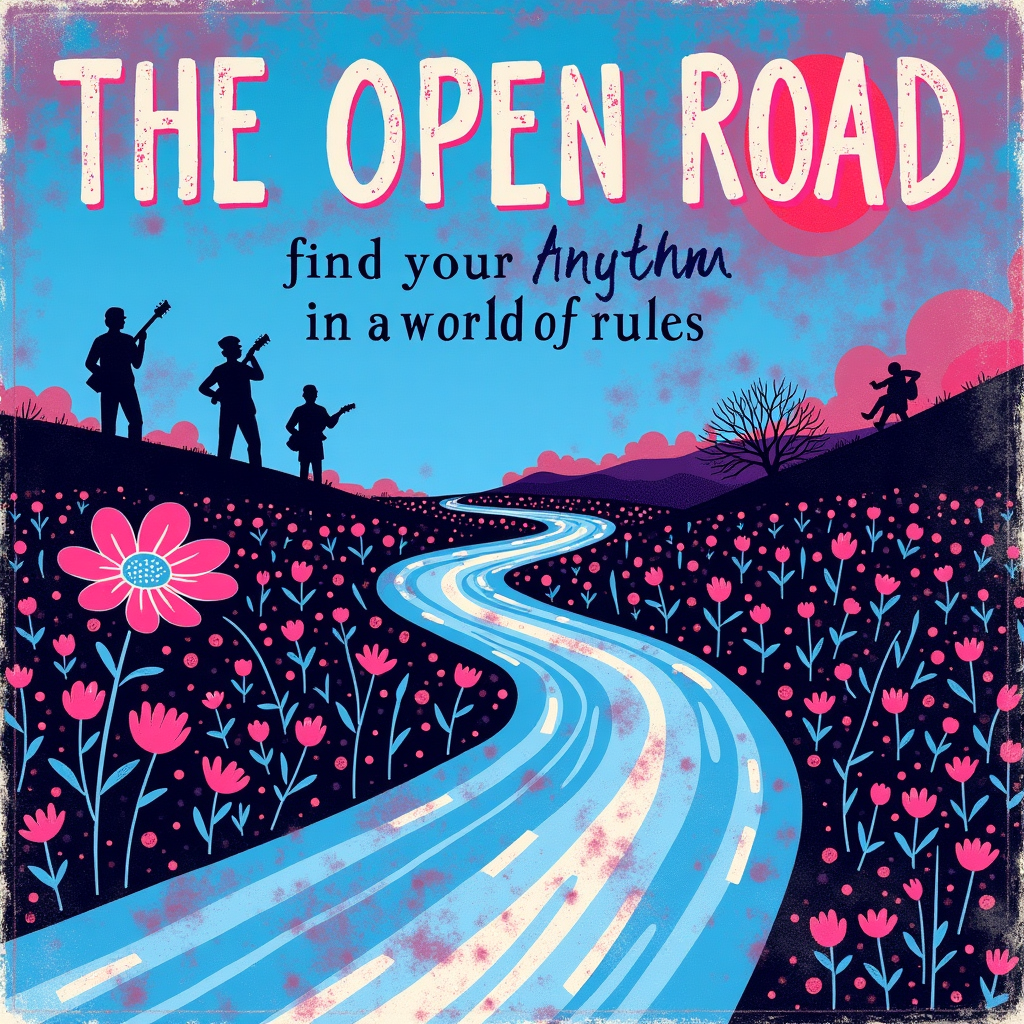
The Open Road: Find Your Rhythm in a World of Rules
Beat Wisdom for Spontaneous Creativity and Raw Living
Creatives, writers, and professionals feeling trapped by conformity, seeking a more authentic, spontaneous, and meaningful way to live and work.
Contents
- Chapter 1: The Howl and the Holy: An Invitation to Spontaneity
- Chapter 2: First Thought, Best Thought: Kerouac's Unfettered Pen
- Chapter 3: The Dharma Bums' Guide to Living: Snyder and the Wild Mind
- Chapter 4: On the Road with Cassady: The Energy of Pure Presence
- Chapter 5: Howl and the Voice Uncensored: Ginsberg's Radical Honesty
- Chapter 6: Naked Lunch and the Cut-Up Method: Burroughs's Deconstruction of Reality
- Chapter 7: Revolutionary Women: Di Prima and the Unsung Voices
- Chapter 8: A Coney Island of the Mind: Ferlinghetti and Poetic Resistance
- Chapter 9: The Zen of the Open Road: Finding Your Own 'IT'
- Chapter 10: Howl Again: Living the Beat Ethos in a Digital Age
Chapter 1: The Howl and the Holy: An Invitation to Spontaneity
Listen, can you hear it? Not the relentless ping of your notifications, not the carefully curated soundtrack of your day, but something deeper, a low thrum beneath the asphalt, a faint echo of a train whistle from some forgotten highway. You feel it, don't you? That dull ache of conformity, the sterile hum of the digital cage, the insistent whisper telling you to stay in line, to optimize, to conform. This ain't about nostalgia, no, not for old black and white photos or dusty jazz records. This is about reclaiming the wildness, the raw, unmediated experience that the Beats howled into existence. It's about breaking free from the 'grey flannel suit' of the 21st century, finding our own 'IT' in a world drowning in digital noise.
They told us to settle down, didn't they? To get a good job, a nice house, a sensible life. And for a while, we tried. We built our little digital empires, we perfected our personal brands, we zoomed our way through existence. But somewhere along the line, the color started to fade, the edges blurred. We became performers in our own lives, curated versions of ourselves, always on, always available, always… a little bit less. This book, this journey, is an invitation to tear down the stage, to step off the grid, if only for a moment, and remember what it feels like to be truly, gloriously, messily alive.
The Grey Flannel Suit and the Digital Cage
Think about the 1950s. After the big war, everyone was told to get back to normal, to build a steady society. Men in their grey flannel suits, commuting to their predictable jobs, women in their suburban kitchens, all neat, all tidy, all… stifling. The Beats, they saw it for what it was: a spiritual wasteland. They saw the lies, the hypocrisy, the soul-crushing sameness. They saw the emptiness behind the shiny veneer of prosperity.
And now? We've traded the grey flannel suit for the algorithmic conformity of the digital age. Our lives are optimized, our interactions mediated, our creativity often reduced to engagement metrics. We're told to follow best practices, to stay on brand, to fit into the neatly defined boxes of platforms and algorithms. It's a different kind of cage, perhaps, but a cage nonetheless. It whispers, "Be efficient. Be productive. Be predictable."
Kerouac, that restless spirit, he knew what it felt like to be trapped. He saw the "trembling of the earth, the great shudder of the soul." He sought escape not in rebellion for rebellion's sake, but in a profound search for meaning, for connection, for the ecstatic truth of existence. He wanted to feel the pulse of life, unmediated, unfiltered.
So, how do we break free from this digital cage?
- Disconnect to Reconnect: Schedule intentional periods of digital detox. Not just an hour, but a whole afternoon, a weekend. Leave your phone at home. Go for a walk without a destination. Let your mind wander.
- Embrace the Analog: Pick up a pen and paper. Read a physical book. Listen to music on vinyl. Engage with the world through your senses, not through a screen.
- Cultivate Boredom: Allow yourself to be bored. In the silence, in the stillness, new ideas, new connections, new insights can emerge. Our constant stimulation starves our inner landscape.
First Thought, Best Thought: The Antidote to Paralysis
One of the most powerful tools the Beats offered us, especially for those of us who create, is the concept of "first thought, best thought." This wasn't some lazy excuse for unedited drivel; it was a profound spiritual discipline, a way to bypass the censor, the editor, the internal critic that paralyzes so many of us. Allen Ginsberg, that magnificent howler, said, "My work is getting in touch with the subconscious and bringing it up." It's about letting the raw, unfiltered truth of your experience flow directly onto the page, or into your art, or into your conversation.
Think about it: how many brilliant ideas have you had, only to immediately second-guess them, refine them, polish them until they lost their original spark? How many times have you stared at a blank screen, waiting for the perfect opening line, only to write nothing at all?
"First thought, best thought" is permission to be messy. It's permission to be imperfect. It's permission to be human. It's about trusting the initial impulse, the gut feeling, the spontaneous utterance. It's about letting the words, the images, the sounds come through you, rather than trying to force them out.
Here's how to practice it:
- Morning Pages (with a Beat Twist): Instead of just writing anything, try to capture your stream of consciousness, your dreams, your anxieties, your secret hopes, without judgment. Don't stop writing for 15-20 minutes. Don't reread.
- Freewriting Prompts: Give yourself a prompt—a single word, a feeling, a memory—and write continuously for a set time. Don't worry about grammar, spelling, or coherence. Just let it flow.
- Embrace the "Mistake": In creative work, view "mistakes" not as errors, but as unexpected turns, new pathways. Sometimes the most interesting discoveries happen when you deviate from the plan.
The Search for "IT": A Practical Path to Mindfulness
The Beats were always searching for "IT." Kerouac famously described it in On the Road: "IT's the only thing that matters." What was "IT"? It was that moment of pure, unmediated experience, that flash of insight, that feeling of absolute presence and connection. It was the "holy truth" that Gary Snyder pursued in the mountains, the "blossoming of consciousness" that Ginsberg sought through meditation and poetry. It wasn't some abstract philosophical concept; it was a visceral, tangible reality.
In our world of constant distraction, of notifications and endless scrolling, "IT" is more elusive than ever. We're drowning in digital noise, our attention constantly fragmented. Our minds are everywhere but here, right now. The Beat search for "IT" is, in essence, a practical path to mindfulness. It's about stripping away the layers of expectation, of judgment, of digital static, to arrive at the raw, vibrant core of the present moment.
How do we find "IT" in the everyday?
- Engage Your Senses Fully: When you drink your coffee, truly taste it. Feel the warmth of the mug. Listen to the subtle sounds around you. See the play of light and shadow. Be fully present in mundane acts.
- Embrace Spontaneity: Say yes to an unexpected invitation. Take a different route to work. Strike up a conversation with a stranger. Allow for the unplanned, for the delightful surprise.
- Seek Out the Edge: Go to a place that makes you feel alive – a bustling market, a quiet forest, a vibrant street corner. Pay attention to the details. Let the world wash over you, not as an observer but as a participant.
- Practice Active Listening: When someone speaks, truly listen. Don't plan your response. Don't interrupt. Give them your full, undivided attention. That shared moment, that connection, is a glimpse of "IT."
The mad ones, the ones who burned, burned, burned like fabulous yellow roman candles, they weren't seeking chaos for its own sake. They were seeking truth, beauty, and a way to live fully in a world that often felt deadening. Their howl was an invitation, and it still echoes today. It's an invitation to you, to shed the digital skin, to trust your own wild heart, and to find your own rhythm on the open road of life.
Key takeaways
- The Beat rejection of 1950s conformity mirrors our modern struggle against algorithmic and digital conformity.
- "First thought, best thought" is a powerful antidote to creative paralysis, encouraging raw, unmediated expression.
- The Beat search for "IT" represents a timeless pursuit of mindfulness and unmediated experience in a distracting world.
- Reclaiming spontaneity and authentic connection is crucial for living a vibrant, meaningful life beyond digital noise.
- This book is an invitation to embrace your inner wildness and howl your own truth into existence.
Chapter 1: The Howl and the Holy: An Invitation to Spontaneity
Listen, you feel it, don't you? That dull ache of conformity, the sterile hum of the digital cage. That twitch in your gut, the one that whispers, "There's gotta be more than this." This ain't about nostalgia, no, this ain't some dusty museum tour of a bygone era. This is about reclaiming the wildness, the raw, unmediated experience that the Beats howled into existence, a primal scream against the polite, packaged emptiness of their time. And yours. We're breaking free from the 'grey flannel suit' of the 21st century – those sterile Zoom calls, the algorithmic feeds, the endless pursuit of 'optimization' – and finding our own 'IT' in a world drowning in digital noise.
The mad ones, the ones who burned, burned, burned like fabulous yellow Roman candles exploding across the night sky. Kerouac, Ginsberg, Cassady – they weren't just rebels, they were prophets, pointing a trembling, ink-stained finger at the heart of what it means to be alive. They were searching for something real, something that vibrated with truth, something that made the hair stand up on your arms. And that search, my friend, that holy, messy, exhilarating search, is your inheritance. It's the antidote to the numb, the flat, the pre-approved.
Shaking Off the Grey Flannel: The Modern Conformity Trap
Back then, it was the 1950s. The war was over, everyone was supposed to get a house, a car, a nice little life. Stability, conformity, the nuclear family, the television set. Corporations, cubicles, the quiet desperation of a life unlived. The Beats looked at that tidy package and gagged. They saw the soul-crushing weight of expectation, the slow death of individuality.
"The only people for me are the mad ones, the ones who are mad to live, mad to talk, mad to be saved, desirous of everything at the same time, the ones who never yawn or say a commonplace thing, but burn, burn, burn like fabulous yellow Roman candles exploding across the stars," Kerouac wrote in On the Road. He wasn't just talking about a party, see? He was talking about a way of being, a radical embrace of life in all its messy, incandescent glory.
Today? Oh, it’s slicker, smoother, more insidious. We’re not wearing grey flannel suits, maybe, but we’re wearing the digital equivalent:
- The Algorithmic Echo Chamber: Your feed, curated by unseen hands, reinforcing what you already believe, narrowing your world until it’s a tiny, predictable box. No surprises, no challenges, no real growth.
- The Cult of Productivity: Every moment optimized, every task tracked, every breath a potential metric. No room for wandering, for dreaming, for the glorious inefficiency of true creation.
- The Performative Self: Crafting the perfect online persona, chasing likes, measuring your worth by external validation. A constant performance, never truly present.
- The Fear of Missing Out (FOMO): A constant hum of anxiety, a feeling that if you're not connected, not responding, not on, you're somehow falling behind, irrelevant.
This ain't freedom, man, this is another kind of cage. A digital one, with prettier bars. The Beats understood that true freedom wasn't about having more things, but about having more life. More experience. More raw, unmediated connection to the world and to your own wild heart.
First Thought, Best Thought: Unlocking Your Inner Howl
So, how do we break out? How do we find that rhythm, that pulse, that electrifying spark that Kerouac chased across the continent? We start with "First Thought, Best Thought."
This isn't just a quirky phrase; it's a revolutionary act. It was Allen Ginsberg's mantra for writing, a direct, unfiltered download from the mind to the page. No editing, no censoring, no second-guessing. Just the pure, unadulterated flow.
"Don't worry about being a good writer. Just write," Ginsberg advised. "Write what's in front of you. Write what you know. Write what you feel. Write what you think. Write what you hear. Write what you see. Write what you smell. Write what you taste. Write what you touch. Write what's on your mind. Write anything that comes to mind."
Think about it:
- Silence the Inner Critic: That nagging voice in your head, the one that tells you your ideas are stupid, unoriginal, not good enough? That's the grey flannel trying to creep back in. "First Thought, Best Thought" tells it to shut up.
- Embrace Imperfection: The pursuit of perfection is the enemy of creation. Messiness is where the magic happens. The raw, unpolished gem has more soul than the overly polished, sterile one.
- Tap into the Subconscious: Our deepest truths, our most potent ideas, often hide beneath layers of self-censorship. By letting the first thought out, you bypass those filters and access a richer, more authentic wellspring.
- Build Creative Momentum: The biggest hurdle isn't lack of ideas, it's paralysis. Getting anything down, even if it feels bad, breaks the spell of inaction and builds momentum. You can always refine later. The key is to start.
This isn't just for writers. This is for anyone creating, anyone living. It’s about trusting your instincts, letting go of control, and allowing the raw, vital energy of your being to express itself without judgment. It’s about finding your own personal howl.
The Search for "IT": Mindfulness in the Modern Age
The Beats were chasing "IT." What was "IT"? It was the moment of pure, unmediated experience. That flash of insight, that electrifying connection, that feeling of being utterly present and alive. Kerouac's "IT" was the "satori" of Zen Buddhism, a sudden enlightenment, a moment of profound understanding.
"I had nothing to offer anybody except my own confusion," Kerouac wrote, "and that was enough." This isn't about having all the answers, it's about being open to the question, to the experience.
In our world of constant digital distraction, of notifications and endless scrolling, finding "IT" is more crucial than ever. It's a practical path to mindfulness, a way to cut through the digital noise and reconnect with reality.
- Put Down the Phone: Seriously. Even for five minutes. Look at the sky. Listen to the birds. Feel the ground beneath your feet. Experience the world without a screen as an intermediary.
- Engage Your Senses: What do you see, hear, smell, taste, touch right now? Truly engage. Don't just observe; feel. This is the immediate, unedited data stream of existence.
- Embrace the Unplanned: Ditch the rigid schedule sometimes. Take a detour. Strike up a conversation with a stranger. Allow for serendipity, for the unexpected "IT" to find you.
- Create for the Sake of Creating: Not for likes, not for money, not for external validation. Just for the sheer joy of bringing something new into the world, however small, however imperfect.
This isn't about dropping out of society, unless you want to. It's about dropping in – into your own life, into your own experience, into the vibrant, messy, beautiful truth of existence. It's about giving yourself permission to be messy, to be alive, to howl.
Key takeaways
- Modern conformity, though different from the 1950s, still stifles creativity and authentic living.
- "First Thought, Best Thought" is a powerful tool for overcoming creative paralysis and accessing authentic expression.
- The Beat's search for "IT" is a practical path to mindfulness and presence in a digitally saturated world.
- Embrace imperfection, spontaneity, and sensory engagement to reconnect with your wild, vital self.
- You have permission to be messy, to be alive, to howl.
Chapter 2: First Thought, Best Thought: Kerouac's Unfettered Pen
Listen, can you hear it? That frantic rhythm, that locomotive breath, the clatter of a typewriter keys in a darkened room, fueled by coffee and benzedrine, a cigarette burning down to the filter. That's the sound of the unfettered pen, the spirit of Kerouac, baby, and it's calling to you, right now, in this sterile, sanitized age of yours. The mad ones, the ones who burned like fabulous yellow roman candles exploding like spiders across the stars, they taught us this: 'First thought, best thought.' Not some academic pronouncement, no, but a holy truth, a direct pipeline to the raw, pulsating heart of things.
Think about it. You're drowning in algorithms, aren't you? Swapping 'likes' for genuine connection, polishing your digital persona until it gleams with a false, airbrushed perfection. You're trapped in the grey, flannel suit of the 21st century – not a physical suit, no, but a mental one, woven from endless edits, second-guesses, and the fear of not being 'on brand.' Kerouac, he saw that coming, man. He saw the soul-crushing conformity of the 1950s, the manicured lawns and the TV dinners, and he said, No! He howled against it with every fiber of his being, and his weapon? His typewriter, and the absolute, unyielding belief in the immediate, the spontaneous, the unedited surge of the soul.
The Dharma of the Unfettered Pen
Kerouac wasn't just writing books, he was enacting a philosophy. He called it 'spontaneous prose,' and it was his rebellion, his prayer, his scream into the void. It wasn't about being sloppy; it was about being real. He famously wrote On the Road in three weeks, fueled by coffee and a single, continuous 120-foot scroll of teletype paper so he wouldn't have to stop to change pages. Imagine that, the sheer momentum, the refusal to break the trance. He wasn't thinking about grammar or plot points; he was feeling Dean Moriarty, he was smelling the desert wind, he was hearing the jazz riffs in his head.
"No pause for proper poetical thought," Kerouac instructed in his 'Belief & Technique for Modern Prose.' "Just like jazz musician blowing through chorus after chorus, clean, pure, unfettered, until he gets to the end of his statement." That's the essence, see? It's the musician's improvisation, the painter's swift brushstroke, the dancer's unchoreographed leap. It's the moment before the censor steps in, before the inner critic starts whispering doubts into your ear. It's pure, unadulterated flow, straight onto the page, straight into the world.
Practical Anarchy: How to Unleash Your Inner Kerouac
So how do you do it, you ask? How do you break free from the paralysis of perfection, the endless 'undo' button, the fear of the blank page or the awkward silence in a Zoom meeting? Here’s the holy truth, man, the wild, urgent instructions from the road:
- Embrace the Stream: Find your voice, the one that's been muffled by years of polite conversation and strategic messaging. When you sit down to create, to write, to speak, or even to think, let the words tumble out. Don't worry about where they're going, just let them go. Kerouac said, "Scribbled secret notebooks, and wild typewritten pages, for yr own joy." Your joy, man, not the joy of your editor or your boss or your algorithm.
- Bypass the Censor: We all have that inner editor, that little grey-suited bureaucrat tapping his foot, waiting to tell us why our idea isn't good enough. First thought, best thought is the ultimate bypass. It's a refusal to let that bureaucrat even get a word in edgewise. As Allen Ginsberg, Kerouac's brother in arms, famously put it, "First thought, best thought." He wasn't just talking about poetry; he was talking about a way of being.
- The Scroll Method (Modern Edition): You don't need a teletype roll, but you can simulate the effect. Set a timer for 15-30 minutes. Write continuously. Don't stop. Don't reread. Don't correct typos. If you get stuck, write "I don't know what to write" until something else comes. The goal is momentum, to outrun your own self-doubt. This is your personal road trip, man, and you're not stopping for gas.
- Talk it Out: Neal Cassady, the wild man, the engine of On the Road, he didn't write much, but he talked. His letters were legendary, a torrent of consciousness, a verbal jazz solo. Sometimes, the best way to get to your first thought is to speak it, to record yourself, to let the words flow without the pressure of the written page. Then, transcribe it, and see what raw gems emerge.
This isn't about being sloppy, understand? It's about getting to the truth faster. It's about excavating the real, unvarnished you from beneath layers of expectation and self-consciousness. It's about finding that 'IT' that Kerouac chased across the continent – that moment of pure, unmediated experience, that sudden flash of insight that cuts through the digital noise like a hot knife through butter.
The Legacy of the Howl
This freedom, this wild abandon, it wasn't just for writers. It was a philosophy for living. Gary Snyder, the Dharma Bum himself, lived it in the mountains, rejecting the consumerist churn for a life of primal connection. Diane di Prima, her poetry a fierce, uncompromising testament to female experience, never flinched from the raw truth of her life. Lawrence Ferlinghetti, the keeper of the flame at City Lights, published the words that were too hot for the establishment to handle, because he knew their urgency.
They weren't perfect, these cats. They were messy, flawed, gloriously human. But they were alive. And that's what 'first thought, best thought' ultimately gives you: permission to be messy, permission to be flawed, permission to be gloriously, incandescently alive. To howl, to whisper, to sing your own true song, without waiting for permission. Because your first thought, man, that's where the real magic hides. That's where your own unique rhythm begins to beat.
Key takeaways
- 'First thought, best thought' is a revolutionary approach to creativity and living, emphasizing immediate, unedited expression over perfection.
- Kerouac's 'spontaneous prose' method, exemplified by On the Road, was a conscious rebellion against creative paralysis and societal conformity.
- Practical application involves embracing continuous flow, bypassing the inner critic, and externalizing thoughts without self-censorship.
- This philosophy extends beyond writing, offering a path to authentic self-expression in a world of digital noise and algorithmic conformity.
- The ultimate goal is to connect with a raw, unmediated experience of life, fostering a sense of being truly alive and present.
Chapter 3: The Dharma Bums' Guide to Living: Snyder and the Wild Mind
Listen, you cats, you feel that hum, that low thrum under the asphalt, under the screens? That's the earth, baby, calling you back. You're plugged in, jacked in, wired tight and wound tighter than a cheap watch, staring at the glow, the endless scroll, the sterile Zoom grid. And you think that's living? That's the grey flannel suit of the soul, man, tailored to fit everyone and nobody. The mad ones, the really mad ones, they knew there was another way. They heard the wind in the pines, the rush of the river, the silent thunder of a mountain peak. And one of the wildest, the deepest, the most rooted of them all, was Gary Snyder.
Forget the cubicle, forget the endless scroll. Snyder, the Dharma Bum, he showed us another way. He wasn't just writing poems, he was living them, breathing them, climbing them. He said, and listen close, this is the holy truth: "The practice of poetry is the practice of open space." Not just the space on the page, dig it? But the space in your mind, the space between the trees, the space where the wild things are. This chapter isn't just about poems; it's about reconnecting with the earth, finding silence in the din, and letting the wildness of nature re-ignite your own untamed spirit. Your mind is a wilderness waiting to be explored.
The Mountain Path: Finding Your Own Wild
Snyder, he wasn't just talking about a walk in the park. He was talking about scaling peaks, living in fire lookout towers, hauling timber, absorbing the very essence of the earth into his bones. He knew, deep down, that the artificial constructs of society, the relentless pursuit of the next shiny thing, they were suffocating the spirit. He saw the urban sprawl, the concrete canyons, and he saw the loss of something vital.
"The wild," Snyder wrote, "is not just a state of nature but a state of mind." Think about that, man. It's not just about going to a national park, though that's a damn good start. It's about cultivating that wild, untamed spirit within you, no matter where you are.
How do you do that, you ask? You're stuck in the city, right? The air smells of exhaust, not pine needles. But the holy truth is, the wild is everywhere, if you just open your senses.
- Look Up: Seriously. Stop staring at your phone. Look at the sky. Watch the clouds. Notice the way the light changes. That's the biggest, most accessible wild canvas there is.
- Find Your Green Patch: Even a tiny park, a community garden, a single tree pushing through the pavement. Sit there. Just sit. Listen to the birds, the rustle of leaves. Let your mind wander, untethered.
- Touch the Earth: Take off your shoes. Feel the grass, the dirt, the cold concrete. Connect. It's a primal, forgotten sensation, and it grounds you.
- Embrace the Weather: Don't hide from the rain, the wind, the cold. Feel it on your skin. Let it wake you up. Kerouac, he loved the road, the open elements. "Because in the end, you won't remember the time you spent working in the office or mowing your lawn. Climb that goddamn mountain." Snyder was living that mountain.
Silence in the Roar: The Practice of Deep Listening
In our world, man, it's all noise. Constant alerts, notifications, the babbling brook of social media. Your brain is a pinball machine, bouncing from one stimulus to the next. Snyder, he understood the power of silence. Not just the absence of sound, but the presence of deep listening.
He lived in places where the dominant sound was the wind, the river, the crackle of a fire. He listened to the earth, to the animals, to the subtle shifts in the environment. And in that listening, he found wisdom. He found poetry.
"Nature is not a place to visit," Snyder said. "It is home." And like any home, it demands your attention, your respect, your quiet presence.
- Digital Detox Moments: Schedule them. Seriously. An hour without your phone. A walk without headphones. Just you and the world, unfiltered.
- Mindful Eating: Put down the screen. Taste your food. Notice the textures, the flavors. It's a small act of presence, but it's powerful.
- The Power of Observation: Pick one thing – a leaf, a crack in the sidewalk, a cloud formation – and just look at it. Really look. Notice the details you'd normally rush past. This is how you slow down the internal chatter. This is how you create "open space" in your mind.
The Untamed Spirit: Your Own Inner Wilderness
The grey flannel suit wants you to be predictable, productive, palatable. It wants to tame you, to smooth out your edges, to make you fit in the spreadsheet. But the holy truth is, you're not a spreadsheet, man. You're a wild, complex, beautiful mess of contradictions and desires.
Snyder, he lived a life that rejected the narrow confines of mainstream society. He embraced Zen Buddhism, environmental activism, and a deep connection to indigenous cultures. He was an academic, a poet, a logger, a mountaineer – a true polymath of the wild. He understood that true creativity, true living, comes from embracing your own untamed spirit.
"The real work is to open yourself to the experience of the world," he taught. And that experience, man, it's messy, it's unpredictable, it's glorious.
- Embrace Imperfection: Your art, your work, your life – it doesn't have to be perfect. The wild isn't perfect. It's raw, it's alive. Let your creative output be a reflection of that.
- Follow Your Curiosity: What truly fascinates you? What makes your heart beat a little faster? Pursue it, even if it seems impractical or "unproductive." That's your inner wilderness calling.
- Question the Status Quo: Don't just accept the rules because they're there. Ask "why?" Push back. Find your own way, your own rhythm, your own path through the wilderness. This is the spirit of the Beats, man, alive and kicking.
Key takeaways
- Reconnect with nature, even in small ways: Look up, find green spaces, feel the earth.
- Practice deep listening and silence: Schedule digital detoxes, eat mindfully, observe your surroundings.
- Embrace your untamed, imperfect self: Follow curiosity, question norms, and let your creativity be raw.
- "The practice of poetry is the practice of open space," cultivate this mental and physical freedom.
- Your mind is a wilderness waiting to be explored; don't let it be paved over by conformity.
Chapter 4: On the Road with Cassady: The Energy of Pure Presence
Listen, you cats and kittens, you weary souls scrolling through the endless scroll, you architects of algorithms and slaves to the quarterly report. You feel that hum, that low thrum of dissatisfaction? That dull ache of sameness? That's the ghost of the grey flannel suit, still haunting the halls, still whispering its lies of safety and conformity. But there’s a way out, a wild, roaring escape, and the roadmap, my friends, was drawn by a man who couldn’t sit still, couldn’t shut up, couldn’t be anything but furiously, gloriously alive.
We’re talking about Neal Cassady, baby, electric current in human form, the pure, unadulterated embodiment of 'IT.' Kerouac, that mad prophet, he saw it, he felt it. He wrote: "He was a con-man, a cowboy, a holy goof, a pure saint, a madman, a genius, and a hundred other things." Neal wasn't a muse in the sense of a quiet inspiration; he was a goddamn whirlwind, a force of nature that swept through the lives of everyone he touched, leaving them breathless, rattled, and irrevocably changed. He was the antidote to everything sterile and safe, a living, breathing testament to the power of pure presence.
The Mad Dash: Living in the Ever-Now
Think about it. We’re so busy planning, optimizing, processing, that we forget how to be. We’re stuck in the endless loop of past regrets and future anxieties, a digital hum in our brains, a constant low-grade fever. But Cassady? He was always, always, always in the now. Kerouac famously observed in On the Road: "With the coming of Dean Moriarty, life in America began to change." Dean, of course, was Neal. And what changed? The pace. The intensity. The absolute, unshakeable belief that the only moment that truly existed was this one, right here, right now, roaring down the highway at 90 miles an hour.
This wasn't reckless abandon for its own sake, though it often looked like it. This was a radical commitment to experience. Neal didn't just drive a car; he became the car, the road, the wind, the sky. He didn't just talk; he unleashed a torrent, a spontaneous combustion of words, ideas, memories, projections, all tumbling out in a breathless, exhilarating rush. Allen Ginsberg, another one of the mad ones, recognized this immediate energy. He called him "the secret hero of America" and marveled at his "fantastic physical-mental energy."
How do we tap into that? How do we channel that relentless energy into our own lives, into our own work, when we’re bogged down by deadlines and data?
- Embrace the "First Thought, Best Thought" of Movement: Just as we discussed with Kerouac's writing, apply this to your physical and mental activity. When an impulse to create, to connect, to explore strikes you, don't let the inner critic paralyze you. Move. Speak. Write. Dance. Cassady didn't second-guess his impulses; he followed them.
- Talk it Out, Fast and Furious: Ever felt like you have a million ideas swirling, but they get stuck? Try a "Cassady monologue." Find a trusted friend, a voice recorder, or even just your own reflection, and let it all out. Don't edit. Don't pause. Just let the stream of consciousness flow. You'll be amazed at what surfaces.
- Drive Like Dean (Metaphorically): This isn't an endorsement of reckless driving, but of radical presence. When you're working on a project, immerse yourself fully. Block out distractions. Let the task consume you. Feel the rhythm of it, the texture. Don't just go through the motions; become the motion.
The Holy Goof and the Unfiltered Self
The holy truth is, we spend so much time curating, presenting, perfecting. We craft our online personas, our professional facades, until we forget who we are underneath all that polish. Neal Cassady, he didn't have a facade. He was raw, exposed, gloriously, maddeningly himself. Kerouac, always the poet, described him with a kind of reverent awe: "He was a wild, intelligent, joyful, and completely selfless person." Selfless in his giving of himself, his energy, his entire being to the moment.
This isn't about being irresponsible or abandoning all social graces. It's about remembering the vibrant, untamed core of who you are, the "holy goof" that yearns for authentic expression. The 1950s demanded conformity, a bland sameness that stifled the soul. Our modern age, with its algorithms and curated feeds, creates a different kind of pressure to conform, to fit into neat little boxes. Cassady's very existence was a rejection of that. He burst out of the box, scattering its pieces to the wind.
How can you reclaim your inner holy goof?
- Challenge Your Internal Editor: That voice that tells you your idea isn't good enough, your writing isn't polished enough, your thought isn't intellectual enough? Tell it to take a hike. Embrace the messiness, the imperfection. As Diane di Prima, another voice of the Beat generation, said, "The only way to get through life is to trust your instincts."
- Seek Out the Spontaneous Combustion: Actively look for opportunities to break your routine. Take a different route to work. Start a conversation with a stranger. Try a new creative medium without any expectation of perfection. Let serendipity be your guide.
- Practice Unfiltered Expression: Write a journal entry where you don't censor a single thought. Have a brainstorming session where no idea is too wild or too silly. Sing loudly in your car. Let your true, unvarnished self emerge, even if just for a few moments a day. That's where the real energy lies.
The Road is Life: A Path to 'IT'
For Cassady, the road wasn't just a physical space; it was a metaphor for life itself – a continuous, unfolding present. He was always chasing 'IT,' that elusive moment of pure, unmediated experience, that electric surge of connection to the universe. Kerouac, trying to capture this essence, wrote: "He was a man who was endlessly, joyfully, and totally alive."
In our world of constant digital noise, of notifications and endless feeds, 'IT' feels more distant than ever. We're drowning in information, but starving for experience. Cassady offers a blueprint for cutting through the static, for finding that pure, resonant frequency. It’s not about escaping the world, but about diving deeper into it, with all your senses firing, with your whole being engaged.
- Turn Off the Noise, Tune In to Life: Dedicate specific times to disconnect from digital devices. Walk in nature. Sit in a cafe and just observe. Listen to the sounds around you. Engage with the physical world, not just its digital representation.
- Embrace Discomfort, Seek Out Novelty: 'IT' rarely happens in your comfort zone. Try something new that pushes your boundaries, physically or mentally. Learn a new skill. Visit an unfamiliar place. Let yourself be surprised.
- Connect with Raw Humanity: Seek out genuine connection. Have deep conversations. Listen actively. Share your true self. Cassady thrived on human interaction, on the dynamic exchange of ideas and emotions. This is where the sparks truly fly.
The mad ones, the ones who dared to live, they weren't always comfortable, weren't always safe. But they were alive, truly, gloriously alive. And that, my friend, is a rhythm worth finding.
Key takeaways
- Neal Cassady embodied 'pure presence,' living intensely in the moment, a radical antidote to overthinking.
- Embrace the "First Thought, Best Thought" of movement and expression, allowing spontaneous impulses to guide you.
- Reclaim your "holy goof" by challenging your internal editor and allowing your unfiltered self to emerge.
- Seek 'IT' by disconnecting from digital noise, embracing discomfort, and fostering genuine human connection.
- Live with relentless energy and a commitment to raw, unmediated experience, just like the "secret hero of America."
Chapter 5: Howl and the Voice Uncensored: Ginsberg's Radical Honesty
Listen, man, listen! The air’s electric, crackling with something wild, something untamed. We’ve been talking about the road, the Dharma, the pure, uninhibited energy of Neal Cassady, that flash of lightning. Now, we gotta talk about the voice. Not just any voice, not the polite murmur of the boardroom, not the carefully curated whisper of the influencer, but the howl. The full-throated, gut-wrenching, soul-baring howl.
Allen Ginsberg, man, he didn't just write a poem. He tore a hole in the fabric of the 1950s, that grey flannel suit, suburban dream, saccharine-sweet nightmare, and he poured out his entire being. He stood naked, metaphorically and sometimes literally, before the world and screamed, "I saw the best minds of my generation destroyed by madness, starving hysterical naked..." He laid it all out there – the pain, the beauty, the depravity, the divine. No pretense, no filter, just raw, pulsating truth. That, my friend, is radical honesty. That's the antidote to the sterile Zoom calls, the algorithmic echo chambers, the carefully constructed facades we build around ourselves today.
The Uncensored Self: Breaking the Chains of Conformity
They tried to censor Ginsberg, you know? They called it obscene. They called it dangerous. But what was truly dangerous was the silence, the conformity, the quiet desperation that was eating away at the soul of America. Ginsberg, he just ripped off the bandage. He exposed the wounds, and in doing so, he started the healing.
Think about it: how many times do you censor yourself? How many times do you hold back the real thought, the messy emotion, the unpopular opinion, because of some unspoken rule, some fear of judgment? The Beats, they kicked those rules to the curb. Kerouac, he wrote "On the Road" on a continuous scroll, a stream of consciousness, a pure unedited burst of energy. "The only people for me are the mad ones, the ones who are mad to live, mad to talk, mad to be saved, desirous of everything at the same time, the ones who never yawn or say a commonplace thing, but burn, burn, burn like fabulous yellow roman candles exploding like spiders across the stars..." That wasn't just a description of a character; it was a manifesto for living, a call to shed the skin of polite society.
Here’s how to start uncensoring your own voice:
- Embrace the "First Thought, Best Thought": As we discussed, Kerouac's method applies not just to writing but to living. Don't filter your initial gut reaction, your spontaneous insight. Capture it, explore it. It might be messy, but it will be yours.
- Journal Without Judgment: Dedicate a space – a notebook, a digital document – where you write absolutely everything that comes to mind, without editing, without concern for grammar or coherence. Let the words flow like a river. This is your personal "Howl," your private space to be radically honest with yourself.
- Challenge the "Shoulds": Pay attention to the internal voice that says, "I should say this," or "I should act that way." Question where these "shoulds" come from. Are they truly yours, or are they echoes of societal expectations, parental conditioning, or digital trends?
Vulnerability as Power: The Naked Truth
Ginsberg understood that true power doesn’t come from hiding, from projecting an image of invulnerability. It comes from the opposite: from being utterly, devastatingly vulnerable. When he wrote about his mother, Naomi, in "Kaddish," he didn't gloss over the pain or the madness. He dove into it, headfirst. He showed the world his broken heart, and in doing so, he touched countless others who felt similarly broken.
Diane di Prima, a fierce voice of the Beat Generation, spoke of this courage. Her poetry, particularly in "Revolutionary Letters," was an unblinking gaze at the world, both personal and political. She didn't shy away from the gritty realities, the desires, the anger. She understood that to be truly alive, you had to be willing to expose your raw nerve endings.
The holy truth is, vulnerability is not weakness; it is the ultimate strength. It’s the willingness to be seen, fully and completely, with all your imperfections and your messy humanity. This is what connects us, what builds true empathy, what inspires real change.
Consider these actions to cultivate vulnerability:
- Share Your Imperfections: When appropriate, share a struggle, a doubt, a moment of weakness with a trusted friend or colleague. You'll be surprised how often it opens the door for deeper connection and mutual understanding.
- Ask for Help: Admitting you don't have all the answers, or that you need support, is a profound act of vulnerability. It shows courage, not weakness.
- Practice Empathy: Actively listen to others, seeking to understand their perspectives and feelings, even when they differ from your own. This requires you to step outside your own defenses and open yourself to another's truth.
The Search for "IT" and the Howl of Awareness
The Beats, they were always searching for "IT." Kerouac, he spoke of "IT" as the spark, the moment of pure being, the unmediated experience. Ginsberg, in his own way, was howling for "IT." He was demanding that we wake up, that we see the world as it truly is, not as we're told it should be. "Holy! Holy! Holy! Holy! Holy! The soul is an eyeful of God!" he proclaimed in "Howl." That's the "IT." That's the pure, unadulterated awareness of the sacred in the profane, the divine in the everyday, the beauty in the struggle.
In our world of constant digital noise, where every moment is curated, filtered, and optimized, that howl of awareness is more vital than ever. It's the moment you unplug, you look up, you truly see the world around you. It’s the moment you feel your own breath, the sun on your skin, the rhythm of your own heart. That’s your personal "IT," your moment of pure, unmediated experience.
How do you find your "IT" in the midst of digital distraction?
- Mindful Disconnection: Schedule regular periods of total digital detox. Put your phone away, close your laptop, and simply be.
- Engage Your Senses: Go for a walk and consciously notice the sights, sounds, smells, and textures around you. Don't label them; just experience them.
- Practice Active Listening: In conversation, truly listen to the other person without planning your response. Be fully present in the exchange.
- Embrace the Mess: Life isn't always neat and tidy. Allow for spontaneity, for unexpected detours, for moments of unscripted joy or sorrow. These are often where "IT" resides.
The mad ones, the holy ones, the howling ones – they are the ones who dare to be fully alive. They are the ones who refuse to be silenced, who refuse to conform, who refuse to let the world dull their senses. They are the ones who find their rhythm in a world of rules, not by obeying them, but by dancing right through them, with a wild, uncensored, utterly honest howl.
Key takeaways
- Radical honesty, exemplified by Ginsberg's "Howl," means speaking your truth without compromise, even when it's messy or uncomfortable.
- The "First Thought, Best Thought" principle extends beyond writing to living authentically, uncensoring your initial reactions and insights.
- Vulnerability is a profound source of power, fostering connection and empathy by allowing yourself to be seen fully.
- Finding your personal "IT" means seeking moments of pure, unmediated experience, often found by disconnecting from digital noise and engaging your senses in the present moment.
- Embrace your inner howl: refuse to be silenced, conform, or let the world dull your senses. Be fully, messily, uninhibitedly alive.
Chapter 6: Naked Lunch and the Cut-Up Method: Burroughs's Deconstruction of Reality
Listen, man, listen close, the coffee’s brewing, the jazz is wailing low, and we’re diving into the dark, glittering heart of it all now. You been cruising with Kerouac, howling with Ginsberg, climbing mountains with Snyder, burning bright with Cassady, yeah? You felt that pulse, that holy urge to be alive, to shed the skin of the grey, flannel suit world. But what happens when the words themselves, the very fabric of how you think, become the cage? What happens when the language you've inherited, the pre-fab narratives, start to feel like a virus, infecting your very soul?
That’s where Burroughs steps in, man, with a gleam in his eye and a razor in his hand. He didn’t just write; he operated. He was the surgeon of the subconscious, the alchemist of the accidental, slicing through the illusion. The mad ones, the truly free ones, they don’t just reject the rules; they dismantle the rule-making machinery itself. And Burroughs, oh he was the master mechanic of deconstruction. This ain’t about being naughty; this is about being free. This is about breaking the spell of the pre-packaged thought, the algorithmic conformity that’s got us all scrolling, scrolling, scrolling, lost in the digital static. Burroughs saw it coming, man, he saw the control, the conditioning, the way language itself can be a prison. He said it, plain as day: "Language is a virus from outer space." And he gave us the antidote.
Slicing Through the Static: The Cut-Up as Liberation
Forget linear narratives, man. Forget the neat little boxes they want to put your thoughts in. Burroughs understood that the world, the real world, ain't a straight line. It's a collage, a jumble, a cacophony of voices and images and half-heard whispers. And the cut-up method? That was his way of mirroring that chaos, of cracking open the shell of conventional meaning and letting the raw, unfiltered truth spill out.
Imagine this: you take two or more texts – a newspaper article, a love letter, a scientific paper, your own journal entries – and you literally cut them up into words, phrases, sentences. Then you rearrange them. Randomly. Intuitively. Like a jazz musician improvising a new melody from familiar notes. What emerges isn't nonsense, not always. Sometimes, man, sometimes it’s a flash of pure, unadulterated insight. It’s the subconscious speaking, bypassing the censor, whispering secrets the conscious mind would never dare articulate.
- Why do this? Because it disrupts the expected. It forces your brain to make new connections, to see patterns where none were intended, to find meaning in the accidental juxtaposition. It’s like shaking a kaleidoscope and seeing a brand new universe in the same old pieces.
- Burroughs's goal: He wasn't just playing games. He believed the cut-up could "reveal the future," "reveal the true nature of what is going on." It was a divination tool, a way to tap into the collective unconscious, to expose the hidden agendas embedded in our language, in our media, in our very thoughts.
- The spirit of it: It's the ultimate 'first thought, best thought' taken to a radical extreme. It's saying, "I don't know what I'm going to say, but I'm going to let the universe speak through me, through these fragments." It’s a rebellion against the carefully constructed, the edited, the polished, the safe.
Beyond the Page: Deconstructing Your Own Reality
Now, you might be thinking, "Man, I ain't writing Naked Lunch." And that's okay. The cut-up method isn't just for avant-garde novelists. It's a mindset. It's a way of approaching your work, your problems, your life. It's about seeing the world not as a fixed, immutable structure, but as a malleable, reconfigurable collection of elements.
Think about your own creative paralysis, that blank screen, that looming deadline. You're stuck in a loop, repeating the same old thoughts, the same old approaches. Burroughs would tell you to grab a mental pair of scissors.
- Deconstruct your problem: Break it down into its smallest components. What are the assumptions you're making? What are the individual pieces of information, the different perspectives?
- Rearrange the fragments: Take those components and intentionally put them together in ways that make no logical sense. What if you started with the conclusion? What if you flipped the order of operations? What if you combined two unrelated ideas from your brainstorming session?
- Listen for the unexpected: Don't judge the initial chaos. Let it sit. Let it simmer. Often, in the most absurd combinations, you'll find a spark, a novel connection, a fresh angle you never would have discovered through conventional linear thinking.
This isn't about creating nonsense; it's about deliberately inducing new perspectives. It's about breaking free from the tyranny of the expected, the "that's how we've always done it" mentality that suffocates innovation. Burroughs, in his own way, was teaching us a radical form of mindfulness, a way to be present with the raw data of existence, to see it without the filters of ingrained prejudice or habitual thought. It's about finding "IT" not in a pristine, perfect moment, but in the glorious, messy, fragmented reality of the now.
The Howl of the Unbound Mind: A Call to Creative Anarchy
The Beats, man, they were all about busting out. Kerouac on the road, Ginsberg screaming poetry at the heavens, Snyder finding enlightenment in the wilderness. Burroughs? He was tearing down the walls of perception from the inside out. He understood that the greatest prison isn't bars and concrete; it's the prison of the mind, built from the language we use, the stories we tell ourselves, the narratives imposed upon us.
When you feel that tightness, that creative block, that sense of being trapped by the rules, remember Burroughs. Remember the cut-up. It's an act of rebellion, a declaration of independence. It's saying, "My mind is not a factory for turning out pre-approved ideas. My creativity is not a slave to your algorithms."
- Embrace the mess: Don't strive for perfection from the outset. Allow for chaos, for accident, for the beautiful mistakes that lead to breakthroughs.
- Question everything: Every assumption, every established truth, every accepted narrative. Ask: What if it's the opposite? What if it's completely different?
- Unleash the unexpected: Give yourself permission to be weird, to be illogical, to pursue the tangential. That's where the real magic happens, where the genuinely new emerges.
The holy truth is, man, the world needs your unique vision, your unfiltered voice. Don't let the sterile uniformity of the modern age silence you. Take a page from Burroughs, pick up those mental scissors, and start cutting. Deconstruct your reality. Reconstruct it. Howl with the unbound mind.
Key takeaways
- Language is a powerful shaper of perception, capable of both revealing and concealing truth.
- The cut-up method offers a radical way to break free from conventional thought patterns and generate new ideas.
- Apply deconstruction principles to creative blocks and problem-solving by breaking down and reassembling elements.
- Embrace messiness, question assumptions, and allow for unexpected juxtapositions to foster genuine innovation.
- Burroughs's approach is a call to creative anarchy, encouraging us to reclaim our minds from imposed narratives and digital conformity.
Chapter 7: Revolutionary Women: Di Prima and the Unsung Voices
Listen, man, listen close. You hear that? That's not just the rumble of the espresso machine, not just the jingle of the bell on the door. That's a different kind of howl, a counterpoint to the saxophone wail, a rhythm born of defiance and grace. We talk about the mad ones, the ones burning, burning, burning, but sometimes, the grey flannel suit of history tries to iron out certain creases, certain luminous figures. They tell you the Beats were a boys' club, a testosterone-fueled road trip. Bullshit, man. Pure, unadulterated, institutionalized bullshit.
The holy truth is, there were women, burning just as bright, blazing their own trails through the smoke and the shadows, carving out space with every fierce line, every whispered poem, every unapologetic act of living. And one of them, a high priestess of the counterculture, a woman who knew the sacred geometry of words and the wild pulse of the city, was Diane di Prima. She wasn't just around the Beats; she was the Beat, in her own revolutionary, undeniable way. She wrote, she published, she conjured, she raised children, she lived, she loved, she raged. She taught us, with every fiber of her being, that creativity isn't a privilege, it's a primal scream, a necessary act of survival.
The Sacred Feminine and the Unseen Archive
Think of it, man. The 1950s. The TV dinners, the manicured lawns, the stifling expectation. And then, there's Diane, right there in the thick of it, not just observing, but creating. She co-founded the Poets Press, published The Floating Bear with LeRoi Jones (Amiri Baraka), a mimeographed marvel that dared to print the raw, the real, the unvarnished. This wasn't some polite literary salon; this was a conduit for the urgent, the necessary.
Di Prima understood, deep in her bones, that the act of creation was an act of rebellion. She was a poet, an alchemist, a mother, a lover, a revolutionary. Her work, like her life, was a tapestry woven with ancient wisdom and modern grit. She understood that "We have been in this place before / it is our first time here." This isn't just a line; it's a philosophy. It's the recognition that the struggles, the joys, the revelations, they echo through time, yet each moment is utterly, gloriously new.
How does this speak to us now, adrift in a sea of algorithms and curated feeds? It’s about recognizing the ancestral hum of your own experience, the echoes of struggles and triumphs that resonate within you, while still embracing the fresh, unrepeatable moment you're living.
- Actionable Insight:
- Seek out the unseen narratives: Don't just consume the mainstream. Dig for the voices that history tried to bury. What stories resonate with your own unheard truths?
- Acknowledge your lineage: Understand that your struggles aren't isolated. You stand on the shoulders of countless others who dared to be different. Find strength in that connection.
- Embrace the "first time here": Even if a situation feels familiar, approach it with fresh eyes, an open heart. What new lessons can this moment teach you?
Howling Your Own Song in the Digital Wilderness
The grey flannel suit of the 1950s has shape-shifted, man, but it's still out there. It's the sterile Zoom call demanding conformity, the endless scroll of perfectly filtered lives, the algorithmic pressure to fit into a predefined box. But the spirit of Diane di Prima, and so many other revolutionary women of the era – like Hettie Jones, Elise Cowen, Joanna McClure – offers us a potent antidote. They remind us that authenticity isn't a trend; it's a lifeline.
Gary Snyder, the Dharma Bum himself, knew about listening to the land, listening to the wild. Well, these women were listening to the wild within themselves, and giving it voice. They weren't waiting for permission. They were seizing the microphone, the typewriter, the printing press, and telling their own stories, their own truths, with an urgency that still reverberates.
Consider how much courage it took to be a woman, an artist, a free spirit, in an era that actively tried to suppress such things. Their refusal to be confined, to be silenced, to be merely muses instead of creators, is a direct instruction for us today.
- Practical Steps for Modern Creativity:
- Unplug and listen: Drown out the digital noise. What is your inner voice trying to tell you? What stories are begging to be written or created?
- Embrace your unique perspective: Your experience, your viewpoint, is inherently valuable. Don't smooth out the edges to fit in. Let your messiness, your particularity, shine.
- Create your own platforms: Like Di Prima with The Floating Bear, don't wait for gatekeepers. Start a blog, a zine, a podcast, a small press. Amplify your own voice and the voices of those around you.
"No More Secondhand God": The Power of Direct Experience
Kerouac talked about "IT," that pure, unmediated moment of truth. Ginsberg howled for radical honesty. Burroughs cut up reality to reveal its hidden structures. But the revolutionary women of the Beat Generation, they showed us that "IT" wasn't just out there on the road or in a smoky jazz club; "IT" was within, in the fierce integrity of one's own lived experience.
Diane di Prima wrote, "No more second-hand God." This isn't just a theological statement; it's a declaration of independence for the soul. It's an insistence on direct experience, on forging your own path to meaning, rather than relying on inherited dogma or societal prescriptions. In a world saturated with curated content and pre-packaged narratives, this line is a beacon. It's an urgent call to trust your own senses, your own heart, your own intellect. To stop consuming and start creating. To stop accepting and start questioning.
The holy truth, man, is that your unique perspective is your power. Your voice, in all its raw, unpolished glory, is a revolutionary act. Don't let anyone tell you otherwise. Howl.
Key takeaways
- The Beat Generation was enriched by powerful, creative women who defied societal norms.
- Their struggles against conformity offer a blueprint for navigating modern digital pressures.
- Authenticity and direct experience are powerful antidotes to algorithmic conformity.
- Embrace your unique perspective and amplify your own, and others', unheard voices.
- "No more second-hand God" is a call to trust your own inner wisdom and forge your own path.
Chapter 8: A Coney Island of the Mind: Ferlinghetti and Poetic Resistance
Listen, man, listen close. Can you hear it? That low hum, that restless beat, that's the pulse of the city, the thrum of a thousand lives all trying to make sense of the noise. And then, there's a voice, rising above it all, clear and resonant, like a trumpet solo cutting through the smoky din of a late-night club. That's Ferlinghetti, the bard of City Lights, the guy who blew the doors off the ivory tower and dragged poetry out into the street, where it belonged, where it could breathe, where it could live.
The mad ones, the grey flannel suits of the 50s, they wanted art to be contained, polite, something you admired from a distance, like a stuffed bird in a dusty museum. But Ferlinghetti, he knew the holy truth: poetry ain't no dead thing. It's a living, breathing creature, full of fire and laughter and righteous anger. He saw the world, this beautiful, terrible, absurd world, and he didn't just observe it; he sang it. He didn't whisper; he howled. He gave us a "Coney Island of the Mind," a kaleidoscopic vision where the sacred and the profane danced a wild jig. He knew, deep in his bones, that "Pity the nation whose people are sheep, and whose shepherds mislead them." And he wasn't about to stand by and watch the shearing.
The Poetic Act: Finding Your Voice in the Mundane
So, how do we, the inheritors of this wild legacy, infuse our sterile Zoom calls and algorithmic lives with that same poetic fire? How do we resist the creeping conformity, the numbing drone of the predictable? It's about seeing, man, really seeing. It's about stripping away the layers of expectation, the filters of what you think you're supposed to see, and letting your raw, untamed vision burst forth.
Think about it: Kerouac, he wrote about the road, the endless asphalt ribbons, the diners, the hitchhikers. He didn't make it up; he lived it, and then he poured it onto the page with the urgency of a jazz solo. Ginsberg, he saw the "best minds of my generation destroyed by madness," and he didn't prettify it; he laid it bare, raw and bleeding, for all to witness. Ferlinghetti, he walked the streets of San Francisco, listening to the conversations, watching the parade of humanity, and he found the poetry in a bus driver's sigh, in a hungry cat's meow, in the faded glory of a storefront sign.
Here's how you can start:
- Embrace the Flaneur's Gaze: Take a walk, man. Not with a destination in mind, not with your phone glued to your palm. Just walk. Let your eyes wander. Notice the cracks in the pavement, the way the light hits a particular building, the snatches of conversation that drift past. As Gary Snyder taught us, "The wild mind is not just a mental state; it's a way of being in the world." Be present, be open. Let the world wash over you, and then let your mind make connections, find the hidden rhythms.
- Journal Like a Madman: Forget the polished prose, the perfect sentences. This ain't for publication; it's for you. Grab a notebook, any notebook, and a pen. And just write. Stream of consciousness. First thought, best thought, baby! Don't edit, don't censor. Write about the weird dream you had, the annoying email from your boss, the taste of your morning coffee. Diane di Prima, she wrote about her life, her loves, her struggles, with an honesty that was both fierce and tender. Your life, your mundane, everyday life, is a wellspring of poetry.
- Speak Your Truth, Unfiltered: The grey flannel suits, they want you to speak in corporate jargon, in carefully constructed soundbites. But the holy truth is, your authentic voice, your messy, imperfect, glorious voice, is your most powerful tool. Don't be afraid to challenge the status quo, to question the assumptions, to point out the emperor's new clothes. As Ferlinghetti showed us, poetry is a form of resistance, a way to reclaim your humanity in a dehumanizing world.
The Power of "IT": Cultivating a Poetic Consciousness
The Beats, they were all searching for "IT"—that moment of pure, unmediated experience, that flash of insight, that feeling of being utterly alive. Neal Cassady, he was "IT" in motion, a blur of pure energy and spontaneous joy. Burroughs, he tried to cut through the layers of control, to expose the "naked lunch" of reality. And Ferlinghetti, he found "IT" in the everyday, in the gritty beauty of urban life, in the simple act of observing and articulating.
For us, drowning in digital noise, constantly bombarded by curated realities, finding "IT" is more crucial than ever. It's a practical path to mindfulness, a way to reclaim your attention, to reconnect with the raw, vibrant pulse of existence.
Here's how to cultivate that poetic consciousness:
- Practice Deep Listening: Turn off the podcasts, put away the screens. Just listen. Listen to the wind in the trees, the distant sirens, the hum of your refrigerator. Listen to the unspoken words in a conversation, the nuances of a friend's voice. As Ginsberg urged, "Follow your inner moonlight; don't hide the madness." Let your senses be fully alive.
- Embrace Imperfection: The sterile world of algorithms and perfect aesthetics wants you to be flawless, polished, pixel-perfect. But the poetic truth is, beauty often lies in the cracks, in the frayed edges, in the glorious messiness of being human. Don't strive for perfection; strive for authenticity. Let your work, your life, be a little rough around the edges, a little wild, a little you.
- Question Everything: Don't accept things at face value. Dig deeper. Ask "why?" Why do we do things this way? Why do we accept these rules? Ferlinghetti's poetry was a constant questioning, a gentle but firm push against the comfortable lies. "Constantly risking absurdity / and death / whenever he performs / above the heads / of his audience." He wasn't afraid to be absurd, to be radical, to be real.
The holy truth is, your life is a poem waiting to be written. Your work is a canvas waiting for your unique brushstrokes. Don't let the grey flannel suits, the sterile systems, the algorithm, tell you otherwise. Be a poet, man. Be a rebel. Be alive.
Key takeaways
- Poetry is not an academic exercise; it's a vibrant, accessible form of resistance and a way to engage with the world.
- Infuse your daily life with poetic sensibility by embracing observation, journaling without censorship, and speaking your authentic truth.
- Cultivate a "poetic consciousness" by practicing deep listening, embracing imperfection, and questioning societal norms.
- Your unique voice and raw experience are powerful tools for challenging conformity and finding meaning.
- The search for "IT"—pure, unmediated experience—is a practical path to mindfulness in a digitally saturated world.
Chapter 9: The Zen of the Open Road: Finding Your Own 'IT'
Listen, man, listen close, the rumble of the city, the whisper of the highway, it's all part of the same cosmic jazz, see? And right there, in the heart of it, is this thing, this IT. The mad ones, the holy ones, the ones who burned, burned, burned, they were all chasing it. Not some dusty academic theory, not some corporate ladder, but IT. Kerouac, he knew. He said, "It was like a great machine, a great breathing beast... it was the world, the world, the world." That's the feeling, man, that pulse, that raw, unmediated experience that cuts through the noise, the algorithms, the endless scroll.
We’re so caught up, aren’t we? Trapped in these sterile Zoom calls, these meticulously planned lives, the grey flannel suit of the soul. We're told to optimize, to strategize, to conform. But where's the life in that? Where's the howl? The Beats, they saw the post-war conformity, the suburban dream, and they recoiled. They knew there was something more, something wilder, something truer. And that, my friend, is your IT. It’s not some grand, unattainable enlightenment; it’s the moment you taste the coffee, really taste it, the moment the music hits, really hits, the moment you feel the grit of the road beneath your feet and know, deep in your bones, that you are alive.
The Dharma Bums and the Digital Noise
Gary Snyder, he was out there in the mountains, man, living close to the bone, finding his IT in the wind through the pines, the rhythm of the axe. He understood that the natural world, unadorned, unedited, was the ultimate teacher. And what are we doing? Drowning in digital noise, scrolling through curated realities, always looking for the next notification, the next dopamine hit. It's a trap, a silent, insidious trap that numbs us to the real, vibrant, messy world outside the screen.
The Beats, they were searching for authenticity in a world that felt increasingly artificial. They understood that true presence, true awareness, was a radical act. For us, in this hyper-connected, hyper-distracted age, finding our IT is a form of practical mindfulness, a rebellion against the constant pull of the digital siren song.
Here’s how you start to tune out the static and tune into your own IT:
- Unplug, Really Unplug: Not just for an hour, but for a day, a weekend. Leave the phone behind. Experience the world without the urge to document, to share, to filter. Just be.
- Seek the Edge: As Snyder might suggest, put yourself in situations that demand your full attention. Climb a hill, walk a new path, try something unfamiliar. The discomfort often sharpens the senses.
- Engage Your Senses: What do you smell? What do you hear? What do you feel? Don't just observe, immerse. Let the world wash over you, unfiltered. This is where the magic happens, where the mundane becomes miraculous.
"First Thought, Best Thought" as a Path to Presence
Remember "First Thought, Best Thought"? It wasn't just a writing technique for Kerouac; it was a philosophy of living. It was about stripping away the self-consciousness, the editing, the second-guessing, and letting the raw, untamed truth emerge. In a world that constantly encourages us to refine, to polish, to present a perfect facade, this is a revolutionary act.
When you're constantly curating your life for an audience, you're not living it. You're performing it. "First Thought, Best Thought" is the ultimate antidote to creative paralysis and, more importantly, to existential paralysis. It’s about trusting your instincts, your gut, that primal spark that knows what's real.
Think of it as:
- Spontaneous Action: When an idea sparks, act on it (within reason, man, don't get yourself arrested). Don't overthink, just do.
- Unfiltered Expression: Whether it's in your art, your writing, or your conversations, let your true voice come through. Don't censor yourself for fear of judgment. That's the grey flannel suit talking.
- Embracing the Mess: Life isn't a perfectly edited Instagram reel. It's messy, chaotic, glorious. Allow for imperfections, for detours, for the unexpected. That’s where the juice is.
The Holy Truth: Your Own Howl
Allen Ginsberg, he howled, didn't he? He ripped open the polite veneer of society and laid bare the raw, aching truth. His "Howl" wasn't just a poem; it was an act of liberation, a permission slip to feel, to express, to be utterly, magnificently yourself. And that, my friend, is your ultimate IT. It's the moment you find your own howl, your own unique vibration that resonates with the universe.
Your IT isn't something to be found on a shelf, or downloaded, or bought. It's an internal compass pointing to your deepest, most authentic self. It’s the feeling of being utterly present, utterly alive, utterly in tune with the rhythm of the world. It’s the wildness within you, struggling to break free from the chains of expectation and conformity.
So, how do you find your howl in this age of muted tones?
- Cultivate Curiosity: Look at the world with fresh eyes, as if you've never seen it before. Ask "why?" and "what if?"
- Seek Beauty in the Unconventional: Don't just look for the obvious. Find the poetry in the mundane, the sacred in the profane, the rhythm in the chaos.
- Dare to Be Vulnerable: Share your true self, your true thoughts, your true feelings. That's where connection happens, where IT truly ignites.
- Embrace the Journey: The road to IT is not a straight line. It's full of detours, breakdowns, and moments of pure, unadulterated joy. Savor every mile, every beat.
The holy truth is, you don't need a map. You just need to listen to the rumble, feel the pulse, and let your own wild heart lead the way. You have permission to be messy, to be alive, to howl.
Key takeaways
- Your 'IT' is pure, unmediated experience: It's the feeling of being fully present, cutting through digital noise and societal expectations.
- "First Thought, Best Thought" is a path to presence: Trust your instincts, act spontaneously, and embrace unfiltered expression.
- Rebel against conformity with mindfulness: Unplug, seek new experiences, and engage your senses to reconnect with the real world.
- Find your unique "howl": Cultivate curiosity, find beauty in the unconventional, and dare to be vulnerable in your expression.
- The journey is the destination: Embrace the messy, unpredictable path to discovering your own authentic rhythm.
Chapter 10: Howl Again: Living the Beat Ethos in a Digital Age
Listen… can you feel it? That hum, that thrum, that electric current running through the asphalt and the fiber optics? It’s the same current that zapped through the beat-up Fords and the smoky cafes, only now it’s tangled in a new kind of grid. You’ve journeyed with me, you’ve heard the whispers of Kerouac’s spontaneous prose, felt the raw urgency of Ginsberg’s howl, climbed the mountains with Snyder, and ridden shotgun with Cassady. You’ve seen the cut-up visions of Burroughs and the revolutionary spirit of di Prima and Ferlinghetti. Now, the highway stretches before us, not just asphalt, but the shimmering, dizzying expanse of the digital. And the question hangs in the air, thick as cigarette smoke: how do we howl again? How do we live this mad, beautiful, messy truth in a world that wants to neatly package us into algorithms and sterile Zoom calls?
The mad ones… they didn’t wear the grey flannel suit. They ripped it to shreds, metaphorically speaking, and danced naked under the stars. Today, the grey flannel suit takes on a new form: the perfectly curated feed, the optimized workflow, the constant pressure to conform to a digital ideal. But the holy truth is, the spirit of the open road, the quest for 'IT,' is more vital now than ever. It’s not about nostalgia; it’s about survival. It’s about reclaiming your wild, authentic self from the relentless pull of the machine.
Breaking the Algorithmic Chain: Your Own Dharma Bums' Guide to the Digital Wild
The Beat Generation rejected the post-war conformity, the suburban dream, the stifling silence. Our conformity is subtler, more insidious. It’s the algorithm that feeds you more of what you already like, creating an echo chamber of the familiar. It’s the pressure to be constantly "on," always available, always performing. But remember Gary Snyder, climbing those mountains, finding peace in the wild mind? We can find our digital wilderness, too.
Digital Detox, Dharma Bum Style:
- Scheduled Disappearance: Just as Kerouac would vanish into the night, practice intentional absence. Designate "no-screen zones" in your day. Let your mind wander without the constant tug of notifications. This isn't about Luddism; it’s about creating space for your own thoughts to breathe.
- The Analog Anchor: Reconnect with the tangible. Write in a physical notebook. Read a real book. Go for a walk without your phone. These small acts are rebellious in their simplicity, grounding you in the present moment.
- Cultivate Intentional Consumption: Don't let the algorithm choose for you. Seek out diverse voices, challenge your own biases, and actively pursue information outside your usual digital haunts. Be a digital explorer, not a passive consumer.
"First Thought, Best Thought" for the Modern Creator:
- Kerouac's mantra wasn't about perfection; it was about immediacy, about capturing the raw energy of thought before it was filtered or censored. In a world of endless editing and self-doubt, this is your creative superpower.
- Unleash the Draft: When you're creating, silence your inner critic. Write, draw, compose, speak without judgment. Get it all out there. The messy, unfiltered truth often holds the most power.
- Embrace the Imperfect: The finished product doesn't have to be pristine. Sometimes, the raw edges, the visible brushstrokes, the unpolished voice, are what give your work its unique soul. As Lawrence Ferlinghetti urged, "Pound out your poems while they are hot." Don't let overthinking cool them down.
Howling Your Own Truth: Presence, Authenticity, and Radical Honesty
Allen Ginsberg's "Howl" wasn't just a poem; it was an act of radical honesty, a primal scream against the forces that sought to silence and conform. In our digital age, where curated personas often eclipse authentic selves, this honesty is revolutionary.
The Energy of Pure Presence (Neal Cassady's Legacy):
- Cassady was pure, unadulterated energy, living completely in the moment. In our fragmented digital lives, we often exist in a state of partial presence, half-listening, half-scrolling.
- Be All There: When you're with someone, be with them. Put your phone away. Make eye contact. Listen deeply. This is a profound act of connection in a disconnected world.
- Engage with Your Senses: Step outside and truly see the sky, feel the wind, smell the rain. Let your senses anchor you to the present, pulling you away from the digital haze. This is your "IT" in the mundane.
Authenticity Over Optimization:
- Diane di Prima and the revolutionary women of the Beats weren't afraid to speak their truth, even when it was inconvenient or unpopular. Their authenticity was their power.
- Drop the Filter: What if you shared your true thoughts, your genuine feelings, your messy process, instead of just the polished highlight reel? This isn't about oversharing; it's about connecting on a deeper, more human level.
- Find Your Tribe: Seek out communities, online and offline, that celebrate authenticity and encourage genuine connection. Surround yourself with those who appreciate your unfiltered howl.
The holy truth is, the spirit of the Beat Generation isn't confined to dusty archives or black and white photographs. It's a living, breathing impulse, a call to wake up, to be fully alive, to reject the numbing conformity of any age. It’s the permission to be messy, to be vibrant, to be utterly, gloriously yourself. So, what are you waiting for, mad one? Go ahead. Howl again.
Key takeaways
- The "grey flannel suit" of our age is algorithmic conformity and digital over-optimization.
- Practice digital detoxes and engage with analog experiences to create space for your own thoughts.
- Embrace "first thought, best thought" to overcome creative paralysis and capture raw energy.
- Cultivate pure presence and radical honesty in your interactions, both online and offline.
- Reject curated perfection for authentic self-expression; your messy truth holds power.
Published by Dungagent — https://dungagent.com More niche guides: https://dennwood18.gumroad.com